Soccer drills for kids aged 7 to 12
Children learn football by playing it, so most drills for kids are small games with a ball each or a ball between two. A child standing in a queue isn't learning anything, and everyone should know who's winning. For 7 and 8 year olds, focus on dribbling and keeping the ball. Around 10, add passing in pairs and small teams, and by 12 players can handle simple tactical rules. A FIFA 11+ Kids warm-up before the session helps prevent injuries. Every drill here can be opened and adjusted to your group.
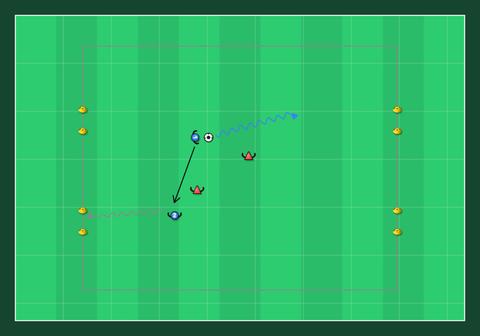
2v2 gate game
2v2 game in a small area, where both teams have 2 cone gates to defend on opposite sides. A goal is scored by dribbling the ball through a gate. A fast and intense small-sided game where every duel matters. Short games (90 seconds), pairs rotate.
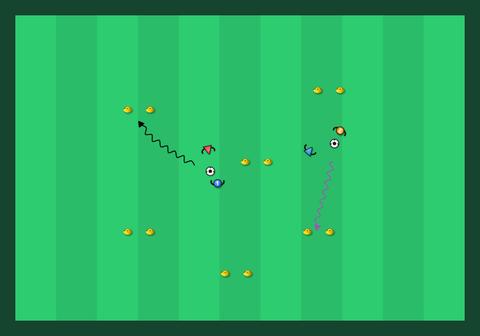
1v1 gate game
Players are split into pairs. There are several small gates on the pitch. The attacker on the ball tries to dribble the ball through a gate, the defender tries to stop them and win the ball. After a successful dribble through a gate, the attacker immediately continues to the next gate of their choice. The same gate cannot be used twice in a row.
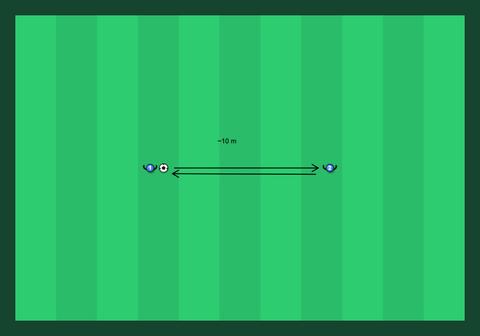
Passing and control in pairs
In pairs facing each other at a distance of about 10 metres. Player A plays a pass along the ground to player B, who controls the ball with the first touch and passes it back with the second touch. Variation: control with the right/left foot.
Warm-up and tag games for kids
A session for kids can start with a game where everyone has a ball and everyone keeps moving. In red light, green light, the coach calls a colour: on green the players dribble at speed, on yellow slowly with small touches, and on red the ball stops under the sole. In the harder version the coach shows the colour with a cone or a bib without saying a word. In the traffic officer version nobody is out: a player still moving does five sole touches and carries on. In Shark Attack, the shark kicks balls out of the area, and every player who loses a ball becomes a shark too. The last player with a ball wins the round. In gate dribbling, players dribble through as many gates as they can in the time given. In ball tag, the tagger may only touch the player with the ball, so the ball has to reach a teammate in time. Ball tag gets easier when played with hands, and harder with more taggers. The relays, tic-tac-toe relay, fill the area relay and the cone relay race with a shot, add a race between teams to dribbling and running.
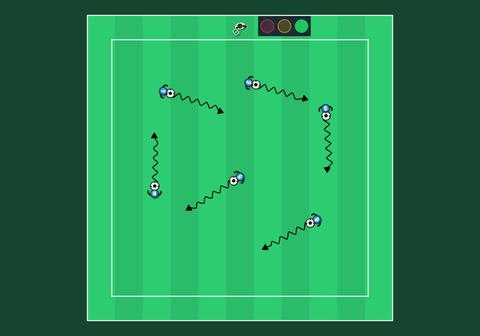
Red light, green light
Everyone has their own ball, and everyone keeps moving all the time. The coach calls out a colour. On green, the players dribble at a good speed; on yellow, slowly with small touches. On red, the ball stops under the sole. Mark out an area of about 15 × 15 metres with cones. The coach stands at the side of the area and changes position from time to time, so the players have to lift their eyes off the ball. The arrows in the picture show the green light. The animation shows the full cycle: green, yellow, red and green again. Harder: the coach shows the colour with a cone or bib and does not say anything. Then the colour can only be seen by looking at the coach. Traffic officer: on red, the coach checks whether anyone is still moving. Any player still moving does five alternating sole touches on top of the ball and continues. Nobody is out of the game. For a bigger group, use a bigger area.
Shark Attack
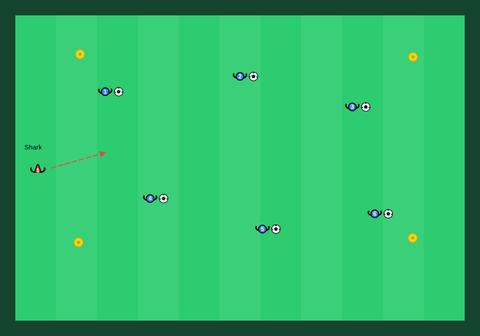
All players have a ball inside the grid except for one "shark", who starts outside the area. On the coach's signal, the shark comes into the area and tries to kick the players' balls out. A player whose ball is kicked out also becomes a shark. The last player on the ball wins the round.
Gate dribbling
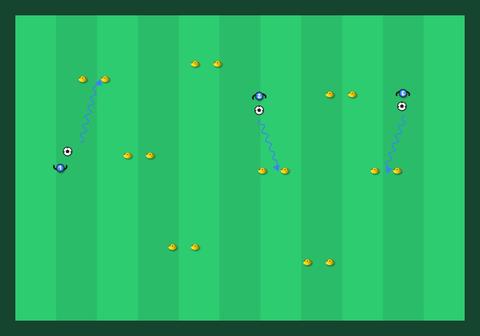
8–12 small gates are set up in the area. Each player has a ball. On the coach’s signal, the players dribble the ball and try to get through as many gates as possible in the given time. You cannot go through the same gate twice in a row.
From dribbling to small teams
In the drills marked for the youngest, every player has a ball or shares one with a partner. For U7 there are the 1v1 gate game, 1v1 to four corner goals, passing and control in pairs, and the 2v2 gate game, which is played in 90-second games with the pairs rotating and where a goal is scored by dribbling through a gate. From U8 come 1v1 to goal, the passing gate competition in pairs, one-two and finishing, 3v3 with goalkeepers, where short games of 3–4 minutes and a tournament format keep the intensity high, and the 5v5 goal-dribbling game, which practises restarting play with a dribble, as the Football Association of Finland's 5v5 rules for 8 and 9 year olds require. U9 and U10 have a page of their own, and this page also lists drills marked for U11 and U12, such as the through ball into space and the switch of play.
1v1 to four corner goals
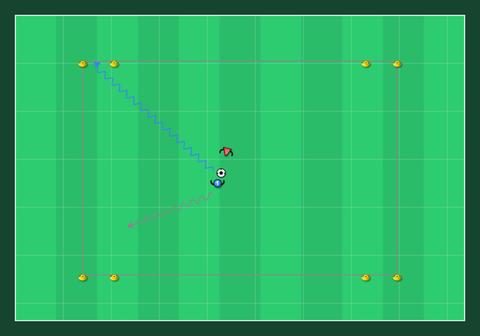
Two players play against each other in a square-shaped area, with a cone goal in each corner. The player on the ball can attack any of the four goals and tries to dribble the ball through the goal.
1v1 to goal — classic duel
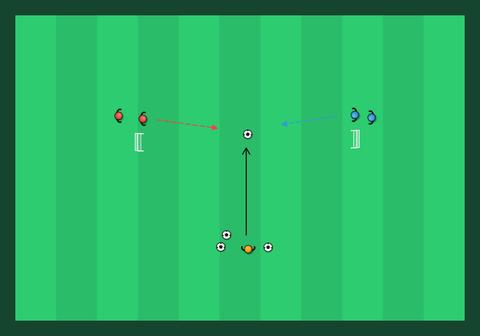
The attacker and defender start from opposite ends of the area. The coach plays a pass into the middle of the area, and both set off to compete for the ball. The player who wins the ball attacks the opponent's goal.
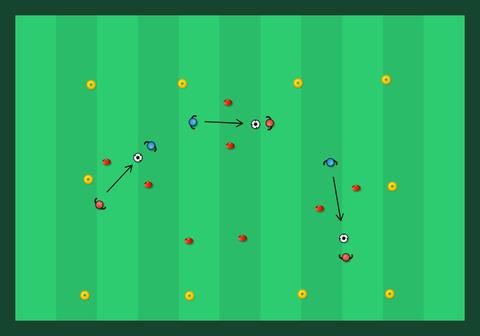
Passing gate competition in pairs
Several small gates are set up on the pitch (two cones 2 metres apart). Pairs pass the ball through the gates and count their successful passes. The gate must always be changed after a successful action. The pair that has gone through the most gates wins.
Questions to ask children
How close to your foot does the ball need to be so that you can stop it straight away? Where is the shark right now, and do you know without looking at the ball? Do you shield the ball with your body? Do you know the next gate before you reach this one? The dribbling relays ask what length of touch suits open space and when to start slowing down so that the ball stays inside the area. In passing in pairs, the questions ask whether the ball stays playable after the first touch, and the players are asked to try it with the weaker foot as well. Many of the questions are about where the eyes are: with the head up, a player sees the coach, the shark and the free gate. In red light, green light the coach moves around now and then for that reason, so the players have to lift their eyes off the ball.
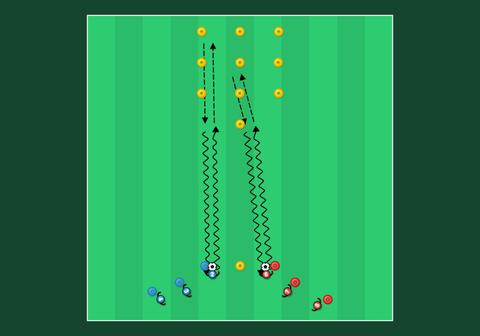
Tic-tac-toe relay
Two teams compete to see which can get three of their own markers in a straight line first. Build a 3 x 3 grid with cones, one cone in each square. Place a starting cone about 10–15 metres from the bottom edge of the grid, with two lines behind it. Each player has one marker in their team’s colour, and the first player in each line has a ball. Both teams start at the same time. The player whose turn it is dribbles the ball to the edge of the grid, leaves the ball there and runs into the grid. They place their marker in one free square, return to the ball and dribble it to the front of the line. The next player starts as soon as the ball is back, and the previous player goes to the back of the line. A team wins when it has three markers in the same row, column or diagonal. There are three markers per team, so every square is worth thinking about. If neither team gets three in a line, collect the markers and start again. With younger players, shorten the distance. Lengthen it if you want more running.
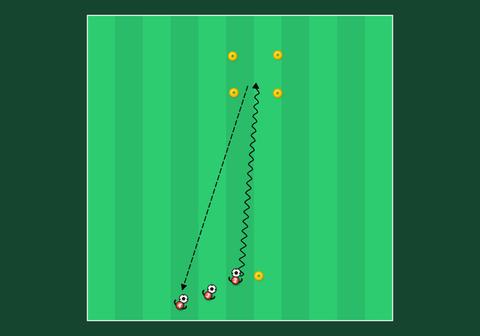
Fill the area relay
Mark out a square-shaped area with cones, about 3 x 3 metres, and a starting cone about 20 metres below it. The line stands at the starting cone, each with their own ball. The first player dribbles their ball into the area, leaves it inside the area and runs back without the ball to the back of the line. The next player sets off as soon as the previous one has left their ball. The rotation continues until all the balls are in the area. Two teams do this at the same time in their own areas. The winner is the one that gets their balls into the area first. The diagram shows the position of the other team. The other one is set up the same way on the other side of the pitch. The ball must stay inside the area. The drill can be continued so that in the second round the balls are collected out of the area.
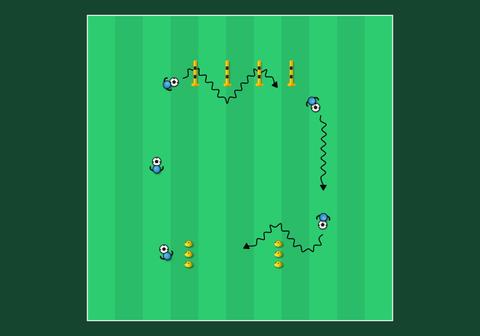
Dribbling circuit with slalom and feint
Set up a circuit in a square shape of about 20 × 20 metres. On the top side, place four slalom poles 2.5 metres apart. On the bottom side, place two defenders about seven metres apart. Each consists of a line of three cones across the direction of travel. The right and left sides remain straight. Each player has their own ball, and the players start at different points on the circuit, so nobody queues. Everyone moves in the same direction. In the slalom, dribble with short touches and at direct speed. Dribble straight towards the middle of the defender, use a feint, and go around one end of the line. If you catch up to someone, beat them on the outside. One circuit suits 6–8 players, so for a large group build several circuits. Change direction every few laps, or dribble only with the right foot or only with the left foot. If there are no poles, the slalom can be done with cones.
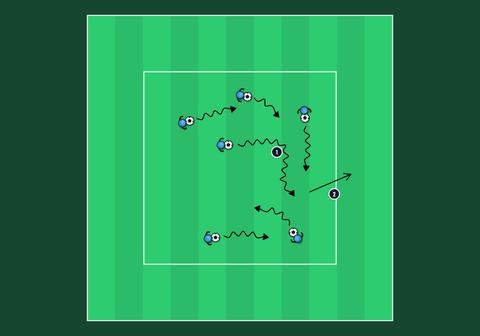
King game: protect your own ball and play the others' balls out
Mark out an area with cones according to the number of players, for example around 15 × 15 metres for six to eight. Each player has their own ball. Everyone dribbles in the area and at the same time tries to play the other players' balls out of the area. Nobody is out of the game. If a player's own ball goes out, the player retrieves it, does the movement task given by the coach and dribbles back into the game. When there are a lot of players, divide them into several areas. The areas can be ranked: the player who plays a ball out moves up to the higher area and the player who loses their ball drops down to the lower area. Also play at times with different-sized balls.
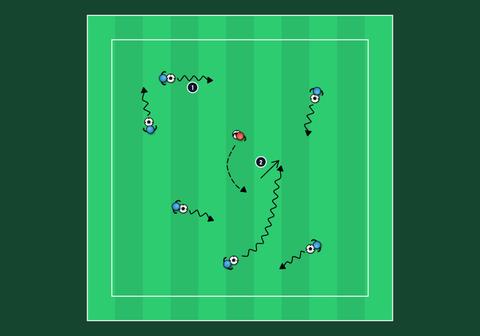
Bib tag: dribbling and shielding the ball with the whole group
Mark out an area of about 20 × 20 metres for around ten players. One of the players is the tagger and has a bib or a small soft ball in their hand. All the others have their own ball. The players on the ball keep dribbling inside the area at all times. The tagger chases them and tries to throw the bib or ball at a dribbler’s ball. When the throw hits, the player whose ball was hit takes the bib or ball and becomes the new tagger. The old tagger takes their ball and continues dribbling. The new tagger cannot immediately throw at the old tagger’s ball. For a large group, set up multiple areas or add more taggers. In a smaller area, dribbling is more difficult.
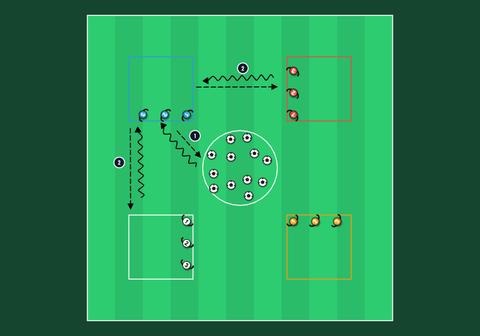
Ball Thieves
Four teams compete to see who can get the most balls into their own nest. The start is played as a relay, and once the centre is empty, everyone is moving. One coach can see the whole group from the middle. Mark out an area of about 24 × 24 metres and mark a 6 × 6 metre nest in each corner and a circle of about seven metres in the middle. Divide the players into four teams; with 12 players, make four teams of three. The teams wait in a line in their own nests. Spread the same number of balls inside the circle as there are players. Phase 1 is played as a relay. The first player from each team sets off, collects a ball from the middle and dribbles it all the way back to their own nest. The next player starts when the ball is in the nest. The middle is emptied once everyone has gone once. When the relay has finished, phase 2 begins: everyone starts moving at the same time, and a ball can be stolen from any nest. Each player dribbles one ball at a time all the way back to their own nest. You may not defend your own nest, and you may not touch a ball being dribbled by another player. A round lasts 60–90 seconds. On the whistle, count the balls. The team with the most balls in their nest wins. Return the balls to the middle and start a new round.
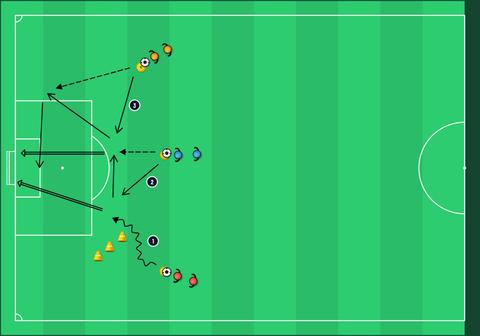
Finishing from three positions
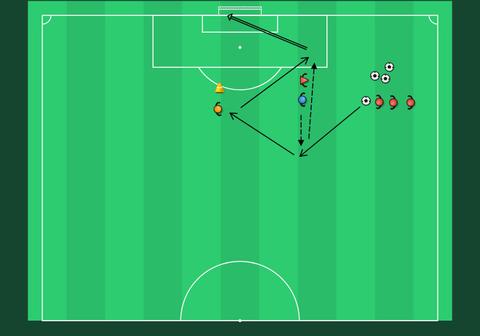
The red player sets off, beats the cone defender and shoots at goal. The blue player immediately gives a pass to the red player, and the red player lays off a one-two, from which the blue player shoots at goal. After this, the yellow player gives a pass to the blue player, who plays a one-two towards the end line. The yellow player crosses from the end line, and both the blue and the red player take part in finishing.
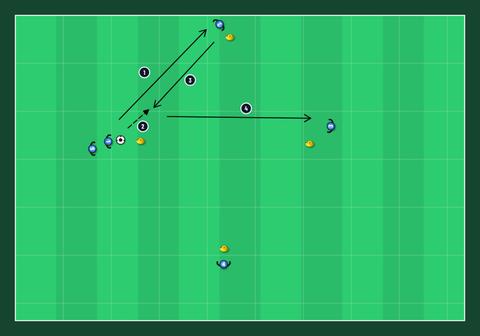
Passing diamond
A diamond is set up with cones, with two players at the first cone and one player at each of the others. Player 1 makes the first pass to player 2, who then sets it back with a one-two. Player 1 aims to play a long pass to player 3 with the first touch. After the passes, always rotate in the direction of the pass.
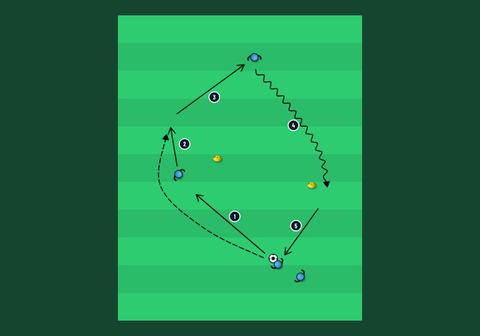
Overlap as a rotating passing drill
Mark out a slightly skewed diamond with cones, about 20 × 10 metres. There is a queue at the bottom corner, and the first player has a ball. There is a wall player at the left corner and a player at the top corner. The first player in the queue dribbles towards the wall player, passes to them and immediately makes an overlap past them on the outside. The wall player steps towards the ball, takes it infield towards the nearby cone and passes forward into the overlap runner’s path when they are almost level. The overlap runner plays the ball first time to the top corner and continues there. The player at the top corner dribbles around the cone on the right side, passes to the queue and goes to the back of the queue. No one runs back. Change the wall player every few rounds. When the pattern is flowing, place a semi-active defender at the wall player’s cone.
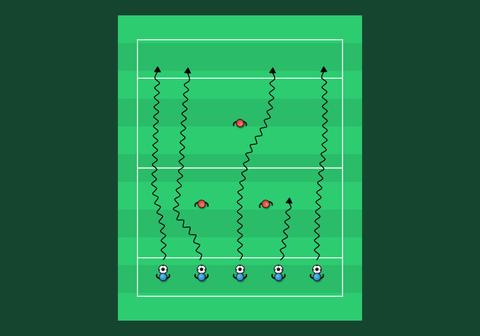
Who’s afraid of the defender? Dribbling game from island to island
Mark out an area of approximately 16 x 20 metres. At each end, create an island about three metres deep, and divide the sea between them into two halves with a halfway line. There are three defenders in the sea: two in one half and one in the other. The defenders stay in their own half. Everyone else has their own ball and starts on the same island. The attackers dribble the ball from one island to the other, and each successful crossing is a point. Set off straight back from the island. If a defender wins the ball, the attacker and defender swap roles. Change the defenders every couple of minutes. Make it harder by adding defenders or removing the halfway line, allowing the defenders to move across the whole sea. For a large group, set up several areas.
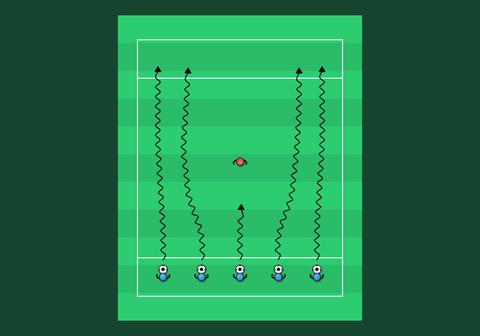
Who’s Afraid of the Defender? Caught Players Help the Defenders
Mark out an area of approximately 16 × 20 metres. At each end, create an island about three metres deep, with the sea in between. In the sea, there is initially one defender, who can move anywhere in the whole sea. Everyone else has their own ball and starts on the same island. Everyone sets off at the same time and tries to dribble the ball to the opposite island. If the defender wins the ball, they kick it out of the area, and the caught player takes a bib and joins the defenders. Players set off straight away back to the other side. With each crossing there are more defenders and fewer dribblers. The last player on the ball wins. For a large group, start with two defenders or make two areas.
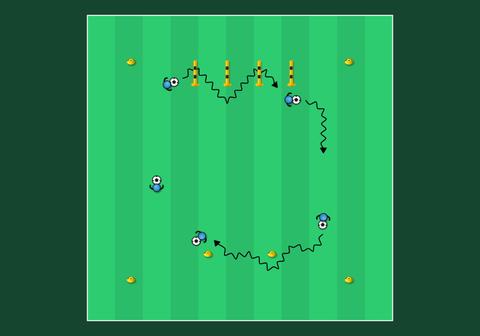
Dribbling circuit with slalom and feint
Set up a square circuit of approximately 20 × 20 metres and mark the corners with cones. On the top side, place four slalom poles at 2.5-metre intervals, and on the bottom side, place two cones about five metres apart. The right and left sides remain straight. Each player has their own ball, and the players start at different points on the circuit so that nobody is queuing. Everyone moves in the same direction. In the slalom, use dribbling with short touches and move through at speed. The cones on the bottom side act as defenders: dribble straight at them, use a feint, and beat an opponent by going past on the opposite side. Anyone who catches up can go around the outside. One circuit suits 6–8 players, so for a large group set up more than one circuit. Change direction every few laps, or have the players dribble with only the right foot or only the left foot. If there are no poles, the slalom can be done with cones.
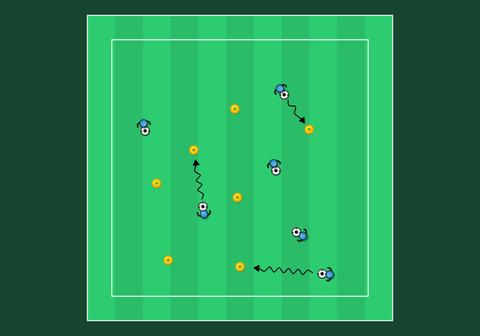
Stop the ball on a cone
Mark out an area of approximately 16 × 16 metres and spread flat cones around it at different distances, so that there are both short and long gaps between them. Ten cones are enough for six players. Each player has their own ball, and everyone works at the same time. The players dribble from cone to cone and use different parts of the foot: the sole, the instep, the inside of the foot and the outside of the foot. When a player stops the ball on top of a cone, they score a point. The ball may be kept on the cone for a maximum of three seconds. If someone is already at a cone, continue to another cone. Who can score the most points in a minute? For a large group, make the area bigger and add more cones in the same proportion. When the game is going well, some of the players become blockers: they dribble their own ball to cones and block them by stopping the ball on top of them.
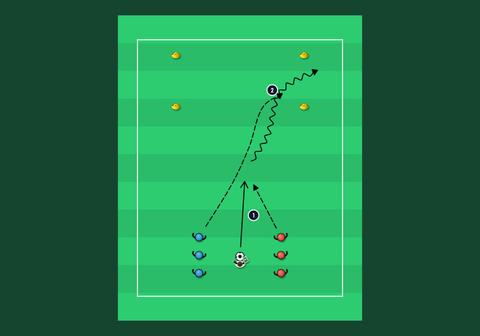
1v1 duel and shielding the ball to two gates
The coach stands with the balls at the lower end of the area, and the teams are in lines on either side of them. In the top corners of the area there are two four-metre gates, through which the ball is dribbled out to the side. The coach plays a pass forward into the middle, and the first player from each line goes for the ball. The player who gets the ball tries to dribble it through either gate, and the other tries to win the ball and stop them. If they win the ball, they can then try to go through either gate themselves. The duel ends with a goal or when the ball goes out of the area, and the players return to the back of their lines. Contact is allowed, but sliding tackles are forbidden. The area is approximately 16 × 20 metres.
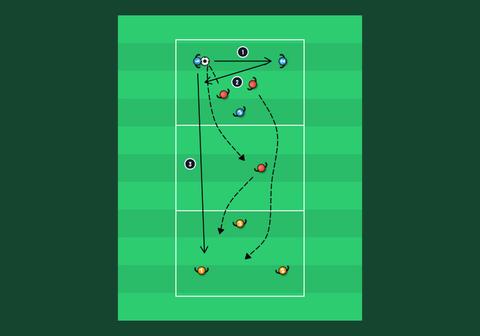
Three-zone rondo (basic)
Mark out a 15 × 30 metre area and divide it into three 10-metre zones. Place a team of three players in each zone. The end teams keep possession and try to play the ball over the central zone to the other end. From the middle team, two players win the ball in the end zone where the ball is, and one stays in the middle to cut out long passes. When the ball switches ends, two players from the middle team run across after it. If the middle team wins the ball or the ball goes out, the team that lost possession moves into the middle and the winning team takes that end zone. Each successful pass from one end zone to the other is a point.
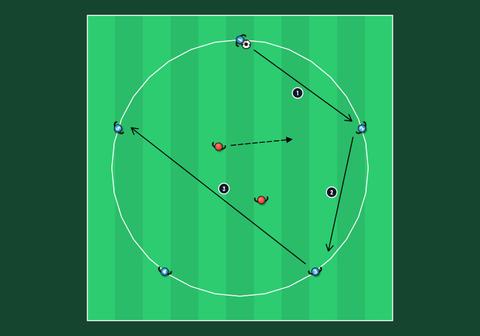
5v2 rondo
Mark out a circle of about 12 metres. Five players set up evenly spaced around the outside, and two defenders go in the middle. The players around the outside pass to each other and move around the circle, but they must not go inside it. When there is a gap between the defenders, the ball is played through it. The player who loses possession goes into the middle, and the defender who has been in the middle longer moves out to take that player's place on the outside. The same rotation is made when the ball goes out of the circle. A point is scored for ten consecutive passes. Limit touches to one-touch or two touches according to level.
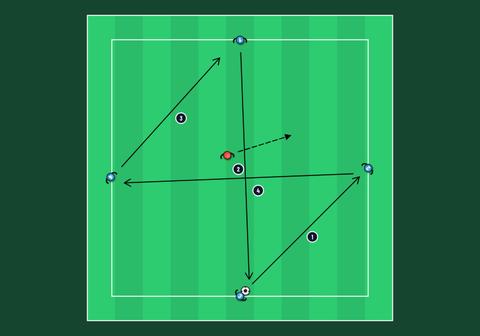
4v1 rondo
Mark out a square of approximately 10 x 10 metres. Four players are on the sides of the square, one on each side, with a defender in the middle. The players on the outside keep possession of the ball. They may move along their own side, but must not go inside the square. The defender tries to intercept the pass. When the defender wins the ball or the ball goes out of the square, the defender swaps places with the player who lost possession. Play restarts immediately. Ten consecutive passes equals one point. Make it easier with a bigger square or unlimited touches, and harder with a smaller square or a two-touch limit.
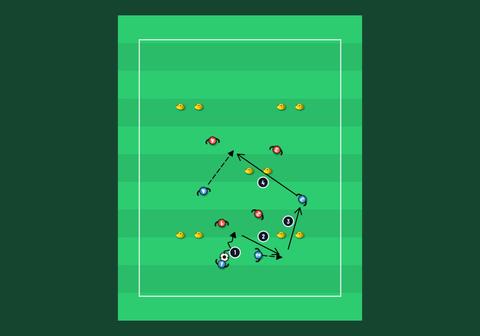
Gate passing game: move away from the ball
When teammates come next to the player on the ball, one defender can cover two of them. In this game, you only score from a pass through a gate to a teammate, so someone has to move away from the ball to the other side of the gate. The animation first shows the usual mistake and then the correct way. Area about 22 × 28 m. Spread five two-metre gates around the area. 4v4 with no goals. A point is scored when the ball is passed through any gate to a teammate who controls it on the other side of the gate. You cannot score two consecutive points through the same gate. Defenders can defend everywhere, and the team that loses possession defends immediately.
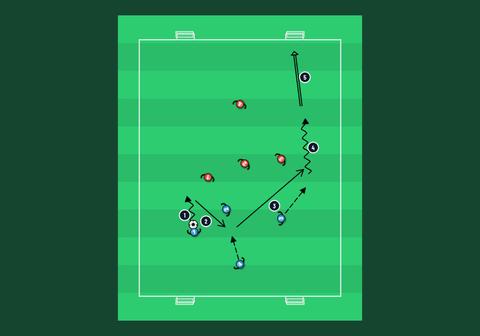
Four-goal game: play with width
With young players, the whole team can easily end up chasing the ball into the same corner. When there are two goals at each end, staying wide pays off straight away: the play is switched to the other side, and the goal there is free. The animation first shows the usual mistake and then the correct way. Area approx. 22 × 28 m, with two small goals at each end close to the corners. 4v4 without goalkeepers. Each team attacks the opponent’s two goals and defends their own. After a goal, the team that conceded restarts by dribbling from their own end. Additional rule for older players: a goal scored after switching play is worth two.
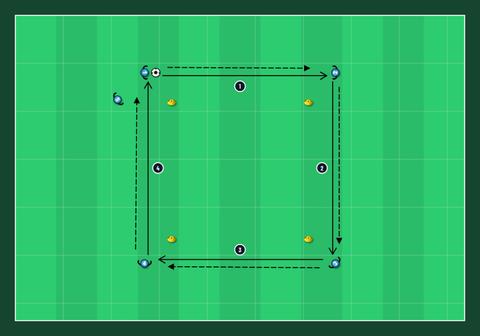
Square passing with directional first touch
Players are placed at four cones in a square. The ball is worked clockwise: the player plays a pass to the next cone and runs after the pass. The receiver takes the ball with a directional first touch.
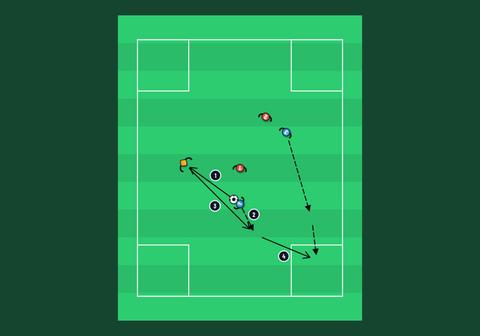
Four corners pass-and-move game
Many players make a pass and then just stand and watch the ball. In this game, you do not score points by standing still. The passer must move into a new space, and you can only arrive in the square by timing the run. The animation first shows the typical mistake and then the correct way. Area 20 × 25 m, with a 5 × 5 m square in each corner. Two teams and a joker, who always plays with the team in possession. The diagram shows 2v2 and a joker, so the attackers have 3v2 numerical superiority. With a bigger group, for example 4v4 and a joker. The attacking team scores a point by passing to a player who has run into a square. The joker does not score points. You cannot wait in the square. You only move there when the pass is coming, and after a point the ball is brought straight back out. When the defenders win the ball, the roles switch and the joker changes sides.
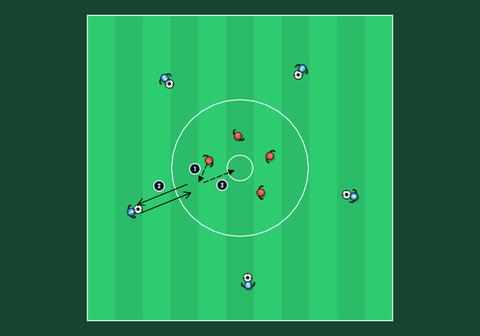
Passing circle
The animation first shows a common mistake and then the correct way. The players on the outside have balls. The players in the middle move and ask for the ball from the outside players and at first return it after a control (aiming to do so with the 2nd touch) and then one-touch as a one-two. The third variation is a throw from the wide player, which the middle player controls and returns. The middle players always go through the middle of the area after the return pass before asking for a new pass.
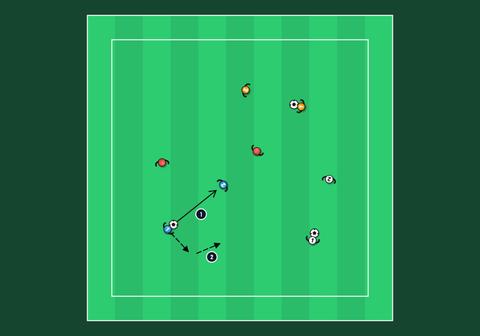
Ball tag
Many players make a pass and then just watch the ball. In tag, that is punished straight away: the ball must be moved on before the tagger gets there, and it can only be passed to a teammate who has moved into space. The animation first shows the usual mistake and then the correct way. Area approximately 23 × 23 m. Four teams, three of which have a ball. The fourth team are the taggers. A tagger may only touch the player with the ball. The teams help each other by passing and moving so that nobody gets caught. A caught player is freed by a high five from a teammate. In the picture, the teams are in pairs, and there are two taggers. Easier: play with hands by throwing and catching, and have fewer taggers. Harder: add more taggers.
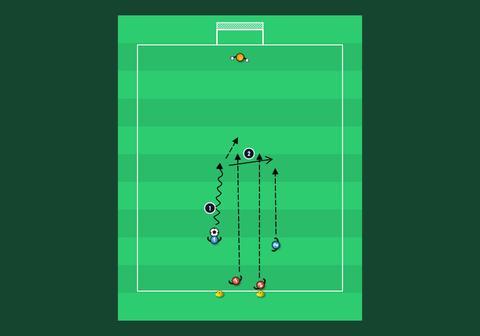
2v2 recovery defending
Two blue players attack the goal with a goalkeeper. Two red defenders start from the markers behind the attackers. The area is approximately 20 x 24 metres, with a cone gate at the opposite end. The blues start with the ball and drive towards the goal, and at the same moment the reds recover. The nearer defender runs along the inside line to get between the ball and the goal and delays the player on the ball. The second defender recovers to the inside, between the remaining attacker and the goal. Once it becomes 2v2, the defenders apply pressing and provide cover. In the example, red 1 gets across in front of blue 1 and delays. When blue passes out wide, red 2 moves to press during the pass and red 1 drops to cover. Red 2 wins the ball, and the reds immediately attack the gate. Now the blues recover. The blues score a point for a goal, the reds for dribbling the ball through the gate. The farther away the defenders start, the more difficult the recovery becomes, so adjust the distance of the starting markers according to the level. Change roles after a few repetitions.
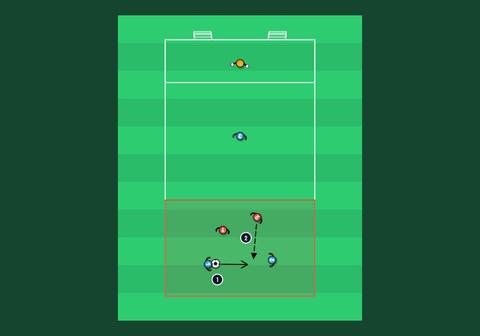
2v2 pressing and penetration
The area is approximately 14 × 24 metres and is divided into three sections. At the bottom is the 2v2 zone, in the middle the penetration zone and at the top the goalkeeper's area. On its end line there are two small goals. In the 2v2 zone, two blue players keep possession and two red players press as a pair. In the penetration zone, one blue defender waits. The reds' task is to win the ball. One presses the player on the ball, the other provides cover from the inside and reads the next pass. After winning the ball, the reds immediately break through: 2v1 against the blue defender and finishing into either small goal. Blue 1 and 2 are not allowed to follow from the 2v2 zone, blue 3 stays in the penetration zone and the goalkeeper stays in their own area. In the pattern, red 2 presses during the pass, and when the ball comes back, the roles change. When blue 1 tries to switch play again, red 2 intercepts the pass. Red 2 dribbles into the penetration zone, draws blue 3 towards them and passes to red 1, who shoots into the left small goal. Change roles every few repetitions so that everyone gets to press, defend the penetration and finish. The blues can be given a point, for example, for five consecutive passes in the 2v2 zone.
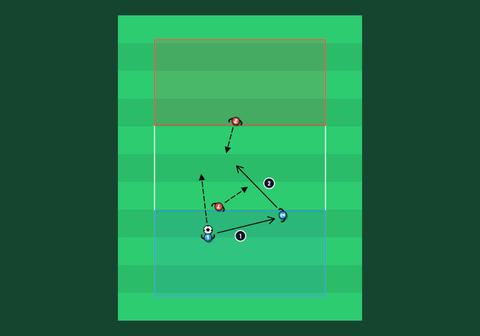
2v2 with a cover line
Two pairs play 2v2 in an area of approximately 16 × 24 metres. At each end there is an end line and a cover line eight metres in front of it. A pair scores a point when they dribble the ball over the opponent’s end line or pass to a teammate who controls it behind the line. The second player in the defending pair must be on or behind their own cover line. One presses the player on the ball, the other provides cover. They must not both go to the ball. The covering player may step off the line when they intercept a pass or win the ball from an attacker who has beaten the presser. In that case, the other defender immediately runs back behind the line. In the diagram, Red 1 presses the player on the ball from the inside and shows them wide. Red 2 is on the line diagonally behind on the inside. When Blue passes across to the other side, Red 1 shifts to press the new player on the ball while the ball is travelling, and Red 2 slides along the line to stay behind them. The pair move together. Blue 1 makes a run in behind the presser, but Red 2 reads the pass and intercepts it. After winning the ball, the Reds attack the Blues’ end line immediately. The nearest Blue presses, and the other runs behind their own cover line. Now the Blues defend in the same way. When Blue 1 wins the ball wide, only Red 2 gets back to the line in time. The Blues play a 2v1. Blue 1 draws Red 2 in and passes into the run of Blue 2, who dribbles the ball over the end line. Play 1–2 minute blocks. If there are more than four players, set up several pitches side by side or rotate pairs between blocks.
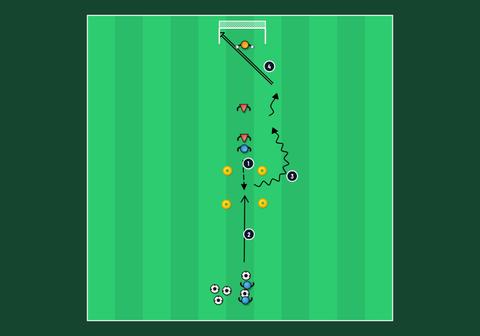
Two-phase 1v1 to goal
Two-phase 1v1. Starts with the attacker’s movement. The attacker asks for the pass into a square marked out with cones (the 1st defender follows), where they aim to move the ball with their first touch to either side. Once the ball is outside the square, it is the second defender’s turn to defend. Now a traditional 1v1, where the attacker aims for finishing. Rotation of roles: attacker goes to the back of the queue, 1st defender becomes the attacker and the second defender becomes the first defender. The passer becomes the second defender.
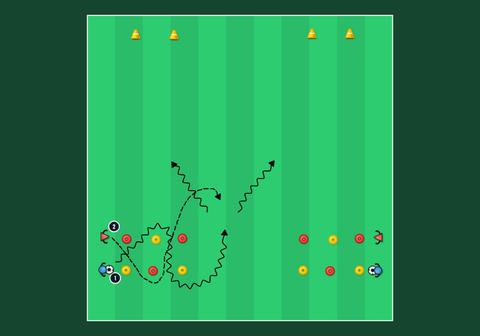
Dribbling and 1v1
A 1v1 drill in which players first weave through cones and then go into a traditional duel towards two small goals. The defender can start moving when the attacker has reached the first turn. After winning the ball, the defender can score by dribbling over the end line between the cones. Change ends and roles after every repetition.
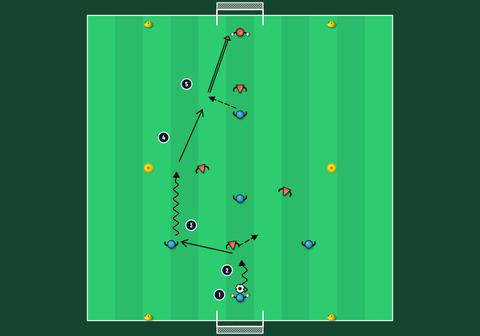
5v5 goal-dribbling game
5v5 game in which the team practises building play with a goal-dribble. When the ball goes over the end line, the defending team restarts by dribbling from any point in their own penalty area. The opponent may wait 5.5 metres from the ball. The player on the ball can carry the ball forwards or pass to a free player. In the example, the presser goes towards the goalkeeper, so the goalkeeper passes to the free player on the left. This player dribbles down the flank and passes to the attacker, who shoots. If an attack that starts from a goal-dribble ends in a goal, it is worth two points. All other goals are worth one. Play short blocks and rotate the teams often. According to the Football Association of Finland rules, 8- and 9-year-olds restart 5v5 by dribbling. In matches for seven-year-olds and younger, the opponent drops back to halfway for the goal-dribble and only defends once play has restarted.
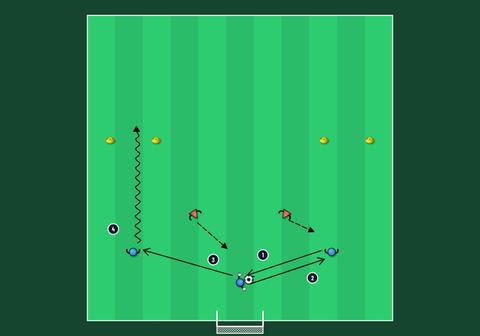
Playing out from a goal kick 3v2
Practise the goal kick in an 8v8 game, where play is started with short passes. The goalkeeper and two centre-backs play against two players pressing. The centre-backs spread out wide level with the corners of the penalty area, and the goalkeeper kicks the ball from the ground to the one who is free. The blue team scores a point when they pass or dribble the ball through the wide gate about 24 metres from the goal line. The reds try to win the ball and score a goal. When the player pressing closes down the centre-back, the centre-back passes the ball back to the goalkeeper, and the goalkeeper switches play to the other side. Start without players pressing, then add one and finally two. In 8v8 for 10-11-year-olds, a goal kick may be taken from the ground anywhere in the penalty area, and the opponent does not have to retreat: it is enough to be 5.5 metres from the ball. The players pressing may therefore stand just as close in the drill as in a match.
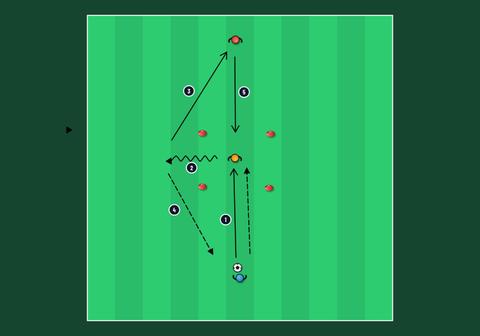
First touch and passing on the move
A three-player drill with one in the middle of a square marked by cones and two on either side at passing distance. The drill starts with a pass, which the player in the middle aims to guide with the first touch outside the square and immediately pass to the third player. After the pass, move into the centre and the middle player fills the empty space.
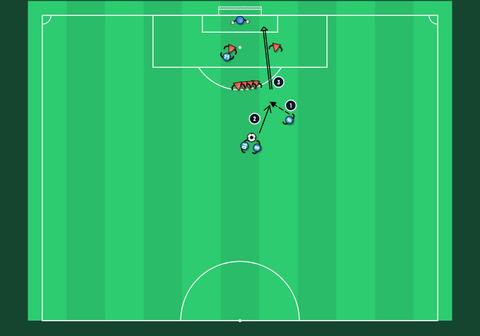
Free kick routine with a fake argument
Two players stay over the ball and begin to act out a disagreement over who will shoot. Meanwhile, a third walks calmly towards his own position off to the side, without looking towards the ball even once. In the middle of the argument, the ball rolls into his path, and the shot is taken with the first touch from a new angle that the wall cannot turn to in time. The pattern lives or dies with the walker: as soon as he glances at the ball or breaks into a run too early, the defending reads the pattern. The pass is played only when the walker is one step away from the shooting position.
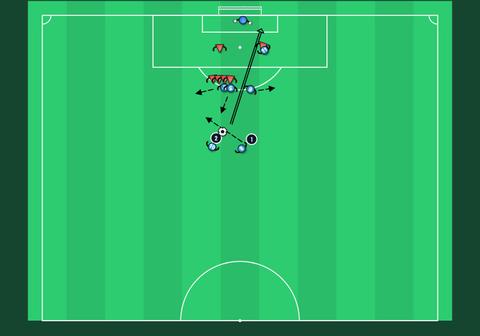
Free kick routine with a splitting wall
Direct free kick from around 20 metres, where your own line of three players stands in the goalkeeper’s line of sight, at least one metre away from the wall, as the law requires. A decoy runner goes over the ball, and at the same moment the line splits to the sides. The shooter strikes low through the newly opened channel into the far corner, where the goalkeeper only has time to look once the ball is already moving. The role of the line is not to cover the whole goal but to take away the goalkeeper’s moment of release: a goalkeeper who reacts late will not reach the low corner. Practise the line splitting so that it happens exactly on the shooter’s final step — if the line splits too early, it reveals everything.
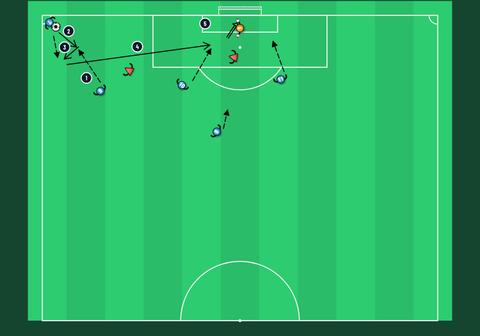
Short corner routine
The corner is played short. The supporting player comes towards the corner flag and receives a pass, which makes the nearest defender come out of the penalty area to apply pressure. The ball is then played back to the taker, who has meanwhile moved from the corner to around eight metres away. The angle for the cross is better from there, and the ball can be delivered low between the near post and the goalkeeper. The player running to the near post finishes one-touch, and the run to the far post starts at the same time. There are two defenders: one applies pressure to the short corner, the other defends the area. Without the defender coming out, the pattern does not show why the short corner works.
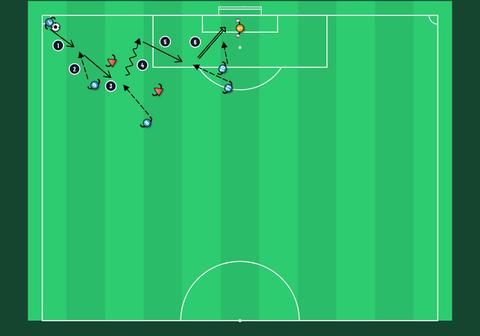
Short corner routine with three players
The corner is played short between three players. The player closest to the flag comes short and receives the pass, which brings the first defender out. Instead of the ball being returned to the taker, it goes first touch to the third player, who has come from the edge of the penalty area into the same corner. Now the second defender also has to come out, and the third player dribbles between them to the end line. From the end line, the ball is played back low towards the penalty spot. The finisher times the run so that they move towards the ball rather than waiting for it standing still. The player occupying the near post takes the goalkeeper with them. Two defenders out means there is briefly a 2v1 in the penalty area. That is the whole idea of the move: the short corner is not looking for a cross but for numerical superiority.
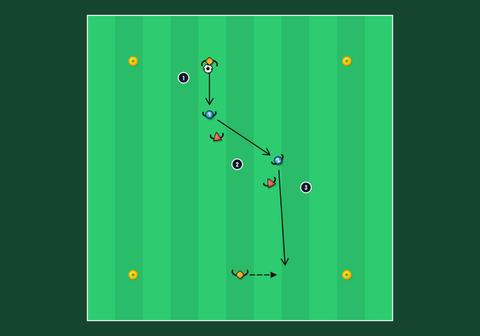
End zone game, target players in the end zones
Six players in three pairs in an empty area. No goals. One pair are the target players, one in each end zone, and they move only along their own end line. The other two pairs play 2v2 in the middle. A point is scored when the ball is dribbled from one end to the other, meaning from one target player to the other. After a successful pass, the same team continues with the ball in the opposite direction. The defending pair try to close the passing lane to the target player and win the ball. After winning the ball, the pair who won it can attack either end zone, but a point always requires the full distance: the ball must go from one target player to the other. In practice, the pair who won it start from the nearest end zone. Three minutes at a time, then the pairs rotate positions.
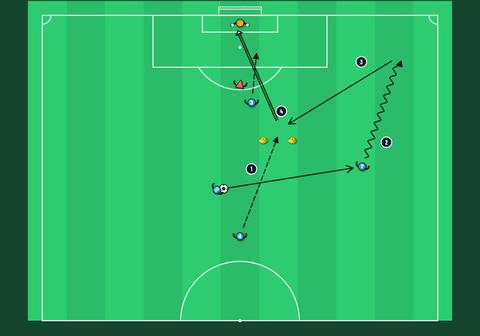
Lay-off for the second wave
A pass from the centre to the winger, who dribbles all the way to the byline. The attacker takes the defender with them to the near post. When the defending has dropped towards the goal, the midfield player arrives late at the edge of the penalty area into the gate. The winger lays the ball back and the arriving player shoots first time from the pass. A goalkeeper in goal. Start alternately from both flanks.
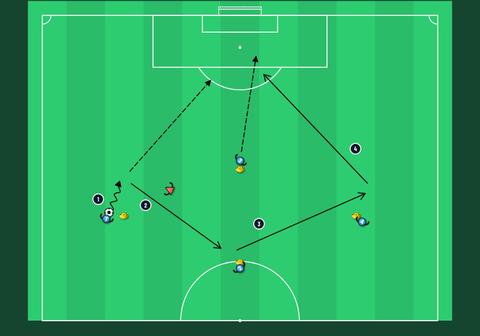
Switch of play and cross
Four players in a diamond: both flanks, one in the middle at the front and one in the middle at the back. The wide player starts dribbling towards goal. The deepest player calls, which stops the dribbling and the ball is played back. The deepest player switches play first time to the opposite flank, who advances and delivers a cross. The others arrive in front of goal in staggered runs to finish. Start alternately from each flank. Instead of a cross, a sharp low pass from the flank is also allowed.
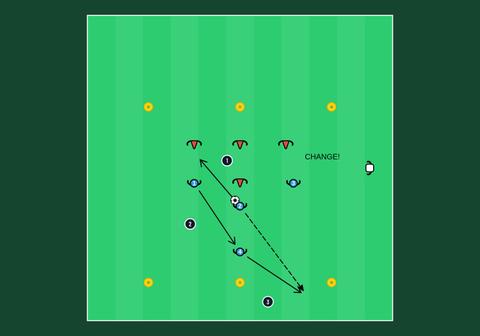
End zone game with changing direction
4v4 with an empty area, with end zones marked by cones at both ends. No goals. A point is scored when a player from your team receives a pass in the end zone. The coach calls for a change of direction during play, and the attacking direction switches from that moment. The defending team have just compacted towards the wrong end, so the space is behind them; this must be seen and used before they have time to turn. Playing time 3-4 minutes at a time, with several calls in each block.
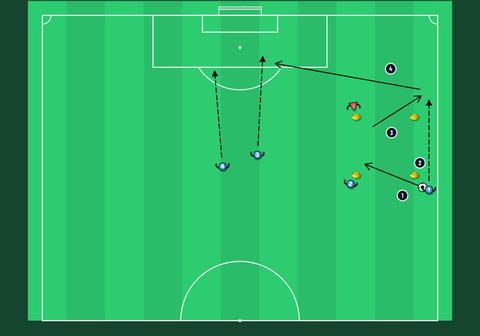
Wide 2v1 and cross
Two attackers break down one defender out wide and deliver a cross. The wide player passes to the inside player, who comes towards the ball and turns towards goal. At the same time, the defender sets off from the opposite corner to apply pressure. The passer immediately makes an overlapping run on the outside past their teammate, into the space between the penalty area and the touchline. From there, they receive the ball back and deliver a cross. The run into the penalty area is staggered: one to the near post, the other to the far post. The defender does not follow outside the square. Start alternately from both flanks. Alternatively, the wide player can solve the situation themselves in a 1v1, either by going inside or down the touchline.
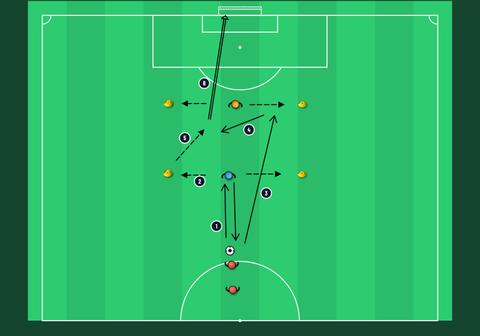
Barcelona shooting drill
A pass is played from the line to the blue player, who plays a one-two back to the first player in the line. He then chooses which cone to move to, and the yellow player moves to the opposite cone on his own line. The first player in the line passes to the yellow player, who lays off a one-two to the blue player, who aims to shoot first time from the pass into the goal.
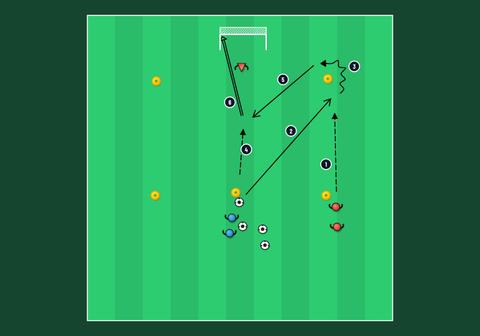
Cutback finishing
The drill starts with the red player making a movement, which the player in the middle looks to find with a pass. The red player controls the ball, goes around the cone near the end line and plays a cut-back pass to the central player, who looks to shoot and score. The queues change after every repetition.
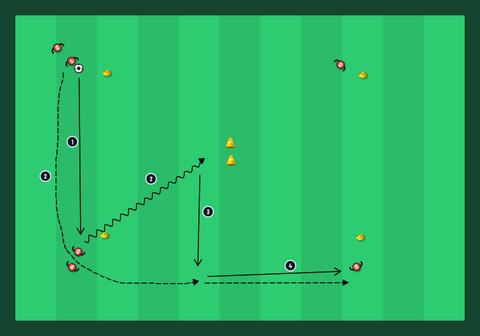
Passing for an overlap
Player passes the ball and makes an overlapping run behind the other player. The receiver dribbles the ball near the cones and passes to the overlapping player, who then passes on to the third queue. The drill progresses in four phases: 1) initial pass, 2) dribbling towards the cones, 3) pass into the overlap and 4) pass to the third queue.
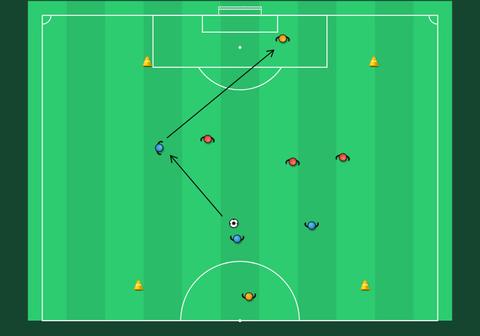
End zone game
3v3 end zone game with two jokers. The jokers play in the end zones with the team in possession. The jokers can join the attack, creating temporary numerical superiority. A goal is scored when a player receives a pass in the end zone
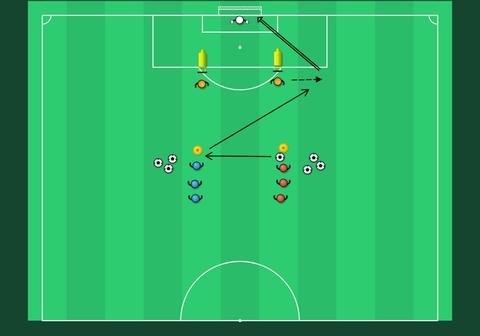
Finishing - defender behind the back
The situation starts with a sideways pass from one queue to the other. The diagonal attacker (orange) moves away to the side from the defender and looks to shoot immediately after the control. In the second variation, the attacker's movement is to the inside of the defender.
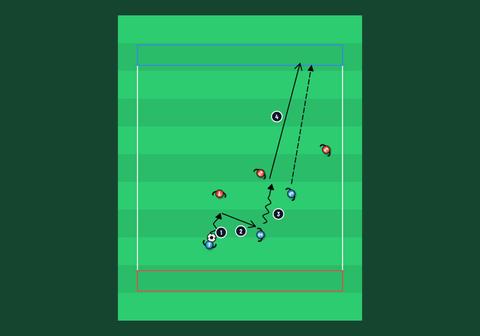
3v3 line game
3v3 game without goals. A goal is scored when a team gets the ball under control behind the opponent’s end line. If the whole team comes short to the ball, there is no one behind the line to pass to. One player stays high and runs in behind the defender. The animation first shows the usual mistake and then the correct way. Area approximately 20 × 20 m, and a two-metre zone behind each end line. The receiver must control the ball behind the line. A shot or dribbling over the line is not enough.
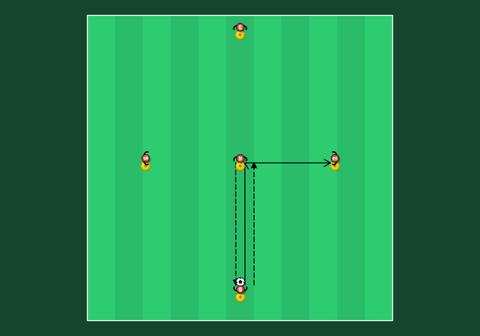
Cross passing with rotation
Five cones in a cross shape: one in the middle, four around it at a distance of 5–10 metres. One player at each cone. The ball starts from an outer cone and is played to the middle player. The middle player takes a directional first touch and with it plays a pass to a new outer cone, not back to where the ball came from. Then the passer and the middle player rotate positions: the passer runs into the middle, and the middle player takes the now free outer position. So there is a different player in the middle on each round. Adjust the distances according to the players’ age and skill level.
Cone relay race with a shot
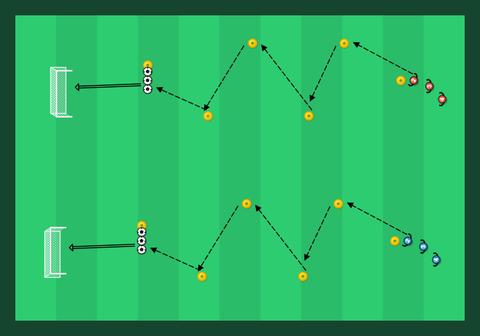
Two identical courses side by side, with a team on each. At the end of the course there is a small goal and a cone in front of it with three balls. Between the goal and the starting cone there are four cones alternating on different sides of the course. The first player starts on the signal and goes round the cones at full speed, passing each on a different side. From the last cone, straight to the ball and a shot into the small goal. When the ball is in the goal, the next player starts. The team that gets all three balls into the goal first wins. Three players on each course, six in total. Adjust the spacing between the cones to suit the group. The closer together the cones are, the more the course demands braking and changes of direction.
4v2 rondo
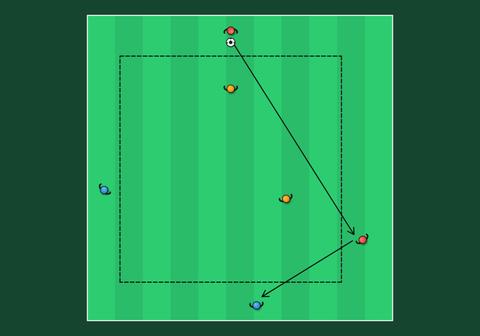
Mark out a square area and make three pairs of two players. Two pairs are on the outside on the edges, so there are four passers, one on each side. One pair is inside the area winning the ball. The outside players keep possession from side to side. The players winning the ball share the job: one presses the player on the ball, the other blocks the next passing lane. When they win the ball, the pairs swap places and play continues immediately without a restart. Adjust the size of the square to the level. A smaller square shortens the passes and forces quicker first touch.
Line passing 2/3
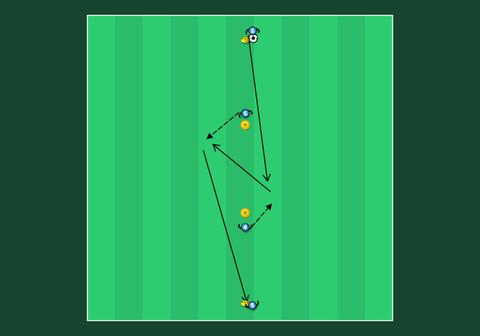
Four players in one line, 5–10 metres apart, each position marked. The ball always bypasses the nearest player. The top player plays a long ball past the first middle player to the second middle player, who has moved out to the side. This player lays the ball off one-touch back to the bypassed player, who has meanwhile moved out to the other side of the line, and the bypassed player plays a long ball to the bottom player, again past the middle player. At the far end, the middle players return to their markers and the same pattern comes back the other way, moving out to the opposite sides. The bypassed player starts moving before the long pass is played.
Line passing 1/3
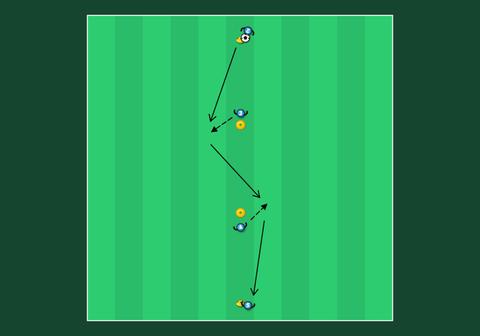
Four players in a straight line 5–10 metres apart, each position marked. The top player starts with the ball. The two middle players move away from their marker to the side of the line, on opposite sides, and receive the ball in an open body position. The ball travels through the line: the top player passes to the first middle player, who passes to the second, who passes to the bottom player. Once it reaches the end, the middle players return to their markers and the same pattern comes back the other way, but now both move out to the opposite side. Start with two touches and move to one-touch when the pattern is flowing.
Line passing 3/3
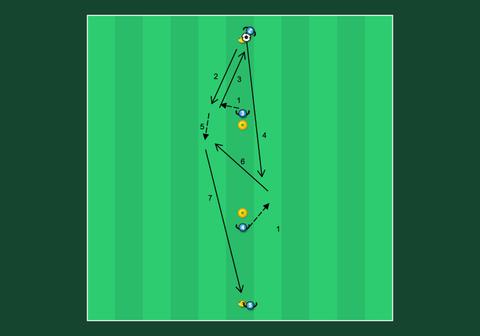
Four players in a line 10–15 metres apart, with a marker at each position. Numbers from top to bottom: two, three, four, five. Two starts with the ball. Going down: two passes to three, who returns it straight back. Two plays a long pass beyond three to four, four directs the ball to three, and three plays a long pass beyond four to five. Going up, the same as a mirror image: five passes to four, gets the return pass and plays a long pass beyond four to three. Three directs it to four, four plays a long pass back to two, and the sequence starts again. Three and four move away from the line to opposite sides just before the pass is played. This allows the long pass to travel beyond the previous player. After their own pass, they return to the line. Short passes with two touches, long passes firmly along the ground. When the pattern is flowing, tighten the short passes to one-touch.
Running duel and winning the ball
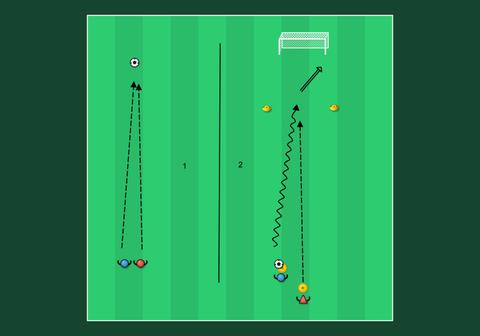
Train progressively how to initiate contact and win the ball with recovery pressing. In phase 1, the players set off on the coach’s signal and try to reach the ball first. Contact already from the start; use of the arms and taking control of the running line are important. In phase 2, practise winning the ball from a slightly similar situation where one player has the ball. The attacking player may try for goal if they are able to advance close enough.
Cone slalom dribbling
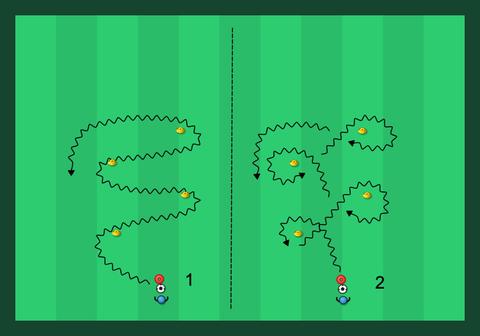
Place the cones generously apart so that there are several touches between them. In phase 1, go around the cones normally, varying the dribbling methods (free, sole of the foot, turns with the outside/inside of the foot, etc.). In phase 2, go fully around the cones using either the inside or the outside of the foot.
Three-player warm-up passing 3/3
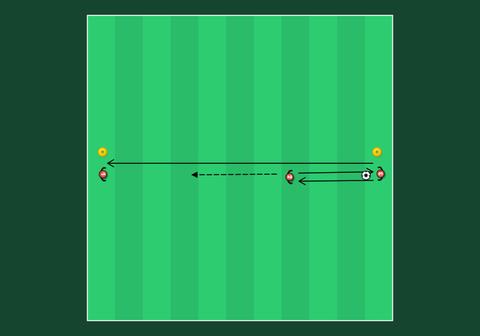
Two players stand still 15–20 metres apart, with markers in front of their feet. The third works between them. One ball. The player on the right plays a short pass to the middle player, who has moved towards the ball, and the middle player returns the ball. Immediately after, the same player plays a long pass to the other end. The middle player does not stay in the passing lane but moves aside and at the same time runs to the other side. The same pattern is repeated there: short pass to the middle player, return pass, and then a long pass back. So the rotation has three passes: short pass in, return pass and long switch. The middle player's job is to get there to receive before the ball and out of the way before the long pass. Change the middle player about every minute.
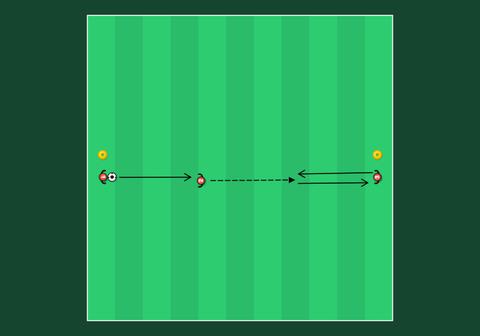
Three-player warm-up passing 2/3
Two players stand still 15–20 metres apart, with markers in front of their feet. The third works between them. One ball. The player on the left passes to the middle player, who has moved towards that side. The middle player takes the first touch towards the opposite side and passes there. The same continues alternately. Demand direction from the first touch: the ball must go where it is going next. Change the middle player about every minute.
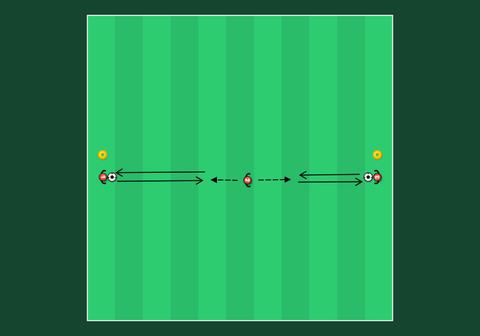
Three-player warm-up passing 1/3
Two players stand still 15–20 metres apart, each with a ball. The third works between them without a ball. The middle player moves towards the player on the right. That player makes a pass, and the middle player returns the ball straight back. He then turns, runs to the other side and does the same with the player on the left. Neither ball crosses the middle area but stays under the control of the wide player on that side. The middle player does not stay standing after the return pass but turns immediately. Change the middle player about every minute. First rounds with two touches. When the rhythm is there, return pass one-touch.
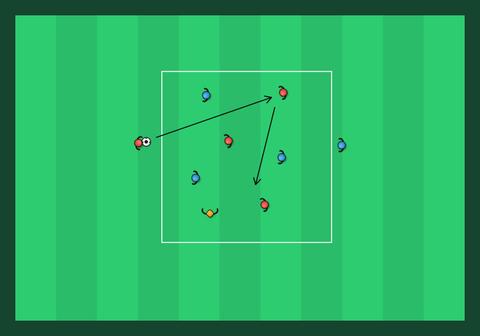
Possession game
The aim is to keep the ball in your own team's possession in a limited area. As variations, some players can be outside the area and/or there is a joker who is always on the side of the team in possession.
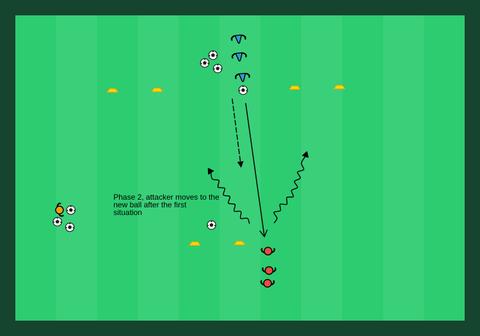
1v1 to gate goals
The drill starts with a defender’s pass and, after the control, the attacker tries to dribble into either gate goal. The defender tries to win the ball and dribble into the opposite gate goal. A second phase can be added to the drill, where after the first situation has ended, the coach adds a new ball and the attacker has to move with their back to the goals.
Finishing from a one-two
The blue player makes the initial movement away from the defender and the first player in the queue plays a pass into the movement. The blue player takes a control and immediately continues with a pass to the yellow player. The yellow player lays off the one-two behind the defender and the blue player aims to shoot the ball into the goal directly from the pass. The defender tracks the run but does not intercept the passes. Rotation: from attacker to laying off the one-two and defender to attacking. The player laying off the one-two goes to the back of the queue and the player making the first pass becomes the defender.
Dribbling and finishing
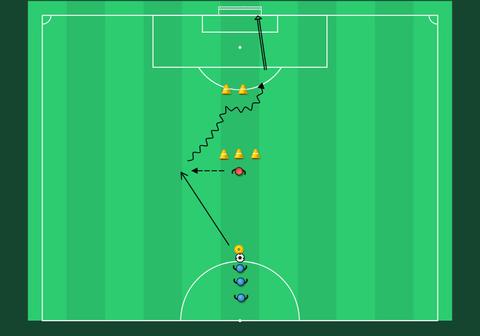
The red player chooses a side to move towards and calls for the pass. The first player in the queue plays the pass and the red player aims to take the first touch in the direction of travel. The red player dribbles towards the goal, beats the cone defender with a feint of their choice and shoots into the goal. Rotation: the passer becomes the finisher.
Passing, dribbling and shot from a through pass
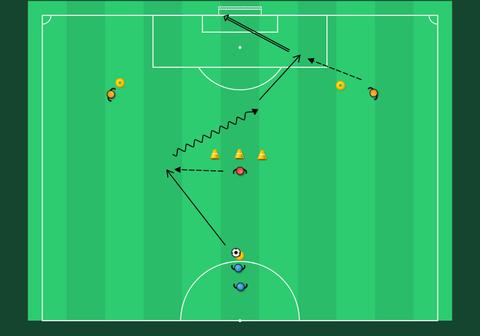
The player in front of the cones makes a movement to either side of the line of cones and asks for the pass. The first player in the queue plays a pass and the receiver takes a short dribble towards the player positioned on the opposite diagonal and plays a through pass to them. The receiving player tries to "avoid offside" (the cones represent the deepest defenders) and finish first time from the pass.
Passing in pairs
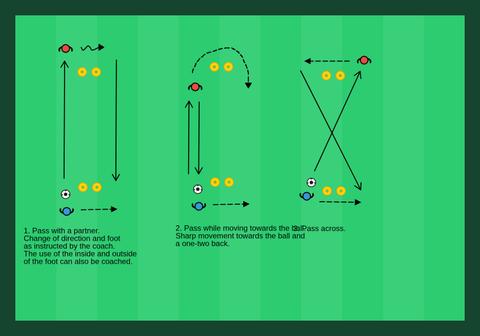
1) Straight pass back and forth with a partner - change of direction and foot as instructed by the coach, the use of the inside and outside of the foot can also be coached. 2) Pass while moving towards the ball - sharp movement towards the ball and a one-two back. 3) Pass across - pairs pass across.
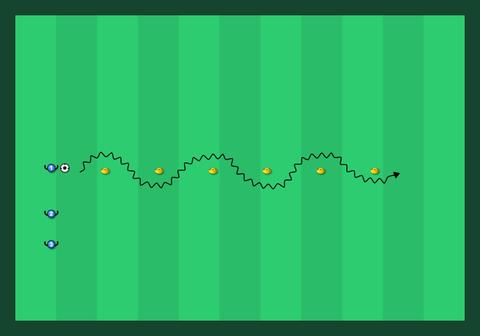
Slalom dribbling relay
Cones are set out in a straight line 0.8–1.5 metres apart. Players dribble the ball between the cones using the inside and outside of the foot. Relay race: the player dribbles through the course, turns and returns, after which the next player sets off.
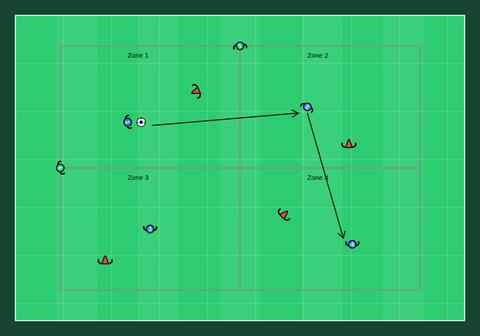
Possession square
Square-shaped area divided into four zones. Two teams (e.g. 4v4+2 jokers). The team in possession keeps the ball and tries to play into as many zones as possible. A point for each new zone the ball is played into in succession. The jokers always play with the team in possession.
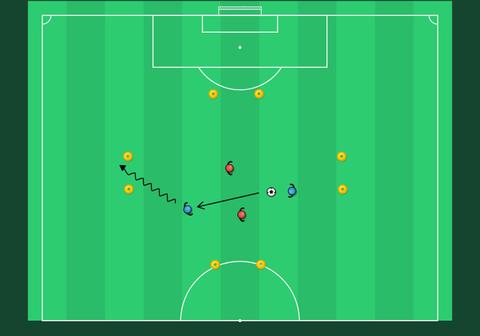
2v2 to four goals
2v2 in a small area, with four cone goals on the edges of the pitch. A goal is scored by dribbling the ball through any pair of cones. Because there are goals in every direction, the player on the ball must constantly turn and shield the ball to find an open goal.
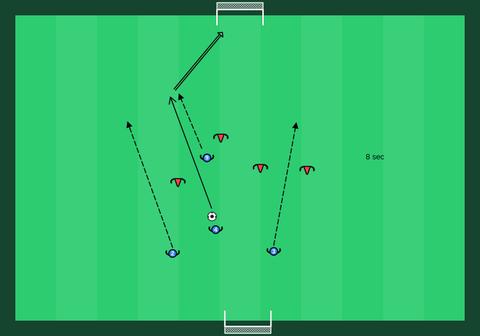
Counter-attack game
The defending team defends their own goal. When they win the ball, they have 8 seconds to attack the opposite goal. If a goal is scored within the time limit, the point counts double. The attacking team continues normal play. A quick transition from defending to attacking is decisive.
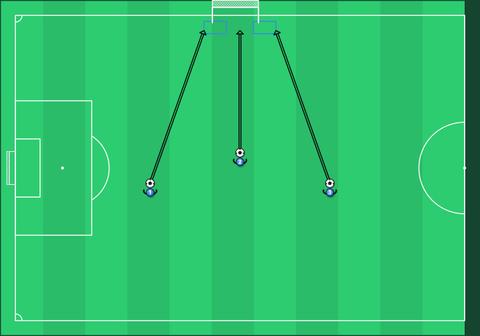
Shooting from a stationary ball
Players take turns shooting a stationary ball towards the goal from different distances (8–15 m). The balls are placed at different angles in front of the goal. Focus on correct striking technique: positioning the non-kicking foot next to the ball, locking the ankle, and striking with the instep.
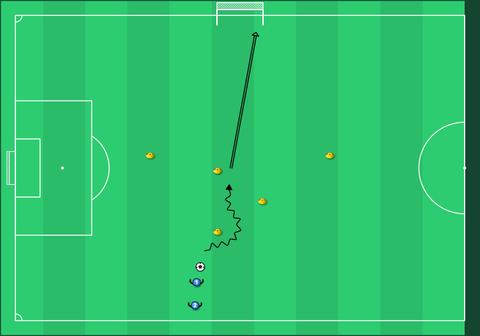
Dribbling and shooting
Players dribble the ball past or through the cones before shooting. The dribbling starts approximately 20–25 metres from the goal, the shooting area marked with cones approximately 10–14 metres away. Head up before shooting.
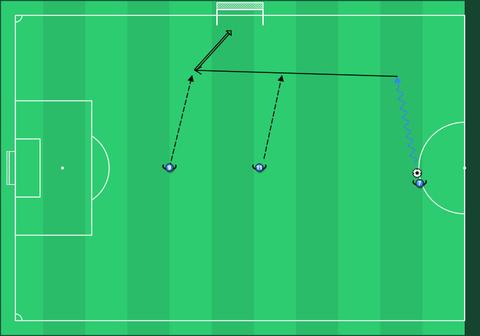
Cross and finishing on the move
The wide player receives the ball and goes to the byline or into the inside channel. In the penalty area, two attackers make crossing runs: one to the near post, the other to the far post. The player crossing chooses the type of cross.
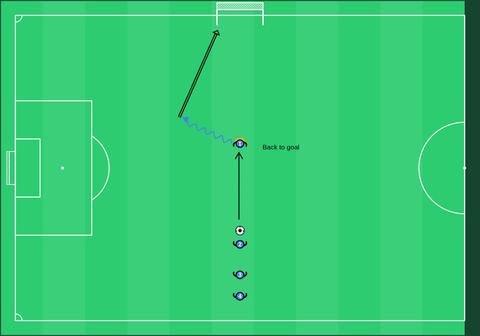
Turn and shoot
The player stands with their back to goal around 11–14 metres away, with the passer in front. The passer plays a low pass, the player controls the ball with the first touch to the side and shoots with the second touch.
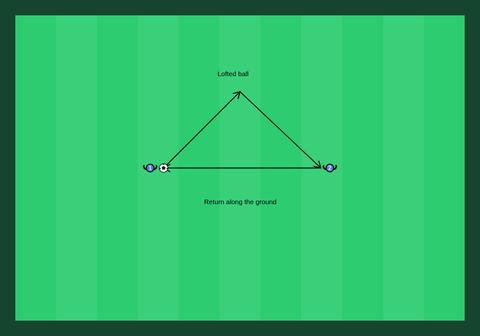
Aerial ball control
In pairs: the server throws a lofted ball to the receiver, who controls it with the thigh, chest or instep and plays the ball back along the ground in two touches. Three stations: thigh and down to the ground, chest and down to the ground, instep and down to the ground.
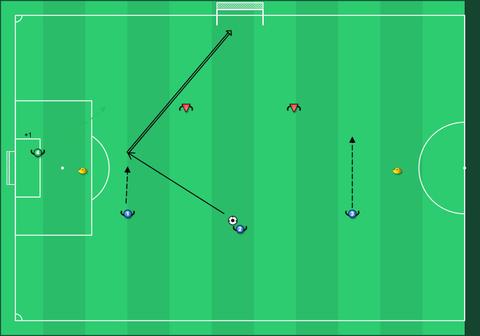
3v2+1 numerical superiority attack
Three attackers play against two defenders. One additional player waits on the flank and joins in when the ball crosses a certain line. The attackers aim for quick finishing before the defending can get organised. If the defenders win the ball, they play a counter-attack.
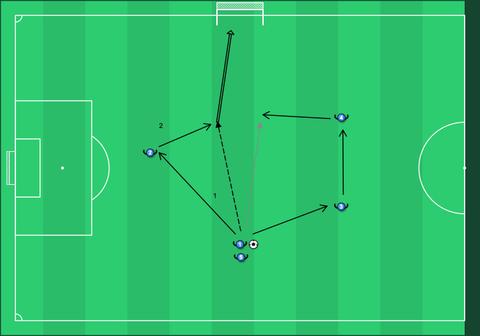
Combination play with one-twos
Players practise different one-two patterns on the move: a simple one-two or a triangle passing pattern. Each pattern ends with a shooting opportunity. First without defenders, then with passive defenders and finally with active defenders.
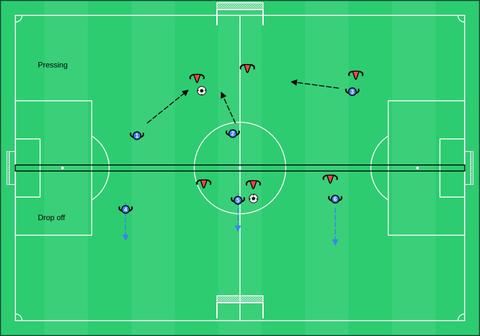
Press or drop off?
The defending team practises two alternative reactions after a loss of possession: (1) counter-press high if the ball was lost in the opponent's half, (2) drop off and reorganise if the ball was lost in their own half. The coach signals which option is to be carried out. The team learns to recognise the right moment for both.
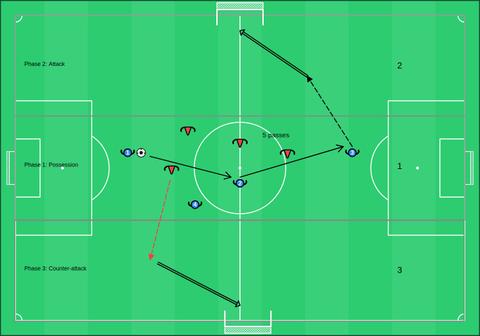
Three-phase transitions game
Pitch divided into three zones. The game starts in the middle zone as a possession game. When a team completes 5 passes, they attack the opponent’s goal (phase 2). If the defending team wins the ball, they launch a counter-attack towards the other goal (phase 3). Each phase requires different tactical understanding.
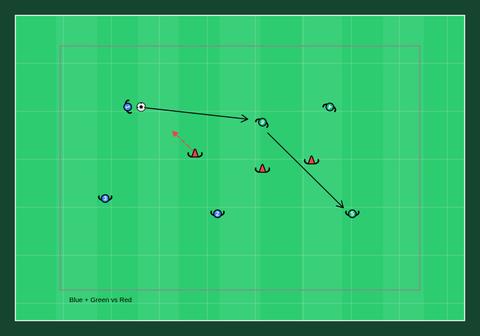
Three-team possession game
Three teams (e.g. 3×3 or 3×4). Two teams play together against the team that has lost possession. When a team loses the ball, it moves into defending and the other team joins the team in possession. Continuous transitions of roles.
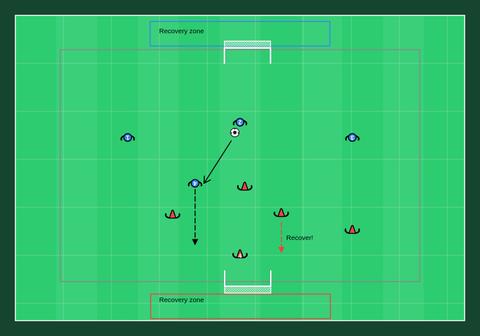
4v4 recovery zone game
4v4 game with two goals. Each team has its own "recovery zone" behind the goal. When a team loses possession, one player must go into the recovery zone before they can take part in defending. This creates temporary numerical superiority for the attacking team and forces a quick transition.
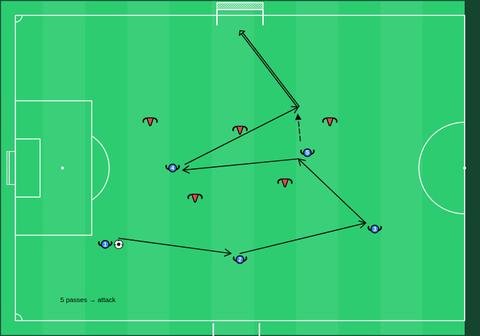
Possession to goal
Team game (e.g. 5v5+GK) on a half pitch. The team in possession keeps the ball and tries to attack the goal. Before attacking the goal, at least 5 consecutive passes are required. The defending team tries to win the ball and play a counter-attack to the other end.
Shooting circuit
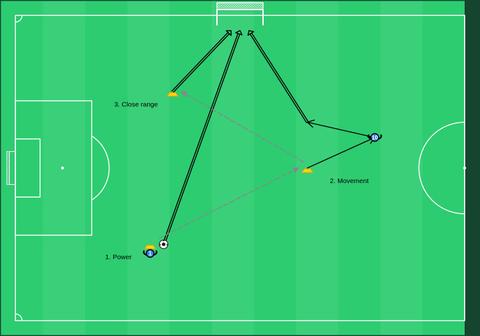
Three-point shooting circuit: (1) power shot from around 20 metres, (2) shot on the move from the passer’s lay-off from around 14 metres and (3) close-range shot or half-volley from short distance. After each shot, quickly move to the next station.
Rondo with jokers
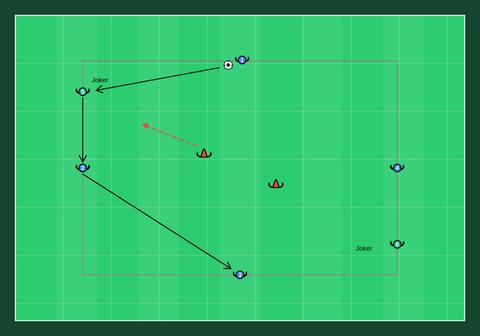
Possession drill (e.g. 4v2) with two jokers, who always play on the side of the player on the ball. The jokers move along the edges of the area and offer extra passing options. 1–2 touch limit for the outside players, jokers on unlimited touches. The defenders try to win the ball — the player who made the last pass goes into the middle.
Third-player movement
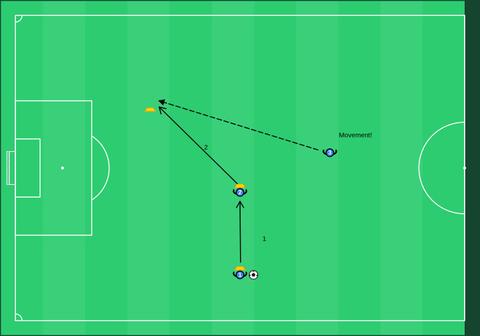
Three-player combination: the first passes to the second, the second plays to the third, who has made a run into free space. The key is the third player's movement — they break away before the ball arrives at the second player. Practise in different patterns: in behind, wide and diagonally.
Zonal rondo
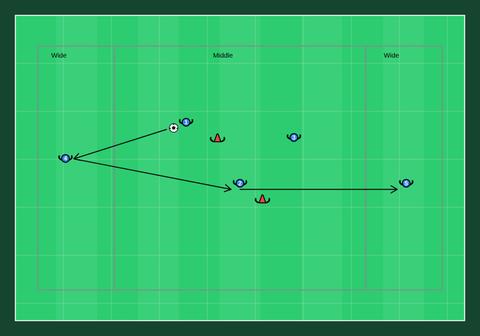
Three zones side by side (narrow-wide-narrow). The team in possession starts in the middle zone and tries to play the ball into the wide zone. The defenders try to prevent play to the side. After a successful pass to the side, the ball is played back into the middle and switched to the other side.
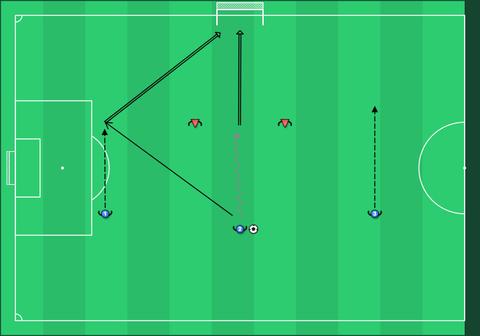
3v2 finishing
Three attackers start with the ball and move towards two defenders. The aim is to create numerical superiority and finish. After a goal, the attackers receive a new ball and attack the opposite goal.
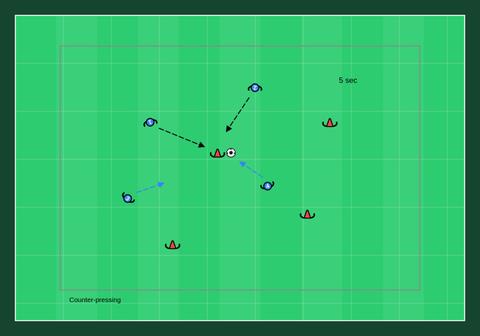
Counter-pressing game
Two teams play a possession game in a confined area. When a team loses possession, it has 5 seconds to win the ball back with counter-pressing. If the ball is won back, play continues. If not, the team that lost possession does a penalty task. Objective: immediate reaction to loss of possession.
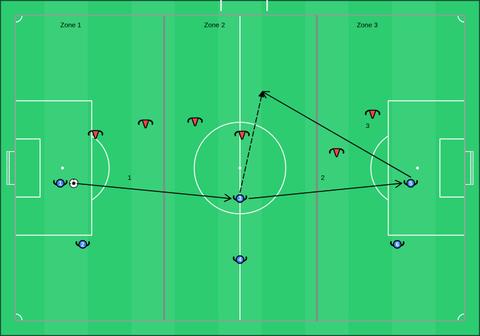
Width and depth
Team game (e.g. 6v6 or 7v7). The pitch is divided into three vertical zones. The attacking team only scores a point when the ball has been in all three zones before finishing. Forces the use of width and prevents narrow central play.
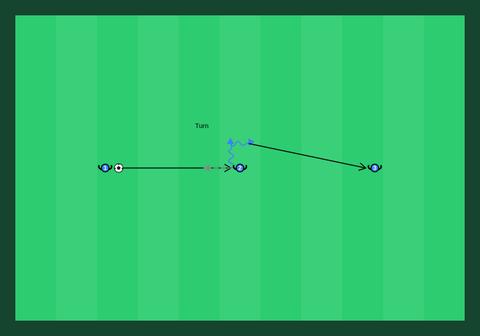
Control and turning
The central player moves towards the passer, takes the control with the first touch and turns 180 degrees. Passes with the second or third touch in the opposite direction to the target player.
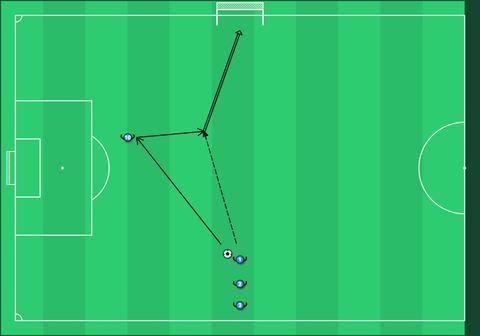
Passing and shooting
A line of players 18–20 metres from the goal, the passer at the edge of the penalty area. The shooter passes to the passer and continues the run, the passer returns the ball with one-touch into the shooter’s path. The shooter finishes directly or with one-touch.
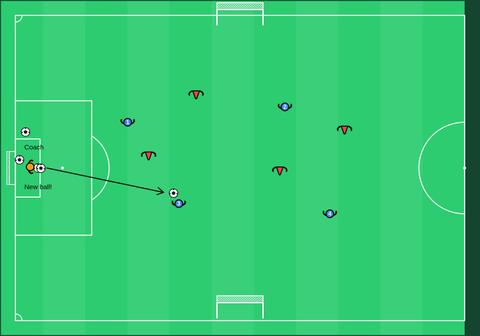
4v4 transition game
4v4 game with two goals (+GK). When the ball goes out of bounds or a goal is scored, the coach passes a new ball onto the pitch to a random team. Continuous transition situation: the teams never know who will get the next ball. Forces constant readiness in both attacking and defending.
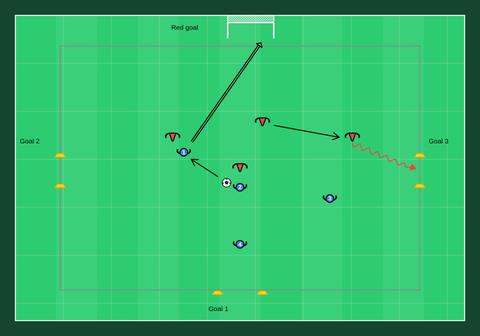
4v4 three goals
4v4 game in which one team has one standard goal and the other has three small cone goals in different parts of the pitch. The one-goal team attacks directly, while the three-goal team looks for the open goal. Roles change regularly.
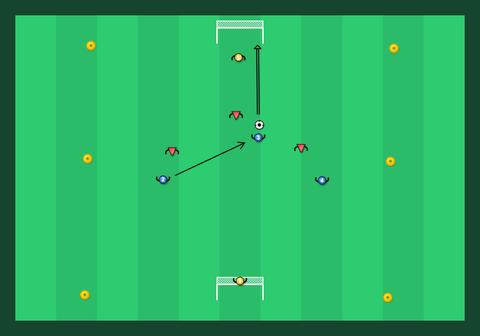
3v3 with goalkeepers
3v3 game with normal small goals and a goalkeeper. A full match situation in a small area: attacking, defending, finishing and goalkeeping. Short games (3–4 min), scoring and a tournament format keep the intensity high. The coach focuses on one theme at a time.
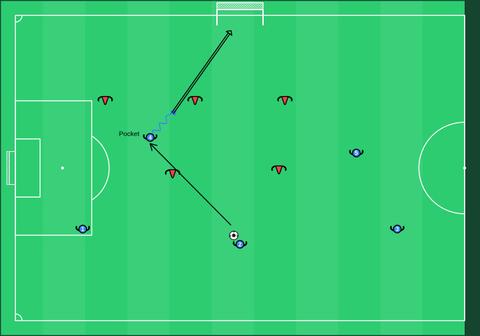
Playing between the lines
The attacking team aims to play the ball into the pocket — between the defensive line and the midfield. The player receiving in the pocket turns and plays forward or shoots. The defending team tries to keep the lines compact and prevent play into the pocket.
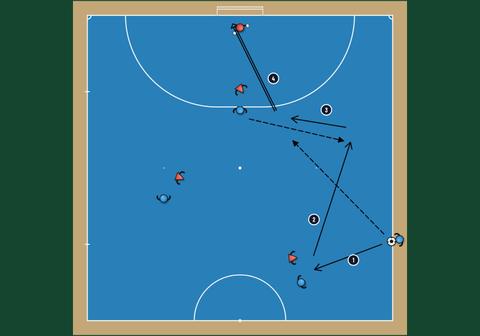
Futsal kick-in routine through the pivot
In futsal, the ball is put back into play from the touchline with a kick-in, and you have four seconds. That is why it is worth having a routine ready for the kick-in. Here the kick-in is taken in the attacking half from the right flank. There are four blue outfield players, three red defenders and a goalkeeper. The kicker plays a short pass to the deep player waiting further inside and immediately makes a diagonal run towards goal. At the same time, the pivot moves from in front of the goal out to the flank, and the marker follows. The deep player passes to the pivot on the flank, and the pivot plays the ball into the middle, where the kicker has run. The kicker shoots. If the passing lane to the pivot is blocked, the deep player switches the ball to the left-sided player. Once the routine is working, add a fourth defender to mark the kicker.
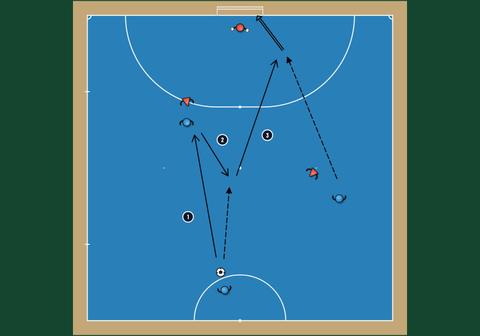
Futsal pivot lay-off and far-post run 3v2
Three blue players attack: a deep player, a pivot and a wide player. They are up against two defenders and a goalkeeper. The pivot plays close to goal with their back to goal, with a defender tight behind. The deep player passes to the pivot and follows their pass. The pivot lays the ball off one-touch to the oncoming deep player. At the same time, the wide player on the opposite side runs to the far post. The second defender has to choose whether to press the player on the ball or track the runner. If they stay with the runner, the deep player shoots. If they come to press, the deep player plays a low ball across the face of goal to the far post, and the wide player finishes. Start with the defenders at half intensity. After winning the ball, the red players attack towards the halfway line, and dribbling over the line is a point. Change roles and sides every few repetitions.
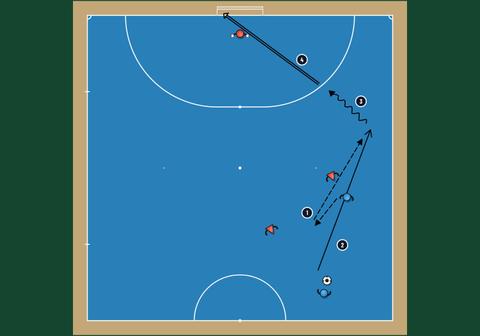
Futsal parallel run 2v2
The parallel run is a basic futsal movement: the wide player gets away behind their marker down the flank. The fixo and the wide player attack against two defenders and a goalkeeper. The wide player first moves diagonally towards the ball and takes the marker with them. Then they change direction and make an explosive run down the flank. At the same moment, the fixo plays a long ball along the flank into space behind the defender. The wide player dribbles inside and shoots towards the far post. The defenders play at half pace until the timing of the run and the pass works. If the reds win the ball, they get a point by dribbling it over the halfway line. Practise from both flanks.