How to coach passing in youth soccer
A good passing drill makes players pass because the game asks for it, not because the coach counts reps. The simplest version is a pattern where the ball never stops and players learn to open their body before it arrives. Once that flows, a defender in the middle forces the receiver to scan and choose. Under-10s need short distances and plenty of touches. By U12 you can stretch the area and ask for one-touch play and switches of play. Coach the first touch as part of the pass, because a receiver who controls the ball into space has made the next pass easier.
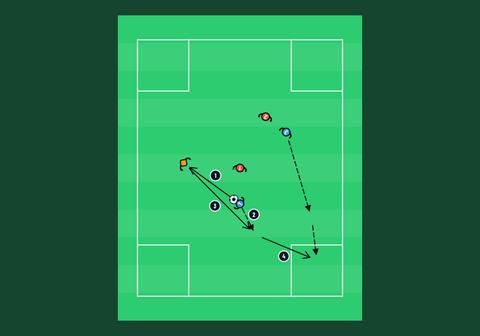
Corner square game: pass and move
Many players make a pass and then just stand and watch the ball. In this game, you do not score points by standing still. The passer must move into a new space, and you can only arrive in the square by timing the run. The animation first shows the typical mistake and then the correct way. Area 20 × 25 m, with a 5 × 5 m square in each corner. Two teams and a joker, who always plays with the team in possession. The diagram shows 2v2 and a joker, so the attackers have 3v2 numerical superiority. With a bigger group, for example 4v4 and a joker. The attacking team scores a point by passing to a player who has run into a square. The joker does not score points. You cannot wait in the square. You only move there when the pass is coming, and after a point the ball is brought straight back out. When the defenders win the ball, the roles switch and the joker changes sides.
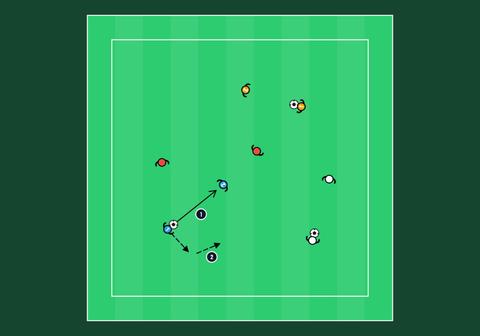
Ball tag
Many players make a pass and then just watch the ball. In tag, that is punished straight away: the ball must be moved on before the tagger gets there, and it can only be passed to a teammate who has moved into space. The animation first shows the usual mistake and then the correct way. Area approximately 23 × 23 m. Four teams, three of which have a ball. The fourth team are the taggers. A tagger may only touch the player with the ball. The teams help each other by passing and moving so that nobody gets caught. A caught player is freed by a high five from a teammate. In the picture, the teams are in pairs, and there are two taggers. Easier: play with hands by throwing and catching, and have fewer taggers. Harder: add more taggers.
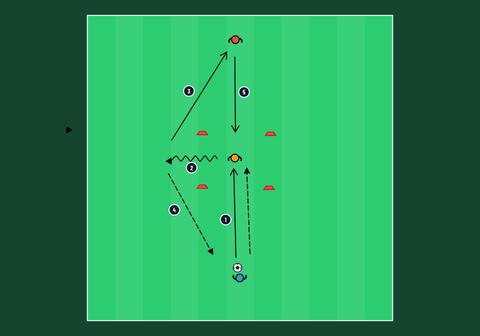
Passing and first touch with continuous movement
A three-player drill with one in the middle of a square marked by cones and two on either side at passing distance. The drill starts with a pass, which the player in the middle aims to guide with the first touch outside the square and immediately pass to the third player. After the pass, move into the centre and the middle player fills the empty space.
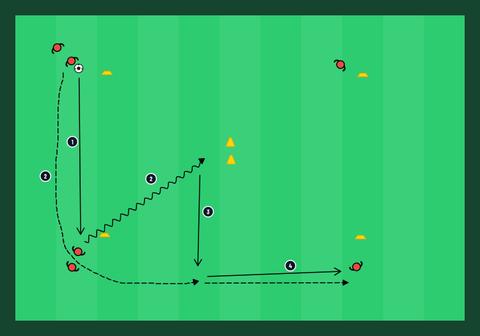
Passing for an overlap
Player passes the ball and makes an overlapping run behind the other player. The receiver dribbles the ball near the cones and passes to the overlapping player, who then passes on to the third queue. The drill progresses in four phases: 1) initial pass, 2) dribbling towards the cones, 3) pass into the overlap and 4) pass to the third queue.
Cross passing with rotation
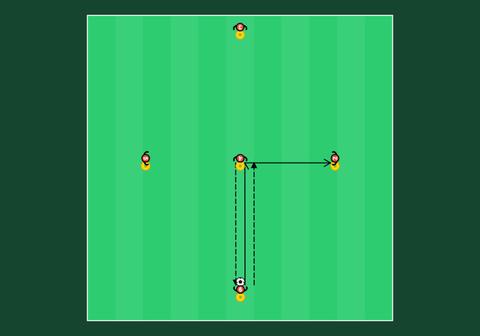
Five cones in a cross shape: one in the middle, four around it at a distance of 5–10 metres. One player at each cone. The ball starts from an outer cone and is played to the middle player. The middle player takes a directional first touch and with it plays a pass to a new outer cone, not back to where the ball came from. Then the passer and the middle player rotate positions: the passer runs into the middle, and the middle player takes the now free outer position. So there is a different player in the middle on each round. Adjust the distances according to the players’ age and skill level.
Line passing 2/3
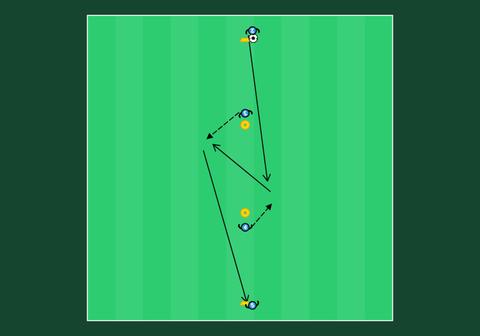
Four players in one line, 5–10 metres apart, each position marked. The ball always bypasses the nearest player. The top player plays a long ball past the first middle player to the second middle player, who has moved out to the side. This player lays the ball off one-touch back to the bypassed player, who has meanwhile moved out to the other side of the line, and the bypassed player plays a long ball to the bottom player, again past the middle player. At the far end, the middle players return to their markers and the same pattern comes back the other way, moving out to the opposite sides. The bypassed player starts moving before the long pass is played.
Passing in a line 1/3
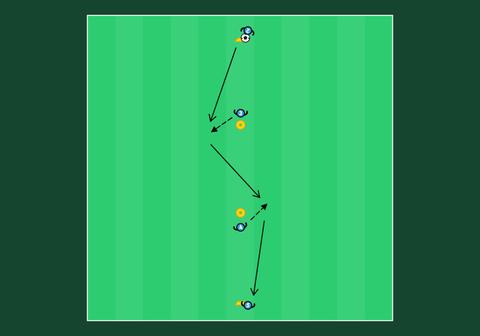
Four players in a straight line 5–10 metres apart, each position marked. The top player starts with the ball. The two middle players move away from their marker to the side of the line, on opposite sides, and receive the ball in an open body position. The ball travels through the line: the top player passes to the first middle player, who passes to the second, who passes to the bottom player. Once it reaches the end, the middle players return to their markers and the same pattern comes back the other way, but now both move out to the opposite side. Start with two touches and move to one-touch when the pattern is flowing.
Line passing 3/3
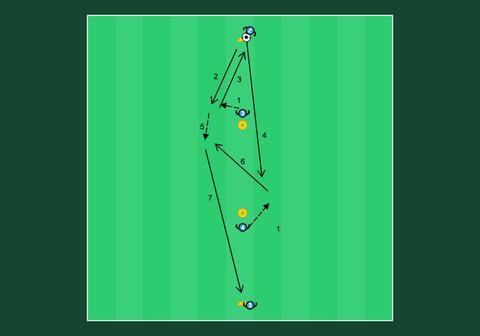
Four players in a line 10–15 metres apart, with a marker at each position. Numbers from top to bottom: two, three, four, five. Two starts with the ball. Going down: two passes to three, who returns it straight back. Two plays a long pass beyond three to four, four directs the ball to three, and three plays a long pass beyond four to five. Going up, the same as a mirror image: five passes to four, gets the return pass and plays a long pass beyond four to three. Three directs it to four, four plays a long pass back to two, and the sequence starts again. Three and four move away from the line to opposite sides just before the pass is played. This allows the long pass to travel beyond the previous player. After their own pass, they return to the line. Short passes with two touches, long passes firmly along the ground. When the pattern is flowing, tighten the short passes to one-touch.
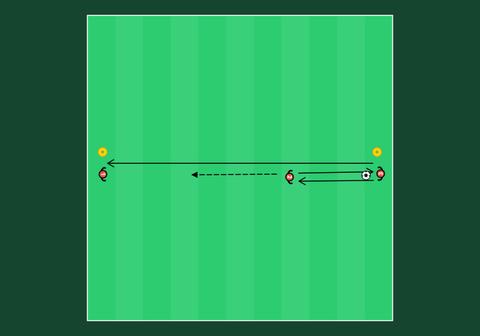
Three-player warm-up passing 3/3
Two players stand still 15–20 metres apart, with markers in front of their feet. The third works between them. One ball. The player on the right plays a short pass to the middle player, who has moved towards the ball, and the middle player returns the ball. Immediately after, the same player plays a long pass to the other end. The middle player does not stay in the passing lane but moves aside and at the same time runs to the other side. The same pattern is repeated there: short pass to the middle player, return pass, and then a long pass back. So the rotation has three passes: short pass in, return pass and long switch. The middle player's job is to get there to receive before the ball and out of the way before the long pass. Change the middle player about every minute.
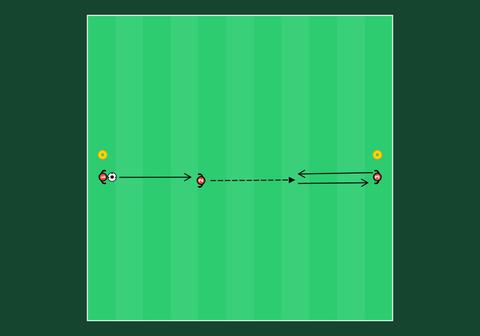
Three-player warm-up passing 2/3
Two players stand still 15–20 metres apart, with markers in front of their feet. The third works between them. One ball. The player on the left passes to the middle player, who has moved towards that side. The middle player takes the first touch towards the opposite side and passes there. The same continues alternately. Demand direction from the first touch: the ball must go where it is going next. Change the middle player about every minute.
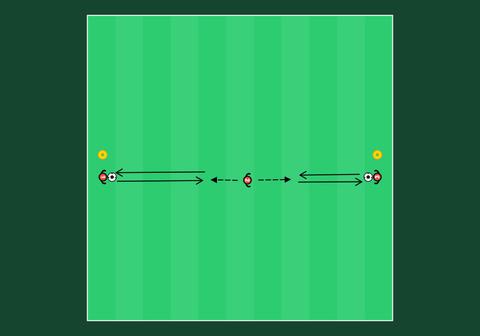
Three-player warm-up passing 1/3
Two players stand still 15–20 metres apart, each with a ball. The third works between them without a ball. The middle player moves towards the player on the right. That player makes a pass, and the middle player returns the ball straight back. He then turns, runs to the other side and does the same with the player on the left. Neither ball crosses the middle area but stays under the control of the wide player on that side. The middle player does not stay standing after the return pass but turns immediately. Change the middle player about every minute. First rounds with two touches. When the rhythm is there, return pass one-touch.
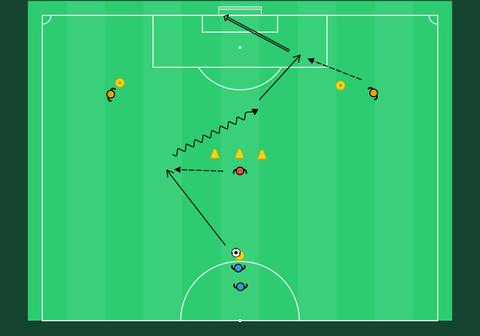
Passing, dribbling and shot from a through pass
The player in front of the cones makes a movement to either side of the line of cones and asks for the pass. The first player in the queue plays a pass and the receiver takes a short dribble towards the player positioned on the opposite diagonal and plays a through pass to them. The receiving player tries to "avoid offside" (the cones represent the deepest defenders) and finish first time from the pass.
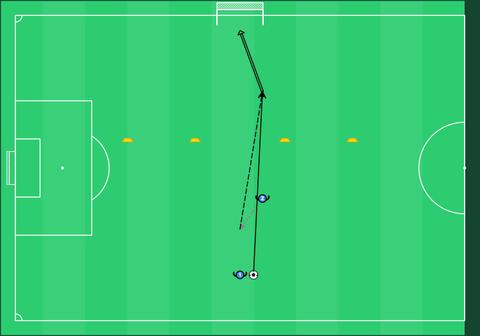
Through pass into space
The passer plays the ball in midfield, the receiver makes a run towards the ball and quickly breaks in behind. The passer plays a through pass into space behind the defensive line. The receiver runs onto the ball and finishes into the goal.
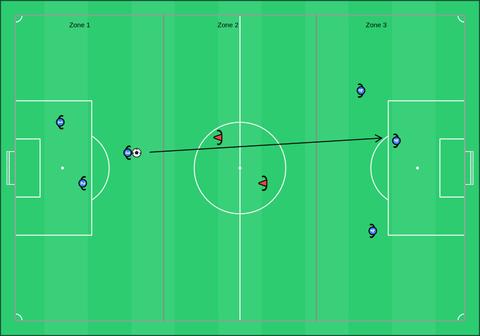
Switch of play
The pitch is divided into three vertical zones. The attacking team plays the ball in one zone and tries to switch play with a long pass into the opposite zone. The defending team tries to intercept the switch of play.
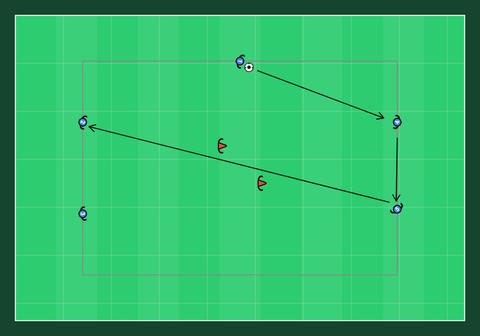
5v2 Keep-ball
Five outside players keep possession, with two defenders in the middle trying to win the ball or intercept a pass. When a defender wins the ball, the player who made the last pass and the previous passer swap into the middle. Touch limit (1–2) depending on level.
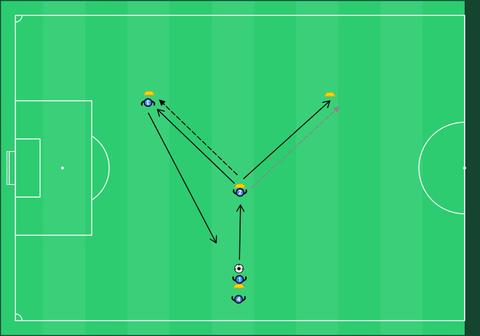
Y passing pattern
Players set up in a Y-shaped pattern at three points. The ball is played through the stem to the branch, the receiver plays a one-two or a through pass to the next point and follows the ball. The pattern is repeated into both branches alternately.
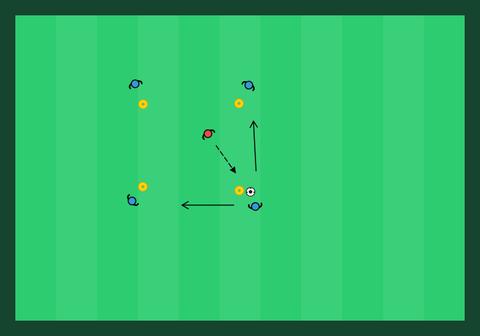
4v1 Keep-away
Four players on the corners of a square keep possession of the ball, with one defender in the middle trying to win it. When the defender wins the ball, they swap places with the player who lost possession.
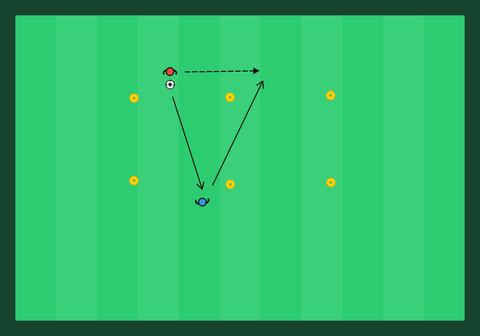
One-two in pairs
Player A plays a pass to player B and immediately moves either to the side or forwards. B returns the ball one-touch into the direction of A’s run. A controls and repeats. Change over every 2–3 minutes.
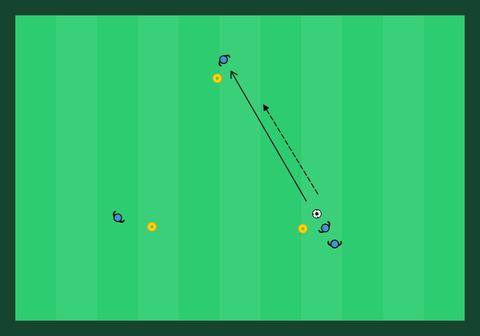
Passing Triangle
Three players form a triangle. The ball moves clockwise or anti-clockwise. After the pass, the player follows the ball and runs to the next cone.
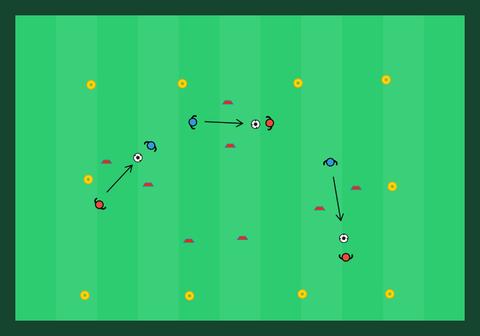
Passing gate competition in pairs
Several small gates are set up on the pitch (two cones 2 metres apart). Pairs pass the ball through the gates and count their successful passes. The gate must always be changed after a successful action. The pair that has gone through the most gates wins.