Soccer possession drills for keeping the ball as a team
Keeping the ball depends more on angles and movement off the ball than on the player in possession. Rondos such as 4v2 and 5v2 teach players to offer a passing line and move the ball quickly. Possession games with jokers give the team on the ball an overload, which makes the job easier for younger players. Bigger games give possession a purpose: switch play into the free zone, play through the middle into the end zone or keep the ball before attacking the goal. Make the area smaller or take a joker out when it gets too easy.
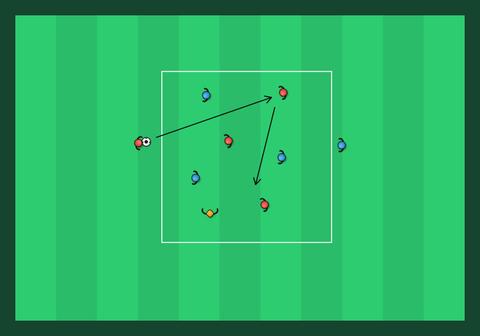
Possession game
The aim is to keep the ball in your own team's possession in a limited area. As variations, some players can be outside the area and/or there is a joker who is always on the side of the team in possession.
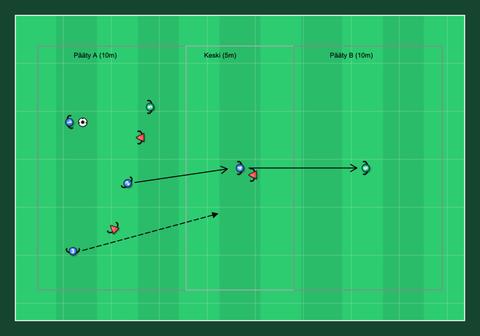
Three-zone build-up game
Two teams + 2 jokers (30×15 m, zones 10–5–10 m). Team A builds up play in the end zone (3v2 + joker) and tries to play through the pivot player in the narrow middle zone to the other end zone, where the joker receives. From the defending team, 2 press in the end zone, 1 covers the middle zone. After winning the ball, the team that won it starts the build-up from their own end zone. The pivot simulates a midfielder, the end-zone players simulate centre-backs.
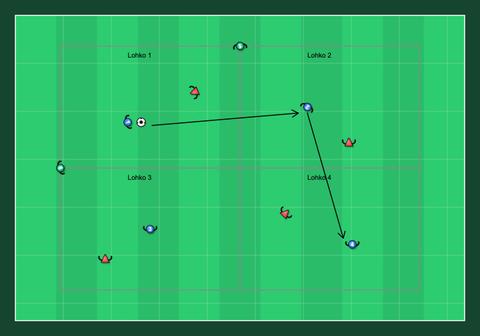
Possession square
Square-shaped area divided into four zones. Two teams (e.g. 4v4+2 jokers). The team in possession keeps the ball and tries to play into as many zones as possible. A point for each new zone the ball is played into in succession. The jokers always play with the team in possession.
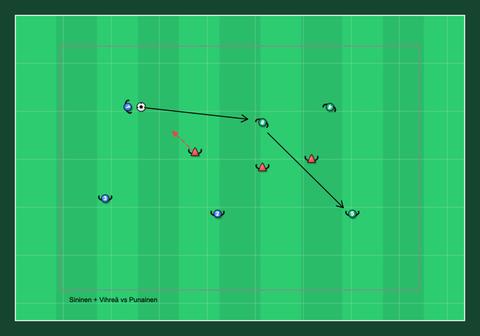
Three-team possession game
Three teams (e.g. 3×3 or 3×4). Two teams play together against the team that has lost possession. When a team loses the ball, it moves into defending and the other team joins the team in possession. Continuous transitions of roles.
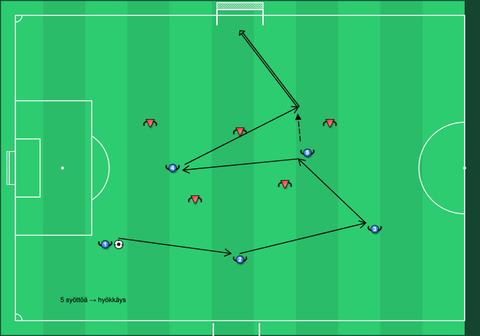
Possession to goal
Team game (e.g. 5v5+GK) on a half pitch. The team in possession keeps the ball and tries to attack the goal. Before attacking the goal, at least 5 consecutive passes are required. The defending team tries to win the ball and play a counter-attack to the other end.
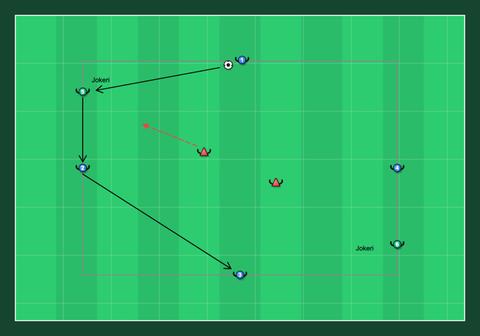
Rondo with jokers
Possession drill (e.g. 4v2) with two jokers, who always play on the side of the player on the ball. The jokers move along the edges of the area and offer extra passing options. 1–2 touch limit for the outside players, jokers on unlimited touches. The defenders try to win the ball — the player who made the last pass goes into the middle.
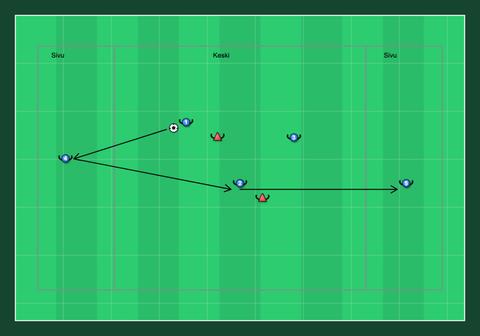
Zonal rondo
Three zones side by side (narrow-wide-narrow). The team in possession starts in the middle zone and tries to play the ball into the wide zone. The defenders try to prevent play to the side. After a successful pass to the side, the ball is played back into the middle and switched to the other side.
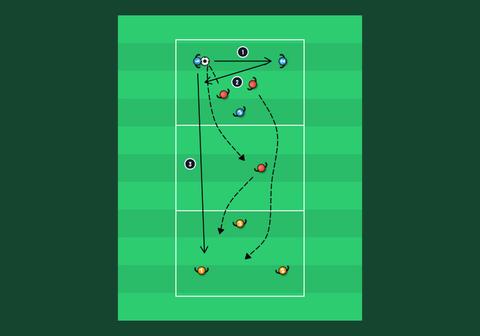
Three-zone rondo (basic)
Mark out a 15 × 30 metre area and divide it into three 10-metre zones. Place a team of three players in each zone. The end teams keep possession and try to play the ball over the central zone to the other end. From the middle team, two players win the ball in the end zone where the ball is, and one stays in the middle to cut out long passes. When the ball switches ends, two players from the middle team run across after it. If the middle team wins the ball or the ball goes out, the team that lost possession moves into the middle and the winning team takes that end zone. Each successful pass from one end zone to the other is a point.
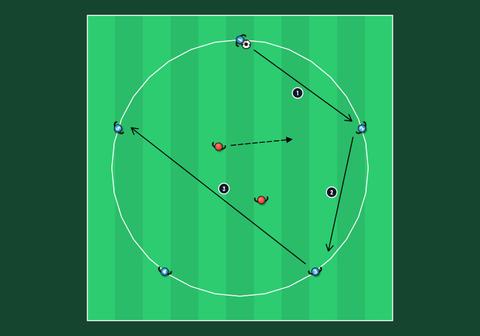
5v2 rondo
Mark out a circle of about 12 metres. Five players set up evenly spaced around the outside, and two defenders go in the middle. The players around the outside pass to each other and move around the circle, but they must not go inside it. When there is a gap between the defenders, the ball is played through it. The player who loses possession goes into the middle, and the defender who has been in the middle longer moves out to take that player's place on the outside. The same rotation is made when the ball goes out of the circle. A point is scored for ten consecutive passes. Limit touches to one-touch or two touches according to level.
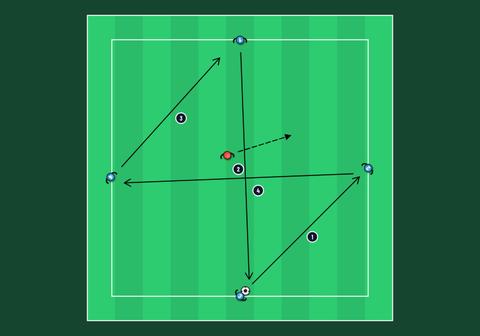
4v1 rondo
Mark out a square of approximately 10 x 10 metres. Four players are on the sides of the square, one on each side, with a defender in the middle. The players on the outside keep possession of the ball. They may move along their own side, but must not go inside the square. The defender tries to intercept the pass. When the defender wins the ball or the ball goes out of the square, the defender swaps places with the player who lost possession. Play restarts immediately. Ten consecutive passes equals one point. Make it easier with a bigger square or unlimited touches, and harder with a smaller square or a two-touch limit.
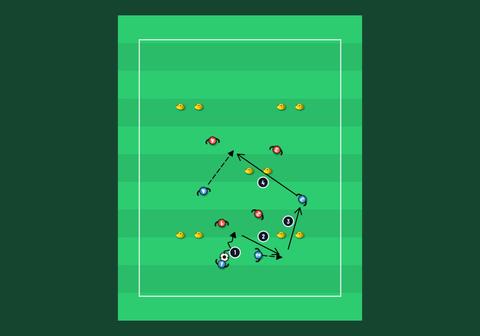
Gate passing game: move away from the ball
When teammates come next to the player on the ball, one defender can cover two of them. In this game, you only score from a pass through a gate to a teammate, so someone has to move away from the ball to the other side of the gate. The animation first shows the usual mistake and then the correct way. Area about 22 × 28 m. Spread five two-metre gates around the area. 4v4 with no goals. A point is scored when the ball is passed through any gate to a teammate who controls it on the other side of the gate. You cannot score two consecutive points through the same gate. Defenders can defend everywhere, and the team that loses possession defends immediately.
Four corners pass-and-move game
Many players make a pass and then just stand and watch the ball. In this game, you do not score points by standing still. The passer must move into a new space, and you can only arrive in the square by timing the run. The animation first shows the typical mistake and then the correct way. Area 20 × 25 m, with a 5 × 5 m square in each corner. Two teams and a joker, who always plays with the team in possession. The diagram shows 2v2 and a joker, so the attackers have 3v2 numerical superiority. With a bigger group, for example 4v4 and a joker. The attacking team scores a point by passing to a player who has run into a square. The joker does not score points. You cannot wait in the square. You only move there when the pass is coming, and after a point the ball is brought straight back out. When the defenders win the ball, the roles switch and the joker changes sides.
Ball tag
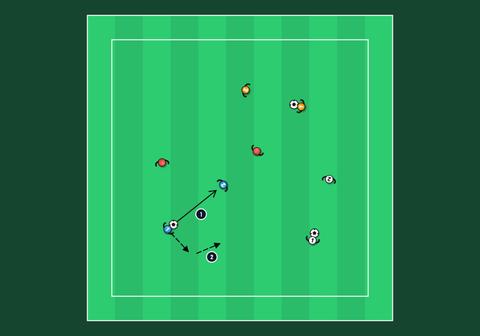
Many players make a pass and then just watch the ball. In tag, that is punished straight away: the ball must be moved on before the tagger gets there, and it can only be passed to a teammate who has moved into space. The animation first shows the usual mistake and then the correct way. Area approximately 23 × 23 m. Four teams, three of which have a ball. The fourth team are the taggers. A tagger may only touch the player with the ball. The teams help each other by passing and moving so that nobody gets caught. A caught player is freed by a high five from a teammate. In the picture, the teams are in pairs, and there are two taggers. Easier: play with hands by throwing and catching, and have fewer taggers. Harder: add more taggers.
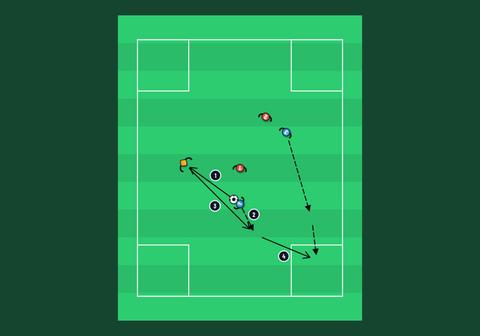
Playing out from a goal kick 3v2
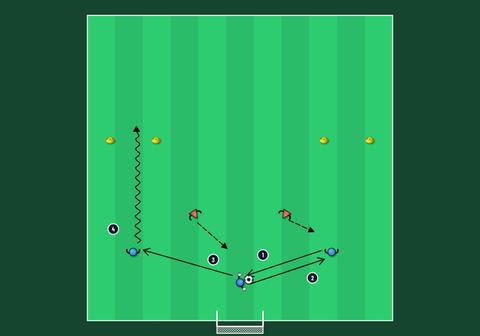
Practise the goal kick in an 8v8 game, where play is started with short passes. The goalkeeper and two centre-backs play against two players pressing. The centre-backs spread out wide level with the corners of the penalty area, and the goalkeeper kicks the ball from the ground to the one who is free. The blue team scores a point when they pass or dribble the ball through the wide gate about 24 metres from the goal line. The reds try to win the ball and score a goal. When the player pressing closes down the centre-back, the centre-back passes the ball back to the goalkeeper, and the goalkeeper switches play to the other side. Start without players pressing, then add one and finally two. In 8v8 for 10-11-year-olds, a goal kick may be taken from the ground anywhere in the penalty area, and the opponent does not have to retreat: it is enough to be 5.5 metres from the ball. The players pressing may therefore stand just as close in the drill as in a match.
End zone game, target players in the end zones
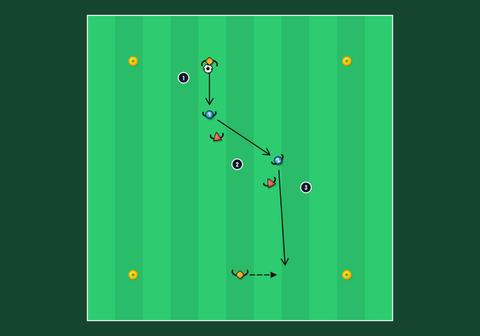
Six players in three pairs in an empty area. No goals. One pair are the target players, one in each end zone, and they move only along their own end line. The other two pairs play 2v2 in the middle. A point is scored when the ball is dribbled from one end to the other, meaning from one target player to the other. After a successful pass, the same team continues with the ball in the opposite direction. The defending pair try to close the passing lane to the target player and win the ball. After winning the ball, the pair who won it can attack either end zone, but a point always requires the full distance: the ball must go from one target player to the other. In practice, the pair who won it start from the nearest end zone. Three minutes at a time, then the pairs rotate positions.
End zone game with changing direction
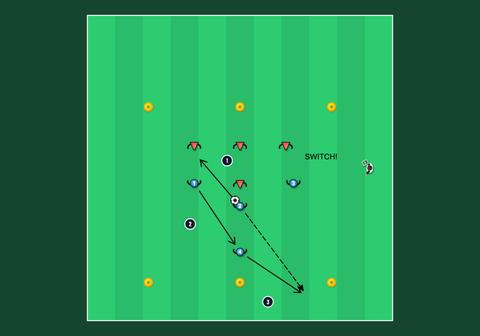
4v4 with an empty area, with end zones marked by cones at both ends. No goals. A point is scored when a player from your team receives a pass in the end zone. The coach calls for a change of direction during play, and the attacking direction switches from that moment. The defending team have just compacted towards the wrong end, so the space is behind them; this must be seen and used before they have time to turn. Playing time 3-4 minutes at a time, with several calls in each block.
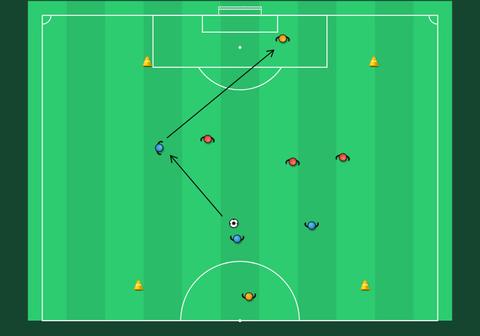
End zone game
3v3 end zone game with two jokers. The jokers play in the end zones with the team in possession. The jokers can join the attack, creating temporary numerical superiority. A goal is scored when a player receives a pass in the end zone
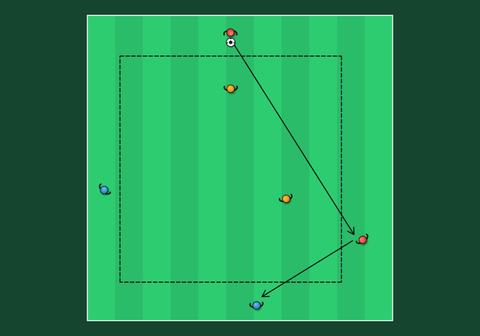
4v2 rondo
Mark out a square area and make three pairs of two players. Two pairs are on the outside on the edges, giving four passers in total, with one on each side. One pair is inside the area trying to win the ball. The players on the outside keep possession from side to side. The players winning the ball split the work: one presses the player on the ball, the other blocks the next passing lane. When they win the ball, the pairs swap places and play continues immediately without a restart. Adjust the size of the square to suit the level. A smaller square shortens the passes and forces quicker touches.
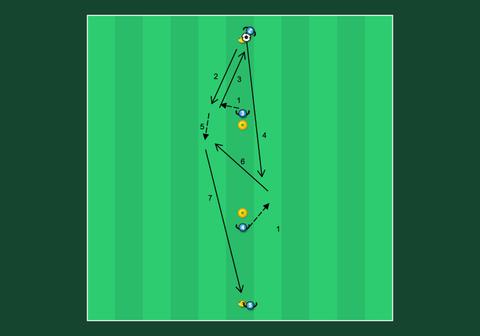
Line passing 3/3
Four players in a line 10–15 metres apart, with a marker at each position. Numbers from top to bottom: two, three, four, five. Two starts with the ball. Going down: two passes to three, who returns it straight back. Two plays a long pass beyond three to four, four directs the ball to three, and three plays a long pass beyond four to five. Going up, the same as a mirror image: five passes to four, gets the return pass and plays a long pass beyond four to three. Three directs it to four, four plays a long pass back to two, and the sequence starts again. Three and four move away from the line to opposite sides just before the pass is played. This allows the long pass to travel beyond the previous player. After their own pass, they return to the line. Short passes with two touches, long passes firmly along the ground. When the pattern is flowing, tighten the short passes to one-touch.
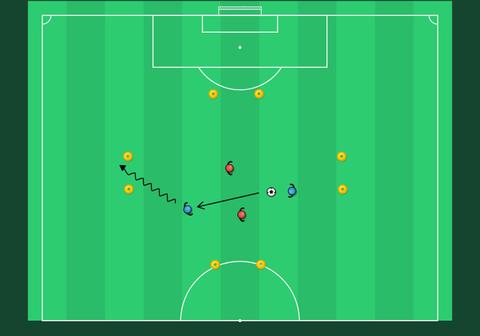
2v2 to four goals
2v2 in a small area, with four cone goals on the edges of the pitch. A goal is scored by dribbling the ball through any pair of cones. Because there are goals in every direction, the player on the ball must constantly turn and shield the ball to find an open goal.