Small-sided games for soccer
Small-sided games fit the whole of football into a smaller space, with fewer players but more touches and more decisions. A 3v3 or 4v4 on a short pitch gives every player the ball more often than a full-size match. The coach steers the session with the rules: a touch limit, two goals each, a bonus point for a switch of play. Change the size of the pitch to make the game easier or harder. Use small-sided games as the main part of a session or to finish it, and open any game here on the board to set your own rules.
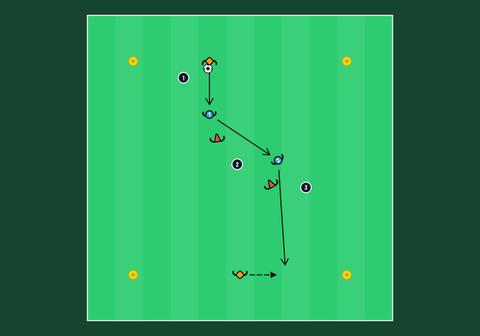
End zone game, target players in the end zones
Six players in three pairs in an empty area. No goals. One pair are the target players, one in each end zone, and they move only along their own end line. The other two pairs play 2v2 in the middle. A point is scored when the ball is dribbled from one end to the other, meaning from one target player to the other. After a successful pass, the same team continues with the ball in the opposite direction. The defending pair try to close the passing lane to the target player and win the ball. After winning the ball, the pair who won it can attack either end zone, but a point always requires the full distance: the ball must go from one target player to the other. In practice, the pair who won it start from the nearest end zone. Three minutes at a time, then the pairs rotate positions.
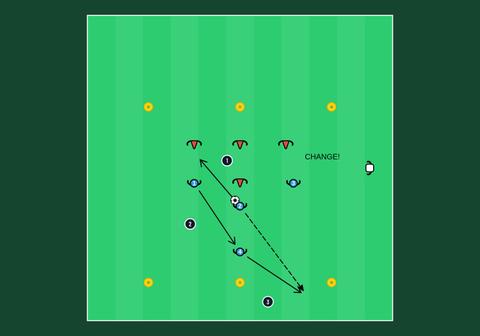
End zone game with changing direction
4v4 with an empty area, with end zones marked by cones at both ends. No goals. A point is scored when a player from your team receives a pass in the end zone. The coach calls for a change of direction during play, and the attacking direction switches from that moment. The defending team have just compacted towards the wrong end, so the space is behind them; this must be seen and used before they have time to turn. Playing time 3-4 minutes at a time, with several calls in each block.
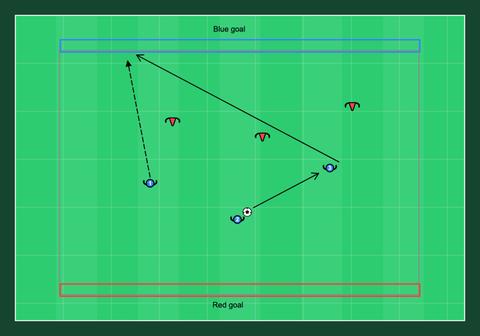
3v3 line game
3v3 game without goals. A goal is scored when a team manages to stop the ball behind the opponent’s end line. The receiver must get the ball under control behind the line; simply kicking it over the line is not enough. Teaches attacking and defending in depth.
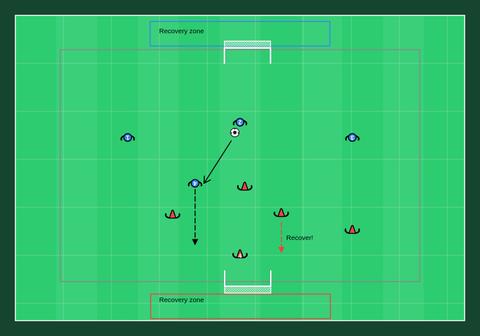
4v4 recovery zone game
4v4 game with two goals. Each team has its own "recovery zone" behind the goal. When a team loses possession, one player must go into the recovery zone before they can take part in defending. This creates temporary numerical superiority for the attacking team and forces a quick transition.
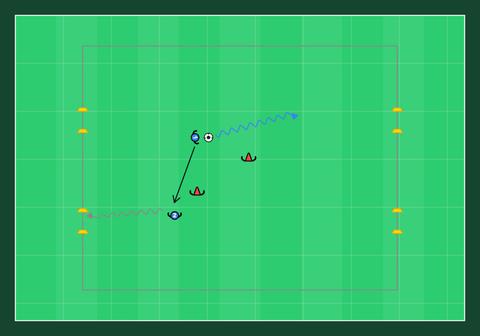
2v2 gate game
2v2 game in a small area, where both teams have 2 cone gates to defend on opposite sides. A goal is scored by dribbling the ball through a gate. A fast and intense small-sided game where every duel matters. Short games (90 seconds), pairs rotate.
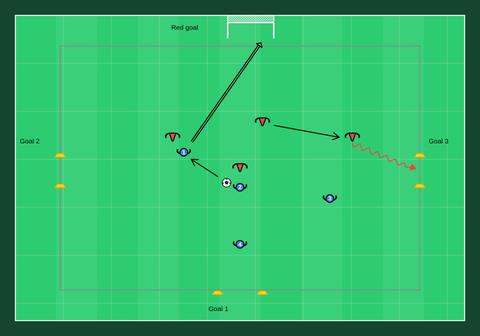
4v4 three goals
4v4 game in which one team has one standard goal and the other has three small cone goals in different parts of the pitch. The one-goal team attacks directly, while the three-goal team looks for the open goal. Roles change regularly.
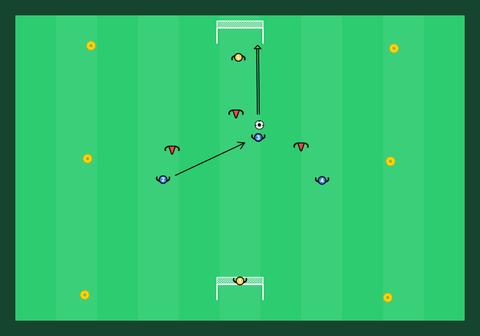
3v3 with goalkeepers
3v3 game with normal small goals and a goalkeeper. A full match situation in a small area: attacking, defending, finishing and goalkeeping. Short games (3–4 min), scoring and a tournament format keep the intensity high. The coach focuses on one theme at a time.
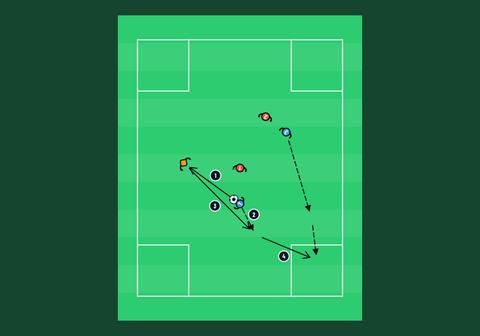
Corner square game: pass and move
Many players make a pass and then just stand and watch the ball. In this game, you do not score points by standing still. The passer must move into a new space, and you can only arrive in the square by timing the run. The animation first shows the typical mistake and then the correct way. Area 20 × 25 m, with a 5 × 5 m square in each corner. Two teams and a joker, who always plays with the team in possession. The diagram shows 2v2 and a joker, so the attackers have 3v2 numerical superiority. With a bigger group, for example 4v4 and a joker. The attacking team scores a point by passing to a player who has run into a square. The joker does not score points. You cannot wait in the square. You only move there when the pass is coming, and after a point the ball is brought straight back out. When the defenders win the ball, the roles switch and the joker changes sides.
2v2 with a cover line
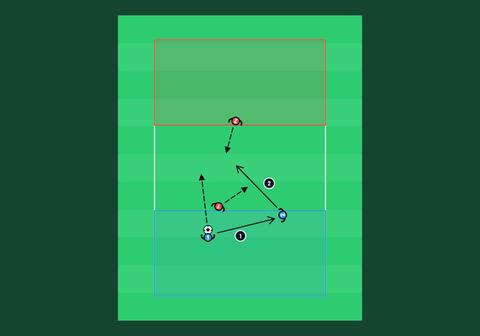
Two pairs play 2v2 in an area of approximately 16 × 24 metres. At each end there is an end line and a cover line eight metres in front of it. A pair scores a point when they dribble the ball over the opponent’s end line or pass to a teammate who controls it behind the line. The second player in the defending pair must be on or behind their own cover line. One presses the player on the ball, the other provides cover. They must not both go to the ball. The covering player may step off the line when they intercept a pass or win the ball from an attacker who has beaten the presser. In that case, the other defender immediately runs back behind the line. In the diagram, Red 1 presses the player on the ball from the inside and shows them wide. Red 2 is on the line diagonally behind on the inside. When Blue passes across to the other side, Red 1 shifts to press the new player on the ball while the ball is travelling, and Red 2 slides along the line to stay behind them. The pair move together. Blue 1 makes a run in behind the presser, but Red 2 reads the pass and intercepts it. After winning the ball, the Reds attack the Blues’ end line immediately. The nearest Blue presses, and the other runs behind their own cover line. Now the Blues defend in the same way. When Blue 1 wins the ball wide, only Red 2 gets back to the line in time. The Blues play a 2v1. Blue 1 draws Red 2 in and passes into the run of Blue 2, who dribbles the ball over the end line. Play 1–2 minute blocks. If there are more than four players, set up several pitches side by side or rotate pairs between blocks.
5v5 goal-dribbling game
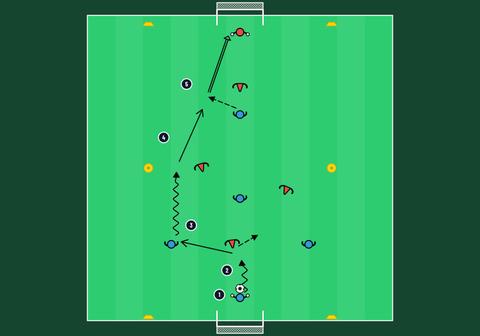
5v5 game in which the team practises building play with a goal-dribble. When the ball goes over the end line, the defending team restarts by dribbling from any point in their own penalty area. The opponent may wait 5.5 metres from the ball. The player on the ball can carry the ball forwards or pass to a free player. In the example, the presser goes towards the goalkeeper, so the goalkeeper passes to the free player on the left. This player dribbles down the flank and passes to the attacker, who shoots. If an attack that starts from a goal-dribble ends in a goal, it is worth two points. All other goals are worth one. Play short blocks and rotate the teams often. According to the Football Association of Finland rules, 8- and 9-year-olds restart 5v5 by dribbling. In matches for seven-year-olds and younger, the opponent drops back to halfway for the goal-dribble and only defends once play has restarted.
End zone game
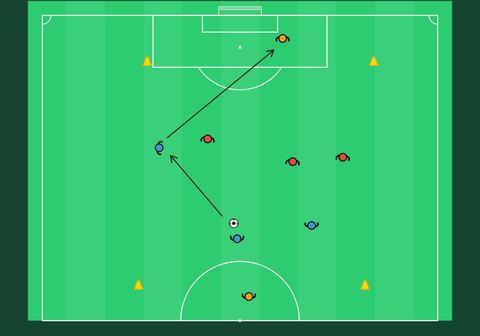
3v3 end zone game with two jokers. The jokers play in the end zones with the team in possession. The jokers can join the attack, creating temporary numerical superiority. A goal is scored when a player receives a pass in the end zone
Possession game
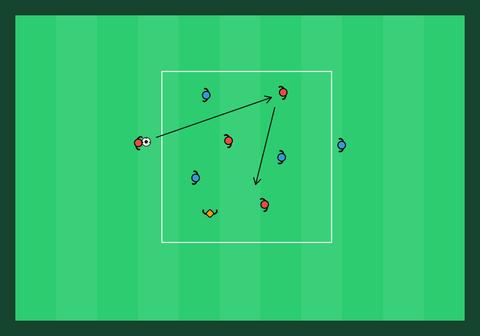
The aim is to keep the ball in your own team's possession in a limited area. As variations, some players can be outside the area and/or there is a joker who is always on the side of the team in possession.
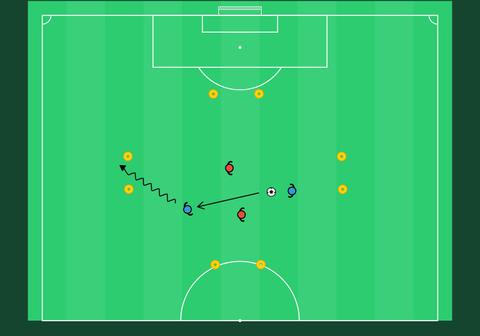
2v2 to four goals
2v2 in a small area, with four cone goals on the edges of the pitch. A goal is scored by dribbling the ball through any pair of cones. Because there are goals in every direction, the player on the ball must constantly turn and shield the ball to find an open goal.
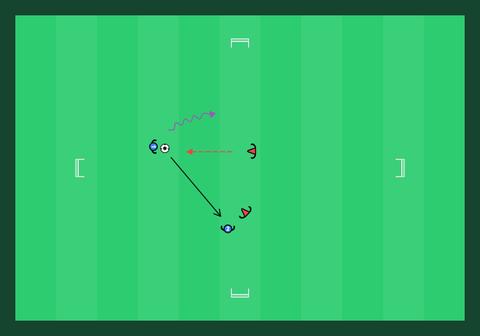
2v2/3v3 with small goals
2v2 or 3v3 small-sided game with small goals and no goalkeeper. When the team loses possession, transition immediately into defending: the first defender presses the player on the ball, the second covers and the third provides balance.
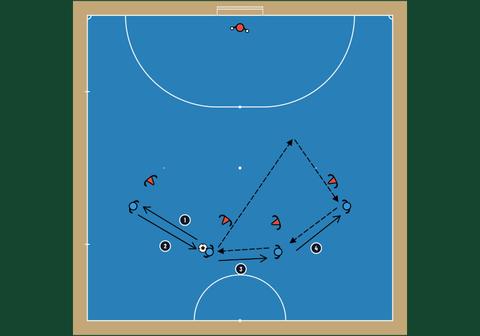
Four-player rotation in futsal (4-0)
Four attackers set up in a wide line without a fixed pivot. Each is marked by their own defender, and there is a goalkeeper in goal. A pass is played from the middle out wide, and the player who made the pass immediately makes a diagonal run towards goal. The marker follows, leaving an empty space in the middle. The other central player and the right wide player each move one position to the left, so the player on the ball has a safe pass nearby. The wide player plays the ball back into the filled space, the ball continues to the right, and the player who made the run becomes the new right wide player. Everyone has moved one position. The same is repeated in the other direction when the right central player passes to the right flank and makes a run. The others then move one position to the right. If the marker stays in place, the runner receives the ball directly and shoots. Play towards one goal in a realistic game situation. When the defenders win the ball, they try to dribble it over the halfway line. Make the game harder with a bib. The attacker wearing the bib is not allowed to receive the ball, and their task is to create space for the others. Change the bib to a different player every few minutes.