How to keep 20 players active in one training session
20 players on the pitch, one ball. In a queue-based drill, 18 players stand and wait for their turn. An Australian study found that in typical youth football sessions, players are inactive for 31% of training time — with an additional 6% lost to transitions between activities [1]. A third of the session goes to waste.
The drill design is the problem. This article shows how to keep 20 players moving throughout the session, backed by research.
Why ball contacts matter
More ball contacts mean faster skill development. And the smaller the game format, the more each player touches the ball.
| Game format | Actions / player / min | Source |
|---|---|---|
| 4v4 | 5.59 | Brandes et al. [2] |
| 7v7 | 2.78 | Brandes et al. [2] |
| 4v4 vs 8v8 | 3x more ball contacts | Jones & Drust [3] |
The interesting part is who benefits most. Brandes et al. found that weaker players increased their actions by 143% when moving from 7v7 to 4v4. Stronger players improved by 72% [2]. Players who tend to be bypassed in larger games get the biggest increase in ball contacts.
Three principles: shrink, split, own ball
1. Shrink the game format
A systematic review (Hill-Haas et al., 2011) showed that teams of 3–4 players produce the best results both physiologically and technically [4]. Katis and Kellis (2009) confirmed: 3v3 produced significantly more short passes, kicks, tackles, dribbles, and goals than 6v6 [5].
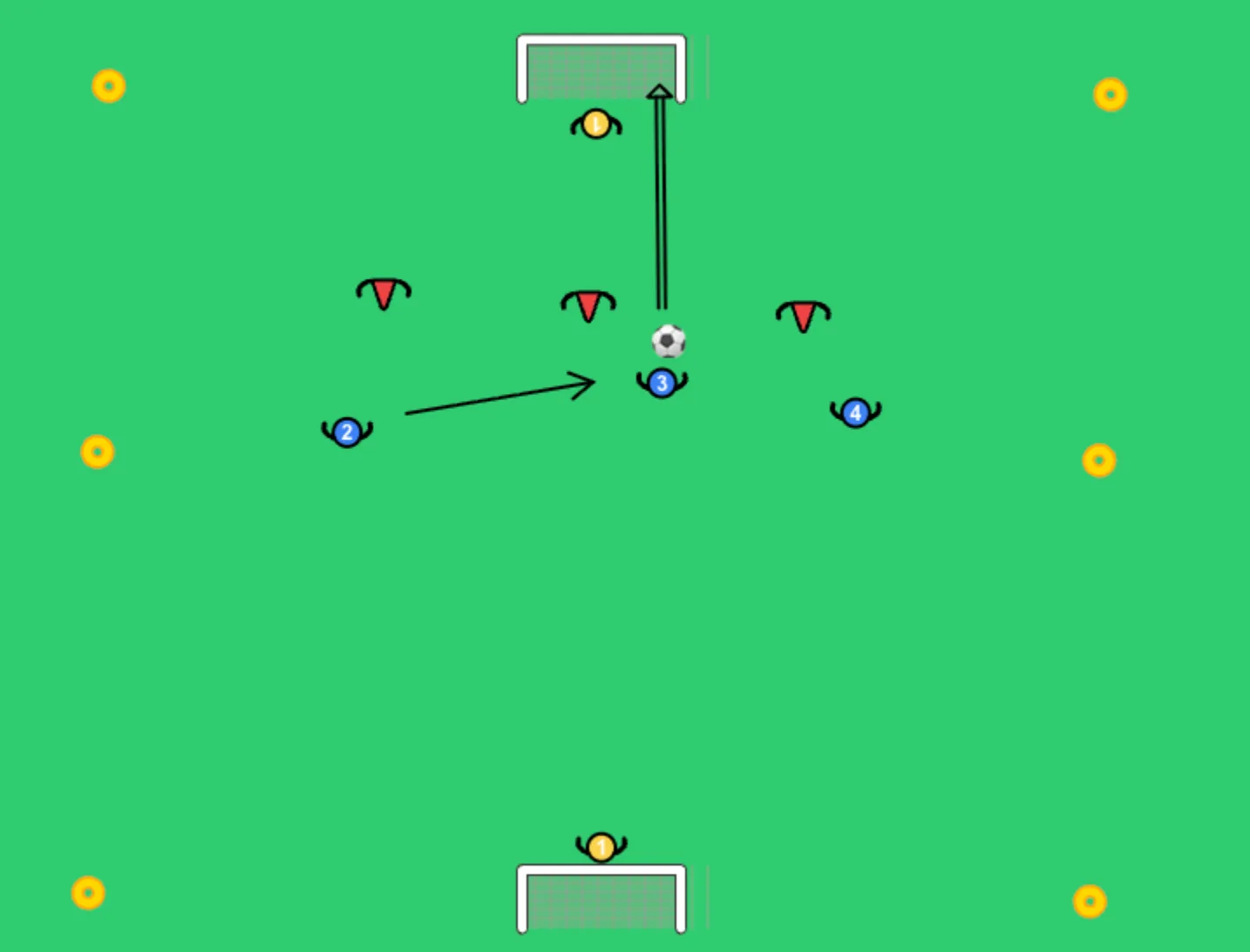
Split 20 players into multiple small-sided games and nearly everyone plays the whole time.
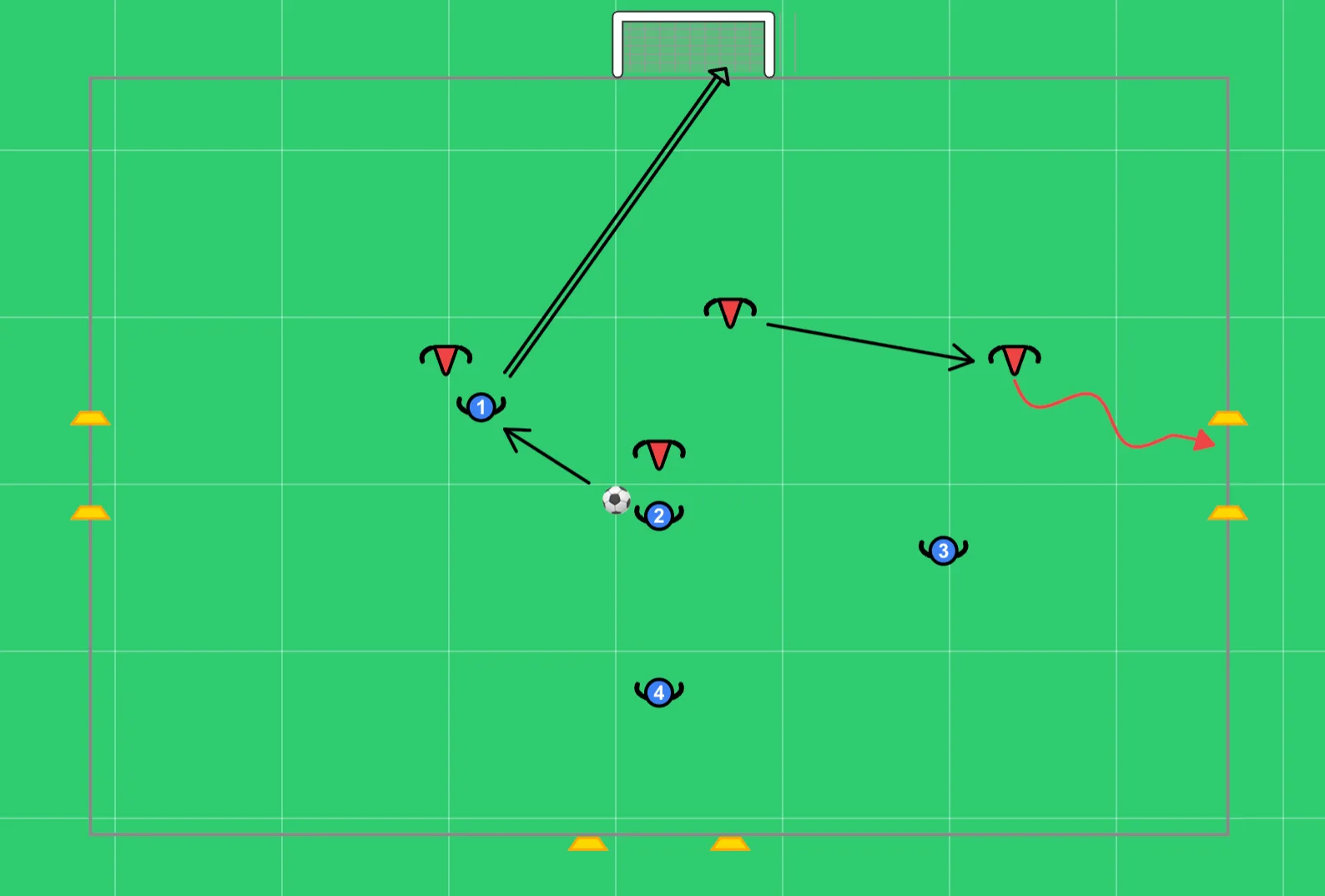
2. Split into stations
Station-based training (carousel) divides the group into 3–4 stations, each working on a different drill under the same theme. The England FA recommends this structure especially for large groups [6].
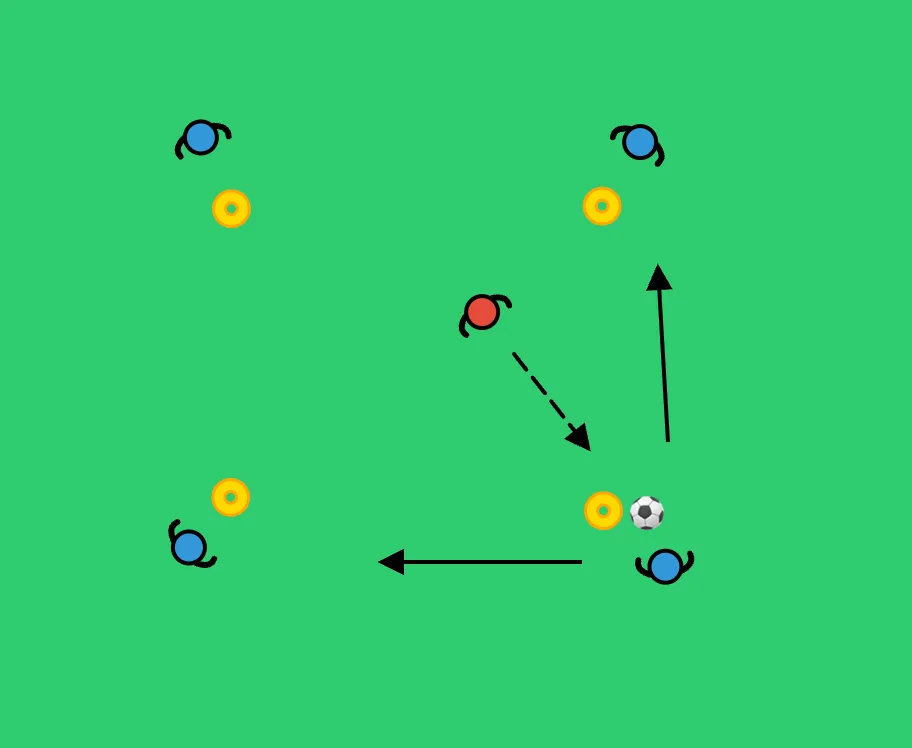
Example with the theme "passing under pressure":
- Station 1: Rondo 4v1 (5 players)
- Station 2: Y-passing pattern (5 players)
- Station 3: Small-sided games 2v2+1 neutral, with goals (5 players)
- Station 4: Build-up play 2v2+1 neutral on half pitch (5 players)
Rotate every 6–8 minutes. Every player does every drill. Nobody stands around.
3. Own ball for everyone
During warm-up, give every player their own ball. This guarantees 100% participation from the first minute. Dribbling, turns, shielding — everything starts without waiting.
The 30-second rule
A practical rule of thumb: no player should wait more than 30 seconds before being active again. When the wait stretches to 2–3 minutes, players lose focus and the learning benefit disappears.
Finnish FA observations support this: 40% of children's sessions included so much standing that active time didn't exceed 60% [7]. Even in professional academies, the average active time reaches only 63% — below the 70% target [8].
Example session: 20 players, 75 minutes
Theme: passing and receiving on the move.
| Phase | Duration | Structure | Players |
|---|---|---|---|
| Warm-up | 10 min | Ball each: dribbling, turns, passing pairs | 20 (all moving) |
| Station work | 30 min | 4 stations, rotate every 7 min | 5 per station |
| Small-sided games | 25 min | 2 × 4v4, subs rotate in | 4 per team |
| Final game | 10 min | 2 × 5v5 with theme-based rules | 10 per pitch |
In this structure, every player is active throughout the session. No queues. No waiting.
You need enough coaches
Four stations don't run with one coach. If you split 20 players into four groups, you need at least two adults — ideally three or four. With younger players, the need is even greater.
The England FA follows NSPCC guidelines for coach-to-player ratios [9]:
| Age group | Ratio |
|---|---|
| 4–8 years | 1 adult per 6 children |
| 9–12 years | 1 adult per 8 children |
| 13–18 years | 1 adult per 10 children |
In practice, a U10 group of 20 players should have at least 3 coaches. Station-based training is exactly the situation where the ratio matters — one coach cannot supervise four stations simultaneously.
If you only have one or two coaches, reduce the number of stations and use drills that run without constant supervision (rondos, small-sided games with clear rules). Be easy on yourself when resources don't stretch to the ideal setup. At grassroots level, small improvements like increasing ball contacts and reducing standing around are already significant steps in the right direction.
Transition time — the hidden loss
O'Connor et al. (2018) found that 5.8% of training time goes to transitions between activities alone [1]. In a 90-minute session, that's over 5 minutes. Small things matter:
- Mark out stations before the session starts
- Use colour-coded bibs to speed up team splits
- Keep instructions short — under 30 seconds per explanation
- Design sessions so the pitch doesn't need rebuilding between phases
Summary of the numbers
- Reducing player numbers from 8–11 to 3–4 doubles or triples ball contacts per player [2][3]
- Weaker players benefit the most — +143% more actions in 4v4 vs 7v7 [2]
- Small-sided game intensity is equal to or higher than full-sized matches [4]
- 31% of typical training time is lost to inactivity [1] — good planning prevents this
Sources
- O'Connor, Larkin & Williams (2018): "Observations of youth football training" — Journal of Sports Sciences
- Brandes, Heitmann & Muller (2012), reported in PLOS ONE (2021): 4v4 vs 7v7 actions per player
- Jones & Drust (2007): "Physiological and technical demands of 4v4 and 8v8" — Kinesiology
- Hill-Haas, Dawson, Impellizzeri & Coutts (2011): "Physiology of small-sided games" — Sports Medicine
- Katis & Kellis (2009): "Effects of small-sided games on physical conditioning and performance" — Journal of Sports Science & Medicine
- England FA (2024): "How to Design Football Practices"
- Finnish FA (2022): "Finnish youth football sessions observed 2022"
- Alder, McRobert, Champ, Causer & Andrew (2025): "Practice activities in a professional female soccer academy" — International Journal of Sports Science & Coaching
- The FA / NSPCC (2024): "Ratios of Adults to Children" — FA Safeguarding Guidelines, Section 5.5