Football practice planning - a guide for coaches
The Finnish FA observed 305 youth team practices and found that in 40% of sessions, players were active for less than 60% of the time [1]. Over a season, the difference between a well-planned and poorly planned session adds up to hundreds of hours of lost activity.
This guide covers session structure, age-group recommendations, and season planning fundamentals.
Part 1: Session structure
Session structure (under-10s)
A children's coaching blog published by the Finnish FA outlines an under-10 structure where the on-pitch portion lasts 60 minutes (adjustable to 90 minutes), preceded and followed by 15 minutes of supplementary work [2]:
| Phase | Duration | Content |
|---|---|---|
| Pre-training | 15 min | Skill and coordination work with the ball |
| 1. Football game / competition | 10 min | Game-based start, speed work |
| 2. Technical-tactical theme | 15 min | Technical work aligned with the session theme |
| 3. 1v1 and 2v2 games | 15 min | Small-sided situations under pressure |
| 4. Larger game | 20 min | 3v3 or 4v4, reduced coach interventions |
| Post-training | 15 min | Skill work with varied equipment |
The Finnish FA research found that session planning and organisation are the biggest factors in how much players move and how many ball contacts they get [1].
England FA's three approaches
England FA identifies three common ways to structure a session [3]:
1. Whole-Part-Whole
Start with a game, isolate one skill for practice, return to the game. Players understand the skill's relevance in a match context.
2. Carousel (station-based)
3-4 stations, each practicing a different skill within the same theme. Finish with a game where skills are applied.
3. Up the Steps
Start with individual exercises, progress to small games (2v2, 3v3), finish with a larger game. According to the England FA, this is "arguably the most commonly used session structure" [4].
The England FA's three Rs principle: a drill should be Realistic (game-like), Relevant (age-appropriate), and provide sufficient Repetition [3].
Research: how is time distributed?
A peer-reviewed study (Larkin et al., 2022) analysed training time usage [5]:
- Drill-based activities: 20-72% of time
- Game-based activities: 28-62% of time
- Passive time (listening): 17-37% of time
Researchers recommend minimising passive time: short instructions, fewer "freeze" stoppages, more coaching during play.
Part 2: Age-group recommendations
| Age group | Duration / session | Sessions / week | Main focus |
|---|---|---|---|
| U7-U9 | 30-60 min | 1-2 | Fun, basic motor skills, play |
| U10-U11 | 60 min | 2-3 | Fundamental skills, coordination |
| U12-U14 | 60-90 min | 3-4 | Individual technique, game understanding |
| U15-U16 | 90 min | 4-5 | Tactics, physical preparation |
U7-U9: The fun phase
- Fun is the only metric - if the player enjoys it, they'll come back
- Varied physical activity, not just football
- No early specialisation - football is a late-specialisation sport [6]
- Small-sided formats: 1v1-5v5
U10-U12: The golden age of learning
- The best window for skill development before the growth spurt [6]
- Introduction of warm-ups and mental preparation
- Technical and tactical training increases
- 7v7 game format
U13-U15: Accelerated development
- The body is physiologically receptive to training stimuli
- Building an aerobic base, developing speed and strength
- Deepening sport-specific skills and tactics
- 9v9 transitioning to 11v11
Part 3: Season planning (periodisation)
Why create a season plan?
Without planning, the same sessions repeat week after week with no development arc. Periodisation ensures training progresses purposefully [7][8].
| Level | Duration | Content |
|---|---|---|
| Annual plan | 12 months | Overall season structure and goals |
| Macrocycle | ~3 months | Season phase (preparation, competition, transition) |
| Mesocycle | 2-4 weeks | Theme block (e.g. "defending") |
| Microcycle | 1 week | Individual session planning |
Season phases
1. Preparation period (general + sport-specific)
Physical base fitness and technique refinement. Building the team's playing style.
2. Competition period
Training supports match rhythm. Weekly cycle structured around match day.
3. Transition period
Recovery and active rest. Varied physical activity without pressure.
Weekly cycle model during competition period
If the match is on Saturday, the week can be structured like this [9][10]:
| Day | Content | Load |
|---|---|---|
| Sun | Recovery / off | Low |
| Mon | Light recovery session | Low |
| Tue | Physical session, endurance | High |
| Wed | Tactical session, game format | Medium-high |
| Thu | Speed and sharpness | Medium-high |
| Fri | Activation, team tactics | Low |
| Sat - Match | High |
Part 4: Communicating sessions to players
Why words alone aren't enough
When a player sees a diagram, they understand their role, position, and the team's plan faster than from a verbal explanation alone.
Richard Mayer's multimedia learning theory (1997) supports this: people learn best when words and images are presented together [11]:
- Information is processed both visually and verbally (dual channel)
- Too much information on one channel causes overload (limited working memory)
- The learner builds their own understanding (active processing)
In practice: show the diagram and explain at the same time. Don't explain for 3 minutes and then show the diagram separately.
Part 5: Practical planning tips
Planning checklist
Before every session, make sure:
- The session has one clear theme (e.g. "passing under pressure")
- Structure follows a progression: easy to hard, individual to game
- Every player moves throughout the entire session - no queues
- The session suits the age group (duration, difficulty, pitch size)
- You know in advance how to make a drill harder or easier
- The assistant coach knows the plan
Example drills
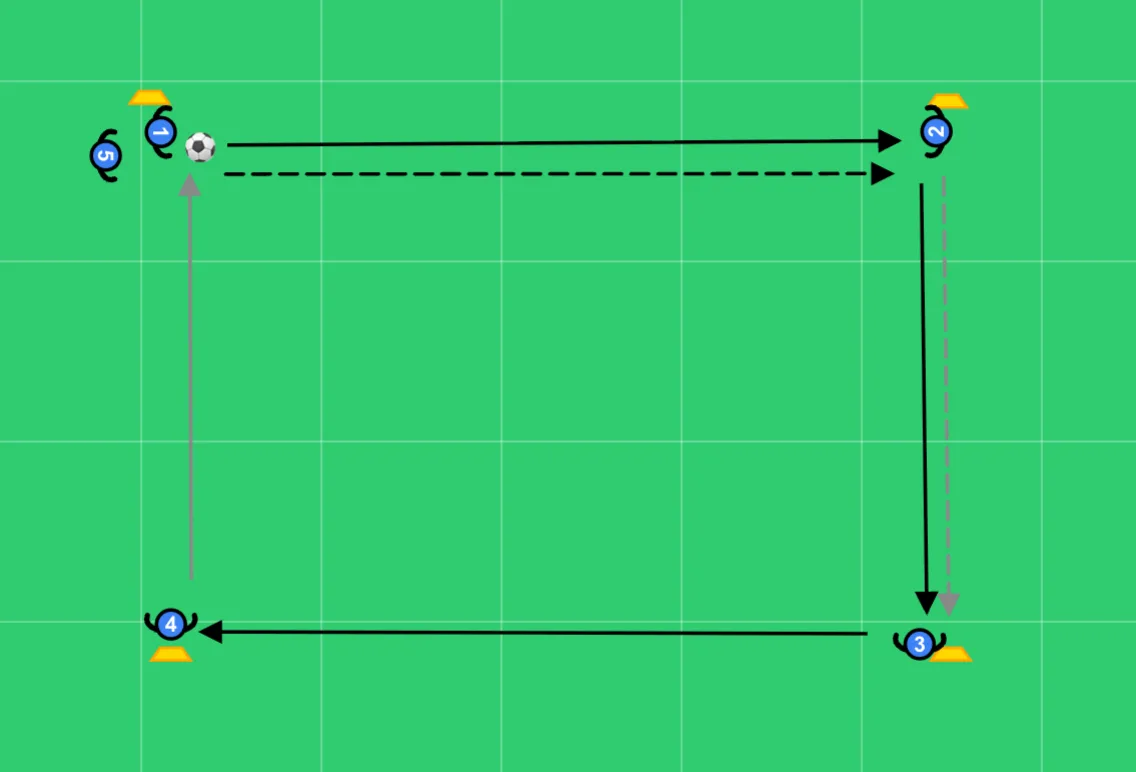
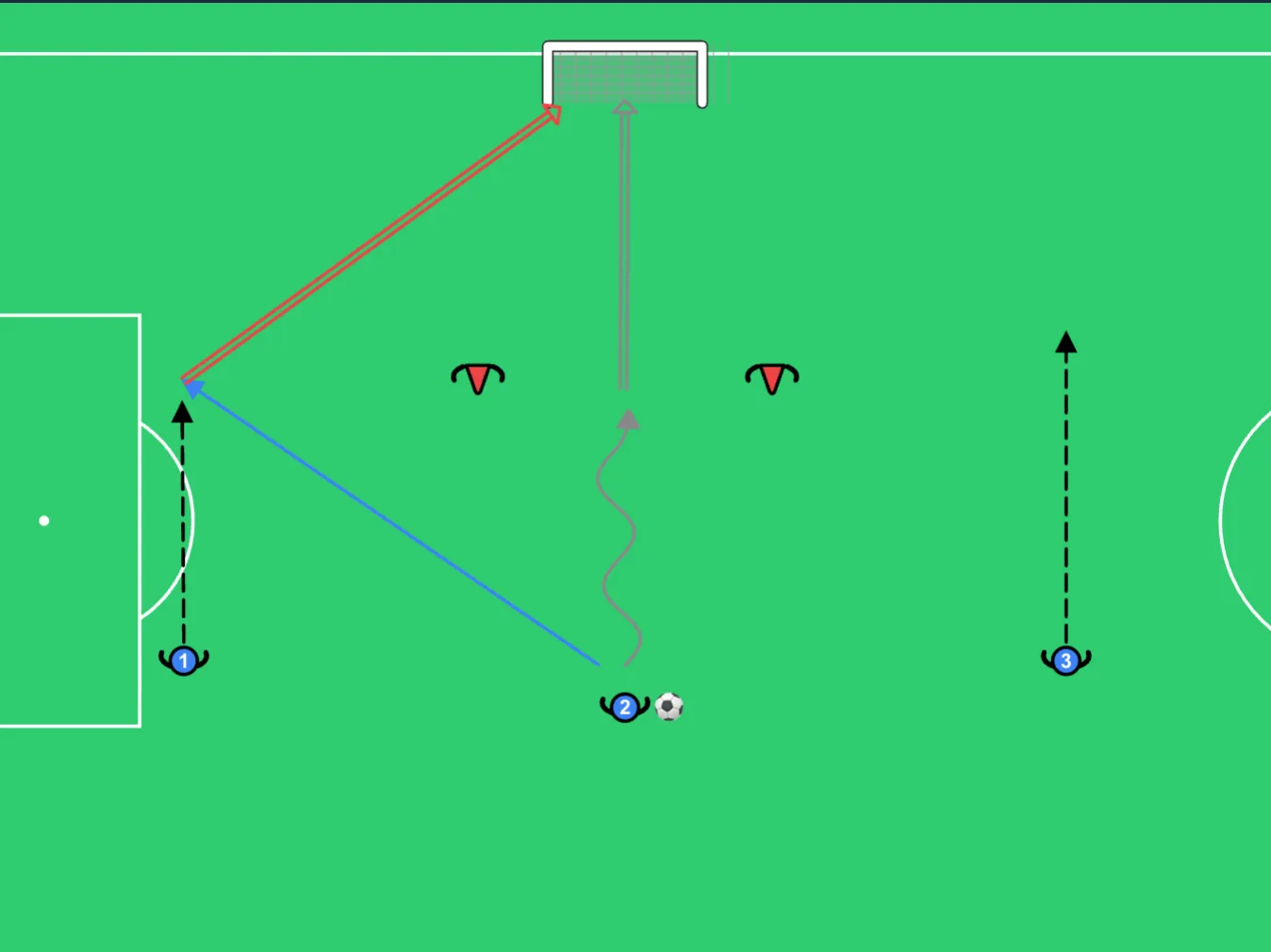
Related reading
- Season periodization for youth football coaches
- How to keep 20 players active in one training session
Sources
- Finnish FA: "Finnish youth football sessions observed 2022"
- Finnish FA: "Good session structure creates the framework for player development"
- England FA: "How to Structure a Training Session"
- Soccer Coach Weekly: "Structuring a Soccer Training Session - Up the Steps"
- Larkin, Barkell & O'Connor (2022): "The Practice Environment" - Frontiers in Sports and Active Living
- Human Kinetics / Balyi: "LTAD Seven Stages"
- Professional Soccer Coaching: "Football Periodization"
- ISSPF: "Periodisation for Soccer"
- Firstbeat: "Micro-Cycle Periodization in Soccer"
- Mingle Sport: "Tactical Periodization in Grassroots Football"
- Digital Learning Institute: "Mayer's 12 Principles of Multimedia Learning"