Season periodization for youth football coaches
A youth football season typically lasts 10–11 months. That's a long time, and without clear structure, training easily drifts into repetitive sameness. Players get bored, development slows, and injury risk increases [1].
Season periodization is a simple idea: the training focus shifts systematically throughout the season. It doesn't require complex theory, just an understanding of a few principles.
Why periodize?
Gabbett (2016) showed in a comprehensive review that sudden spikes in training load are the single most important injury risk factor in sport [2]. An ACWR (acute:chronic workload ratio) above 1.5 increases injury risk 2–7 times.
Periodization doesn't mean training less. It means increasing load in a controlled manner and making room for recovery.
A three-phase season model
Bompa and Buzzichelli (2019) divide the season into three main phases [3]. In youth football the model is simpler than in senior sport, but the underlying logic is the same.
1. Pre-season (4–6 weeks)
- Focus: general fitness, ball mastery, team fundamentals
- Load increases progressively week by week
- Game-based training from the start, not just running [4]
- Goal: players can handle the physical demands of the competitive season
2. In-season (6–8 months)
- Focus: game skills, tactics, match preparation
- Load management: heavy and light days alternate
- Weekly rhythm follows the match calendar [5]
- For youth: development matters more than results. Training isn't subordinate to matches alone
3. Off-season (4–8 weeks)
- Focus: recovery and other sports
- AAP (2024) recommends at least 3 months per year away from the primary sport [1]
- Active rest: other sports, unstructured play
- Complete rest for the first 1–2 weeks
Weekly rhythm during the season
Anderson et al. (2016) studied the weekly rhythm of young elite players and found that load timing relative to matches affects both performance and injury risk [5].
| Day | Content | Intensity |
|---|---|---|
| Match +1 | Rest or light recovery | Low |
| Match +2 | Technique, ball mastery | Medium |
| Match +3 | Hardest session: SSGs, strength work | High |
| Match -2 | Tactical training, match preparation | Medium |
| Match -1 | Activation, short games, recovery | Low |
Youth teams train less often (2–4 times per week), so not every day is needed. The principle remains: the hardest session goes as far from match day as possible.
Monitoring load
Impellizzeri et al. (2019) recommend the session-RPE method for load monitoring in youth teams [6]. It's straightforward:
- After training (30 min), the player rates effort on a 1–10 scale
- RPE multiplied by session duration in minutes = load units
- Weekly loads are summed
Example: 90-minute session, RPE 7 = 630 units. Weekly load change should not exceed 10% from the previous week [2].
Differences by age group
The Finnish Football Association's coaching guidelines (2023) define age-specific training priorities [8]. The table below combines these priorities with typical weekly session counts by age group.
| Age group | Sessions/week | Focus | Periodization need |
|---|---|---|---|
| U7–U9 | 1–2 | Variety, fun, fundamental movement | No formal periodization |
| U10–U12 | 2–3 | Ball mastery, SSG skills, agility foundation | Light: season/off-season |
| U13–U15 | 3–4 | Game skills, tactical understanding, physical development | Important: account for growth spurt [7] |
| U16–U18 | 4–5 | Match model training, physical training | Systematic periodization |
Accounting for the growth spurt
Read et al. (2021) showed that during the circa-PHV phase (peak height velocity), injury risk increases significantly [7]. Players growing more than 0.6 cm/month face 1.63x the risk.
In practice this means:
- Slower load progression during the growth spurt
- More recovery time
- Fewer rapid direction changes and jumps
- Growth tracking (standing height monthly)
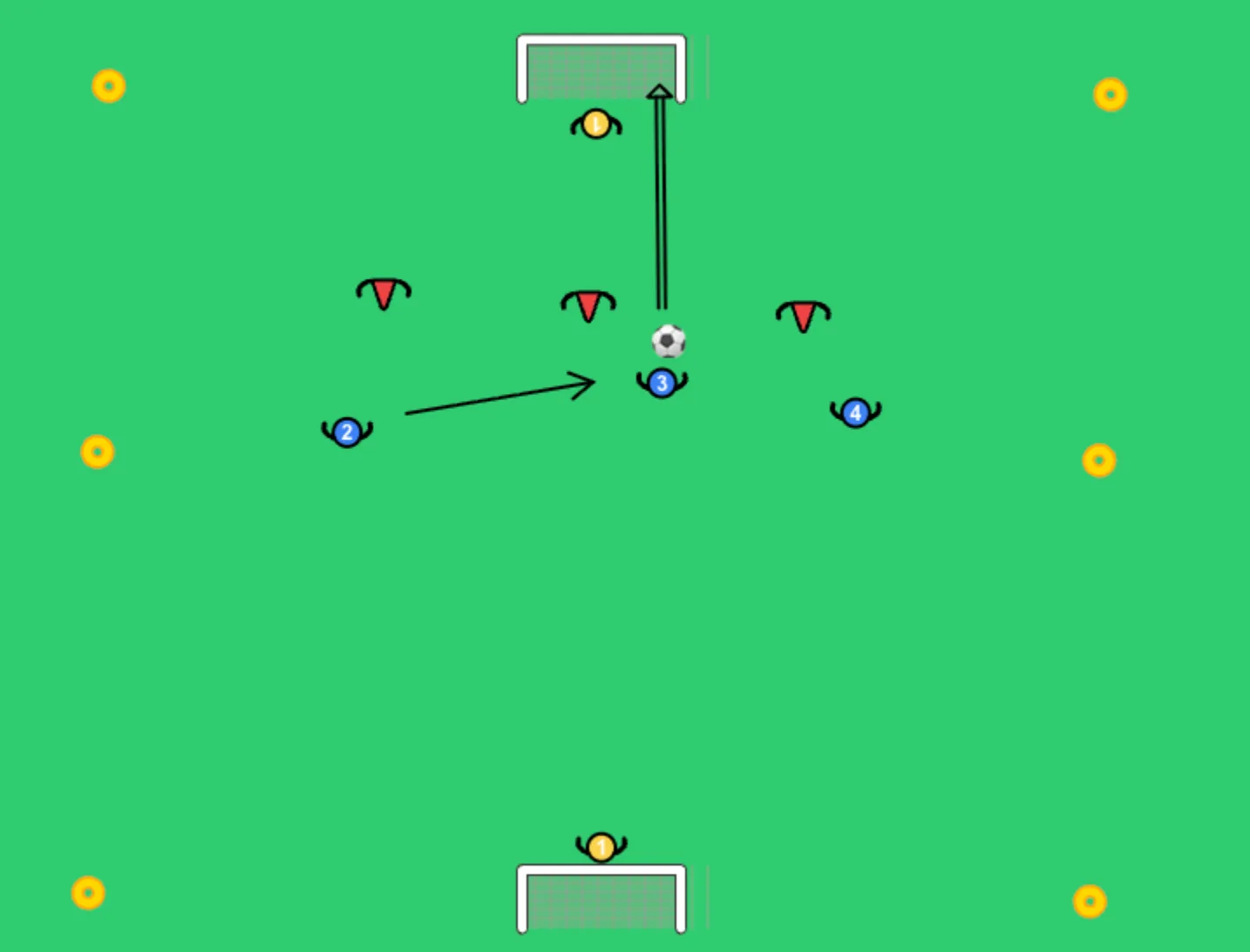
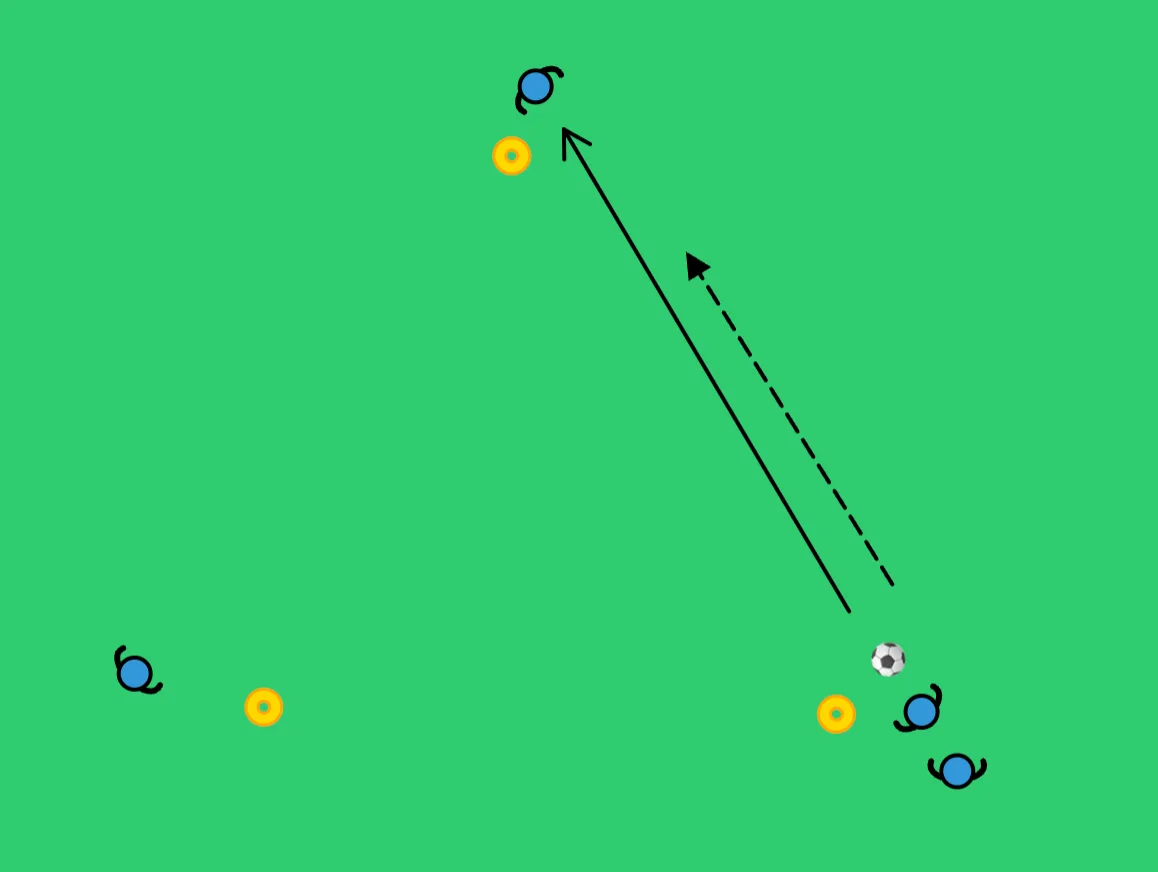
Example drills for the weekly rhythm
Heavy and light days need different drills. Here's an example of each:
Summary
Season periodization doesn't require a degree in sports science. You need a plan for the season structure, a weekly rhythm that accounts for matches, and the discipline to keep light days light even when it feels more productive to train harder.
Related reading
Sources
- AAP (2024): "Overuse Injuries, Overtraining, and Burnout in Young Athletes" — Pediatrics
- Gabbett (2016): "The training-injury prevention paradox" — British Journal of Sports Medicine
- Bompa & Buzzichelli (2019): Periodization: Theory and Methodology of Training — Human Kinetics
- Los Arcos, Vazquez, Martin et al. (2015): "Effects of Small-Sided Games vs. Interval Training" — PLOS ONE
- Anderson, Orme, Di Michele et al. (2016): "Quantification of Seasonal-Long Physical Load in Soccer Players" — Journal of Sports Sciences
- Impellizzeri, Marcora & Coutts (2019): "Internal and External Training Load: 15 Years On" — International Journal of Sports Physiology and Performance
- Read et al. (2021): "Training Management of the Elite Adolescent Soccer Player" — IJSSC
- Finnish Football Association (2023): "Valmennuslinja 2023"