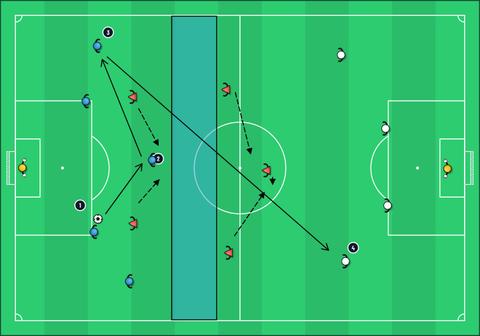
Interception Main Part
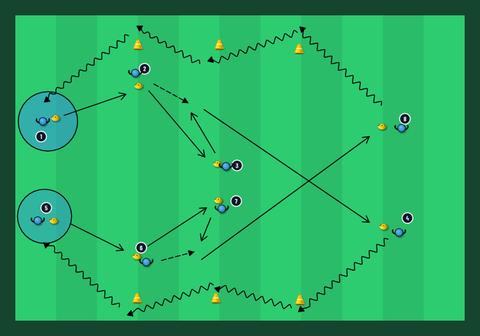
Three teams, with an intermediate zone, where half or more than half of the defending team will stay there to intercept the pass from one team to the other side.
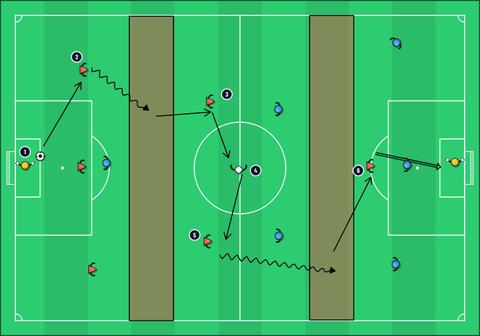
Dribbling main part
Conditioned game with three zones; they must move from one zone to another through dribbling.
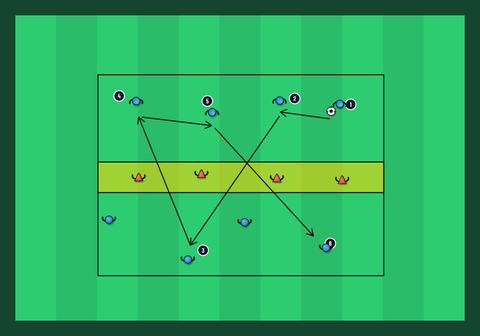
Interception
Three zones; the players in the wide areas must try to pass the ball from one side to the other through the middle. The players in the middle have to intercept the grounded passes.
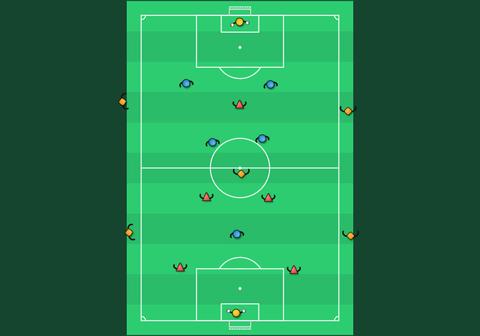
CONTROL-PASS MAIN DRILL
5 vs 5, with 4 outside jokers and 1 inside joker, and 2 goalkeepers, one in each goal. Possession with a minimum of 8 passes before being able to switch play (from goalkeeper to goalkeeper) and score a point.
Two finishing actions
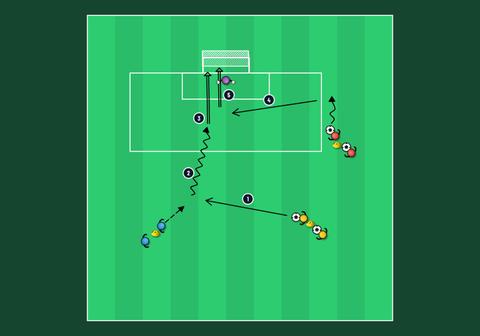
Split the players into three equal groups in front of the goal, with a goalkeeper in goal. The blue players are on the left, the yellow players on the right, and the red players near the right corner. The yellow players and the red players have balls. The first blue player starts a run, and the yellow player plays a pass into his path. The blue player dribbles briefly at full speed and shoots at goal. Immediately afterwards, he finishes from the red player's cross. After that, all three switch places: the finisher goes to the red queue, the crosser to the yellow queue, and the passer to the blue queue. Every shot should be on target.
Futsal 1-2-1 defending and intercepting the pass into the pivot 4v4
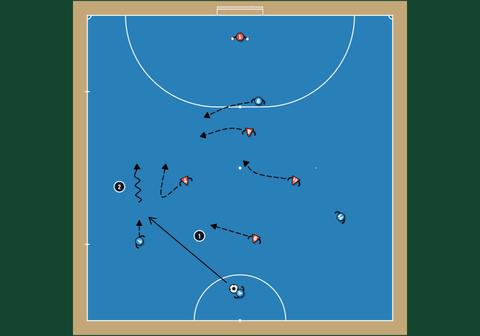
Four blue players attack: a fixo, two wide players and a pivot in front of the goal. The red players defend in a 1-2-1 diamond in front of the goalkeeper. The fixo passes wide, and the whole diamond shifts to the ball side during the pass. The nearest defender presses the receiver immediately, the top player moves inside to the ball side, the opposite wide defender moves more centrally and the deepest defender stays in front of the pivot. When the wide player dribbles along the touchline, the pressing defender tracks sideways and does not drop back towards the goal. The pivot checks towards the ball, but the deepest defender reads the pass and intercepts it in front of the pivot. After winning the ball, the red players attack the halfway line, and dribbling the ball over the line scores a point. The blue players score a point with a goal. Change roles every few repetitions.
Futsal wide pressing and cover 3v2
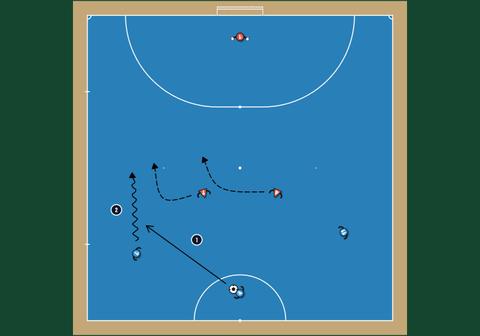
Three blue players attack: the fixo on the halfway line and two wide players providing width. They are opposed by two defenders and a goalkeeper. The fixo passes wide. The nearest defender presses while the ball is travelling and moves to the receiver’s inside, so the attacker is left with only the direction along the touchline. The second defender provides cover centrally and stays closer to their own goal than the pressing defender. This way, they block both the turn inside and the square pass to the opposite flank. The touchline is the third defender: when the wide player dribbles along it, the pressing defender gets alongside and wins the ball. After winning the ball, the red players attack towards the halfway line, and dribbling the ball over the line is a point. The blue players score a point with a goal. Change roles every few repetitions.
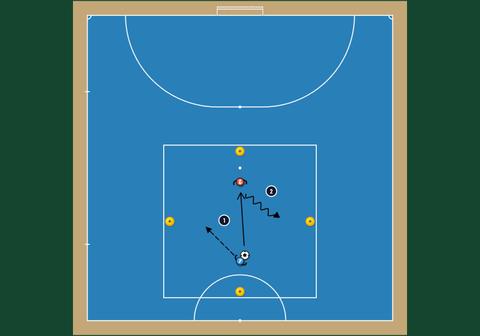
Futsal sole passes and 1v1 to four markers
In pairs, one ball per pair. Mark out an approximately 10 × 10 metre grid and place a marker in the middle of each side. The pairs pass to each other and receive the ball with the sole of the foot. After each pass, both move a quarter turn clockwise, and the player receiving the ball takes it along. When the pair has gone all the way around the circle and is facing each other again, the 1v1 begins. Either player can start the attack. Stopping the ball under control at a side marker is one point; beat an opponent and stop it at the marker behind them for three points. Make it more difficult by having the player on the ball keep the ball for as long as possible before scoring a point. If the opponent wins the ball cleanly, they attack immediately.
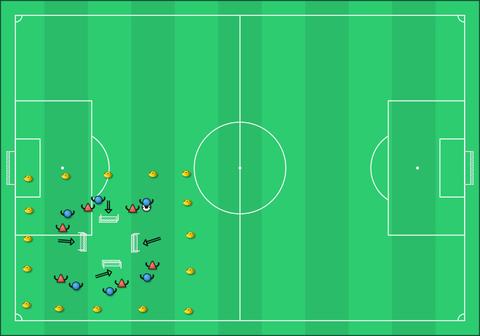
Square - handball
Square - handball, split into 2 teams of 5 or more players in each. Depending on the number of players at training. You can score in either goal after a set number of passes and a specific type of strike on the ball. 1. Strike with the inside of the foot with the right foot 2. Strike with the instep 3. Header 4. Strike with the inside of the foot with the left foot. Each strike is performed on the volley. The team that scores the most points wins.
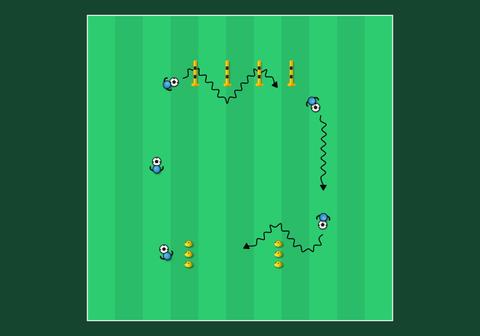
Dribbling circuit with slalom and rows of cones
Set up a circuit in a square shape of about 20 × 20 metres. On the top side, place four slalom poles 2.5 metres apart. On the bottom side, place two defenders about seven metres apart. Each consists of a line of three cones across the direction of travel. The right and left sides remain straight. Each player has their own ball, and the players start at different points on the circuit, so nobody queues. Everyone moves in the same direction. In the slalom, dribble with short touches and at direct speed. Dribble straight towards the middle of the defender, use a feint, and go around one end of the line. If you catch up to someone, beat them on the outside. One circuit suits 6–8 players, so for a large group build several circuits. Change direction every few laps, or dribble only with the right foot or only with the left foot. If there are no poles, the slalom can be done with cones.
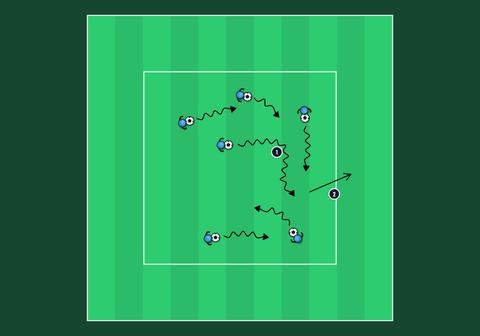
King game: protect your own ball and play the others' balls out
Mark out an area with cones according to the number of players, for example around 15 × 15 metres for six to eight. Each player has their own ball. Everyone dribbles in the area and at the same time tries to play the other players' balls out of the area. Nobody is out of the game. If a player's own ball goes out, the player retrieves it, does the movement task given by the coach and dribbles back into the game. When there are a lot of players, divide them into several areas. The areas can be ranked: the player who plays a ball out moves up to the higher area and the player who loses their ball drops down to the lower area. Also play at times with different-sized balls.
Bib tag: dribbling and shielding the ball with the whole group
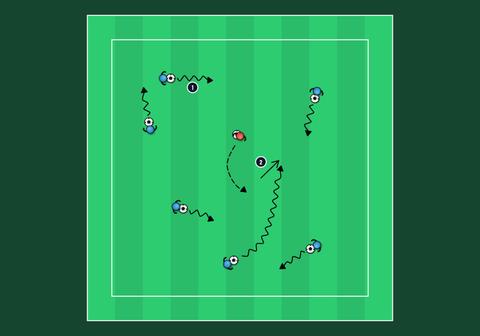
Mark out an area of about 20 × 20 metres for around ten players. One of the players is the tagger, and they hold a bib or a small soft ball in their hand. All the others have their own ball. The players on the ball keep dribbling inside the area at all times. The tagger chases them and tries to throw the bib or ball at a dribbler’s ball. When the throw hits, the player whose ball was hit takes the bib or ball and becomes the new tagger. The previous tagger takes their ball and continues dribbling. The new tagger cannot immediately throw at the previous tagger’s ball. For a large group, set up several areas or add more taggers. In a smaller area, dribbling is more difficult.
Ball Thieves
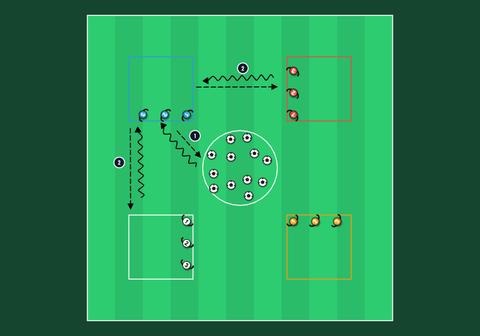
Four teams compete to see who can get the most balls into their own nest. The start is played as a relay, and once the centre is empty, everyone is moving. One coach can see the whole group from the middle. Mark out an area of about 24 × 24 metres and mark a 6 × 6 metre nest in each corner and a circle of about seven metres in the middle. Divide the players into four teams; with 12 players, make four teams of three. The teams wait in a line in their own nests. Spread the same number of balls inside the circle as there are players. Phase 1 is played as a relay. The first player from each team sets off, collects a ball from the middle and dribbles it all the way back to their own nest. The next player starts when the ball is in the nest. The middle is emptied once everyone has gone once. When the relay has finished, phase 2 begins: everyone starts moving at the same time, and a ball can be stolen from any nest. Each player dribbles one ball at a time all the way back to their own nest. You may not defend your own nest, and you may not touch a ball being dribbled by another player. A round lasts 60–90 seconds. On the whistle, count the balls. The team with the most balls in their nest wins. Return the balls to the middle and start a new round.
Finishing from three positions
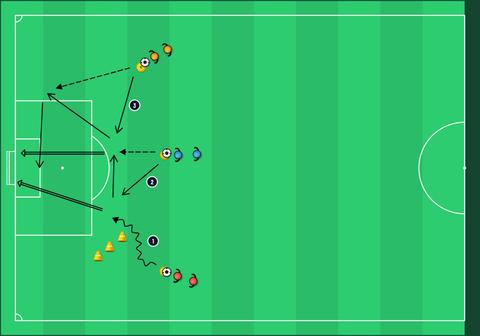
The red player sets off, beats the cone defender and shoots at goal. The blue player immediately gives a pass to the red player, and the red player lays off a one-two, from which the blue player shoots at goal. After this, the yellow player gives a pass to the blue player, who plays a one-two towards the end line. The yellow player crosses from the end line, and both the blue and the red player take part in finishing.
Finishing training in a small-sided context
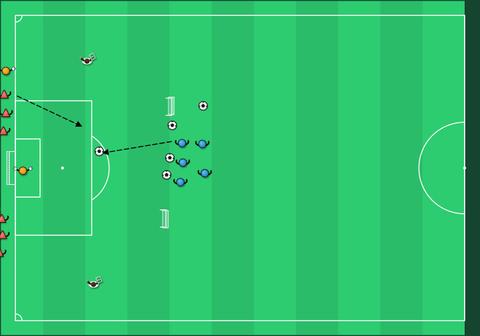
In this finishing drill, the ball always starts with the attacker, who then goes on and tries to score. The defender who wins the ball must score in the small goals within a few seconds. 2nd - Immediately afterwards, they play 1v2, with the attackers having to finish in a short space of time. 3rd - 2v2, with the defender coming out with the ball under control and having to score in the small goals. The drill then continues in this way, always with the addition of 1 player so that the team always has numerical superiority or not. Variation: 1 - The finishing must be completed in a maximum of 10 seconds.
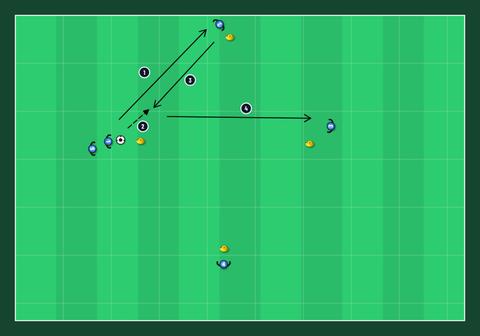
Passing diamond
A diamond is set up with cones, with two players at the first cone and one player at each of the others. Player 1 makes the first pass to player 2, who then sets it back with a one-two. Player 1 aims to play a long pass to player 3 with the first touch. After the passes, always rotate in the direction of the pass.
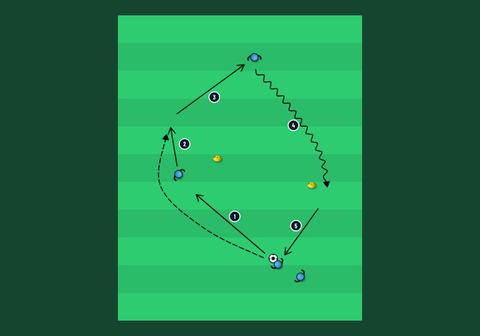
Overlap as a rotating passing drill
Mark out a slightly skewed diamond with cones, about 20 × 10 metres. There is a queue at the bottom corner, and the first player has a ball. There is a wall player at the left corner and a player at the top corner. The first player in the queue dribbles towards the wall player, passes to them and immediately makes an overlap past them on the outside. The wall player steps towards the ball, takes it infield towards the nearby cone and passes forward into the overlap runner’s path when they are almost level. The overlap runner plays the ball first time to the top corner and continues there. The player at the top corner dribbles around the cone on the right side, passes to the queue and goes to the back of the queue. No one runs back. Change the wall player every few rounds. When the pattern is flowing, place a semi-active defender at the wall player’s cone.
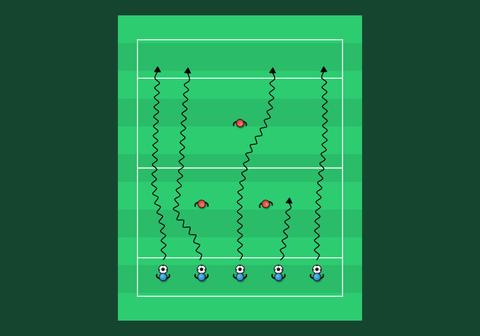
Who’s afraid of the defender? Dribbling game from island to island
Mark out an area of approximately 16 x 20 metres. At each end, create an island about three metres deep, and divide the sea between them into two halves with a halfway line. There are three defenders in the sea: two in one half and one in the other. The defenders stay in their own half. Everyone else has their own ball and starts on the same island. The attackers dribble the ball from one island to the other, and each successful crossing is a point. Set off straight back from the island. If a defender wins the ball, the attacker and defender swap roles. Change the defenders every couple of minutes. Make it harder by adding defenders or removing the halfway line, allowing the defenders to move across the whole sea. For a large group, set up several areas.
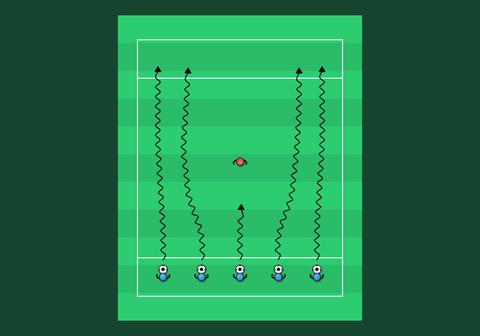
Who’s Afraid of the Defender? Caught Players Help the Defenders
Mark out an area of approximately 16 × 20 metres. At each end, create an island about three metres deep, with the sea in between. In the sea, there is initially one defender, who can move anywhere in the whole sea. Everyone else has their own ball and starts on the same island. Everyone sets off at the same time and tries to dribble the ball to the opposite island. If the defender wins the ball, they kick it out of the area, and the caught player takes a bib and joins the defenders. Players set off straight away back to the other side. With each crossing there are more defenders and fewer dribblers. The last player on the ball wins. For a large group, start with two defenders or make two areas.