Soccer attacking drills: overloads, width and depth
Attacking play is about making more of the moments when your team has the ball near goal. Many drills here start with an overload, 2v1, 3v2 or 3v2+1, so attackers learn to use the spare player before the defence recovers. Others work on width and depth: a switch of play, a cross from the byline, a through pass in behind or a pass into the pocket between the lines. The run should start before the pass, not after it. Finish with a game such as 4v4 with three goals, where the team has to look for the free goal. The drills go from U8 up to older age groups.
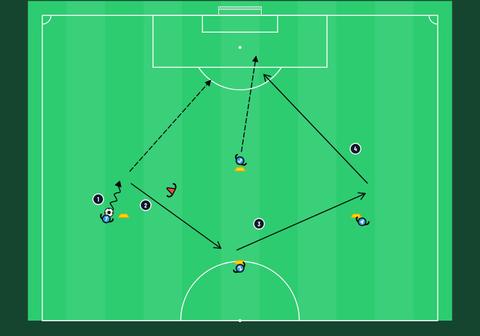
Switch of play and cross
Four players in a diamond: both flanks, one in the middle at the front and one in the middle at the back. The wide player starts dribbling towards goal. The deepest player calls, which stops the dribbling and the ball is played back. The deepest player switches play first time to the opposite flank, who advances and delivers a cross. The others arrive in front of goal in staggered runs to finish. Start alternately from each flank. Instead of a cross, a sharp low pass from the flank is also allowed.
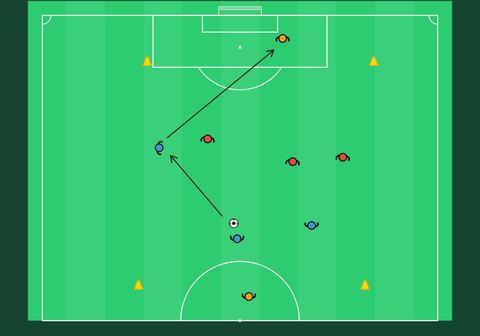
End zone game
3v3 end zone game with two jokers. The jokers play in the end zones with the team in possession. The jokers can join the attack, creating temporary numerical superiority. A goal is scored when a player receives a pass in the end zone
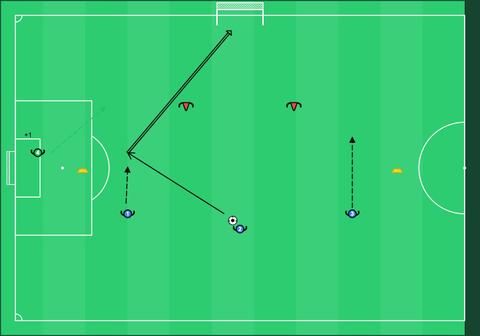
3v2+1 numerical superiority attack
Three attackers play against two defenders. One additional player waits on the flank and joins in when the ball crosses a certain line. The attackers aim for quick finishing before the defending can get organised. If the defenders win the ball, they play a counter-attack.
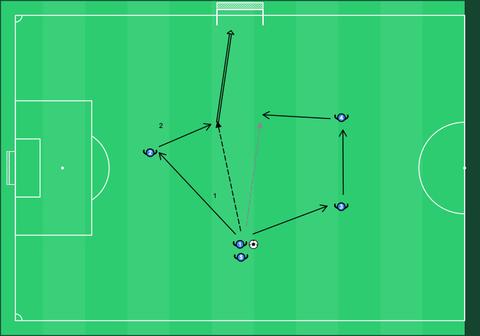
Combination play with one-twos
Players practise different one-two patterns on the move: a simple one-two or a triangle passing pattern. Each pattern ends with a shooting opportunity. First without defenders, then with passive defenders and finally with active defenders.
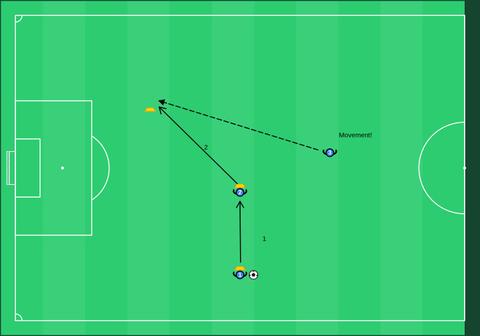
Third-player movement
Three-player combination: the first passes to the second, the second plays to the third, who has made a run into free space. The key is the third player's movement — they break away before the ball arrives at the second player. Practise in different patterns: in behind, wide and diagonally.
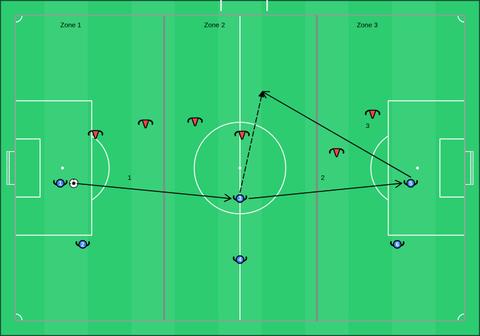
Width and depth
Team game (e.g. 6v6 or 7v7). The pitch is divided into three vertical zones. The attacking team only scores a point when the ball has been in all three zones before finishing. Forces the use of width and prevents narrow central play.
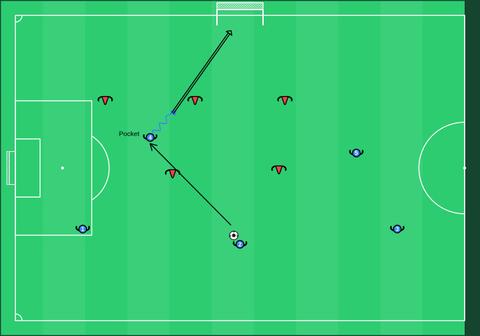
Playing into the pocket
The attacking team aims to play the ball into the pocket — between the defensive line and the midfield. The player receiving in the pocket turns and plays forward or shoots. The defending team tries to keep the lines compact and prevent play into the pocket.
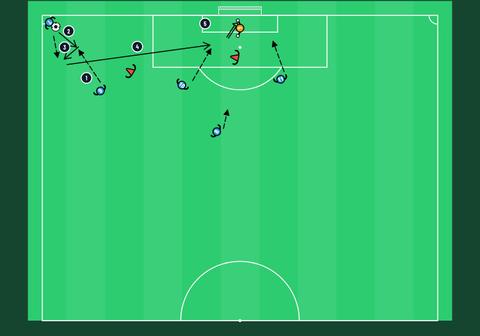
Short corner
The corner is played short. The supporting player comes towards the corner flag and receives a pass, which makes the nearest defender come out of the penalty area to apply pressure. The ball is then played back to the taker, who has meanwhile moved from the corner to around eight metres away. The angle for the cross is better from there, and the ball can be delivered low between the near post and the goalkeeper. The player running to the near post finishes one-touch, and the run to the far post starts at the same time. There are two defenders: one applies pressure to the short corner, the other defends the area. Without the defender coming out, the pattern does not show why the short corner works.
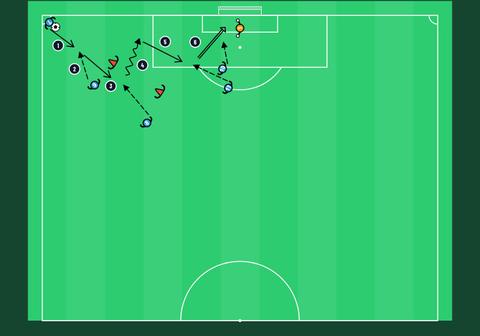
Short corner with three
The corner is played short between three players. The player closest to the flag comes short and receives the pass, which brings the first defender out. Instead of the ball being returned to the taker, it goes first touch to the third player, who has come from the edge of the penalty area into the same corner. Now the second defender also has to come out, and the third player dribbles between them to the end line. From the end line, the ball is played back low towards the penalty spot. The finisher times the run so that they move towards the ball rather than waiting for it standing still. The player occupying the near post takes the goalkeeper with them. Two defenders out means there is briefly a 2v1 in the penalty area. That is the whole idea of the move: the short corner is not looking for a cross but for numerical superiority.
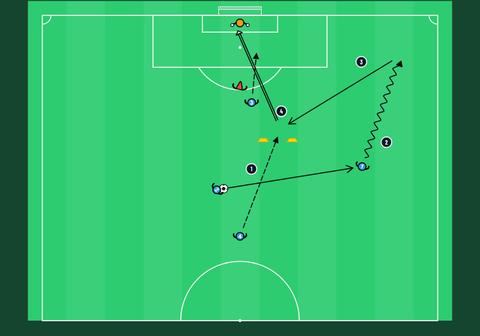
Lay-off for the second wave
A pass from the centre to the winger, who dribbles all the way to the byline. The attacker takes the defender with them to the near post. When the defending has dropped towards the goal, the midfield player arrives late at the edge of the penalty area into the gate. The winger lays the ball back and the arriving player shoots first time from the pass. A goalkeeper in goal. Start alternately from both flanks.
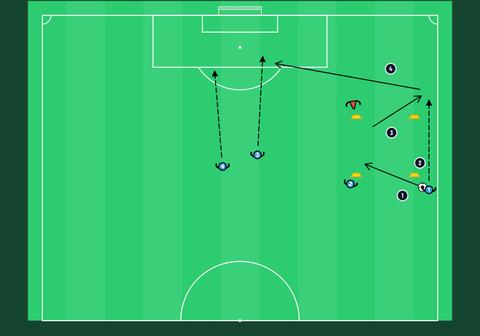
Wide 2v1 and cross
Two attackers break down one defender out wide and deliver a cross. The wide player passes to the inside player, who comes towards the ball and turns towards goal. At the same time, the defender sets off from the opposite corner to apply pressure. The passer immediately makes an overlapping run on the outside past their teammate, into the space between the penalty area and the touchline. From there, they receive the ball back and deliver a cross. The run into the penalty area is staggered: one to the near post, the other to the far post. The defender does not follow outside the square. Start alternately from both flanks. Alternatively, the wide player can solve the situation themselves in a 1v1, either by going inside or down the touchline.
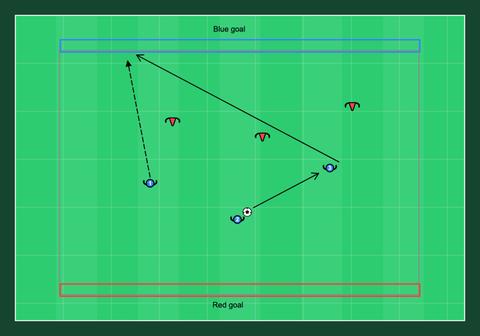
3v3 line game
3v3 game without goals. A goal is scored when a team manages to stop the ball behind the opponent’s end line. The receiver must get the ball under control behind the line; simply kicking it over the line is not enough. Teaches attacking and defending in depth.
Finishing from a one-two
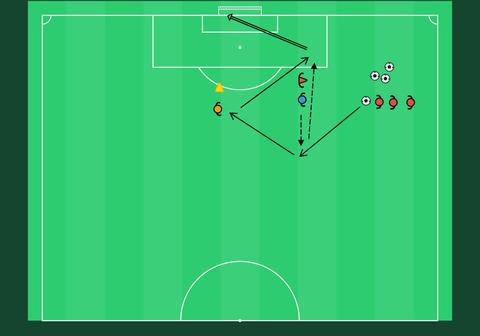
The blue player makes the initial movement away from the defender and the first player in the queue plays a pass into the movement. The blue player takes a control and immediately continues with a pass to the yellow player. The yellow player lays off the one-two behind the defender and the blue player aims to shoot the ball into the goal directly from the pass. The defender tracks the run but does not intercept the passes. Rotation: from attacker to laying off the one-two and defender to attacking. The player laying off the one-two goes to the back of the queue and the player making the first pass becomes the defender.
Counter-attack game
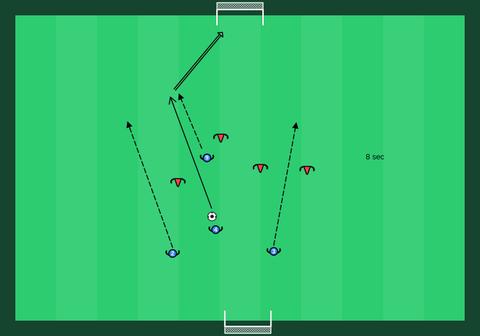
The defending team defends their own goal. When they win the ball, they have 8 seconds to attack the opposite goal. If a goal is scored within the time limit, the point counts double. The attacking team continues normal play. A quick transition from defending to attacking is decisive.
Cross and finishing on the move
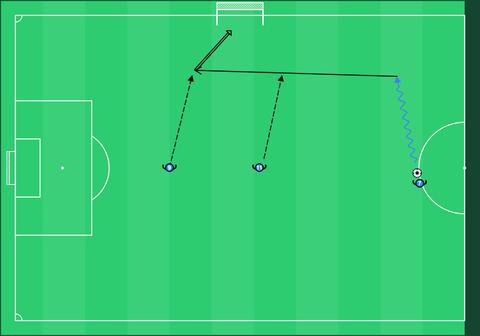
The wide player receives the ball and goes to the byline or into the inside channel. In the penalty area, two attackers make crossing runs: one to the near post, the other to the far post. The player crossing chooses the type of cross.
Three-phase transition game
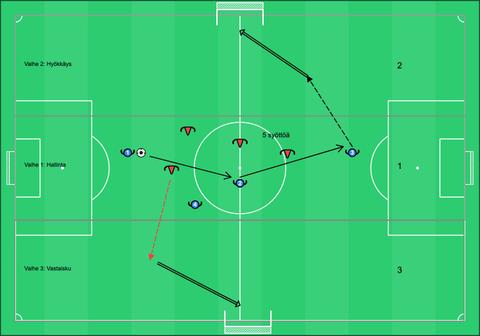
The pitch is divided into three zones. The game starts in the middle zone as a possession game. When a team completes 5 passes, they attack the opponent's goal (phase 2). If the defending team wins the ball, they make a counter-attack towards the other goal (phase 3). Each phase requires different tactical understanding.
4v4 recovery zone game
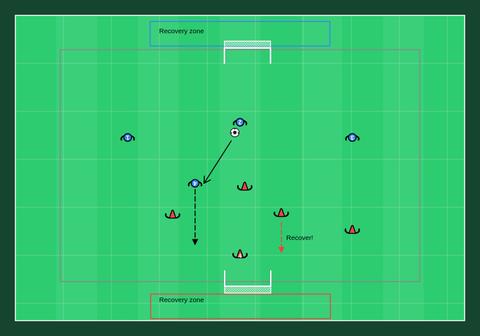
4v4 game with two goals. Each team has its own "recovery zone" behind the goal. When a team loses possession, one player must go into the recovery zone before they can take part in defending. This creates temporary numerical superiority for the attacking team and forces a quick transition.
Possession to goal
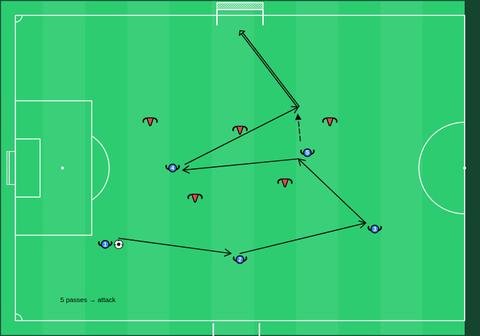
Team game (e.g. 5v5+GK) on a half pitch. The team in possession keeps the ball and tries to attack the goal. Before attacking the goal, at least 5 consecutive passes are required. The defending team tries to win the ball and play a counter-attack to the other end.
3v2 finishing
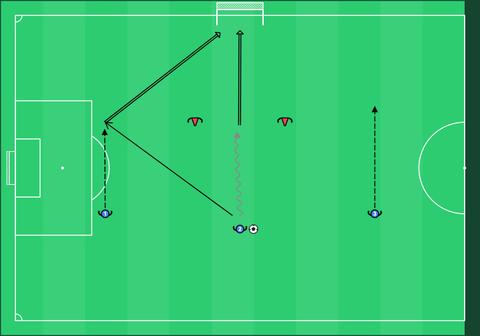
Three attackers start with the ball and move towards two defenders. The aim is to create numerical superiority and finish. After a goal, the attackers receive a new ball and attack the opposite goal.
4v4 transition game
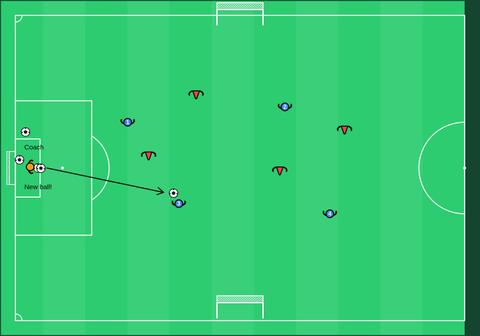
4v4 game with two goals (+GK). When the ball goes out of bounds or a goal is scored, the coach passes a new ball onto the pitch to a random team. Continuous transition situation: the teams never know who will get the next ball. Forces constant readiness in both attacking and defending.