Transition drills for the seconds after the ball changes hands
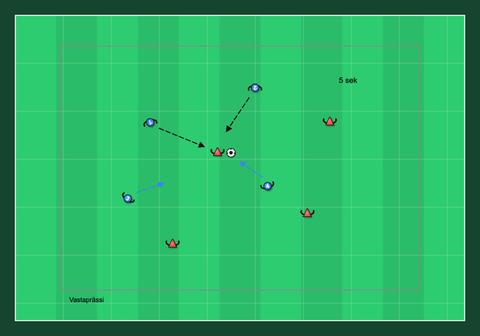
A transition is the moment the ball changes team, and these drills train the seconds that follow. After winning the ball the team attacks fast: in the counter-attacking game it has 8 seconds to reach the opposite goal. After losing it the nearest players press at once or drop back, and in the counter-pressing game a team has 5 seconds to win the ball back. Drills such as 2v2 recovery defending and the 4v4 recovery zone game teach players to get back after losing the ball. Keep the rounds short and the intensity high, and stop play only to point out the moment the ball changed hands.
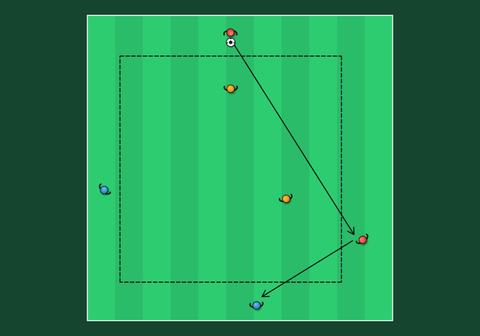
4v2 rondo
Mark out a square area and make three pairs of two players. Two pairs are on the outside on the edges, giving four passers in total, with one on each side. One pair is inside the area trying to win the ball. The players on the outside keep possession from side to side. The players winning the ball split the work: one presses the player on the ball, the other blocks the next passing lane. When they win the ball, the pairs swap places and play continues immediately without a restart. Adjust the size of the square to suit the level. A smaller square shortens the passes and forces quicker touches.
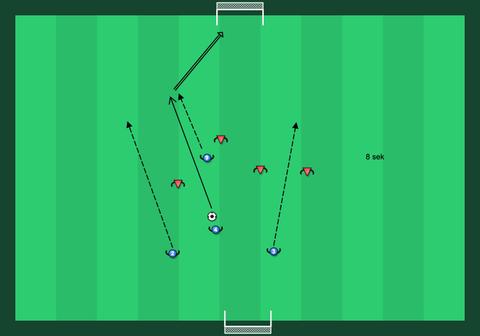
Counter-attack game
The defending team defends their own goal. When they win the ball, they have 8 seconds to attack the opposite goal. If a goal is scored within the time limit, the point counts double. The attacking team continues normal play. A quick transition from defending to attacking is decisive.
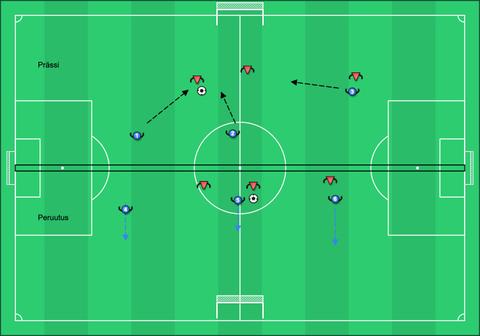
Press or drop off?
The defending team practises two alternative reactions after a loss of possession: (1) counter-press high if the ball was lost in the opponent's half, (2) drop off and reorganise if the ball was lost in their own half. The coach signals which option is to be carried out. The team learns to recognise the right moment for both.
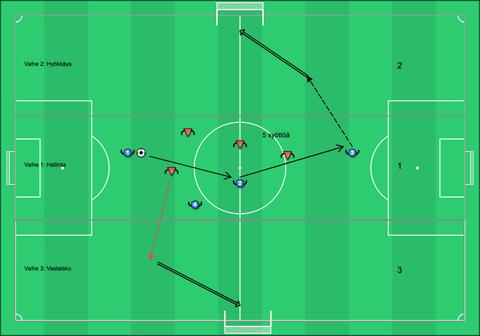
Three-phase transitions game
Pitch divided into three zones. The game starts in the middle zone as a possession game. When a team completes 5 passes, they attack the opponent’s goal (phase 2). If the defending team wins the ball, they launch a counter-attack towards the other goal (phase 3). Each phase requires different tactical understanding.
Counter-pressing game
Two teams play a possession game in a confined area. When a team loses possession, it has 5 seconds to win the ball back with counter-pressing. If the ball is won back, play continues. If not, the team that lost possession does a penalty task. Objective: immediate reaction to loss of possession.
4v4 transition game
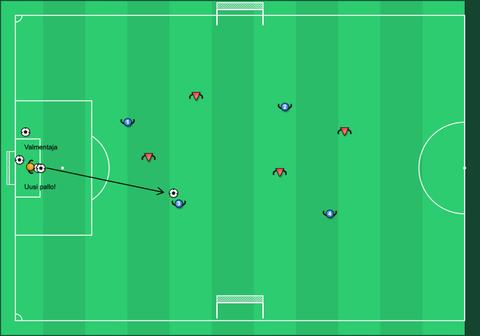
4v4 game with two goals (+GK). When the ball goes out of bounds or a goal is scored, the coach passes a new ball onto the pitch to a random team. Continuous transition situation: the teams never know who will get the next ball. Forces constant readiness in both attacking and defending.
Three-zone rondo (basic)
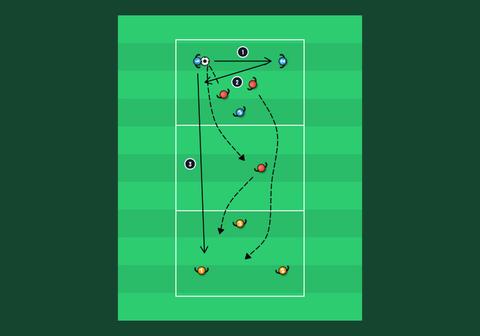
Mark out a 15 × 30 metre area and divide it into three 10-metre zones. Place a team of three players in each zone. The end teams keep possession and try to play the ball over the central zone to the other end. From the middle team, two players win the ball in the end zone where the ball is, and one stays in the middle to cut out long passes. When the ball switches ends, two players from the middle team run across after it. If the middle team wins the ball or the ball goes out, the team that lost possession moves into the middle and the winning team takes that end zone. Each successful pass from one end zone to the other is a point.
2v2 recovery defending
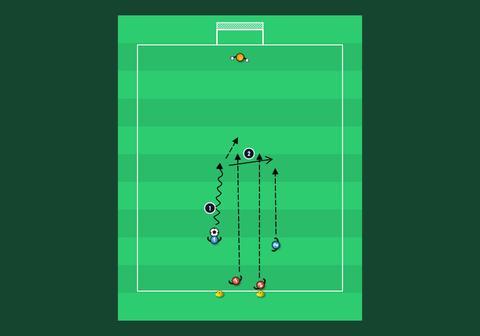
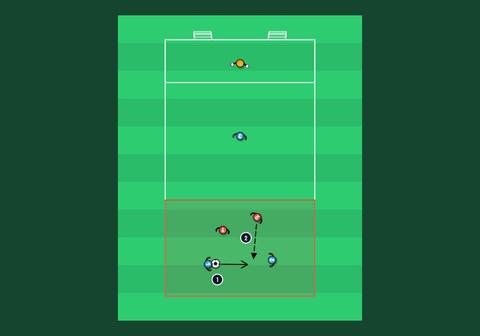
Two blue players attack the goal with a goalkeeper. Two red defenders start from the markers behind the attackers. The area is approximately 20 x 24 metres, with a cone gate at the opposite end. The blues start with the ball and drive towards the goal, and at the same moment the reds recover. The nearer defender runs along the inside line to get between the ball and the goal and delays the player on the ball. The second defender recovers to the inside, between the remaining attacker and the goal. Once it becomes 2v2, the defenders apply pressing and provide cover. In the example, red 1 gets across in front of blue 1 and delays. When blue passes out wide, red 2 moves to press during the pass and red 1 drops to cover. Red 2 wins the ball, and the reds immediately attack the gate. Now the blues recover. The blues score a point for a goal, the reds for dribbling the ball through the gate. The farther away the defenders start, the more difficult the recovery becomes, so adjust the distance of the starting markers according to the level. Change roles after a few repetitions.
2v2 pressing and penetration
The area is approximately 14 × 24 metres and is divided into three sections. At the bottom is the 2v2 zone, in the middle the penetration zone and at the top the goalkeeper's area. On its end line there are two small goals. In the 2v2 zone, two blue players keep possession and two red players press as a pair. In the penetration zone, one blue defender waits. The reds' task is to win the ball. One presses the player on the ball, the other provides cover from the inside and reads the next pass. After winning the ball, the reds immediately break through: 2v1 against the blue defender and finishing into either small goal. Blue 1 and 2 are not allowed to follow from the 2v2 zone, blue 3 stays in the penetration zone and the goalkeeper stays in their own area. In the pattern, red 2 presses during the pass, and when the ball comes back, the roles change. When blue 1 tries to switch play again, red 2 intercepts the pass. Red 2 dribbles into the penetration zone, draws blue 3 towards them and passes to red 1, who shoots into the left small goal. Change roles every few repetitions so that everyone gets to press, defend the penetration and finish. The blues can be given a point, for example, for five consecutive passes in the 2v2 zone.
End zone game with changing direction
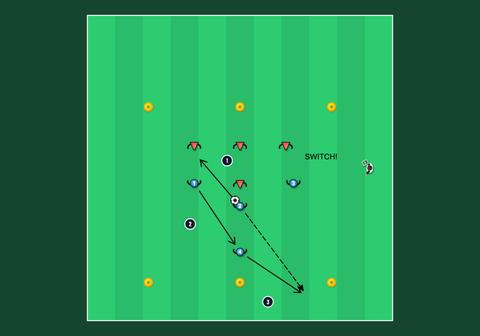
4v4 with an empty area, with end zones marked by cones at both ends. No goals. A point is scored when a player from your team receives a pass in the end zone. The coach calls for a change of direction during play, and the attacking direction switches from that moment. The defending team have just compacted towards the wrong end, so the space is behind them; this must be seen and used before they have time to turn. Playing time 3-4 minutes at a time, with several calls in each block.
Three-zone build-up game
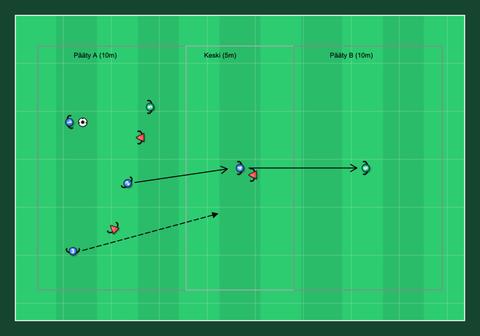
Two teams + 2 jokers (30×15 m, zones 10–5–10 m). Team A builds up play in the end zone (3v2 + joker) and tries to play through the pivot player in the narrow middle zone to the other end zone, where the joker receives. From the defending team, 2 press in the end zone, 1 covers the middle zone. After winning the ball, the team that won it starts the build-up from their own end zone. The pivot simulates a midfielder, the end-zone players simulate centre-backs.
4v4 recovery zone game
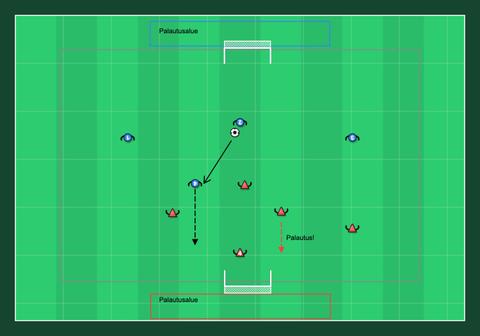
4v4 game with two goals. Each team has its own "recovery zone" behind the goal. When a team loses possession, one player must go into the recovery zone before they can take part in defending. This creates temporary numerical superiority for the attacking team and forces a quick transition.
Pressing line and transitions
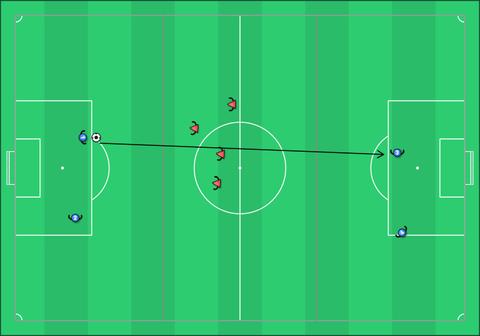
The pitch is divided into three vertical zones. The defending team sets up in the middle zone as a compact block. The attacking team plays the ball in the wide zones and tries to switch play. When the ball is moved, the defending block shifts together towards the ball.
2v2/3v3 with small goals
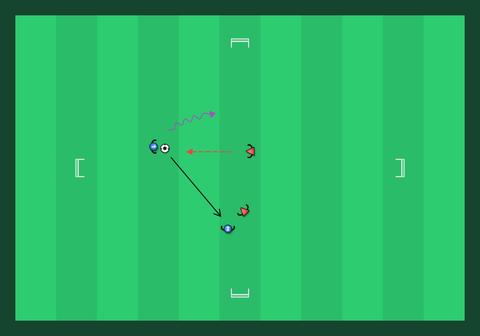
2v2 or 3v3 small-sided game with small goals and no goalkeeper. When the team loses possession, transition immediately into defending: the first defender presses the player on the ball, the second covers and the third provides balance.
Futsal 1-2-1 defending and intercepting the pass into the pivot 4v4
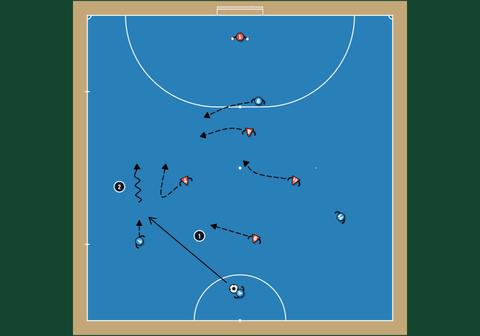
Four blue players attack: a fixo, two wide players and a pivot in front of the goal. The red players defend in a 1-2-1 diamond in front of the goalkeeper. The fixo passes wide, and the whole diamond shifts to the ball side during the pass. The nearest defender presses the receiver immediately, the top player moves inside to the ball side, the opposite wide defender moves more centrally and the deepest defender stays in front of the pivot. When the wide player dribbles along the touchline, the pressing defender tracks sideways and does not drop back towards the goal. The pivot checks towards the ball, but the deepest defender reads the pass and intercepts it in front of the pivot. After winning the ball, the red players attack the halfway line, and dribbling the ball over the line scores a point. The blue players score a point with a goal. Change roles every few repetitions.
Futsal wide pressing and cover 3v2
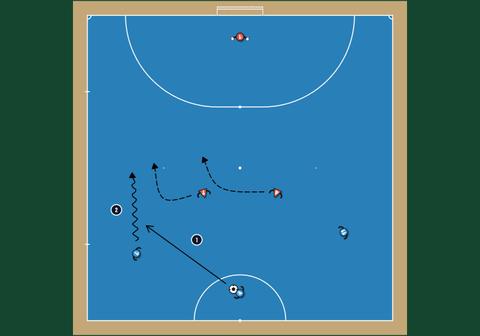
Three blue players attack: the fixo on the halfway line and two wide players providing width. They are opposed by two defenders and a goalkeeper. The fixo passes wide. The nearest defender presses while the ball is travelling and moves to the receiver’s inside, so the attacker is left with only the direction along the touchline. The second defender provides cover centrally and stays closer to their own goal than the pressing defender. This way, they block both the turn inside and the square pass to the opposite flank. The touchline is the third defender: when the wide player dribbles along it, the pressing defender gets alongside and wins the ball. After winning the ball, the red players attack towards the halfway line, and dribbling the ball over the line is a point. The blue players score a point with a goal. Change roles every few repetitions.