Soccer dribbling drills that beat a defender
There has to be someone to dribble past. Close control around cones is fine for a warm-up, but the real skill is reading the defender, changing pace and direction at the right moment and keeping the ball out of reach. Build the pressure up in steps. At first nobody defends, then a passive defender comes in, and in the end they defend for real. In small groups every player gets the ball often. Finish with a game where beating your opponent opens the way to a small goal or over a line, so the player knows straight away whether the move worked.
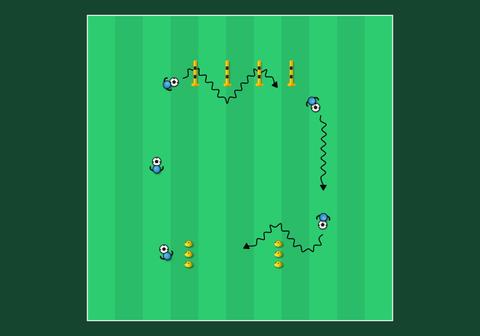
Dribbling circuit with slalom and rows of cones
Set up a circuit in a square shape of about 20 × 20 metres. On the top side, place four slalom poles 2.5 metres apart. On the bottom side, place two defenders about seven metres apart. Each consists of a line of three cones across the direction of travel. The right and left sides remain straight. Each player has their own ball, and the players start at different points on the circuit, so nobody queues. Everyone moves in the same direction. In the slalom, dribble with short touches and at direct speed. Dribble straight towards the middle of the defender, use a feint, and go around one end of the line. If you catch up to someone, beat them on the outside. One circuit suits 6–8 players, so for a large group build several circuits. Change direction every few laps, or dribble only with the right foot or only with the left foot. If there are no poles, the slalom can be done with cones.
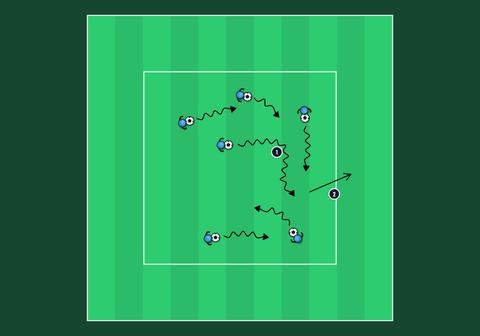
King game: protect your own ball and play the others' balls out
Mark out an area with cones according to the number of players, for example around 15 × 15 metres for six to eight. Each player has their own ball. Everyone dribbles in the area and at the same time tries to play the other players' balls out of the area. Nobody is out of the game. If a player's own ball goes out, the player retrieves it, does the movement task given by the coach and dribbles back into the game. When there are a lot of players, divide them into several areas. The areas can be ranked: the player who plays a ball out moves up to the higher area and the player who loses their ball drops down to the lower area. Also play at times with different-sized balls.
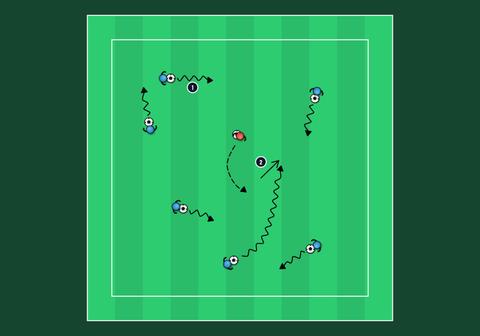
Bib tag: dribbling and shielding the ball with the whole group
Mark out an area of about 20 × 20 metres for around ten players. One of the players is the tagger, and they hold a bib or a small soft ball in their hand. All the others have their own ball. The players on the ball keep dribbling inside the area at all times. The tagger chases them and tries to throw the bib or ball at a dribbler’s ball. When the throw hits, the player whose ball was hit takes the bib or ball and becomes the new tagger. The previous tagger takes their ball and continues dribbling. The new tagger cannot immediately throw at the previous tagger’s ball. For a large group, set up several areas or add more taggers. In a smaller area, dribbling is more difficult.
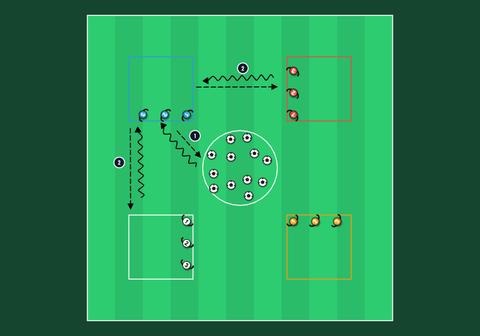
Ball Thieves
Four teams compete to see who can get the most balls into their own nest. The start is played as a relay, and once the centre is empty, everyone is moving. One coach can see the whole group from the middle. Mark out an area of about 24 × 24 metres and mark a 6 × 6 metre nest in each corner and a circle of about seven metres in the middle. Divide the players into four teams; with 12 players, make four teams of three. The teams wait in a line in their own nests. Spread the same number of balls inside the circle as there are players. Phase 1 is played as a relay. The first player from each team sets off, collects a ball from the middle and dribbles it all the way back to their own nest. The next player starts when the ball is in the nest. The middle is emptied once everyone has gone once. When the relay has finished, phase 2 begins: everyone starts moving at the same time, and a ball can be stolen from any nest. Each player dribbles one ball at a time all the way back to their own nest. You may not defend your own nest, and you may not touch a ball being dribbled by another player. A round lasts 60–90 seconds. On the whistle, count the balls. The team with the most balls in their nest wins. Return the balls to the middle and start a new round.
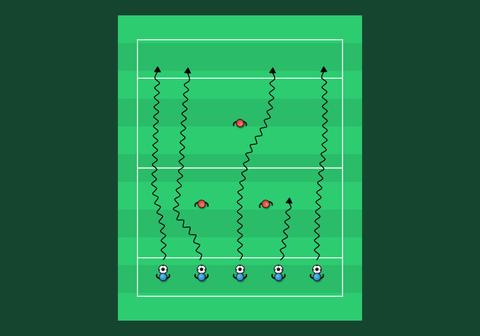
Who’s afraid of the defender? Dribbling game from island to island
Mark out an area of approximately 16 x 20 metres. At each end, create an island about three metres deep, and divide the sea between them into two halves with a halfway line. There are three defenders in the sea: two in one half and one in the other. The defenders stay in their own half. Everyone else has their own ball and starts on the same island. The attackers dribble the ball from one island to the other, and each successful crossing is a point. Set off straight back from the island. If a defender wins the ball, the attacker and defender swap roles. Change the defenders every couple of minutes. Make it harder by adding defenders or removing the halfway line, allowing the defenders to move across the whole sea. For a large group, set up several areas.
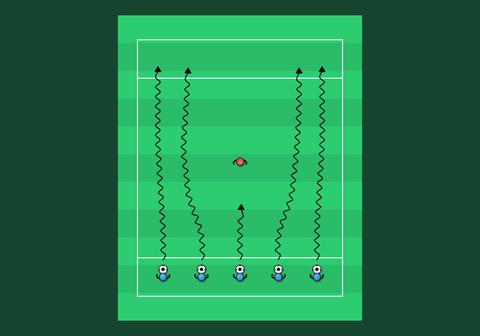
Who’s Afraid of the Defender? Caught Players Help the Defenders
Mark out an area of approximately 16 × 20 metres. At each end, create an island about three metres deep, with the sea in between. In the sea, there is initially one defender, who can move anywhere in the whole sea. Everyone else has their own ball and starts on the same island. Everyone sets off at the same time and tries to dribble the ball to the opposite island. If the defender wins the ball, they kick it out of the area, and the caught player takes a bib and joins the defenders. Players set off straight away back to the other side. With each crossing there are more defenders and fewer dribblers. The last player on the ball wins. For a large group, start with two defenders or make two areas.
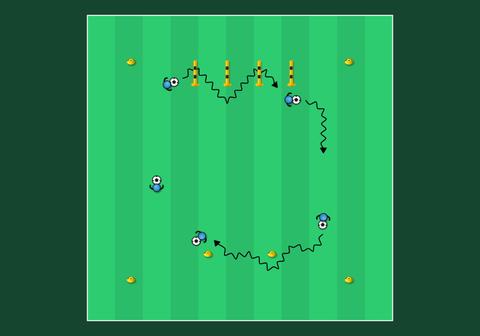
Dribbling circuit with slalom and feint
Set up a square circuit of approximately 20 × 20 metres and mark the corners with cones. On the top side, place four slalom poles at 2.5-metre intervals, and on the bottom side, place two cones about five metres apart. The right and left sides remain straight. Each player has their own ball, and the players start at different points on the circuit so that nobody is queuing. Everyone moves in the same direction. In the slalom, use dribbling with short touches and move through at speed. The cones on the bottom side act as defenders: dribble straight at them, use a feint, and beat an opponent by going past on the opposite side. Anyone who catches up can go around the outside. One circuit suits 6–8 players, so for a large group set up more than one circuit. Change direction every few laps, or have the players dribble with only the right foot or only the left foot. If there are no poles, the slalom can be done with cones.
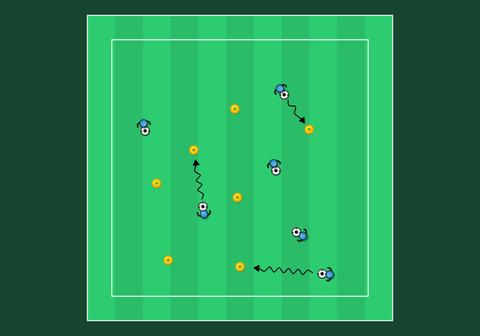
Stop the ball on a cone
Mark out an area of approximately 16 × 16 metres and spread flat cones around it at different distances, so that there are both short and long gaps between them. Ten cones are enough for six players. Each player has their own ball, and everyone works at the same time. The players dribble from cone to cone and use different parts of the foot: the sole, the instep, the inside of the foot and the outside of the foot. When a player stops the ball on top of a cone, they score a point. The ball may be kept on the cone for a maximum of three seconds. If someone is already at a cone, continue to another cone. Who can score the most points in a minute? For a large group, make the area bigger and add more cones in the same proportion. When the game is going well, some of the players become blockers: they dribble their own ball to cones and block them by stopping the ball on top of them.
Red light, green light
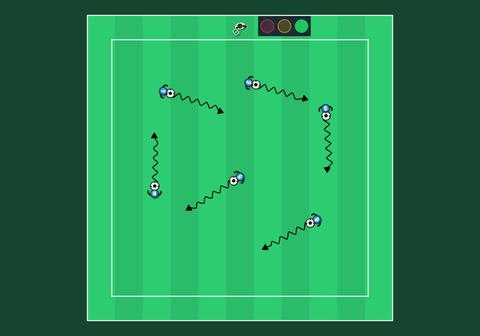
Everyone has their own ball, and everyone keeps moving all the time. The coach calls out a colour. On green, the players dribble at a good speed; on yellow, slowly with small touches. On red, the ball stops under the sole. Mark out an area of about 15 × 15 metres with cones. The coach stands at the side of the area and changes position from time to time, so the players have to lift their eyes off the ball. The arrows in the picture show the green light. The animation shows the full cycle: green, yellow, red and green again. Harder: the coach shows the colour with a cone or bib and does not say anything. Then the colour can only be seen by looking at the coach. Traffic officer: on red, the coach checks whether anyone is still moving. Any player still moving does five alternating sole touches on top of the ball and continues. Nobody is out of the game. For a bigger group, use a bigger area.
Fill the area relay
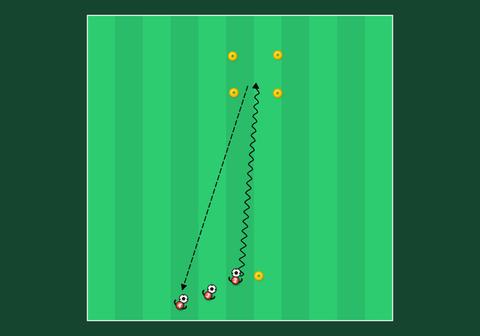
Mark out a square-shaped area with cones, about 3 x 3 metres, and a starting cone about 20 metres below it. The line stands at the starting cone, each with their own ball. The first player dribbles their ball into the area, leaves it inside the area and runs back without the ball to the back of the line. The next player sets off as soon as the previous one has left their ball. The rotation continues until all the balls are in the area. Two teams do this at the same time in their own areas. The winner is the one that gets their balls into the area first. The diagram shows the position of the other team. The other one is set up the same way on the other side of the pitch. The ball must stay inside the area. The drill can be continued so that in the second round the balls are collected out of the area.
Cone slalom dribbling
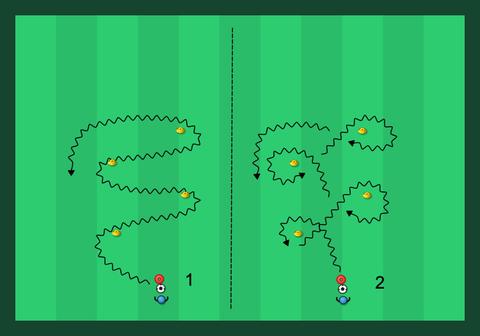
Place the cones generously apart so that there are several touches between them. In phase 1, go around the cones normally, varying the dribbling methods (free, sole of the foot, turns with the outside/inside of the foot, etc.). In phase 2, go fully around the cones using either the inside or the outside of the foot.
Tic-tac-toe relay
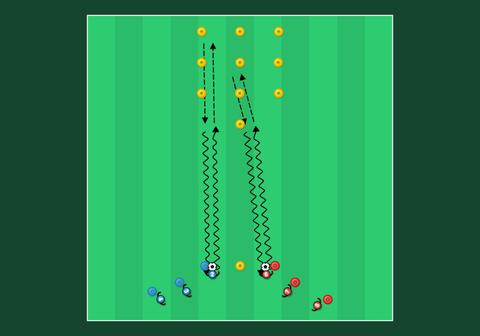
Two teams compete to see which can get three of their own markers in a straight line first. Build a 3 x 3 grid with cones, one cone in each square. Place a starting cone about 10–15 metres from the bottom edge of the grid, with two lines behind it. Each player has one marker in their team’s colour, and the first player in each line has a ball. Both teams start at the same time. The player whose turn it is dribbles the ball to the edge of the grid, leaves the ball there and runs into the grid. They place their marker in one free square, return to the ball and dribble it to the front of the line. The next player starts as soon as the ball is back, and the previous player goes to the back of the line. A team wins when it has three markers in the same row, column or diagonal. There are three markers per team, so every square is worth thinking about. If neither team gets three in a line, collect the markers and start again. With younger players, shorten the distance. Lengthen it if you want more running.
1v1 gate game
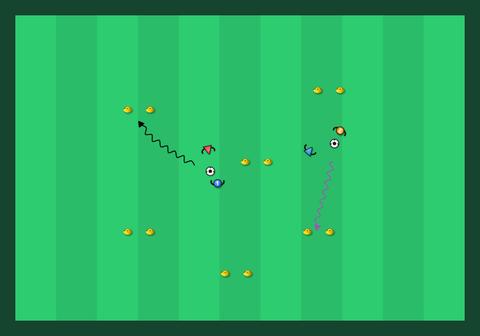
Players are split into pairs. There are several small gates on the pitch. The attacker on the ball tries to dribble the ball through a gate, the defender tries to stop them and win the ball. After a successful dribble through a gate, the attacker immediately continues to the next gate of their choice. The same gate cannot be used twice in a row.
Slalom dribbling relay
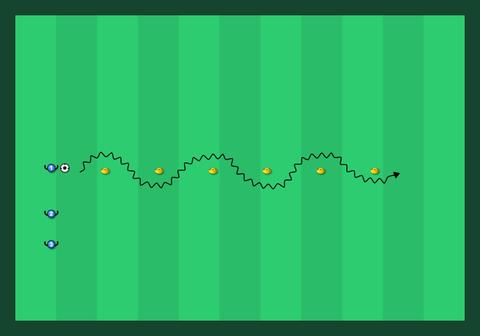
Cones are set out in a straight line 0.8–1.5 metres apart. Players dribble the ball between the cones using the inside and outside of the foot. Relay race: the player dribbles through the course, turns and returns, after which the next player sets off.
Gate dribbling
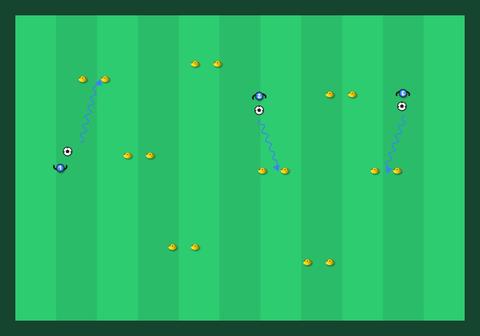
8–12 small gates are set up in the area. Each player has a ball. On the coach’s signal, the players dribble the ball and try to get through as many gates as possible in the given time. You cannot go through the same gate twice in a row.
Shark Attack
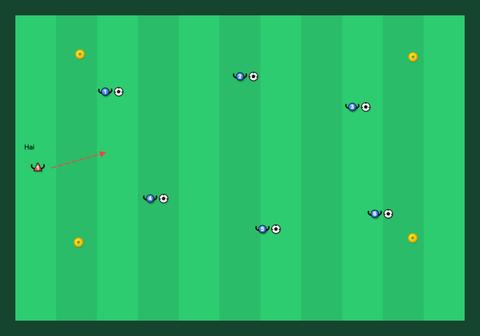
All players have a ball inside the grid except for one "shark", who starts outside the area. On the coach's signal, the shark comes into the area and tries to kick the players' balls out. A player whose ball is kicked out also becomes a shark. The last player on the ball wins the round.
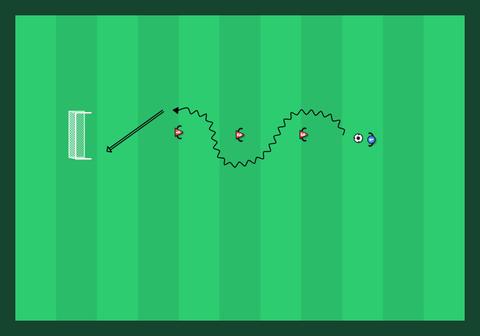
Dribbling-through course
The player starts to dribble the ball towards the first defender and tries to beat an opponent in a 1v1 situation. After beating the defender, the player continues to the next defender and finally finishes into the goal. The defenders are passive (U10–U11) or active (U12+).
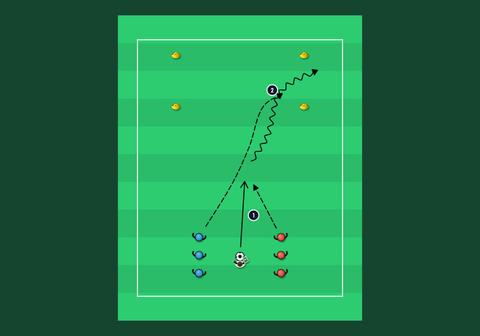
1v1 duel and shielding the ball to two gates
The coach stands with the balls at the lower end of the area, and the teams are in lines on either side of them. In the top corners of the area there are two four-metre gates, through which the ball is dribbled out to the side. The coach plays a pass forward into the middle, and the first player from each line goes for the ball. The player who gets the ball tries to dribble it through either gate, and the other tries to win the ball and stop them. If they win the ball, they can then try to go through either gate themselves. The duel ends with a goal or when the ball goes out of the area, and the players return to the back of their lines. Contact is allowed, but sliding tackles are forbidden. The area is approximately 16 × 20 metres.
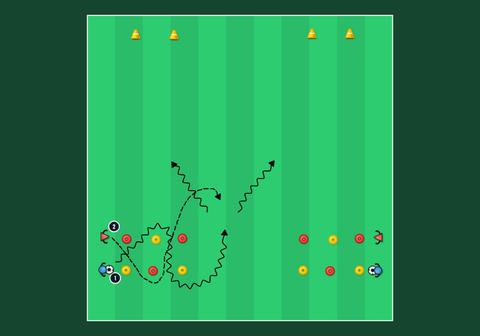
Dribbling and 1v1
A 1v1 drill in which players first weave through cones and then go into a traditional duel towards two small goals. The defender can start moving when the attacker has reached the first turn. After winning the ball, the defender can score by dribbling over the end line between the cones. Change ends and roles after every repetition.
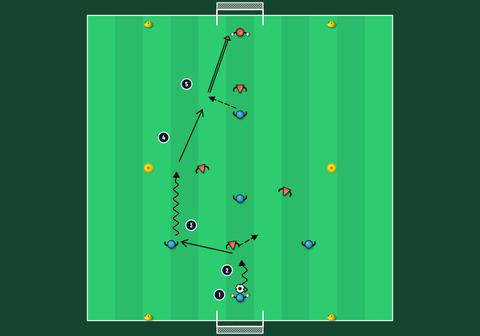
5v5 goal-dribbling game
5v5 game in which the team practises building play with a goal-dribble. When the ball goes over the end line, the defending team restarts by dribbling from any point in their own penalty area. The opponent may wait 5.5 metres from the ball. The player on the ball can carry the ball forwards or pass to a free player. In the example, the presser goes towards the goalkeeper, so the goalkeeper passes to the free player on the left. This player dribbles down the flank and passes to the attacker, who shoots. If an attack that starts from a goal-dribble ends in a goal, it is worth two points. All other goals are worth one. Play short blocks and rotate the teams often. According to the Football Association of Finland rules, 8- and 9-year-olds restart 5v5 by dribbling. In matches for seven-year-olds and younger, the opponent drops back to halfway for the goal-dribble and only defends once play has restarted.