1v1 dribbling — how to train beating a defender
In its 2023 coaching-line renewal and age-phase coach education, the Finnish Football Association (Palloliitto) chose two main development priorities: the ball-carrying attacker and the player defending against the ball carrier. "Through various studies and international comparisons, we have found that these players' skills are a clear development area for us," the association states [1].
Beating a defender — the attacker's ability to win a 1v1 — is exactly this ball-carrying skill. So how do you actually train it?
Dribbling separates the best
Huijgen et al. (2009) followed 131 Dutch academy players from age 14 to 18. Those who became professionals were on average 0.3 seconds faster in a 30-metre dribbling test, and a full second faster in a repeated 3 × 30 m test [3]. Dribbling ability predicted professional status more reliably than many other measured attributes.
FIFA's U-17 World Cup analysis (2023) showed it at match level too. Senegal's Amara Diouf stood out for his dribbling and created danger for his team even when they had less of the ball than their opponents [4]. His 1v1 ability made up for the lack of ball dominance.
Ages 8–12: the golden window
FIFA calls the 8–12 age band the "golden era of learning" [5]. Children pick up coordination and technical skills faster during this period than at any other age. The coach's job is to maximise ball contacts: every player needs lots of touches, lots of attempts, and a safe environment to experiment in.
Palloliitto's childhood phase (U7–U11) recommendations list ball carrying, receiving, and turns as technical priorities [2]. 1v1 situations begin here, but without tactical overload. In the youth phase (U12–U15), 1v1 becomes the main theme of Palloliitto's age-phase coaching course [6].
Small-sided games create the most 1v1 situations
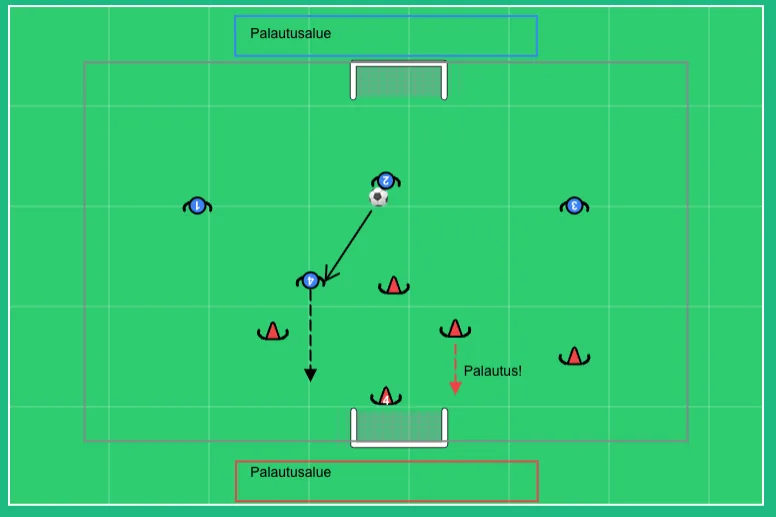
Fenoglio's (2003) study at Manchester United compared 4v4 and 8v8 formats with U9 players. 4v4 produced 225% more 1v1 situations, 280% more dribbling tricks, and 500% more goals [7]. Small-sided games force players into 1v1 because fewer teammates are available.
Coutinho et al. (2022) studied ball touches in small-sided games: the format's rules shape how often each player gets on the ball and makes decisions [8]. Tight spaces and fewer players mean more 1v1 repetitions.
Game situations teach more than cone courses
Santos et al. (2023) compared analytical and game-based dribbling training with 9-year-olds. In the short term, both improved technique equally. The difference showed up in transfer: game-trained players applied the skill in matches better [9].
In a Teaching Games for Understanding (TGfU) study, both game-based and drill-based groups improved passing and dribbling over five weeks. The gap appeared in retention tests: the game-based group kept the skill longer [10]. Drills can introduce a technique, but the skill only sticks in game context.
FIFA's three-phase model
FIFA's grassroots programme teaches 1v1 skills in three phases [11]:
- Start without a defender. Lots of repetitions. The player builds confidence on the ball.
- Add a defender. Guide with questions: "What did you do when the defender closed in?"
- Move to a game. Players apply what they learned, coach steps back.
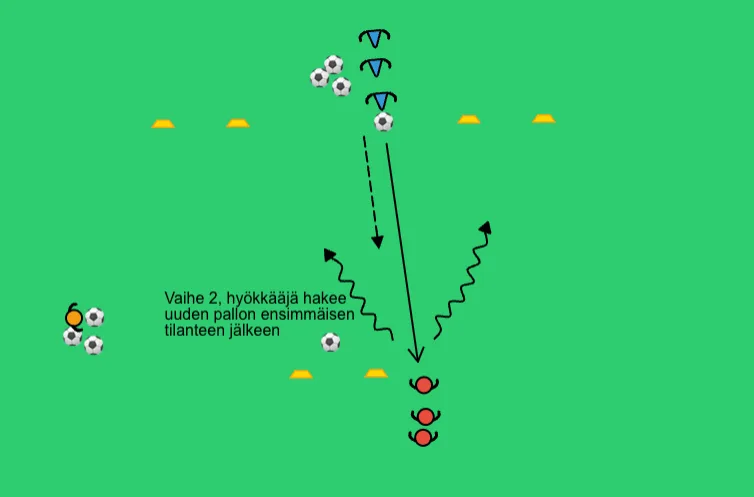
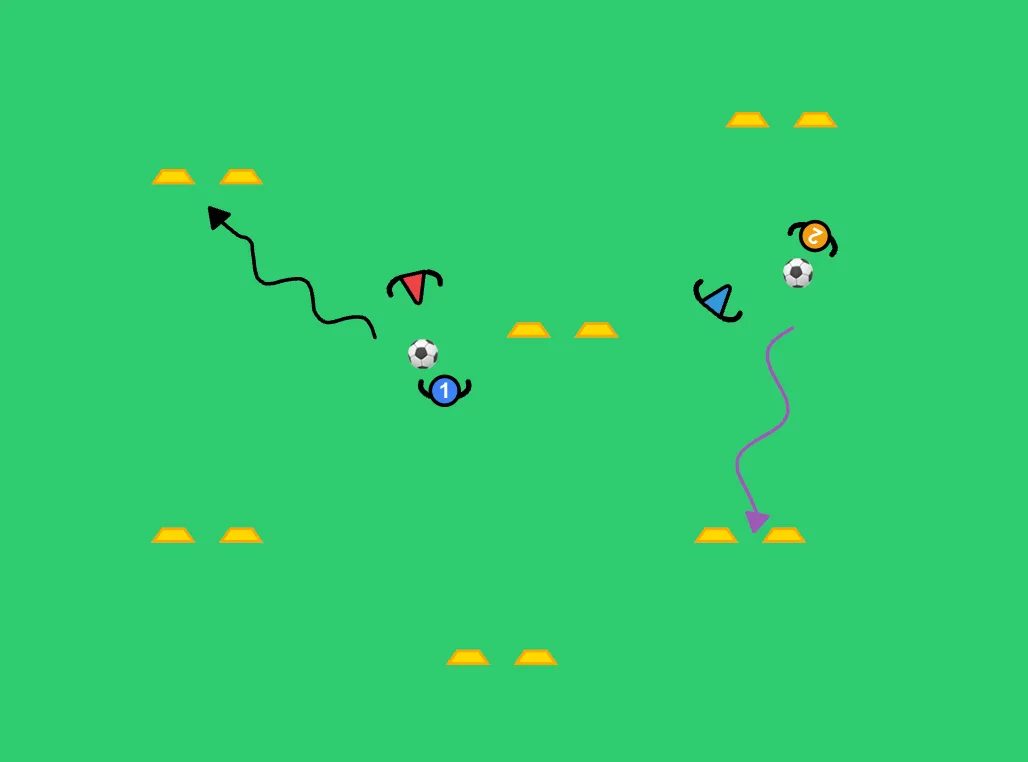
FIFA's session "Look for the 1v1" (ages 12–15) puts this into practice: warm-up is a tag game, skill work is a competitive dribbling task, and the match is 6v6 with the rule "beat a defender before you can pass" [12]. The rule is relaxed as the session progresses, so players learn to read when to dribble and when to pass.
Palloliitto's 1v1 programme
Palloliitto adopted a 1v1 tournament concept from Poland, where roughly 55,000 juniors play it annually [13]. The aim is to build individual skill and signal to coaches that 1v1 matters in children's training.
Finland's technique competitions (ages 9–12) also measure dribbling directly: the weaving test requires at least 3 ball touches on straight sections, and the dribble-and-shoot test requires at least 2 touches before the penalty area [13]. They measure the same basics that 1v1 demands.
Principles for session design
A few practical takeaways:
- Small-sided games (3v3, 4v4) produce the most 1v1 situations. Use them as the core of the session.
- Introduce technique without a defender first, but move to game situations quickly. A move learned on a cone course does not transfer to a match without a live opponent.
- Use rules to steer behaviour: "beat a defender before you pass" forces attempts. Relax the rule when players are ready.
- Palloliitto targets 80% active time [14]. 1v1 and 2v2 formats keep passive time low by design.
- Let players experiment. Beating a defender takes courage, and courage grows in an environment where failing is allowed.
Sources
- Palloliitto (2025): "Coaching line put into practice through coach education" — age-phase training priorities
- Palloliitto (2023): "Coaching line updated in 2023"
- Huijgen, Elferink-Gemser, Post & Visscher (2009): "Soccer Skill Development in Professionals" — International Journal of Sports Medicine
- FIFA Training Centre (2023): "Beating defenders 1v1 in the final third" — U-17 World Cup 2023
- FIFA Training Centre: "Ages 8–12: Focusing on technical skills"
- Palloliitto: "Coaching line brought to practice through coach education"
- Fenoglio (2003): "The Manchester United 4v4 Pilot Scheme for U9s" — FA Coaches Association Journal
- Coutinho et al. (2022): "Exploring how limiting the number of ball touches during small-sided games affects youth football players' performance across different age groups" — International Journal of Sports Science & Coaching
- Santos et al. (2023): "Development of Dribbling in Young Football Players: Comparison Between Analytical and Game-Based Tasks"
- "Improving football playing skills through teaching games for understanding: A small-sided games approach" (2023)
- FIFA Training Centre: "Introduction to the progressive methodology"
- FIFA Training Centre: "#139 Look for the 1v1"
- Palloliitto: "Club technique competitions and new 1v1 tournament concept"
- Palloliitto (2022): "Finnish youth football sessions observed"