Game-based training – why drills aren't enough
In traditional coaching, skills are taught in isolation and then transferred to the game. Research shows this sequence works poorly. Isolated skills don't transfer to match situations because the drill strips away the information players use to make decisions — defender positioning, teammate movement, space, and time [1].
Game-based training works the other way: start with a game, identify the problem, practise it in a game-like environment, and return to the game. FIFA calls this the Play-Practice-Play model [2].
What the research says
Decision-making improves
Praxedes et al. (2018) studied 19 U12 players over 14 sessions. The experimental group trained using conditioned small-sided games; the control group used traditional drills. Result: decision-making improved with statistical significance (p < .001) and passing execution improved (p = .003) in the experimental group [3].
Skills are retained better
Bianchi et al. (2024) compared an ecological-dynamic approach to a traditional teaching model with young players. The game-based group improved immediately and retained the skill better in follow-up testing [4].
Fitness develops simultaneously
Los Arcos et al. (2015) compared small-sided games and interval training in young elite players. SSGs improved VO2max values just as effectively as intervals — and produced significantly higher enjoyment [5].
Small-sided games by the numbers
| Quality | Game-based | Traditional drill |
|---|---|---|
| Decision-making | Significant improvement [3] | Not directly trained |
| Technical execution | Improves in game context [6] | Improves in isolation, poor transfer |
| Skill retention | Better long-term retention [4] | Weaker without context |
| VO2max | Equal or better [5] | Effective but non-specific |
| Enjoyment | Significantly higher [5] | Lower |
Constraints guide, the coach doesn't dictate
The Constraints-Led Approach (CLA) says player behaviour is shaped by changing task constraints (rules, pitch size, player numbers, equipment) rather than telling players what to do [7].
Three constraint types:
- Task constraints: rules, pitch size, goals, touch limits
- Environmental constraints: surface, weather, social context
- Individual constraints: body, skill level, motivation
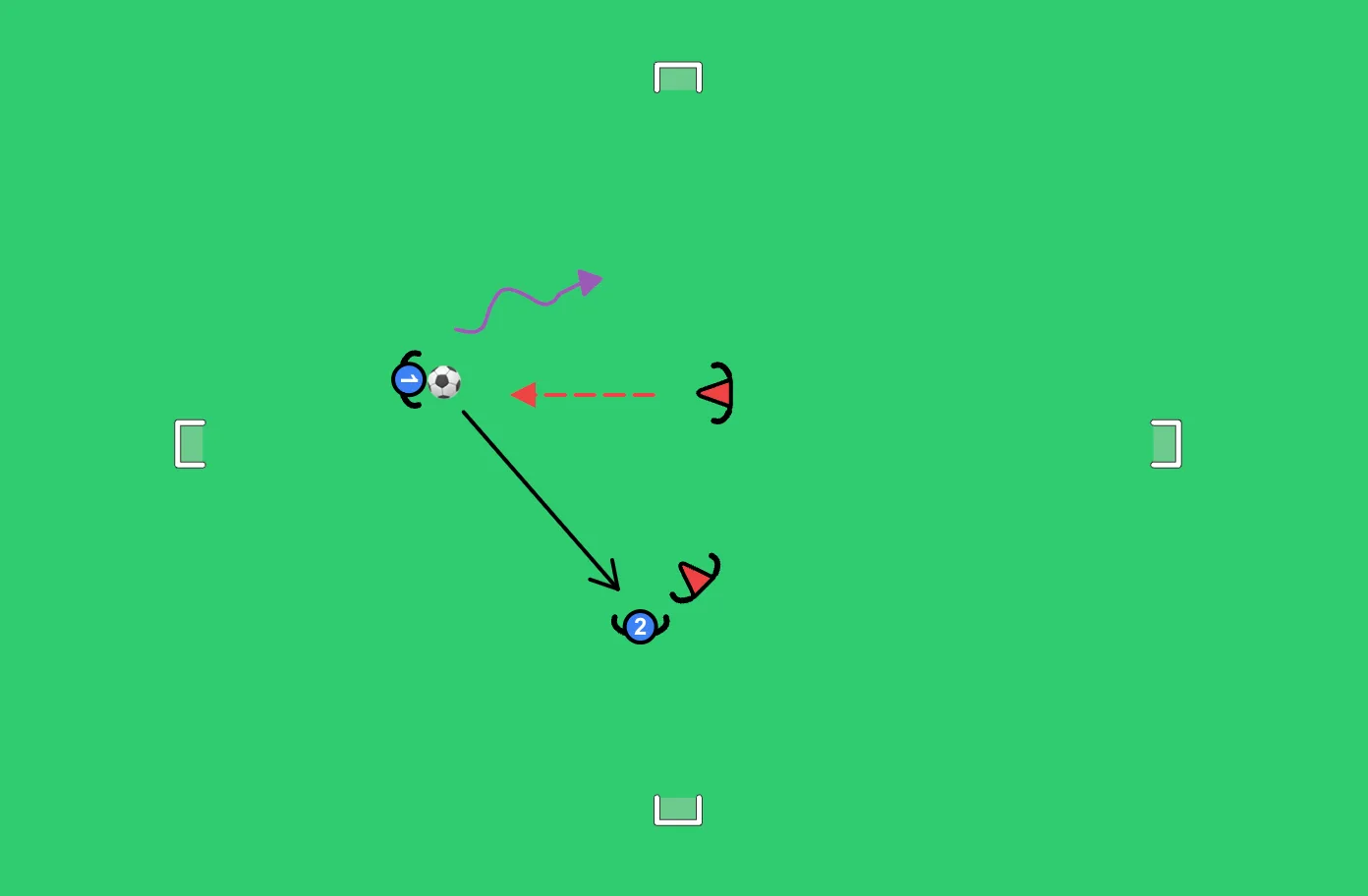
In practice: if you want players to play forward faster, shrink the pitch and add end-zone goals. Don't say "play faster".
Pitch size matters
Folgado et al. (2018) found that when SSG pitch size matches the match-derived relative player area (~300 m²/player), tactical behaviour patterns most closely resemble actual matches [8]. Arbitrarily chosen pitch sizes produce unrepresentative training.
Rampinini et al. (2007) showed that 3v3 on a large pitch with coach encouragement reaches 91% of maximal heart rate. 6v6 on a small pitch without encouragement stays at 84% [9]. The coach's role and pitch size together regulate intensity precisely.
Play-Practice-Play in practice
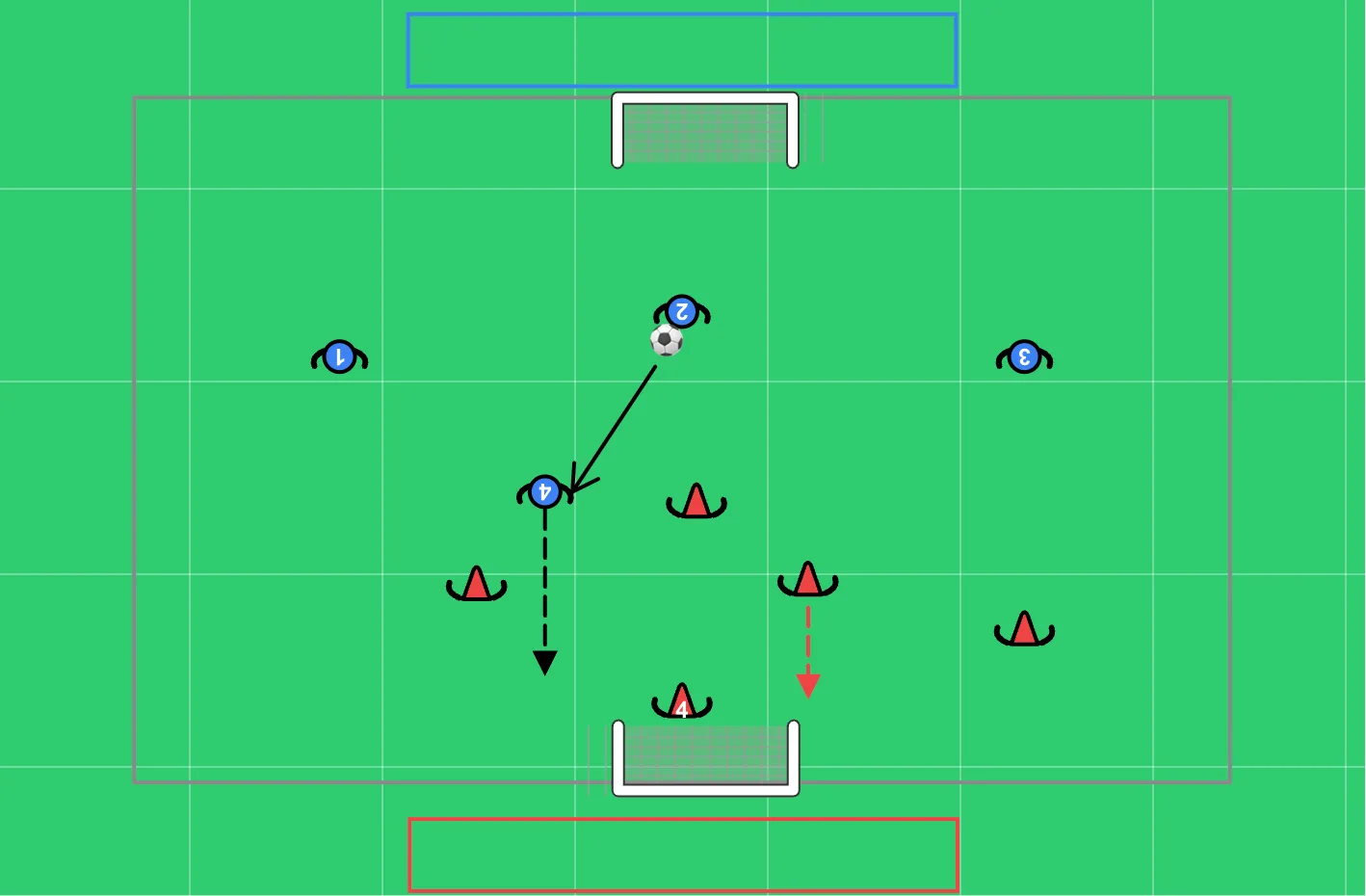
The PPP model used by FIFA and US Soccer in three phases [2]:
- Play: Start with a game. Observe what problems arise.
- Practice: Isolate the problem. Practise it in a game-like environment (not in a queue, but under pressure).
- Play: Return to the game. Let players apply what they learned.
The Finnish FA session structure follows the same logic: game-based start, themed drill, 1v1/2v2, and a larger game to finish [10].
Who does this apply to?
Ford and Williams (2012) followed young players, some of whom progressed to professional level. Those who became professionals had trained significantly more in game-like environments and unstructured play compared to those who didn't progress [11].
Yet Ford et al. (2010) found that coaches at all levels still spend more time on drills than games [1]. The research points one way, coaching practice still points the other.
Sources
- Ford, Yates & Williams (2010): "An analysis of practice activities and instructional behaviours" — Journal of Sports Sciences
- FIFA Training Centre: "An Introduction to Play-Practice-Play"
- Praxedes, Moreno, Gil-Arias, Claver & Del Villar (2018): "The Impact of Nonlinear Pedagogy on Decision-Making" — Journal of Human Kinetics
- Bianchi, Trequattrini & Morelli (2024): "Ecological-Dynamic Approach vs. Traditional Prescriptive Approach" — PMC
- Los Arcos, Vazquez, Martin et al. (2015): "Effects of Small-Sided Games vs. Interval Training" — PLOS ONE
- Gonzalez-Villora, Clemente, Martins & Pastor-Vicedo (2021): "Effects of SSG Interventions on Technical Execution" — Frontiers in Psychology
- Renshaw, Davids, Newcombe & Roberts (2019): The Constraints-Led Approach — Routledge
- Folgado, Goncalves & Sampaio (2018): "Match-Derived Relative Pitch Area" — Journal of Strength & Conditioning Research
- Rampinini, Impellizzeri, Castagna et al. (2007): "Factors influencing physiological responses to SSGs" — Journal of Sports Sciences
- Finnish FA (2023): "Good session structure creates the framework for player development"
- Ford & Williams (2012): "The developmental activities engaged in by elite youth soccer players" — Psychology of Sport and Exercise