Adapting drills on the fly — when and how?
A session plan is a hypothesis. It's based on assumptions about what players need and how they'll respond. Reality only reveals itself on the pitch — and that's when coaches need to know how to adapt.
Partington and Cushion (2013) found that experienced coaches make significantly more spontaneous changes to drills than novices. These changes aren't random; they come from systematic observation [1].
When should you adapt a drill?
Three situations that call for adaptation:
- Players succeed more than 80% of the time. Challenge is missing and learning stalls [2].
- Success rate below 20%. Frustration builds and motivation drops [2].
- Players standing around, queuing, or waiting for their turn. Over 30% passive time is common [3].
Challenge level matters
Guadagnoli and Lee (2004) proposed the Challenge Point Framework: learning is most effective when task difficulty matches the player's skill level [2]. Too easy provides no challenge; too hard prevents success.
In practice, this means a success rate of roughly 40–70%. If nearly every pass reaches its target in a passing drill, it's too easy. If nobody succeeds, it's too hard.
Changing constraints
The Constraints-Led Approach (CLA) gives coaches concrete tools for adjusting drills [4]. The Finnish Football Association's coaching guidelines (2023) also emphasise game-centred training where changing conditions guides player behaviour [11]. Instead of telling players what to do, change the conditions so that the desired behaviour emerges naturally.
Increasing difficulty
- Reduce pitch size → less time and space for decisions
- Add defenders → more pressure
- Limit touches → forces faster thinking
- Remove goals and add end zones → requires combination play
Decreasing difficulty
- Enlarge pitch → more space and time
- Add a floater/joker → easier ball retention
- Allow unlimited touches → less pressure
- Add small goals → more scoring opportunities
Quick adjustments by the numbers
| Change | Effect | Source |
|---|---|---|
| 20% pitch size reduction | Heart rate up 3–5%, more touches | [5] |
| 3v3 → 4v4 | Ball contacts drop ~25%, tactical complexity increases | [6] |
| Adding a floater | Possession time increases, pressure drops | [7] |
| Touch limit (2-touch) | Passing speed increases, decision time decreases | [8] |
| Coach encouragement | Heart rate rises from 84% to 91% HRmax | [5] |
An observation model for training
Harvey et al. (2013) developed a model describing coaching decision-making as a continuous process [9]. The coach doesn't just launch a drill and watch from the side — they actively read the situation.
A practical tool: the 90-second cycle.
- Observe for 60 seconds. What are players doing? Is the challenge right? Are there inactive players?
- Decide in 10 seconds. Is a change needed? What single thing would improve the drill?
- Act in 20 seconds. Change one thing: pitch size, player numbers, a rule, or the goal type.
One change at a time. If you change everything at once, you won't know what worked.
Common mistake: too many changes at once
Abraham and Collins (2011) warn that inexperienced coaches often make too many changes simultaneously [10]. The result: the original drill falls apart and the new version doesn't work either.
One rule: change one thing at a time. Allow 2–3 minutes to see the effect before making another adjustment.
Example: a 4v4 game that isn't working
Situation: players cluster around the ball, no real game develops.
- Observation: The pitch is too small for the number of players. No space or time.
- Option A: Enlarge pitch by 5 metres per side → space to play.
- Option B: Switch to 3v3 + floater → overload player opens up the game.
- Option C: Add end zones instead of goals → forces use of wide areas.
Pick one. Try it. Reassess after 2 minutes.
Try it in practice
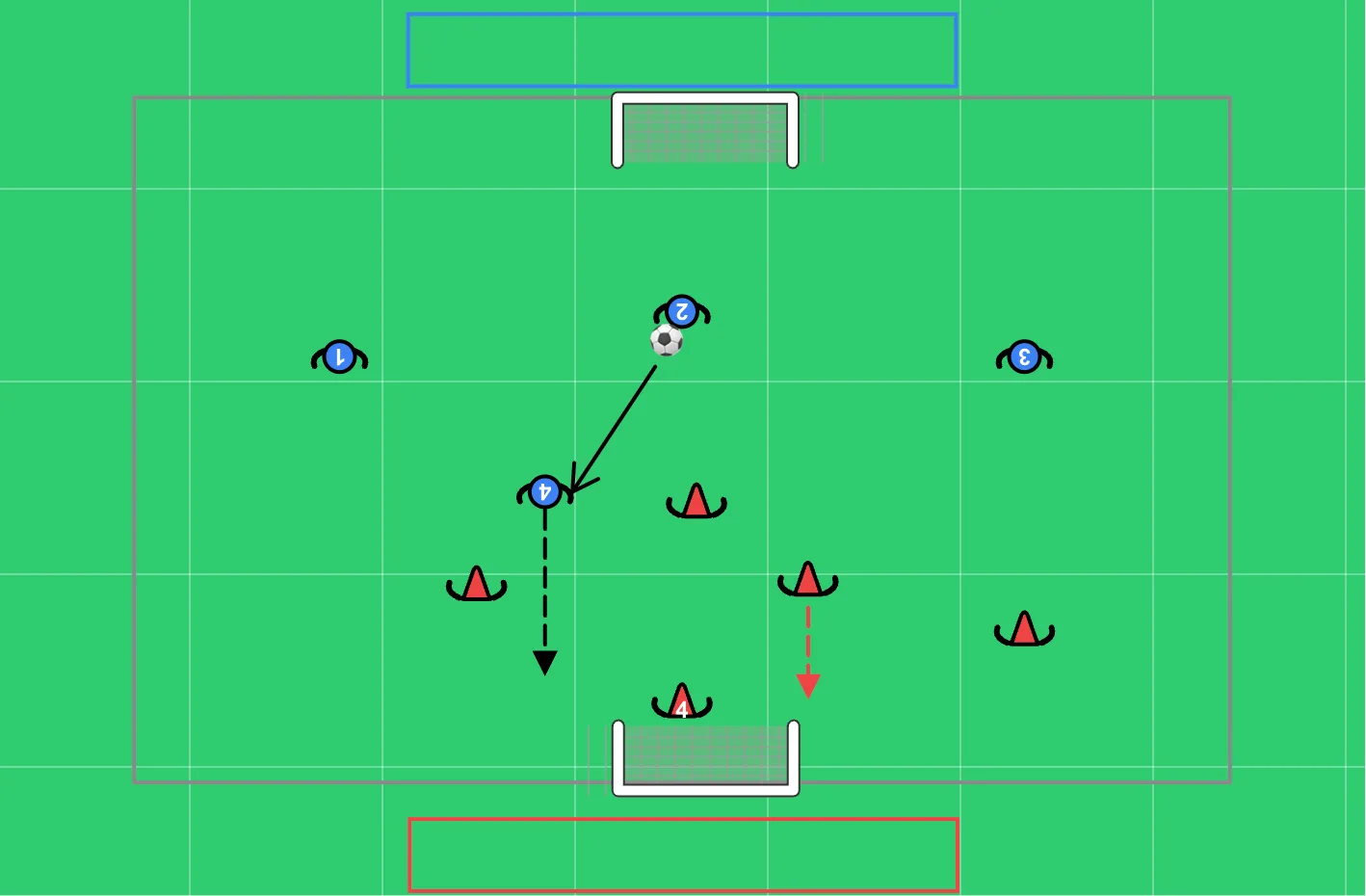
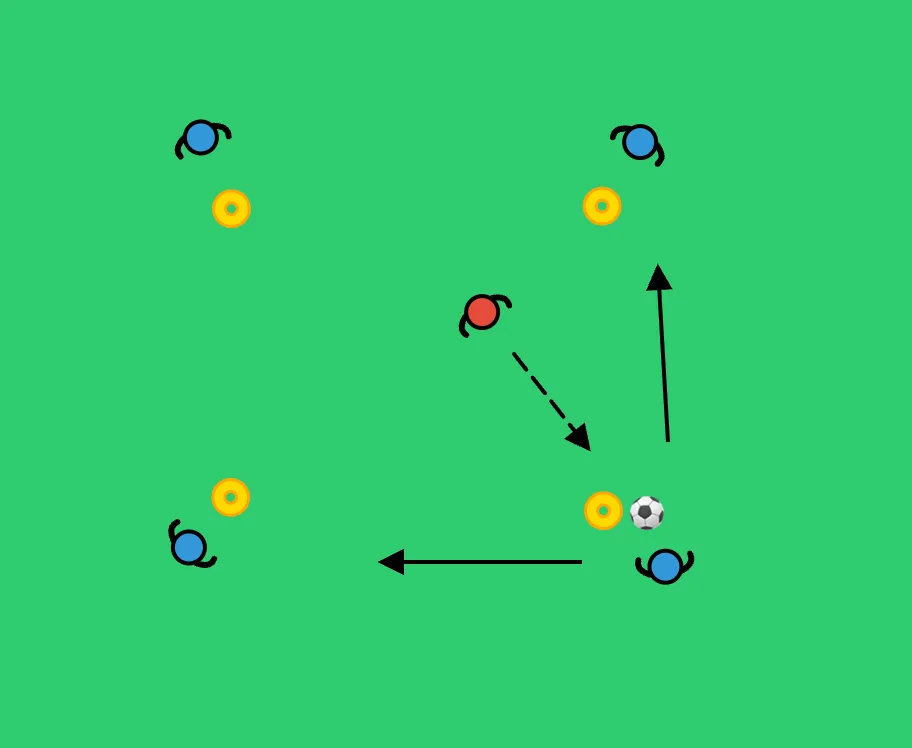
Two drills where adjusting difficulty is a natural part of the exercise:
Related reading
Sources
- Partington & Cushion (2013): "An investigation of the practice activities and coaching behaviors of professional top-level youth soccer coaches" — Scandinavian Journal of Medicine & Science in Sports
- Guadagnoli & Lee (2004): "Challenge Point: A Framework for Conceptualizing the Effects of Various Practice Conditions" — Journal of Motor Behavior
- O'Connor, Larkin & Williams (2018): "Observations of youth football training" — Journal of Sports Sciences
- Renshaw, Davids, Newcombe & Roberts (2019): The Constraints-Led Approach — Routledge
- Rampinini, Impellizzeri, Castagna et al. (2007): "Factors influencing physiological responses to SSGs" — Journal of Sports Sciences
- Clemente, Martins & Mendes (2014): "Periodization Based on Small-Sided Soccer Games" — Strength & Conditioning Journal
- Sampaio, Lago, Goncalves, Macas & Leite (2014): "Effects of pacing, status and unbalance in elite football" — International Journal of Sports Medicine
- Dellal, Lago-Penas, Wong & Chamari (2011): "Effect of the Number of Ball Contacts within Bouts of 4 vs. 4 SSGs" — International Journal of Sports Physiology and Performance
- Harvey, Cushion, Cope & Muir (2013): "A season long investigation into coaching behaviours" — Journal of Sports Sciences
- Abraham & Collins (2011): "Taking the next step: Ways forward for coaching science" — Quest
- Finnish Football Association (2023): "Valmennuslinja 2023"