1v1 defending — how to teach it
In its 2023 coaching-line renewal and age-phase coach education, the Finnish Football Association (Palloliitto) chose two main development priorities: the ball-carrying attacker and the player defending against the ball carrier. "Through various studies and international comparisons, we have found that these players' skills are a clear development area for us," the association states [1].
1v1 defending has thus been placed at the centre of Finnish player development. So what actually decides it?
Body control matters, not speed
Duarte et al. (2012) studied U12 players in 1v1 situations. Successful defending was characterised by predictable positioning and constraining the attacker's options [3]. The defender leads the situation rather than reacting to it.
Wilson et al. (2018) measured 1v1 defending performance in over a thousand trials with 17-year-olds. Sprint speed did not predict defensive success at all [4]. Players with better dribbling ability defended better. Ball handling apparently develops the same body control and balance that defending demands.
FIFA's defending principles
FIFA's Talent Coach Programme defines the ball-near defender (D1) principles [5][6]:
| Principle | In practice |
|---|---|
| Body shape | Low, side-on stance. Never square to the attacker. |
| Approach | Sprint to close distance, decelerate with small steps. Stay balanced. |
| Engagement distance | 2–3 metres when the attacker receives the ball. |
| Forcing direction | Push the attacker wide. Press from the inside. |
| Pressing triggers | Poor first touch, slow pass, attacker facing own goal. |
Four steps
Both research and FIFA's materials use the same four steps [5][6]:
- Close down the attacker's time on the ball.
- Stay balanced and hold position.
- Force the attacker into a less dangerous area.
- Tackle, but only when the odds are good.
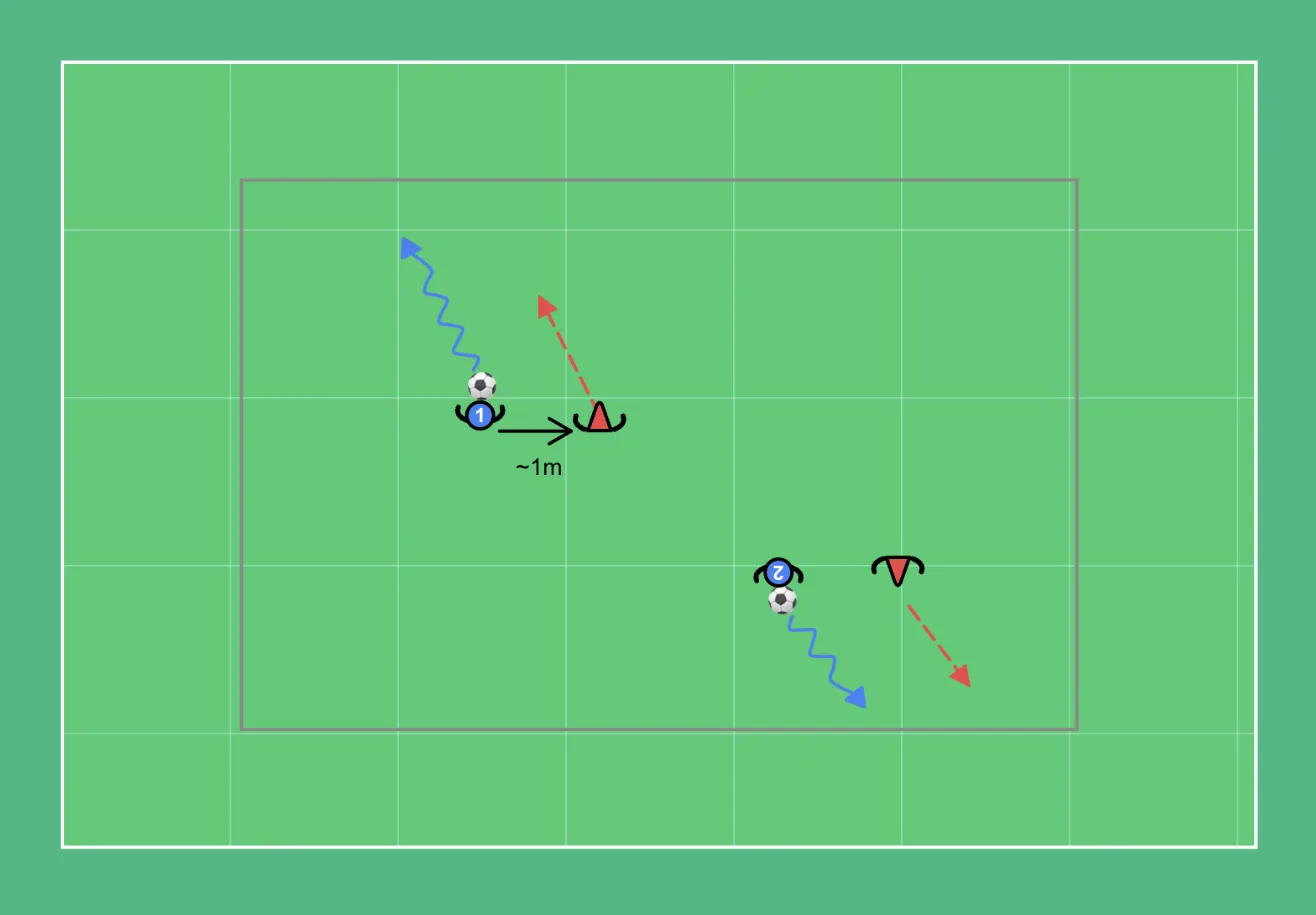
Most successful defensive actions end at steps 2 or 3. The tackle is the riskiest move: most traumatic football injuries occur in contact situations, especially tackles [7]. A good defender resolves the situation before tackling.
When to teach defending
FIFA and Palloliitto follow the same progression [2][8][9]:
- U7–U9: no separate defending instruction. Defending emerges naturally from small-sided games.
- U10–U11: 1v1 defending enters training. 1v1 situations are the main focus of Palloliitto's age-phase coach education at this stage [1].
- U12–U15: technical-tactical defending becomes part of structured coaching [9].
- U15–U19: full pressing system with duel-winning techniques and counter-pressing [10].
FIFA's South Africa U15 session trains defending progressively: 1v1 → 1v2 → 2v3 → 3v4 → 4v5 [6]. Each step adds tactical complexity while the 1v1 foundation stays.
Small-sided games and targeted practice
Small-sided formats (3v3, 4v4) produce the most individual defending situations: tackles, delays, and transitions [11]. Larger formats (7v7, 8v8) develop collective defending like compactness and inter-line play.
Small-sided games alone are not enough, though. Research found that interception and tackling skills did not improve through SSG training alone [12]. These need targeted practice. FIFA's D1 drill is a good example: the defender practises approach and directional control in a restricted area before moving to game context [5].
Pressing
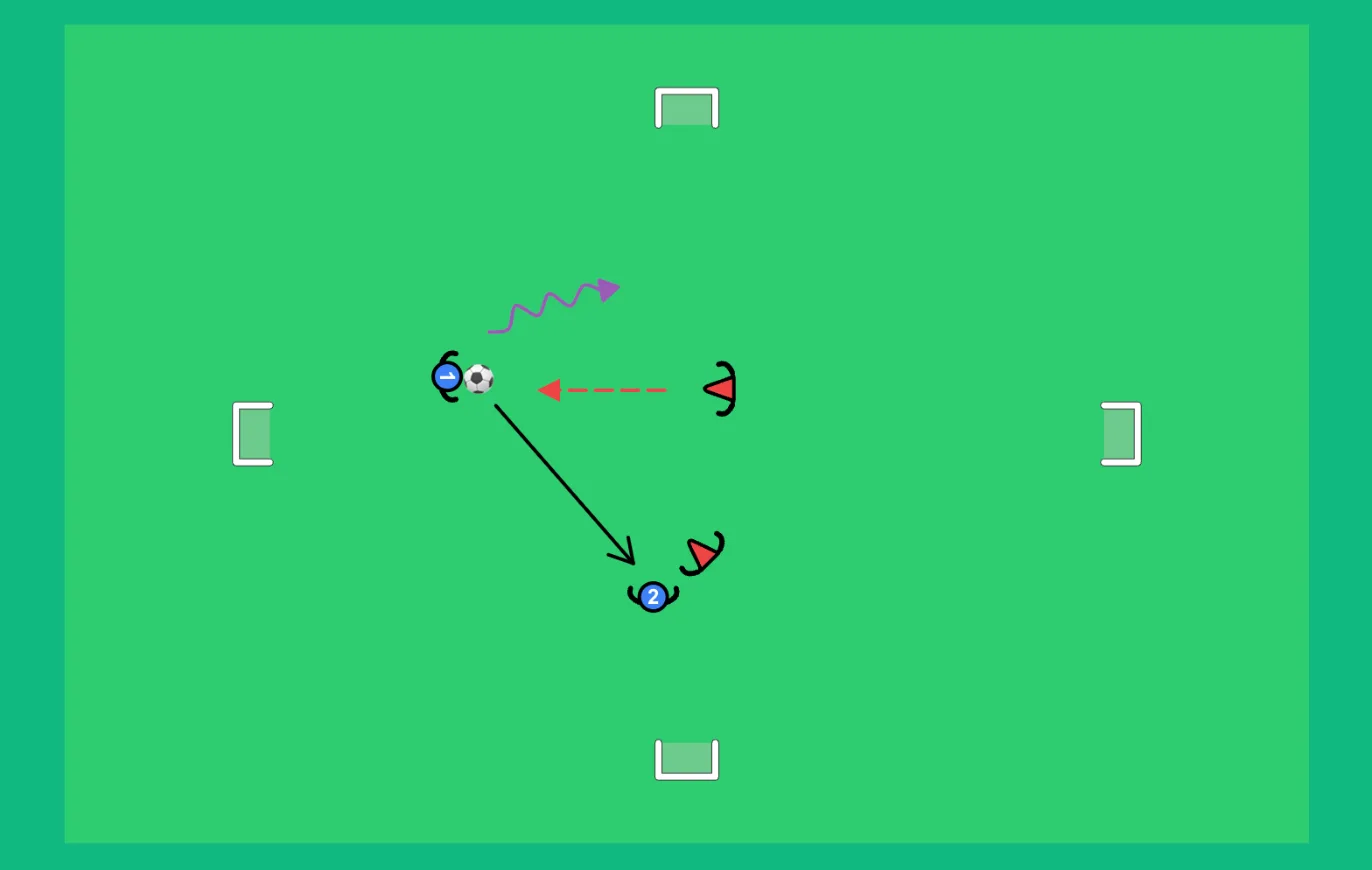
Pressing is one of four playing principles in Palloliitto's youth national team philosophy [10]. In their words: "Duel play is naturally an important part of pressing. Players need rapid approach skills and ball-winning techniques."
Counter-pressing matters as much. It is done at full speed and together, and does not stop after the first setback but continues to the end [10]. A defender who gets beaten keeps defending.
Principles for sessions
A few practical takeaways:
- 1v1 defending is a coordination problem, not a speed contest. Train positioning and body control.
- Teach four steps: approach, delay, control, tackle. The tackle is the last resort.
- Small-sided games (3v3, 4v4) create defending situations, but add targeted D1 drills separately.
- Pressing triggers (poor touch, slow pass) are coaching moments. Name them for your players.
- 1v1 situations are the main focus of Palloliitto's age-phase coach education [1]. Defending is part of that.
Sources
- Palloliitto (2025): "Coaching line put into practice through coach education"— age-phase training priorities
- Palloliitto (2023): "Coaching line updated in 2023"
- Duarte, Araújo, Davids, Travassos, Gazimba & Sampaio (2012): "Interpersonal coordination tendencies shape 1-vs-1 sub-phase performance outcomes in youth soccer"— Journal of Sports Sciences
- Wilson, Smith et al. (2018): "Predicting the defensive performance of individual players in one vs. one soccer games" — PLOS ONE
- FIFA Training Centre: "Defending in 1v1: Orientating attackers away from goal"(Talent Coach Programme)
- FIFA Training Centre: "South Africa U15: Fundamentals of attacking and defending"
- Fuller, Junge & Ekstrand (2004–2013): FIFA contact injury studies
- Palloliitto: "Good session structure creates the framework for player development"
- Palloliitto: "Youth phase U12–U15"
- Palloliitto: "Youth national team playing principles: Pressing"
- Clemente et al. (2021): "Effects of Small-Sided Game Interventions on Technical Execution and Tactical Behaviors" — Frontiers in Psychology
- "Agility development in youth soccer: the efficacy of fixed-role small-sided games" (2025) — Frontiers in Sports and Active Living