What rondo drills train
A rondo is a possession game in a small area: the players on the outside keep the ball, and one or more defenders in the middle try to win it. Rondo drills train quick, accurate passes with the right weight, a first touch away from the defender who is pressing, and the habit of knowing where that defender is before the ball arrives. The small area packs a lot of touches and decisions into a few minutes, and the rules are simple enough that you can start straight away. In most of the rondos on this page, when the defenders win the ball, the players who lost it go into the middle and play goes on.
4v1 rondo
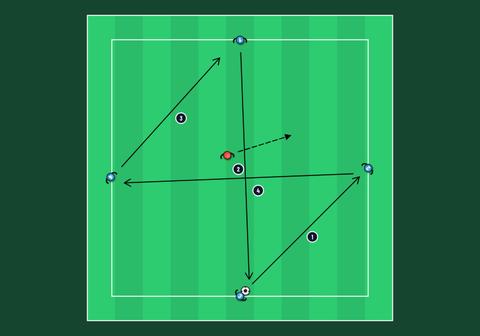
Mark out a square of approximately 10 x 10 metres. Four players are on the sides of the square, one on each side, with a defender in the middle. The players on the outside keep possession of the ball. They may move along their own side, but must not go inside the square. The defender tries to intercept the pass. When the defender wins the ball or the ball goes out of the square, the defender swaps places with the player who lost possession. Play restarts immediately. Ten consecutive passes equals one point. Make it easier with a bigger square or unlimited touches, and harder with a smaller square or a two-touch limit.
4v2 rondo
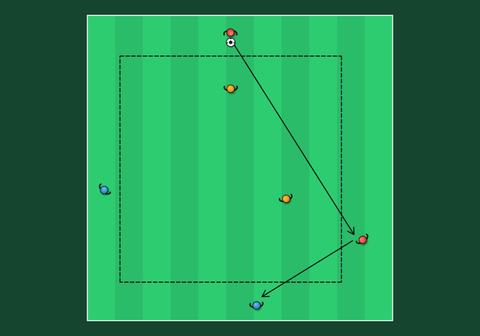
Mark out a square area and make three pairs of two players. Two pairs are on the outside on the edges, giving four passers in total, with one on each side. One pair is inside the area trying to win the ball. The players on the outside keep possession from side to side. The players winning the ball split the work: one presses the player on the ball, the other blocks the next passing lane. When they win the ball, the pairs swap places and play continues immediately without a restart. Adjust the size of the square to suit the level. A smaller square shortens the passes and forces quicker touches.
5v2 rondo
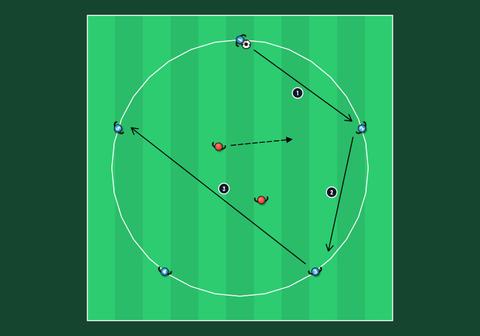
Mark out a circle of about 12 metres. Five players set up evenly spaced around the outside, and two defenders go in the middle. The players around the outside pass to each other and move around the circle, but they must not go inside it. When there is a gap between the defenders, the ball is played through it. The player who loses possession goes into the middle, and the defender who has been in the middle longer moves out to take that player's place on the outside. The same rotation is made when the ball goes out of the circle. A point is scored for ten consecutive passes. Limit touches to one-touch or two touches according to level.
The rondos on this page
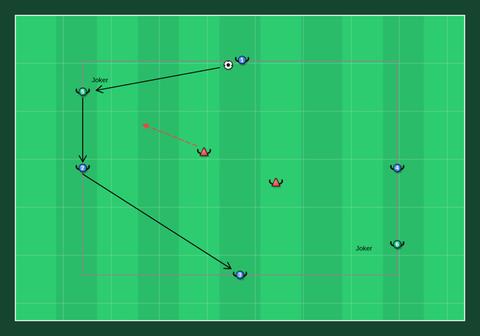
First up is the single-defender rondo. In the 4v1 rondo, four players, one on each side of a square, keep the ball away from one defender and can move along their own side. A defender who wins it swaps places with the player who lost it. In the 4v2 rondo there's a second defender, and the two share the work: one presses the player on the ball, the other blocks the next passing lane. When the ball is won, the pairs swap places and play goes on at once without a restart. A smaller square shortens the passes and forces a quicker first touch. In the 5v2 rondo, five outside players face two defenders with a limit of one or two touches, depending on the level. In the rondo with jokers, two jokers always play for the team on the ball, so the outside players have to choose between the joker and another outside player. The jokers move along the edges of the area on unlimited touches, while the outside players have one or two. The 4v2 pressing rondo puts the defenders first. They press by cutting off passing lanes, and nobody chases the ball. The last two spread it over zones. In the three-zone rondo, an area of 30 × 15 metres is split into three zones. The teams in the end zones try to pass across the middle, the middle team sends two players to win the ball, and a point comes when the ball travels from end to end. When the ball is won or goes out, the team that lost it moves into the middle. In the zonal rondo, the team on the ball starts in the middle zone, plays out to a wide zone and switches through the middle to the other side.
Rondo with jokers
Possession drill (e.g. 4v2) with two jokers, who always play on the side of the player on the ball. The jokers move along the edges of the area and offer extra passing options. 1–2 touch limit for the outside players, jokers on unlimited touches. The defenders try to win the ball — the player who made the last pass goes into the middle.
4v2 pressing rondo
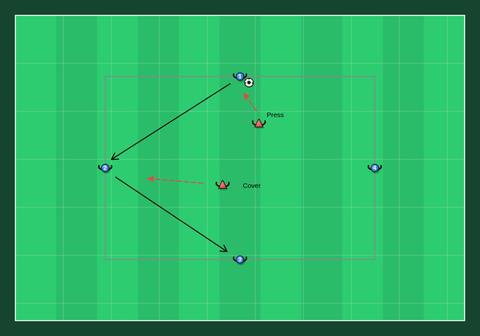
The outside players keep possession with one-touch or two touches, 2 defenders in the middle try to win the ball or intercept the pass. When a defender gets the ball or forces it outside the area, the player who made the last pass goes into the middle.
Three-zone rondo (basic)
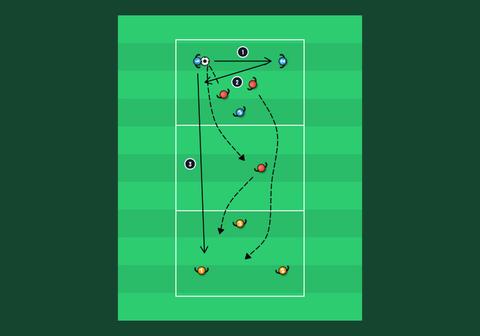
Mark out a 15 × 30 metre area and divide it into three 10-metre zones. Place a team of three players in each zone. The end teams keep possession and try to play the ball over the central zone to the other end. From the middle team, two players win the ball in the end zone where the ball is, and one stays in the middle to cut out long passes. When the ball switches ends, two players from the middle team run across after it. If the middle team wins the ball or the ball goes out, the team that lost possession moves into the middle and the winning team takes that end zone. Each successful pass from one end zone to the other is a point.
Coaching points and key questions
Three of the rondos ask what you see before you receive. The 4v2 rondo asks where you look before the ball comes to you, and the 5v2 rondo which way you turn your body before it arrives. The 4v1 rondo asks where you move on your side when a teammate gets the ball, and how you can tell that a pass through the middle won't get past the defender. In the 4v1 rondo the first touch goes away from the defender, in the 4v2 rondo towards the side where the next pass goes. In the 4v2 rondo, the 5v2 rondo, the pressing rondo and the three-zone rondo, the defenders are asked who presses and who covers. The pressing rondo also asks whether they talk to each other on the pitch. The 5v2 rondo asks the outside players how they recognise the moment to pass between the defenders, and the zonal rondo asks how many touches you need and why. The three-zone rondo brings in the transition too: the team that loses the ball moves straight into the middle to defend.
Zonal rondo
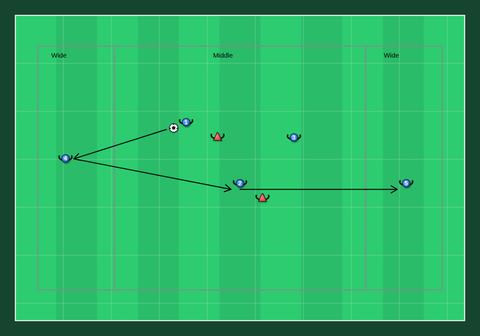
Three zones side by side (narrow-wide-narrow). The team in possession starts in the middle zone and tries to play the ball into the wide zone. The defenders try to prevent play to the side. After a successful pass to the side, the ball is played back into the middle and switched to the other side.
Rondos by age
The 4v1 rondo and the rondo with jokers are marked from U9, the 4v2 rondo, the 5v2 rondo, the three-zone rondo and the zonal rondo from U10, and the 4v2 pressing rondo from U11. With a single defender, the 4v1 rondo is the simplest drill on the list. Jokers make keeping the ball easier, because they always create a numerical advantage. Still, the easiest dial to turn is the size of the area: a bigger square gives more time, a smaller one less.