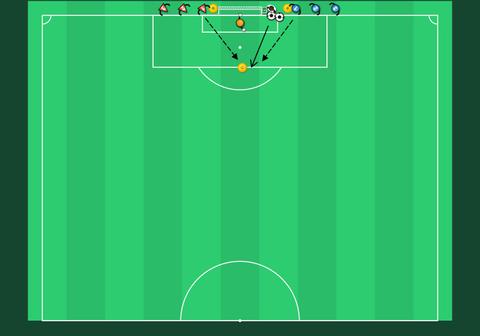
Corsa alla palla e tiro
I giocatori vengono divisi in due squadre, che si dispongono in fila dietro la linea di fondo ciascuna dal lato del proprio palo. La testa della fila è segnata con un cono. In porta c'è un portiere. L'allenatore si posiziona con i palloni dietro la linea di fondo accanto al palo destro. Al centro, a circa 20 metri dalla porta, viene posizionato un cono segnalatore. L'allenatore effettua un passaggio oltre il cono segnalatore in modo che la palla si fermi alla stessa distanza dalla testa di entrambe le file. I primi delle file partono al momento del passaggio. Chi arriva per primo sulla palla attacca, l'altro difende. Da lì si gioca un 1 contro 1 fino al tiro. Entrambi tornano in fondo alla propria fila e la coppia successiva inizia. Si contano i gol: quale squadra ne realizza di più? Con la direzione e la velocità del passaggio, l'allenatore mantiene equilibrata la sfida. I giocatori più grandi possono effettuare il passaggio da soli. In quel caso, il giocatore della fila di destra effettua il passaggio oltre il cono e parte in rincorsa; la palla può essere toccata solo dopo il cono, e il giocatore della fila di sinistra difende. Per aumentare la difficoltà della fase offensiva si può inserire un limite di tempo.
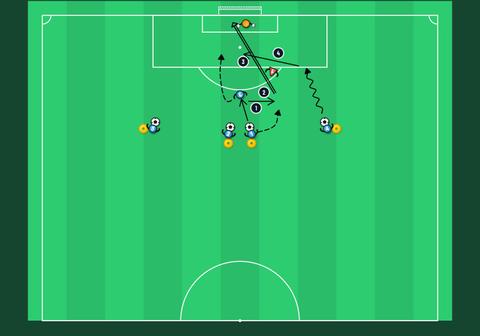
Two shots: lay-off from the wall and a square pass from the wing
A goal includes a goalkeeper. At the top of the penalty arc there is a wall player without the ball, and in the middle 7–8 metres behind them there are two lines with balls. On both wings there is a wide line with balls on the extension of the side of the penalty area, level with the central lines. On the edge of the penalty area there is one defender. The first player in the central line passes to the wall and makes a diagonal run wide. The wall lays the ball off into their run, and they shoot first time from about 18 metres before the defender can get tight. The wide player starts dribbling towards goal already during the first pass. After the lay-off, the wall drops back a step, runs into the penalty area and finishes first time from the wide player's square pass. The shooter then becomes the next wall player, the wall goes to the wide line on the side from which they finished, and the wide player goes to the central line. The next repetition is done from the opposite wing, so the side changes on every repetition.
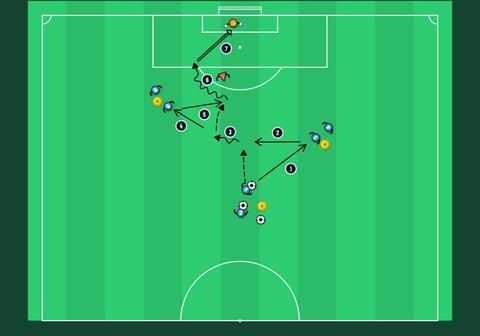
Two one-twos, a feint and a shot
There is a goalkeeper in goal. In the middle, outside the penalty area, there is a queue with balls. The wall players are on the sides: the right one slightly closer to the goal, the left one above the corner of the penalty area. Both have their own queue. There is a defender at the edge of the penalty arc. The first player in the middle queue plays a pass to the right wall player and runs forward. The wall player returns it one-touch into his run. He dribbles the ball to the left, plays a pass to the left wall player and runs forward again, and the wall player returns it into his run. At the defender, he shows inside, goes past on the outside and shoots into the far corner. The defender reacts to the feint but does not win the ball. Change the defender every few repetitions. The rotation goes anticlockwise. The shooter moves to the right wall queue, the right wall player to the left wall queue and the left wall player to the middle queue. When the pattern is mirrored, the first wall player is on the left and the shot is with the left foot.
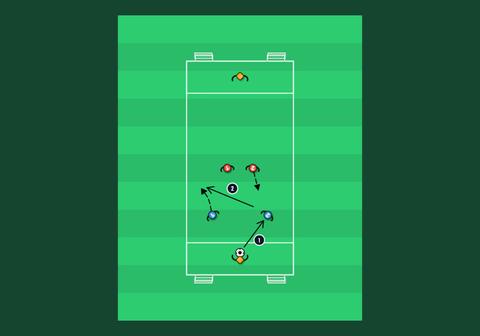
2v2+2 outnumbered: the pair closes the pass into the end zone
Mark out a 10 x 20 metre area and a three-metre zone at each end. There is a joker in each zone, who plays with the team in possession and does not leave their zone. Behind each end, place two small goals. In the middle, two teams of two players play. The joker starts by passing to a player from the team in possession. The pair tries to play the ball to the joker at the opposite end, receive it back from them, and score in either of the small goals at that end. As a target player, the joker may only play backwards. The defending pair tries to stop the split pass and win the ball. When they succeed, the roles change immediately. There are two phases in the animation. First, the blue team attacks up the pitch. When the joker passes to blue 2, red 2 starts pressing during the pass and red 1 stays inside to provide cover. Blue 2 plays into the run of blue 1. Red 1 shifts during the pass, but remains a step too far away, and the ball goes through to the joker. The joker plays it into the run of blue 2. The reds turn immediately and close the space behind them, and red 2 gets tight and wins the ball before the shot. In the second phase, the reds attack down the pitch immediately after winning the ball, when the blues have not yet had time for recovery defending. Red 2 plays into the run of red 1 to the left. Before blue 1 can get tight, red 1 passes directly along the touchline to the lower joker. The joker plays the ball into the run of red 2, and red 2 scores in the right small goal. The blues turn, but are a step late because the pair did not manage to close the passing lane into the end zone.
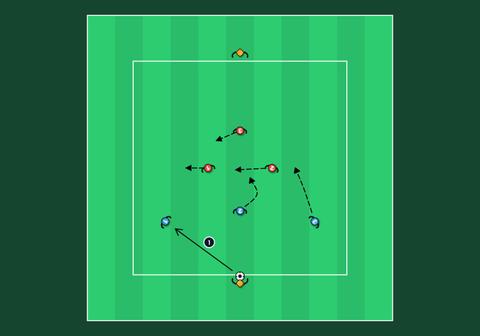
3v3+2 outnumbered: close the middle and force wide
Mark out a 20 × 20 metre area. Place a joker at each end, always playing with the team in possession. Two teams of three players play inside the area. The game starts with a joker. The team in possession tries to move the ball to the joker at the opposite end, so they have five players against three. The defending three try to win the ball. When they succeed, the roles change immediately, and the team that won the ball attacks. The nearest joker can be used as support. There are two rounds in the animation. First, the blues attack upwards. When the ball goes left, the reds shift across as a full three towards the ball side. Red 1 forces Blue 1 towards the touchline, and Red 2 closes the pass into the middle. Blue 1 still tries to play the ball inside, and Red 2 intercepts the ball. The reds keep the ball and play it through the nearest joker. The blues press for a moment and then drop back into their own three. In the second round, the blues stay compact, so the red player in the middle has to pass wide. The blues shift during the pass as one unit, Blue 1 closes down at the touchline and wins the ball, and the blues immediately launch a new attack.
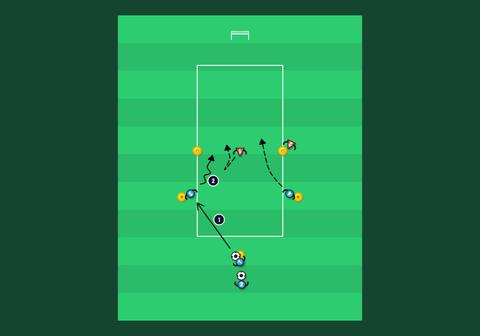
1v2 overload against: turn the situation into 1v1
Mark out a 10 × 20 metre area and a line across the halfway point with two flat cones. The small goal is placed three metres behind the top end of the area and a cone the same distance behind the bottom end. Two passers wait one behind the other by the cone, each with a ball. The wide players stand outside the area on each side, about five metres from the bottom end. The defender is on the halfway line, and the next defender waits at the end of the line outside the area. The passer plays the ball to either wide player. The defender sets off during the pass and decides whether to press the receiver or hold position. The wide players attack the small goal as a pair, and the defender tries to win the ball. The situation ends with a goal or when the ball goes out. There are two repetitions in the animation. In the first, blue 3 receives the ball on the left and dribbles inside. Red 1 approaches at an angle that blocks the pass to blue 4 and drops off diagonally. When blue starts dribbling towards goal, red closes down and plays the ball over the touchline. In the second repetition, the ball goes to the right. Red 2 stays farther away, drops back between the attackers and cuts out an overhit square pass. After winning the ball, he plays it back to the passers' cone. Rotation: the passer follows the pass to the wide position, the wide player who received the ball switches to the opposite flank, and the other wide player goes to the passers' queue. The defenders swap positions after every situation.
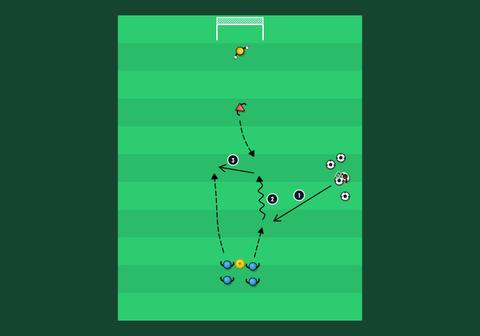
Continuous 2v1 towards one goal
The attackers wait in two queues next to a flat cone, the defender is in front of the goal and the coach is on the wing with balls. The coach plays a pass to the first players in the queues, who attack the goal as a pair. They are up against a defender and a goalkeeper. The defender tries to win the ball, and the attackers’ decision depends on what he does. If he closes down the player on the ball, the player on the ball passes to the free player just before the confrontation. If he stays to block the passing lane, the player on the ball dribbles towards goal and shoots. If the player on the ball delays, the defender has time to win the ball. He passes the won ball back to the coach. When the situation ends, the attacker who shot or lost possession stays in as the next defender. The other attacker and the previous defender go to the back of the queues, and the coach starts the next round immediately. Bibs are not changed, so the defender can be of either colour.
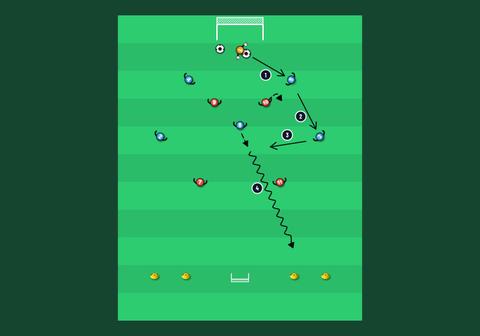
Safe build-up play with numerical superiority
The blues, five players and a goalkeeper, build up from the back against four reds. The blues attack the small goal in the middle or either cone goal on the flank. Dribbling through a cone goal is worth one point and a goal in the small goal is worth two. When the reds win the ball, they attack the large goal, and a goal gives them two points. Play always restarts with the blue goalkeeper, who has spare balls next to him. Every four minutes the teams swap tasks, and one player moves to the other team so that the attacking team has numerical superiority again. For a bigger group, the same game works with eight plus a goalkeeper against seven. The game can be made more difficult by limiting the blues to three touches.
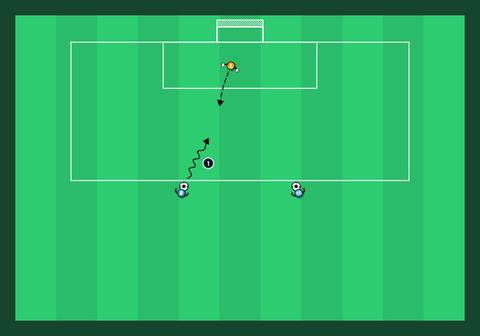
Goalkeeper in a one-on-one through on goal
Two attackers wait with a ball at the edge of the penalty area, one on the left and one on the right. One of them dribbles towards the goal, and the goalkeeper comes out along the line between the ball and the centre of the goal. They stop two or three metres from the attacker and are in a low, wide basic stance before the ball is struck. If the attacker shoots, the goalkeeper catches the ball. If the ball is pushed too far ahead, the goalkeeper attacks it and claims it. After that, the goalkeeper rolls the ball back, and the turn goes to the other side. The attacker may also try to go round the goalkeeper.
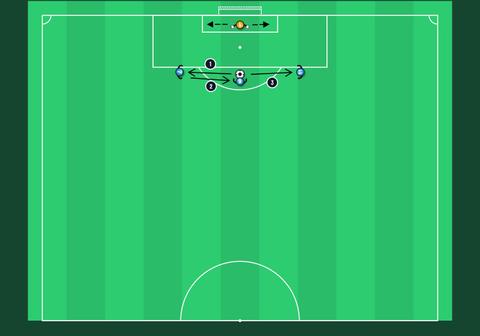
Goalkeeper on the line between the ball and the goal
Three attackers circulate the ball in front of the penalty area. The goalkeeper moves during each pass onto the line between the ball and the centre of the goal, around three metres from the goal line, and is stationary before the ball arrives. On the coach’s signal, the player on the ball dribbles into the penalty area and shoots. The goalkeeper comes out towards them diagonally along the line, because moving only sideways would open up the far corner. After the save, the goalkeeper distributes the ball from their hands to the central attacker, and a new repetition begins. With two goalkeepers, rotate after five shots.
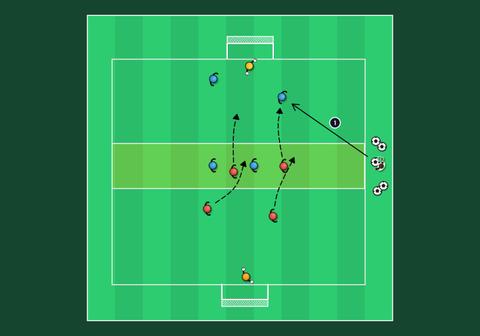
Three-zone pressing game
The coach gives the ball to the other team. The players in the middle can step up to press in their own attacking zone, at which point the players in their own defending zone can move in to fill the spaces in the middle. When the ball is won, free play continues until a goal or a stoppage in play.
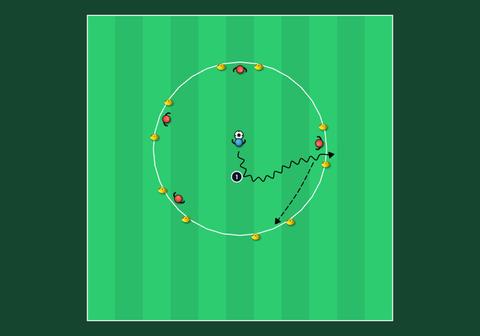
Dribbling through the free gate
The player on the ball in the middle must try to dribble the ball through a free gate. There is one more gate than there are defending players. The defending players guard the gate goals and must not step out to win the ball. The player on the ball tries to use feints to beat the defenders so that they can dribble through a free gate. The feint can also be made with their back to the opponent. In the central area, for example one minute at a time, and then rotate.
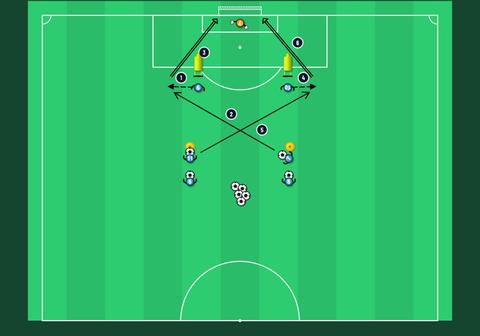
Breaking away and shooting from both sides
Finishing when the defender is behind you. The attacker stands in front of the mannequin with their back to goal. They move away from the mannequin outwards and call for a pass from the queue on the opposite side. First touch towards goal and a shot. Then the same on the other side. Rotation: the passer goes to shoot, and after the shot the finisher stays in the queue on their own side, so the queue changes on every repetition.
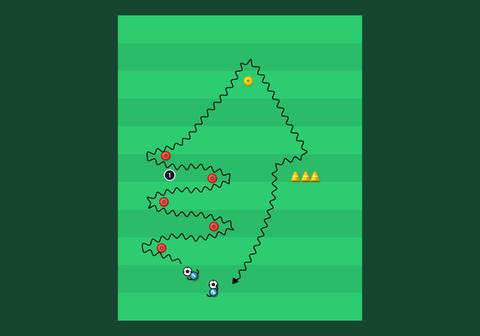
Slalom dribbling, feint and change of tempo
Around the red cones: 1. slalom dribbling (wide spacing, change of tempo important) 2. body feint at every cone. Around the yellow cone and feint past the yellow tall cones with a clear change of tempo. The players queue at the bottom with a ball each. The next player sets off when the previous one has gone through the red cones. In the animation, player 1 slaloms through the red cones and player 2 performs a body feint at each cone. After the yellow cone, the player dribbles straight towards the tall cones, feints in front of them and accelerates past them. Finally, he dribbles the ball back to the end of the queue. In the image, the area is 20 × 25 m.
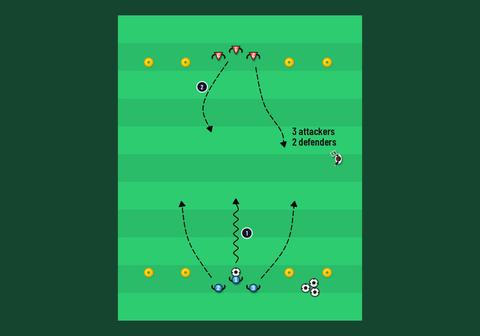
Numerical superiority and counter-attack on the coach’s call.
A small-sided game drill where the coach gives instructions on how many players from each side enter the pitch at a time. For example, "1 defender, 2 attackers". The defender(s) can start moving once the attackers have set off. The attackers queue with balls at one end and the defenders at the opposite end. There are two cone goals at each end. The attackers score by dribbling the ball through either of the opposite goals. If a defender wins the ball, they immediately attack the goals at the attackers’ end. The repetition ends when a goal is scored or the ball goes out. The players return to the back of their queues, and the coach calls the next numbers. Vary the numerical superiority, equal numbers and numerical inferiority, for example 2v1, 3v2, 2v2 and 1v2. Swap the attackers’ and defenders’ queues every few minutes.
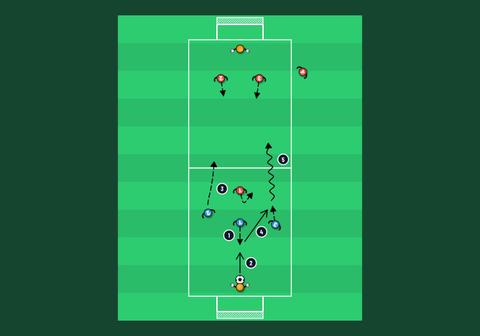
Counter-attack with numerical superiority
Play on a long, narrow pitch with a halfway line and a goal and goalkeeper at each end. In the diagram, the area is 16 x 40 m. Make it as long as the space allows. The blues attack with three. The reds are the counter-attackers: one is in the blues' half, two are in their own half in front of the goal, and a fourth waits outside the touchline. The other groups of three attackers wait for their turn outside the area with their own balls. The goalkeeper starts by giving the ball to an attacker who drops in to receive. In their own half, the blues beat one counter-attacker 3v1 and dribble over the halfway line. There they attack the goal against two. When the blues score, the next group of three starts. If they lose possession, the reds immediately break into a counter-attack towards the other end, and the fourth player who was waiting on the side joins in to create numerical superiority. The reds are not called defenders because they attack as well. Progression: add a time limit.
Alternating 3v2 numerical superiority
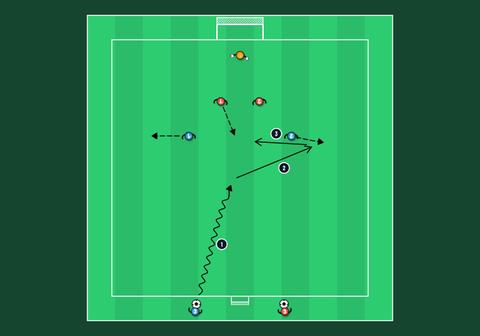
Indoor game on two pitches. On each pitch there is a goal with a goalkeeper and a small goal on the halfway line without a goalkeeper. Instead of the small goal, a bench turned onto its side can be used. The diagram shows one of the pitches, about 20 × 20 m, i.e. half a handball court. On the pitch, each team has two players in front of the goal and one with the ball behind the end line next to the small goal. Blue attacks first. The waiting blue player behind the end line dribbles at full speed towards the goal, creating a 3v2. The other two attackers position themselves as wide as possible. When the reds win the ball, they immediately pass it into the small goal. That is the goal for their counter-attack. The situation continues until there is a goal or the ball goes out. Then the attacking turn changes, and the waiting red player dribbles in. In the diagram, the blue overload player goes back behind the line so that the reds have a 3v2. Variation: blue attacks with numerical superiority towards the other goal and red does the same at the same time at the other end. The first goal is worth two points, including from the counter-attack.
2v2 attacking and counter-attack
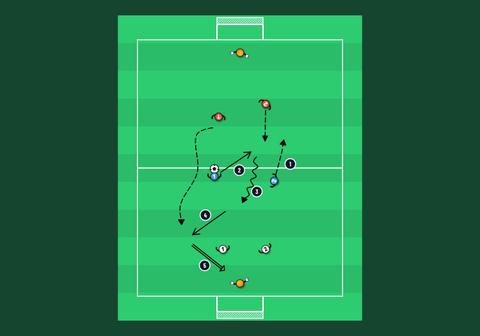
Eight players: three pairs and two goalkeepers. The area is split into two halves by a halfway line, and there is a goal at each end. In the diagram the area is 24 × 30 m. Adapt the size to the age group. One pair starts with the ball from the halfway line and attacks 2v2 towards the goal defended by the second pair. The third pair waits in the other half. If the defenders win the ball, they immediately attack the other end against the third pair. Play does not stop, and there is no need to collect the ball from the goalkeeper. When the attack ends with a goal or a save, or the ball goes out of play, the goalkeeper gives the ball to the pair that was defending, and they attack in the same way towards the other end. The pair that lost possession stays in their own half and defends when the next attack comes there. The defenders engage high so that the attacker cannot get a shot away. For a larger group, set up more than one area.
FIFA 11+ warm-up: full programme
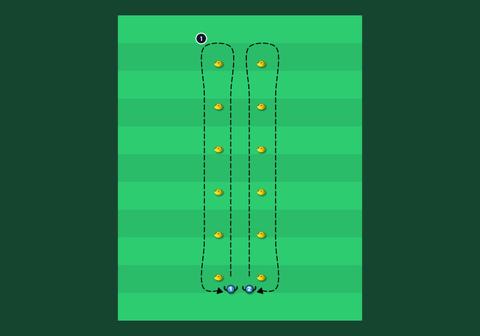
FIFA developed 11+ to reduce injuries, and it is intended for players aged 14 and over. The programme replaces the usual warm-up. It is done at the start of every session, at least twice a week, and takes about 20 minutes. The order of the movements always stays the same. Before a match, only parts 1 and 3 are done. There is a separate programme for under-14s, FIFA 11+ Kids. The course is six pairs of cones, with about 6 metres between the cones both lengthways and widthways. The pair starts at the same time from the first pair of cones and performs the movement between the rows of cones. After the last cone, both return on the outside of their own row. The animation shows movement 1. Part 1, running (8 mins). Each movement is done twice, and the start of the course is jogged lightly. The return on the outside is a jog unless the movement says otherwise. 1. Running forwards: straight to the last cone, return at a slightly quicker pace. 2. Running + outward hip rotation: stop at each cone, knee up in front and rotate out to the side. At the next cone, use the other leg. 3. Running + inward hip rotation: knee up to the side and rotate forwards, alternating legs. 4. Running + rotation around partner: from the cone, side steps to the middle to the partner, circle around each other while keeping your eyes facing the same direction throughout, and back to your own cone. 5. Running + shoulder contact: side steps to the middle, jump sideways towards each other with shoulders against each other and land on both feet with hips and knees bent. Then back to your own cone. Jump at the same time as your partner. 6. Running forwards and backwards: quickly to the second cone and backwards to the first, then again two forwards and one backwards to the end of the course. Short, quick steps. Part 2, strength, jumps and balance (10 mins). There are three levels in each movement. 7. Plank hold, 3 sets: 1) on elbows, body straight from head to feet, hold for 20–30 secs, 2) feet raised alternately with a 2-second hold, 40–60 secs, 3) one foot 10–15 cm off the ground for 20–30 secs, then the other. 8. Side plank, 3 sets on each side: 1) lower knee bent to 90°, hips and top leg in line, hold for 20–30 secs, 2) legs straight, hips down to the ground and back up for 20–30 secs, 3) top leg up and slowly down for 20–30 secs. 9. Hamstrings: kneeling on a soft surface, arms crossed on the chest, partner holds the lower legs just above the ankles. The body leans slowly forwards in a straight line from head to knees, and at the end the hands take the weight into a press-up position. 1 set: beginners 3–5, intermediate 7–10, advanced 12–15 repetitions. 10. Balance, 2 sets, 30 secs on each leg: 1) ball in both hands (harder: heel raised or ball around the waist or under the knee), 2) throw the ball to a partner 2–3 metres away, 3) from arm's length, alternately unbalance each other. 11. Squat, 2 sets: 1) squat with knees at 90°, then rise onto the toes, 30 secs, 2) walking lunge, 10 on each leg, front knee does not go beyond the toes, 3) single-leg squat while holding lightly onto a partner, 10 on each leg. 12. Jumps, 2 sets, 30 secs: 1) squat jump: knees at 90°, brief hold, jump as high as possible and land softly, 2) skating jump about a metre sideways from one leg to the other with a brief hold, 3) cross jumps over an imaginary cross forwards, backwards, sideways and diagonally. Part 3, running (2 mins). Each movement is done twice across the pitch, and the return is a light jog. 13. Running: about 40 metres at 75–80% speed, the rest at a jog. 14. Bounding: a few warm-up steps, then 6–8 bounds with the knee high and the opposite arm across the front of the body. The rest at a jog. 15. Change of direction: 4–5 jogging steps, right foot into the ground and change direction to the left, 5–7 steps at 80–90% speed, decelerate and the same to the other direction. Continue like this to the far side of the pitch. Start all movements in part 2 at level 1. Move to the next level when the movement can be done without problems for the required time or number of repetitions. Learning level 1 takes 2–3 training sessions. Source: FIFA 11+ manual (F-MARC). The English movement names are adapted from the FIFA 11+ programme.
FIFA 11+ Kids warm-up: full programme
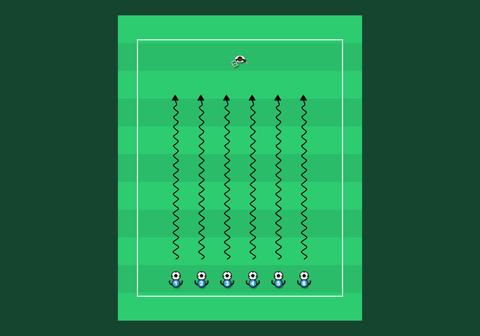
FIFA 11+ Kids is FIFA's warm-up programme for 7–13-year-olds, and it is there to reduce injuries. It replaces the usual warm-up: seven movements in the same order at the start of the session, at least twice a week. Once the players know the movements, the programme takes about 15 minutes. Every player needs a ball. Depending on the group, you need anything from a penalty area to a half pitch. The players start on the goal line about two metres apart. The coach stands in front, where they can see everyone and everyone can see them. The animation shows level 5 of movement 1. Every movement has five levels. Start at level 1. Players move up a level only when the movement goes well over several sessions in a row and there is little to correct. No level is skipped, and a player can easily be at level 1 in one movement and level 3 in another. 1. Stopping, 3 sets × 5 stops. The players run towards the coach. On the stop command they stand for 3 seconds on the leg the coach names, and after the set they jog back to the line. Levels: 1) spoken command, 2) the coach shows the command with a hand, 3) spoken command with the ball in the hands, 4) hand signal with the ball in the hands, 5) spoken command while dribbling: the ball is stopped with the sole, and the free foot doesn't touch the ball. 2. Jumps, 2 × 10 jumps (5 on each leg). Leap from one leg to the other diagonally forwards, so the path zigzags. Hold for 3 seconds after every landing. Levels: 1) learning to land, 2) ball in both hands, 3) ball in an outstretched hand, 4) after landing, the ball is lowered slowly to the ground, 5) as 4, with the free leg reaching back and the arms forwards so that ball, head, body and leg form a horizontal line. 3. Balance in pairs, 1 set on each leg. The partners stand facing each other on one leg. Levels: 1) throwing the ball 3–5 metres, 5 throws each, 2) after the throw, the ball is circled around the free leg, 3) ground passes with the instep over 2–5 metres, stopping the ball before the return pass, 4) a throw that the partner volleys back with the foot for the thrower to catch, 5) balance contest within arm's reach: each holds a ball, the balls are pressed together at chest height and each tries to knock the other off balance, 20 seconds on each leg. 4. Push and hold. Levels: 1) tunnel ball: the players are in a press-up position side by side, forming a tunnel, and the ball is rolled through it. The roller goes to the start of the tunnel in the press-up position, and the last player takes the ball and rolls it again. 2 rounds, at most 8 players in a group. 2) forearm support with the ball under the shins, the body slides slowly forwards and back, 3 × 15 s, 3) press-up position, the ball is circled in a figure of eight around the hands, 3 × 15 s, 4) the ball goes from a hand under the body to a foot, and from the foot to the other hand, 3 × 15 s, 5) hands on the ball, the feet walk back in small steps and return, 3 × 10 s. On wet grass, do level 4. 5. Hops, 2 × 10 hops (5 on each leg). The longest hop you can do on one leg, landing on the same leg, with a 3-second hold after landing. Levels: 1) forwards, 2) forwards and back, 3) sideways, 4) the coach shows the direction, 5) as 4, ball in both hands. Leave space between the players to the sides as well. 6. Core in the crab position: hands and feet on the ground, back facing the ground, bottom up. Levels: 1) the ball is rolled forwards and back with the foot, legs in turn, 3 × 15 s, 2) hands and feet move further out in turn and back, 3 × 15 s, 3) crab walk forwards 5–10 m, 3 sets, 4) crab walk dribbling the ball with the feet, 5) feet on the ball, the ball rolls under the feet for 3–7 m. 7. Roll, 5 in each direction. Learning to fall: chin to chest, and the roll goes over the outside of the arm and the shoulder, diagonally across the back. It isn't a straight forward roll: the head doesn't touch the ground. The coach names the direction every time and waits at least 5 seconds before the next one. Levels: 1) from a squat, 2) standing, slowly, 3) standing, quickly, 4) from walking, 5) from jogging. Move up a level only when the previous one is done safely in both directions. In a study (Rössler et al. 2018), teams that used the programme had 48% fewer injuries than the comparison teams. Sources: the FIFA 11+ for Kids manual and the Finnish FA's FIFA 11+ Kids poster.