Small sided game per il calcio
Gli small sided game mettono tutto il calcio in uno spazio più piccolo, con meno giocatori ma più tocchi e più decisioni. Un 3 contro 3 o un 4 contro 4 su un campo corto dà palla a ogni giocatore più spesso di una partita a campo intero. L'allenatore guida la seduta con le regole: un limite di tocchi, due porte per squadra, un punto bonus per il cambio di gioco. Cambia le dimensioni del campo per rendere il gioco più facile o più difficile. Usa gli small sided game come parte centrale della seduta o per chiuderla, e apri sulla lavagna qualsiasi gioco di questa pagina per impostare le tue regole.
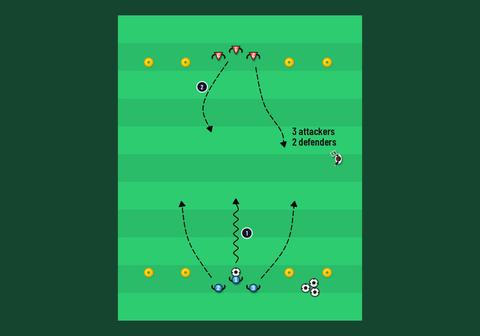
Numerical superiority and counter-attack on the coach’s call.
A small-sided game drill where the coach gives instructions on how many players from each side enter the pitch at a time. For example, "1 defender, 2 attackers". The defender(s) can start moving once the attackers have set off. The attackers queue with balls at one end and the defenders at the opposite end. There are two cone goals at each end. The attackers score by dribbling the ball through either of the opposite goals. If a defender wins the ball, they immediately attack the goals at the attackers’ end. The repetition ends when a goal is scored or the ball goes out. The players return to the back of their queues, and the coach calls the next numbers. Vary the numerical superiority, equal numbers and numerical inferiority, for example 2v1, 3v2, 2v2 and 1v2. Swap the attackers’ and defenders’ queues every few minutes.
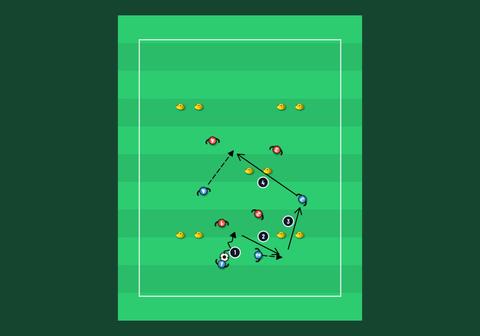
Gate passing game: move away from the ball
When teammates come next to the player on the ball, one defender can cover two of them. In this game, you only score from a pass through a gate to a teammate, so someone has to move away from the ball to the other side of the gate. The animation first shows the usual mistake and then the correct way. Area about 22 × 28 m. Spread five two-metre gates around the area. 4v4 with no goals. A point is scored when the ball is passed through any gate to a teammate who controls it on the other side of the gate. You cannot score two consecutive points through the same gate. Defenders can defend everywhere, and the team that loses possession defends immediately.
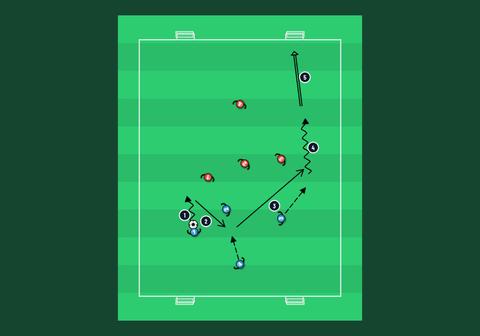
Four-goal game: play with width
With young players, the whole team can easily end up chasing the ball into the same corner. When there are two goals at each end, staying wide pays off straight away: the play is switched to the other side, and the goal there is free. The animation first shows the usual mistake and then the correct way. Area approx. 22 × 28 m, with two small goals at each end close to the corners. 4v4 without goalkeepers. Each team attacks the opponent’s two goals and defends their own. After a goal, the team that conceded restarts by dribbling from their own end. Additional rule for older players: a goal scored after switching play is worth two.
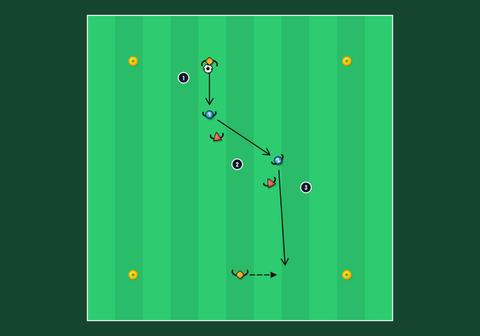
End zone game, target players in the end zones
Six players in three pairs in an empty area. No goals. One pair are the target players, one in each end zone, and they move only along their own end line. The other two pairs play 2v2 in the middle. A point is scored when the ball is dribbled from one end to the other, meaning from one target player to the other. After a successful pass, the same team continues with the ball in the opposite direction. The defending pair try to close the passing lane to the target player and win the ball. After winning the ball, the pair who won it can attack either end zone, but a point always requires the full distance: the ball must go from one target player to the other. In practice, the pair who won it start from the nearest end zone. Three minutes at a time, then the pairs rotate positions.
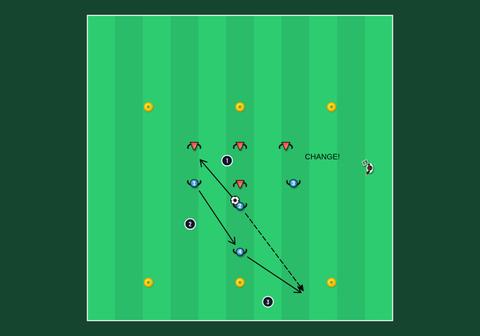
End zone game with changing direction
4v4 with an empty area, with end zones marked by cones at both ends. No goals. A point is scored when a player from your team receives a pass in the end zone. The coach calls for a change of direction during play, and the attacking direction switches from that moment. The defending team have just compacted towards the wrong end, so the space is behind them; this must be seen and used before they have time to turn. Playing time 3-4 minutes at a time, with several calls in each block.
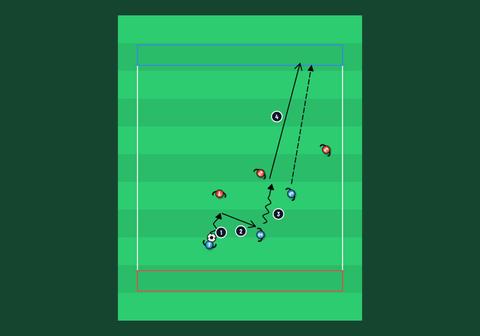
3v3 line game
3v3 game without goals. A goal is scored when a team gets the ball under control behind the opponent’s end line. If the whole team comes short to the ball, there is no one behind the line to pass to. One player stays high and runs in behind the defender. The animation first shows the usual mistake and then the correct way. Area approximately 20 × 20 m, and a two-metre zone behind each end line. The receiver must control the ball behind the line. A shot or dribbling over the line is not enough.
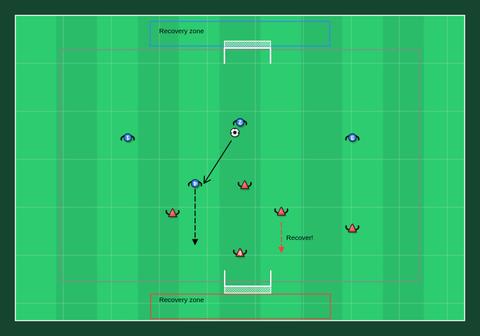
4v4 recovery zone game
4v4 game with two goals. Each team has its own "recovery zone" behind the goal. When a team loses possession, one player must go into the recovery zone before they can take part in defending. This creates temporary numerical superiority for the attacking team and forces a quick transition.
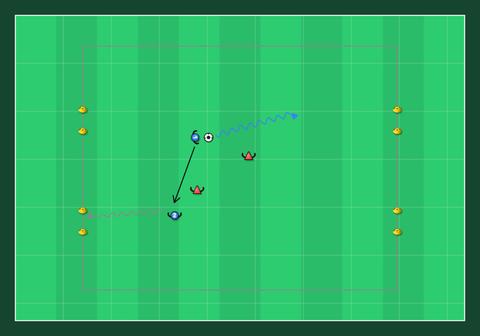
2v2 gate game
2v2 game in a small area, where both teams have 2 cone gates to defend on opposite sides. A goal is scored by dribbling the ball through a gate. A fast and intense small-sided game where every duel matters. Short games (90 seconds), pairs rotate.
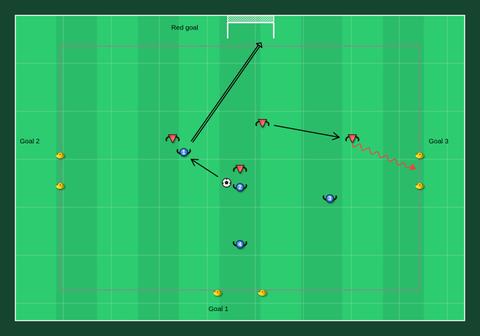
4v4 three goals
4v4 game in which one team has one standard goal and the other has three small cone goals in different parts of the pitch. The one-goal team attacks directly, while the three-goal team looks for the open goal. Roles change regularly.
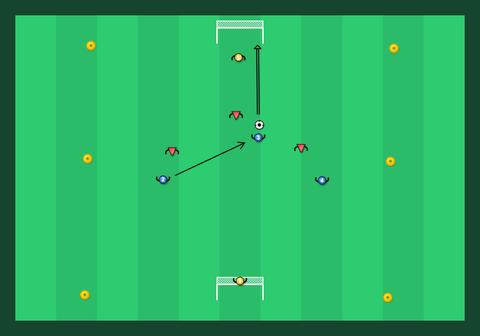
3v3 with goalkeepers
3v3 game with normal small goals and a goalkeeper. A full match situation in a small area: attacking, defending, finishing and goalkeeping. Short games (3–4 min), scoring and a tournament format keep the intensity high. The coach focuses on one theme at a time.
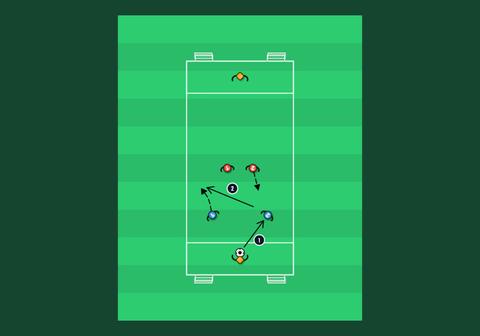
2v2+2 outnumbered: the pair closes the pass into the end zone
Mark out a 10 x 20 metre area and a three-metre zone at each end. There is a joker in each zone, who plays with the team in possession and does not leave their zone. Behind each end, place two small goals. In the middle, two teams of two players play. The joker starts by passing to a player from the team in possession. The pair tries to play the ball to the joker at the opposite end, receive it back from them, and score in either of the small goals at that end. As a target player, the joker may only play backwards. The defending pair tries to stop the split pass and win the ball. When they succeed, the roles change immediately. There are two phases in the animation. First, the blue team attacks up the pitch. When the joker passes to blue 2, red 2 starts pressing during the pass and red 1 stays inside to provide cover. Blue 2 plays into the run of blue 1. Red 1 shifts during the pass, but remains a step too far away, and the ball goes through to the joker. The joker plays it into the run of blue 2. The reds turn immediately and close the space behind them, and red 2 gets tight and wins the ball before the shot. In the second phase, the reds attack down the pitch immediately after winning the ball, when the blues have not yet had time for recovery defending. Red 2 plays into the run of red 1 to the left. Before blue 1 can get tight, red 1 passes directly along the touchline to the lower joker. The joker plays the ball into the run of red 2, and red 2 scores in the right small goal. The blues turn, but are a step late because the pair did not manage to close the passing lane into the end zone.
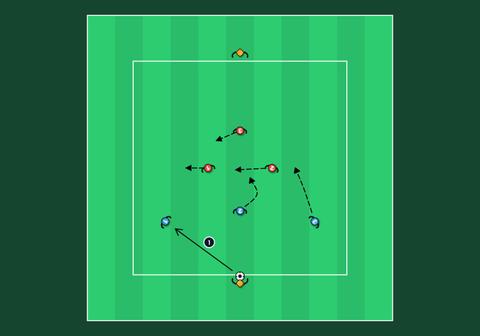
3v3+2 outnumbered: close the middle and force wide
Mark out a 20 × 20 metre area. Place a joker at each end, always playing with the team in possession. Two teams of three players play inside the area. The game starts with a joker. The team in possession tries to move the ball to the joker at the opposite end, so they have five players against three. The defending three try to win the ball. When they succeed, the roles change immediately, and the team that won the ball attacks. The nearest joker can be used as support. There are two rounds in the animation. First, the blues attack upwards. When the ball goes left, the reds shift across as a full three towards the ball side. Red 1 forces Blue 1 towards the touchline, and Red 2 closes the pass into the middle. Blue 1 still tries to play the ball inside, and Red 2 intercepts the ball. The reds keep the ball and play it through the nearest joker. The blues press for a moment and then drop back into their own three. In the second round, the blues stay compact, so the red player in the middle has to pass wide. The blues shift during the pass as one unit, Blue 1 closes down at the touchline and wins the ball, and the blues immediately launch a new attack.
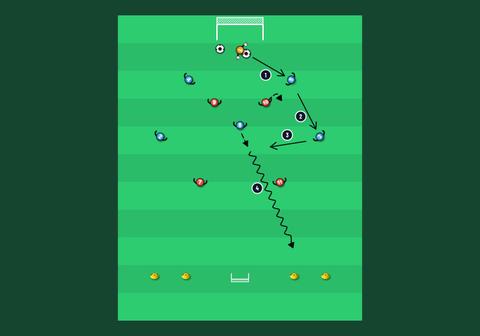
Safe build-up play with numerical superiority
The blues, five players and a goalkeeper, build up from the back against four reds. The blues attack the small goal in the middle or either cone goal on the flank. Dribbling through a cone goal is worth one point and a goal in the small goal is worth two. When the reds win the ball, they attack the large goal, and a goal gives them two points. Play always restarts with the blue goalkeeper, who has spare balls next to him. Every four minutes the teams swap tasks, and one player moves to the other team so that the attacking team has numerical superiority again. For a bigger group, the same game works with eight plus a goalkeeper against seven. The game can be made more difficult by limiting the blues to three touches.
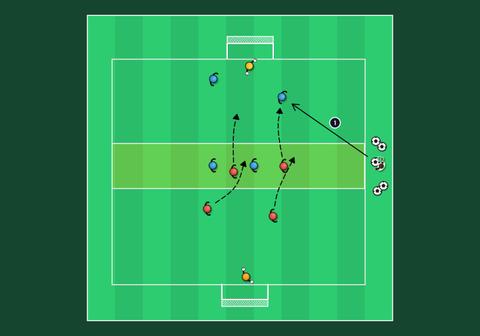
Three-zone pressing game
The coach gives the ball to the other team. The players in the middle can step up to press in their own attacking zone, at which point the players in their own defending zone can move in to fill the spaces in the middle. When the ball is won, free play continues until a goal or a stoppage in play.
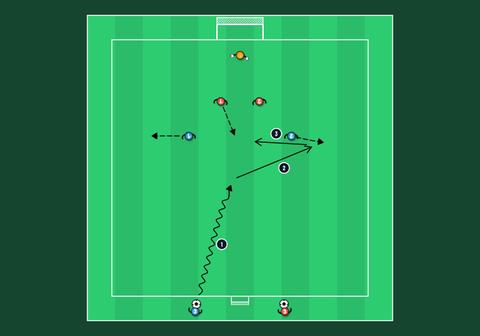
Alternating 3v2 numerical superiority
Indoor game on two pitches. On each pitch there is a goal with a goalkeeper and a small goal on the halfway line without a goalkeeper. Instead of the small goal, a bench turned onto its side can be used. The diagram shows one of the pitches, about 20 × 20 m, i.e. half a handball court. On the pitch, each team has two players in front of the goal and one with the ball behind the end line next to the small goal. Blue attacks first. The waiting blue player behind the end line dribbles at full speed towards the goal, creating a 3v2. The other two attackers position themselves as wide as possible. When the reds win the ball, they immediately pass it into the small goal. That is the goal for their counter-attack. The situation continues until there is a goal or the ball goes out. Then the attacking turn changes, and the waiting red player dribbles in. In the diagram, the blue overload player goes back behind the line so that the reds have a 3v2. Variation: blue attacks with numerical superiority towards the other goal and red does the same at the same time at the other end. The first goal is worth two points, including from the counter-attack.
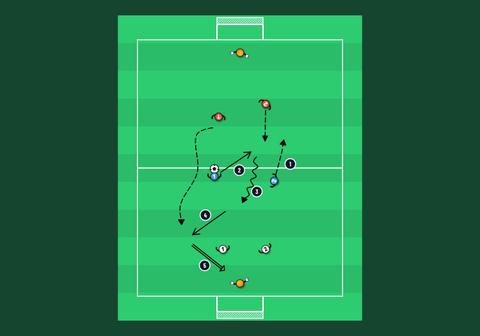
2v2 attacking and counter-attack
Eight players: three pairs and two goalkeepers. The area is split into two halves by a halfway line, and there is a goal at each end. In the diagram the area is 24 × 30 m. Adapt the size to the age group. One pair starts with the ball from the halfway line and attacks 2v2 towards the goal defended by the second pair. The third pair waits in the other half. If the defenders win the ball, they immediately attack the other end against the third pair. Play does not stop, and there is no need to collect the ball from the goalkeeper. When the attack ends with a goal or a save, or the ball goes out of play, the goalkeeper gives the ball to the pair that was defending, and they attack in the same way towards the other end. The pair that lost possession stays in their own half and defends when the next attack comes there. The defenders engage high so that the attacker cannot get a shot away. For a larger group, set up more than one area.
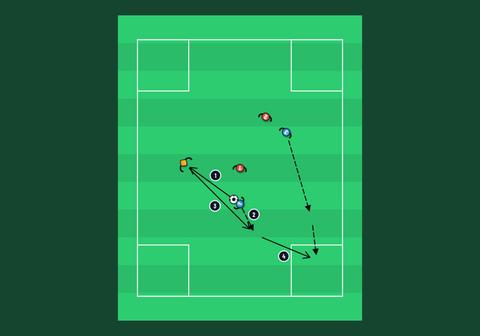
Four corners pass-and-move game
Many players make a pass and then just stand and watch the ball. In this game, you do not score points by standing still. The passer must move into a new space, and you can only arrive in the square by timing the run. The animation first shows the typical mistake and then the correct way. Area 20 × 25 m, with a 5 × 5 m square in each corner. Two teams and a joker, who always plays with the team in possession. The diagram shows 2v2 and a joker, so the attackers have 3v2 numerical superiority. With a bigger group, for example 4v4 and a joker. The attacking team scores a point by passing to a player who has run into a square. The joker does not score points. You cannot wait in the square. You only move there when the pass is coming, and after a point the ball is brought straight back out. When the defenders win the ball, the roles switch and the joker changes sides.
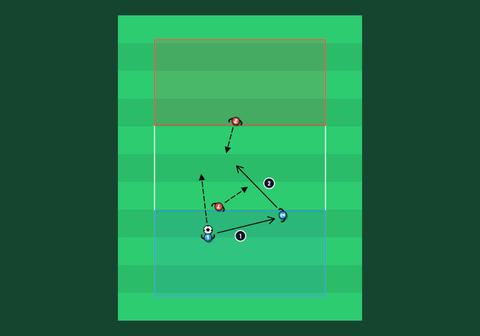
2v2 with a cover line
Two pairs play 2v2 in an area of approximately 16 × 24 metres. At each end there is an end line and a cover line eight metres in front of it. A pair scores a point when they dribble the ball over the opponent’s end line or pass to a teammate who controls it behind the line. The second player in the defending pair must be on or behind their own cover line. One presses the player on the ball, the other provides cover. They must not both go to the ball. The covering player may step off the line when they intercept a pass or win the ball from an attacker who has beaten the presser. In that case, the other defender immediately runs back behind the line. In the diagram, Red 1 presses the player on the ball from the inside and shows them wide. Red 2 is on the line diagonally behind on the inside. When Blue passes across to the other side, Red 1 shifts to press the new player on the ball while the ball is travelling, and Red 2 slides along the line to stay behind them. The pair move together. Blue 1 makes a run in behind the presser, but Red 2 reads the pass and intercepts it. After winning the ball, the Reds attack the Blues’ end line immediately. The nearest Blue presses, and the other runs behind their own cover line. Now the Blues defend in the same way. When Blue 1 wins the ball wide, only Red 2 gets back to the line in time. The Blues play a 2v1. Blue 1 draws Red 2 in and passes into the run of Blue 2, who dribbles the ball over the end line. Play 1–2 minute blocks. If there are more than four players, set up several pitches side by side or rotate pairs between blocks.
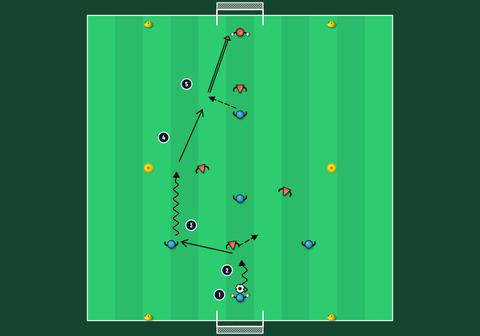
5v5 goal-dribbling game
5v5 game in which the team practises building play with a goal-dribble. When the ball goes over the end line, the defending team restarts by dribbling from any point in their own penalty area. The opponent may wait 5.5 metres from the ball. The player on the ball can carry the ball forwards or pass to a free player. In the example, the presser goes towards the goalkeeper, so the goalkeeper passes to the free player on the left. This player dribbles down the flank and passes to the attacker, who shoots. If an attack that starts from a goal-dribble ends in a goal, it is worth two points. All other goals are worth one. Play short blocks and rotate the teams often. According to the Football Association of Finland rules, 8- and 9-year-olds restart 5v5 by dribbling. In matches for seven-year-olds and younger, the opponent drops back to halfway for the goal-dribble and only defends once play has restarted.
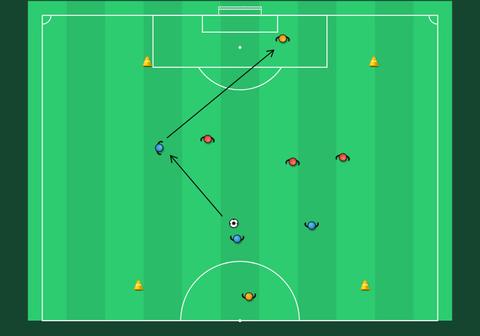
End zone game
3v3 end zone game with two jokers. The jokers play in the end zones with the team in possession. The jokers can join the attack, creating temporary numerical superiority. A goal is scored when a player receives a pass in the end zone