Esercitazioni di transizione e ripartenza per i secondi dopo il cambio di possesso
La transizione è il momento in cui la palla passa all'altra squadra, e queste esercitazioni allenano i secondi che seguono. La squadra che riconquista la palla attacca subito, prima che gli avversari abbiano il tempo di riorganizzarsi. La squadra che la perde o va subito in pressione per riconquistarla o rientra davanti alla propria porta. Molte esercitazioni partono da un possesso o da un attacco normale, così la transizione arriva di sorpresa, come in partita. Tieni i turni brevi e l'intensità alta, e ferma il gioco solo per indicare il momento in cui è cambiato il possesso.
Ripartenza subito dopo la riconquista
Nel 2 contro 2 attacco e ripartenza tre coppie e due portieri giocano su un campo con la linea di metà campo e una porta per lato. Quando la coppia che difende riconquista la palla, attacca subito l'altra porta contro la terza coppia e non torna dal portiere a prendere la palla. La ripartenza in superiorità numerica funziona allo stesso modo su un campo lungo e stretto. I blu attaccano in tre, e quando i rossi riconquistano la palla entra un quarto rosso che aspetta oltre la linea laterale, per creare la superiorità. Nella partita a ripartenze la squadra che riconquista la palla ha 8 secondi per attaccare la porta opposta, e un gol entro il tempo limite vale doppio. Nella partita di transizione in tre fasi una squadra attacca dopo cinque passaggi, e se i difensori riconquistano la palla ripartono verso l'altra porta.
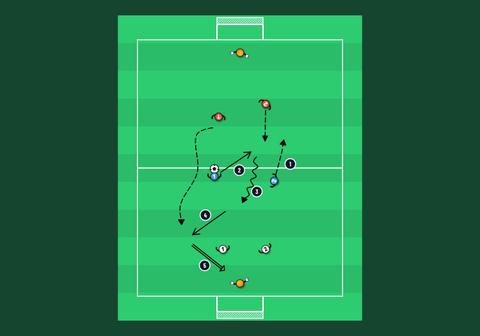
2v2 attacking and counter-attack
Eight players: three pairs and two goalkeepers. The area is split into two halves by a halfway line, and there is a goal at each end. In the diagram the area is 24 × 30 m. Adapt the size to the age group. One pair starts with the ball from the halfway line and attacks 2v2 towards the goal defended by the second pair. The third pair waits in the other half. If the defenders win the ball, they immediately attack the other end against the third pair. Play does not stop, and there is no need to collect the ball from the goalkeeper. When the attack ends with a goal or a save, or the ball goes out of play, the goalkeeper gives the ball to the pair that was defending, and they attack in the same way towards the other end. The pair that lost possession stays in their own half and defends when the next attack comes there. The defenders engage high so that the attacker cannot get a shot away. For a larger group, set up more than one area.
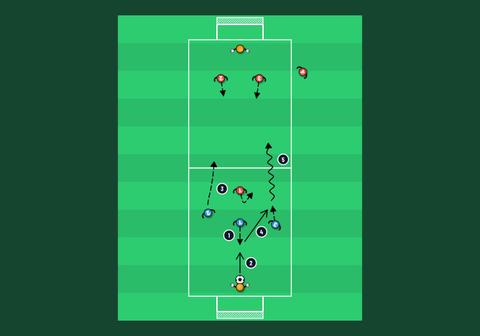
Counter-attack with numerical superiority
Play on a long, narrow pitch with a halfway line and a goal and goalkeeper at each end. In the diagram, the area is 16 x 40 m. Make it as long as the space allows. The blues attack with three. The reds are the counter-attackers: one is in the blues' half, two are in their own half in front of the goal, and a fourth waits outside the touchline. The other groups of three attackers wait for their turn outside the area with their own balls. The goalkeeper starts by giving the ball to an attacker who drops in to receive. In their own half, the blues beat one counter-attacker 3v1 and dribble over the halfway line. There they attack the goal against two. When the blues score, the next group of three starts. If they lose possession, the reds immediately break into a counter-attack towards the other end, and the fourth player who was waiting on the side joins in to create numerical superiority. The reds are not called defenders because they attack as well. Progression: add a time limit.
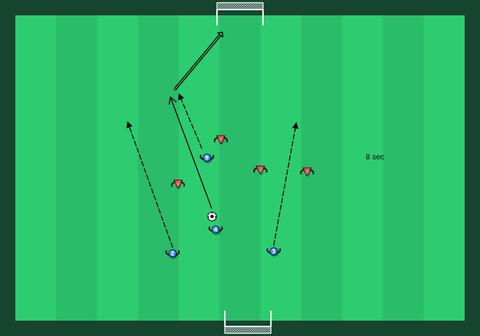
Counter-attack game
The defending team defends their own goal. When they win the ball, they have 8 seconds to attack the opposite goal. If a goal is scored within the time limit, the point counts double. The attacking team continues normal play. A quick transition from defending to attacking is decisive.
Una superiorità numerica che cambia lato
La superiorità numerica alternata 3 contro 2 è un gioco al chiuso su due campi. Due giocatori per squadra stanno davanti alla porta, e un giocatore che aspetta oltre la linea di fondo entra in conduzione a tutta velocità per fare il 3 contro 2. Quando i difensori riconquistano la palla la passano subito in una porticina sulla linea di metà campo, e poi l'attacco passa all'altra squadra. Nella partita 4 contro 4 con zona di recupero un giocatore della squadra che ha perso palla deve passare dalla zona di recupero dietro la propria porta prima di poter difendere, così gli attaccanti hanno per un attimo l'uomo in più. Nel 2 contro 2 pressing e penetrazione chi riconquista la palla si infila subito, gioca 2 contro 1 contro un solo difensore e conclude in una delle due porticine.
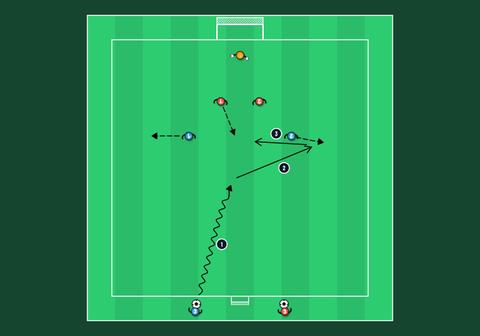
Alternating 3v2 numerical superiority
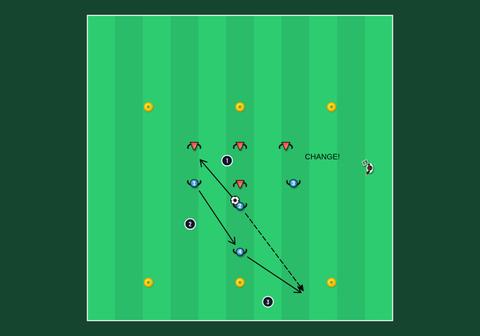
Indoor game on two pitches. On each pitch there is a goal with a goalkeeper and a small goal on the halfway line without a goalkeeper. Instead of the small goal, a bench turned onto its side can be used. The diagram shows one of the pitches, about 20 × 20 m, i.e. half a handball court. On the pitch, each team has two players in front of the goal and one with the ball behind the end line next to the small goal. Blue attacks first. The waiting blue player behind the end line dribbles at full speed towards the goal, creating a 3v2. The other two attackers position themselves as wide as possible. When the reds win the ball, they immediately pass it into the small goal. That is the goal for their counter-attack. The situation continues until there is a goal or the ball goes out. Then the attacking turn changes, and the waiting red player dribbles in. In the diagram, the blue overload player goes back behind the line so that the reds have a 3v2. Variation: blue attacks with numerical superiority towards the other goal and red does the same at the same time at the other end. The first goal is worth two points, including from the counter-attack.
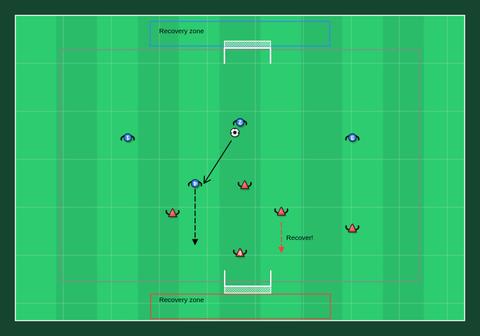
4v4 recovery zone game
4v4 game with two goals. Each team has its own "recovery zone" behind the goal. When a team loses possession, one player must go into the recovery zone before they can take part in defending. This creates temporary numerical superiority for the attacking team and forces a quick transition.
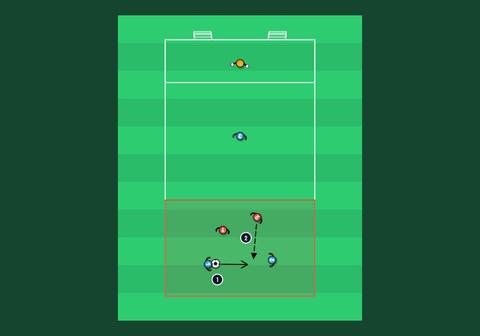
2v2 pressing and penetration
The area is approximately 14 × 24 metres and is divided into three sections. At the bottom is the 2v2 zone, in the middle the penetration zone and at the top the goalkeeper's area. On its end line there are two small goals. In the 2v2 zone, two blue players keep possession and two red players press as a pair. In the penetration zone, one blue defender waits. The reds' task is to win the ball. One presses the player on the ball, the other provides cover from the inside and reads the next pass. After winning the ball, the reds immediately break through: 2v1 against the blue defender and finishing into either small goal. Blue 1 and 2 are not allowed to follow from the 2v2 zone, blue 3 stays in the penetration zone and the goalkeeper stays in their own area. In the pattern, red 2 presses during the pass, and when the ball comes back, the roles change. When blue 1 tries to switch play again, red 2 intercepts the pass. Red 2 dribbles into the penetration zone, draws blue 3 towards them and passes to red 1, who shoots into the left small goal. Change roles every few repetitions so that everyone gets to press, defend the penetration and finish. The blues can be given a point, for example, for five consecutive passes in the 2v2 zone.
Dopo la palla persa: riaggressione o ripiegamento
Nella partita di riaggressione la squadra che ha perso palla ha 5 secondi per riconquistarla. In Pressare o ripiegare? l'allenatore segnala cosa fare: riaggredire alto se la palla è stata persa nella metà campo avversaria, oppure ripiegare e riorganizzarsi se è stata persa nella propria. Nel 2 contro 2 ripiegamento difensivo il difensore più vicino corre sulla linea interna tra la palla e la porta e rallenta il portatore di palla, mentre l'altro rientra tra l'attaccante rimasto e la porta. Nella partita di transizione 4 contro 4 l'allenatore gioca un nuovo pallone a una squadra a caso, così nessuna delle due sa se dovrà attaccare o difendere.
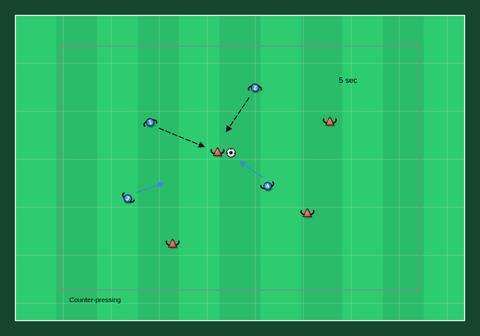
Counter-pressing game
Two teams play a possession game in a confined area. When a team loses possession, it has 5 seconds to win the ball back with counter-pressing. If the ball is won back, play continues. If not, the team that lost possession does a penalty task. Objective: immediate reaction to loss of possession.
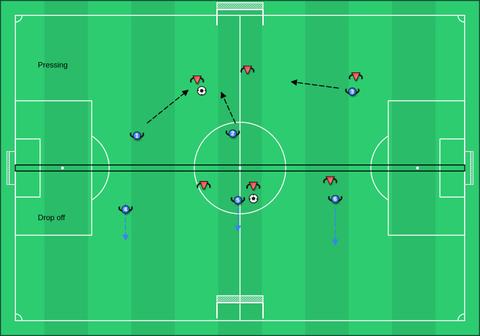
Press or drop off?
The defending team practises two alternative reactions after a loss of possession: (1) counter-press high if the ball was lost in the opponent's half, (2) drop off and reorganise if the ball was lost in their own half. The coach signals which option is to be carried out. The team learns to recognise the right moment for both.
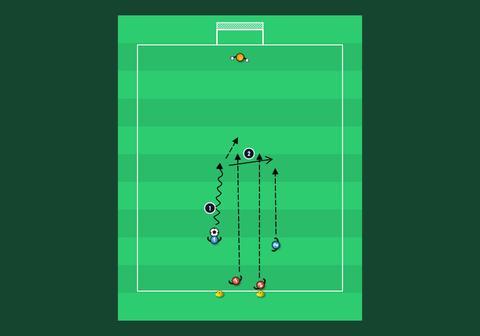
2v2 recovery defending
Two blue players attack the goal with a goalkeeper. Two red defenders start from the markers behind the attackers. The area is approximately 20 x 24 metres, with a cone gate at the opposite end. The blues start with the ball and drive towards the goal, and at the same moment the reds recover. The nearer defender runs along the inside line to get between the ball and the goal and delays the player on the ball. The second defender recovers to the inside, between the remaining attacker and the goal. Once it becomes 2v2, the defenders apply pressing and provide cover. In the example, red 1 gets across in front of blue 1 and delays. When blue passes out wide, red 2 moves to press during the pass and red 1 drops to cover. Red 2 wins the ball, and the reds immediately attack the gate. Now the blues recover. The blues score a point for a goal, the reds for dribbling the ball through the gate. The farther away the defenders start, the more difficult the recovery becomes, so adjust the distance of the starting markers according to the level. Change roles after a few repetitions.
Esercitazioni di transizione per età
Ogni esercitazione ha un'indicazione dell'età da cui è adatta. Il 2 contro 2 attacco e ripartenza è indicato dagli U7. La partita di riaggressione, il 2 contro 2 pressing e penetrazione e il 2 contro 2 ripiegamento difensivo sono indicati per gli U9. La superiorità numerica alternata 3 contro 2, la ripartenza in superiorità numerica, la partita a ripartenze, la partita 4 contro 4 con zona di recupero e la partita di transizione 4 contro 4 sono indicate per gli U10. Pressare o ripiegare? è per gli U11, e la partita di transizione in tre fasi per gli U12. Con i più piccoli basta una regola alla volta: prima solo la ripartenza dopo la riconquista, più avanti un tempo limite o la riaggressione.
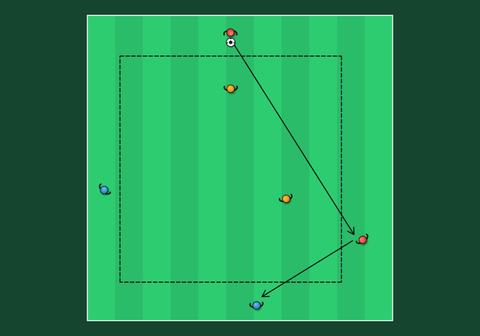
4v2 rondo
Mark out a square area and make three pairs of two players. Two pairs are on the outside on the edges, giving four passers in total, with one on each side. One pair is inside the area trying to win the ball. The players on the outside keep possession from side to side. The players winning the ball split the work: one presses the player on the ball, the other blocks the next passing lane. When they win the ball, the pairs swap places and play continues immediately without a restart. Adjust the size of the square to suit the level. A smaller square shortens the passes and forces quicker touches.
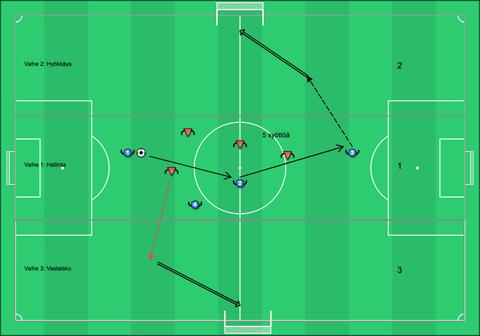
Gioco di transizioni in tre fasi
Campo diviso in tre zone. Il gioco inizia nella zona centrale come possesso palla. Quando una squadra completa 5 passaggi, attacca la porta dell’avversario (fase 2). Se la squadra in fase difensiva riconquista la palla, lancia un contropiede verso l’altra porta (fase 3). Ogni fase richiede una diversa comprensione tattica.
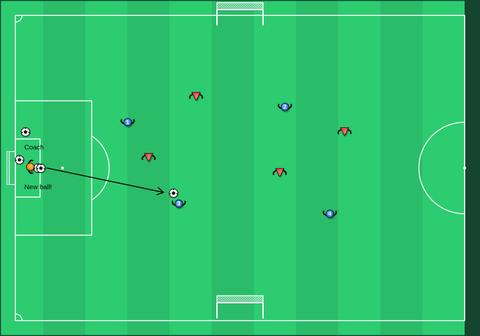
4v4 transition game
4v4 game with two goals (+GK). When the ball goes out of bounds or a goal is scored, the coach passes a new ball onto the pitch to a random team. Continuous transition situation: the teams never know who will get the next ball. Forces constant readiness in both attacking and defending.
Safe build-up play with numerical superiority
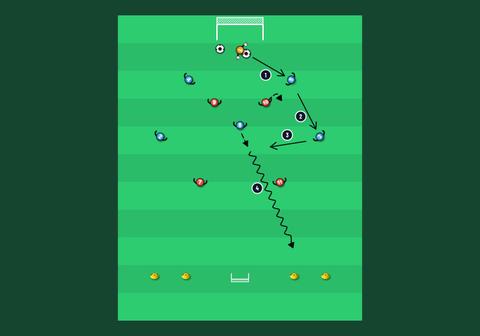
The blues, five players and a goalkeeper, build up from the back against four reds. The blues attack the small goal in the middle or either cone goal on the flank. Dribbling through a cone goal is worth one point and a goal in the small goal is worth two. When the reds win the ball, they attack the large goal, and a goal gives them two points. Play always restarts with the blue goalkeeper, who has spare balls next to him. Every four minutes the teams swap tasks, and one player moves to the other team so that the attacking team has numerical superiority again. For a bigger group, the same game works with eight plus a goalkeeper against seven. The game can be made more difficult by limiting the blues to three touches.
Three-zone pressing game
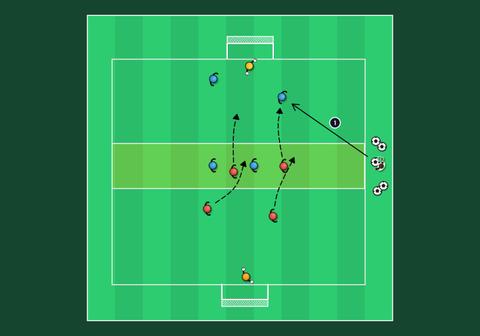
The coach gives the ball to the other team. The players in the middle can step up to press in their own attacking zone, at which point the players in their own defending zone can move in to fill the spaces in the middle. When the ball is won, free play continues until a goal or a stoppage in play.
Numerical superiority and counter-attack on the coach’s call.
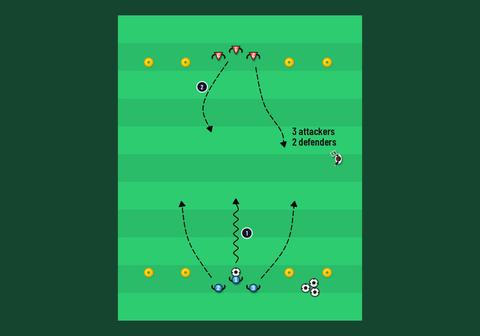
A small-sided game drill where the coach gives instructions on how many players from each side enter the pitch at a time. For example, "1 defender, 2 attackers". The defender(s) can start moving once the attackers have set off. The attackers queue with balls at one end and the defenders at the opposite end. There are two cone goals at each end. The attackers score by dribbling the ball through either of the opposite goals. If a defender wins the ball, they immediately attack the goals at the attackers’ end. The repetition ends when a goal is scored or the ball goes out. The players return to the back of their queues, and the coach calls the next numbers. Vary the numerical superiority, equal numbers and numerical inferiority, for example 2v1, 3v2, 2v2 and 1v2. Swap the attackers’ and defenders’ queues every few minutes.
Three-zone rondo (basic)
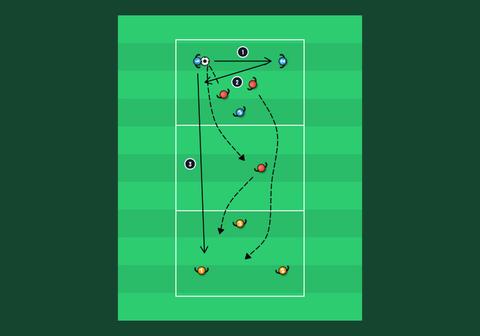
Mark out a 15 × 30 metre area and divide it into three 10-metre zones. Place a team of three players in each zone. The end teams keep possession and try to play the ball over the central zone to the other end. From the middle team, two players win the ball in the end zone where the ball is, and one stays in the middle to cut out long passes. When the ball switches ends, two players from the middle team run across after it. If the middle team wins the ball or the ball goes out, the team that lost possession moves into the middle and the winning team takes that end zone. Each successful pass from one end zone to the other is a point.
End zone game with changing direction
4v4 with an empty area, with end zones marked by cones at both ends. No goals. A point is scored when a player from your team receives a pass in the end zone. The coach calls for a change of direction during play, and the attacking direction switches from that moment. The defending team have just compacted towards the wrong end, so the space is behind them; this must be seen and used before they have time to turn. Playing time 3-4 minutes at a time, with several calls in each block.
Three-zone build-up game
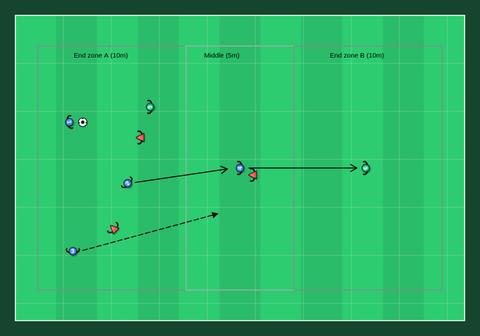
Two teams + 2 jokers (30×15 m, zones 10–5–10 m). Team A builds up play in the end zone (3v2 + joker) and tries to play through the pivot player in the narrow middle zone to the other end zone, where the joker receives. From the defending team, 2 press in the end zone, 1 covers the middle zone. After winning the ball, the team that won it starts the build-up from their own end zone. The pivot simulates a midfielder, the end-zone players simulate centre-backs.
Pressing line and transitions
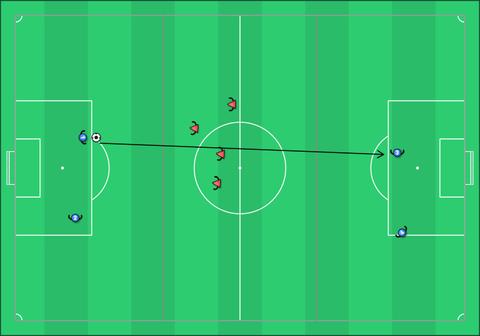
The pitch is divided into three vertical zones. The defending team sets up in the middle zone as a compact block. The attacking team plays the ball in the wide zones and tries to switch play. When the ball is moved, the defending block shifts together towards the ball.
2v2/3v3 with small goals
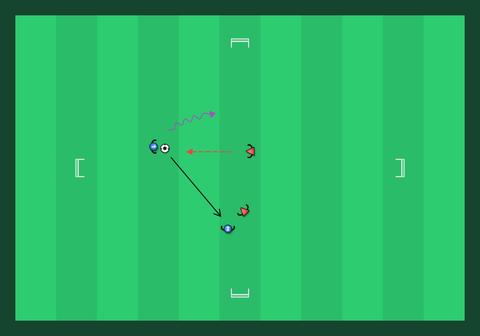
2v2 or 3v3 small-sided game with small goals and no goalkeeper. When the team loses possession, transition immediately into defending: the first defender presses the player on the ball, the second covers and the third provides balance.
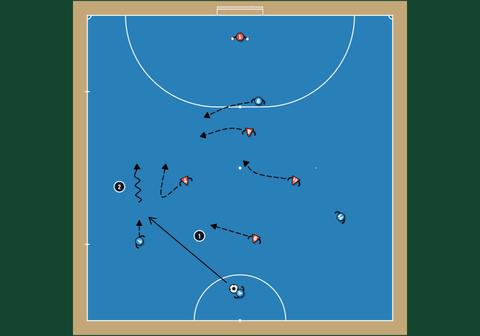
Futsal 1-2-1 defending and intercepting the pass into the pivot 4v4
Four blue players attack: a fixo, two wide players and a pivot in front of the goal. The red players defend in a 1-2-1 diamond in front of the goalkeeper. The fixo passes wide, and the whole diamond shifts to the ball side during the pass. The nearest defender presses the receiver immediately, the top player moves inside to the ball side, the opposite wide defender moves more centrally and the deepest defender stays in front of the pivot. When the wide player dribbles along the touchline, the pressing defender tracks sideways and does not drop back towards the goal. The pivot checks towards the ball, but the deepest defender reads the pass and intercepts it in front of the pivot. After winning the ball, the red players attack the halfway line, and dribbling the ball over the line scores a point. The blue players score a point with a goal. Change roles every few repetitions.
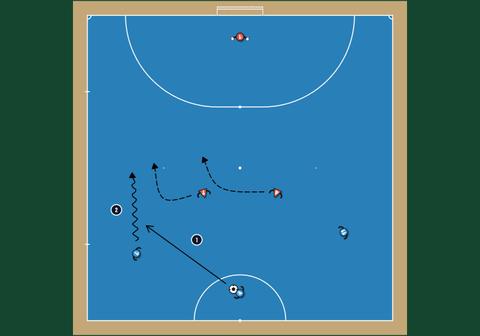
Futsal wide pressing and cover 3v2
Three blue players attack: the fixo on the halfway line and two wide players providing width. They are opposed by two defenders and a goalkeeper. The fixo passes wide. The nearest defender presses while the ball is travelling and moves to the receiver’s inside, so the attacker is left with only the direction along the touchline. The second defender provides cover centrally and stays closer to their own goal than the pressing defender. This way, they block both the turn inside and the square pass to the opposite flank. The touchline is the third defender: when the wide player dribbles along it, the pressing defender gets alongside and wins the ball. After winning the ball, the red players attack towards the halfway line, and dribbling the ball over the line is a point. The blue players score a point with a goal. Change roles every few repetitions.