Esercitazioni di attacco: superiorità numerica, ampiezza e profondità
Attaccare vuol dire sfruttare meglio i momenti in cui la squadra ha palla vicino alla porta. Molte esercitazioni qui partono in superiorità numerica, 2 contro 1, 3 contro 2 o 3 contro 2+1, così gli attaccanti imparano a usare l'uomo in più prima che la difesa si riorganizzi. Altre lavorano su ampiezza e profondità: un cambio di gioco, un cross dalla linea di fondo, un passaggio filtrante alle spalle della difesa o un passaggio nello spazio tra le linee. La corsa deve partire prima del passaggio, non dopo. Chiudi con una partita come il 4 contro 4 con tre porte, in cui la squadra deve cercare la porta libera. Le esercitazioni vanno dagli U8 fino alle categorie più grandi.
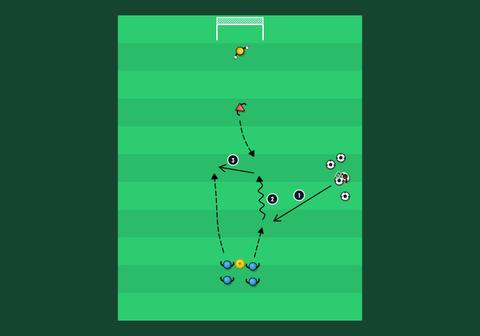
Continuous 2v1 towards one goal
The attackers wait in two queues next to a flat cone, the defender is in front of the goal and the coach is on the wing with balls. The coach plays a pass to the first players in the queues, who attack the goal as a pair. They are up against a defender and a goalkeeper. The defender tries to win the ball, and the attackers’ decision depends on what he does. If he closes down the player on the ball, the player on the ball passes to the free player just before the confrontation. If he stays to block the passing lane, the player on the ball dribbles towards goal and shoots. If the player on the ball delays, the defender has time to win the ball. He passes the won ball back to the coach. When the situation ends, the attacker who shot or lost possession stays in as the next defender. The other attacker and the previous defender go to the back of the queues, and the coach starts the next round immediately. Bibs are not changed, so the defender can be of either colour.
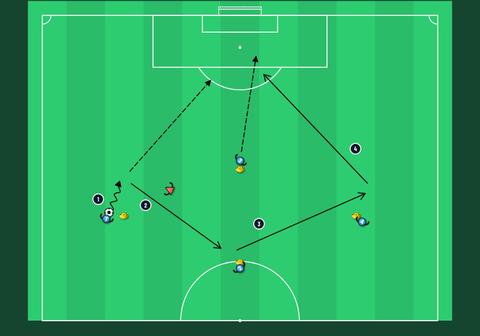
Switch of play and cross
Four players in a diamond: both flanks, one in the middle at the front and one in the middle at the back. The wide player starts dribbling towards goal. The deepest player calls, which stops the dribbling and the ball is played back. The deepest player switches play first time to the opposite flank, who advances and delivers a cross. The others arrive in front of goal in staggered runs to finish. Start alternately from each flank. Instead of a cross, a sharp low pass from the flank is also allowed.
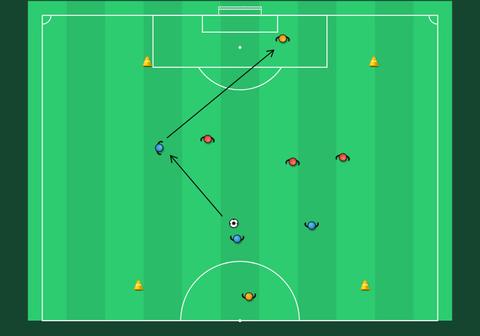
End zone game
3v3 end zone game with two jokers. The jokers play in the end zones with the team in possession. The jokers can join the attack, creating temporary numerical superiority. A goal is scored when a player receives a pass in the end zone
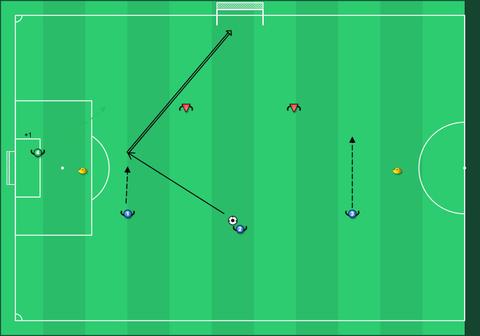
3v2+1 numerical superiority attack
Three attackers play against two defenders. One additional player waits on the flank and joins in when the ball crosses a certain line. The attackers aim for quick finishing before the defending can get organised. If the defenders win the ball, they play a counter-attack.
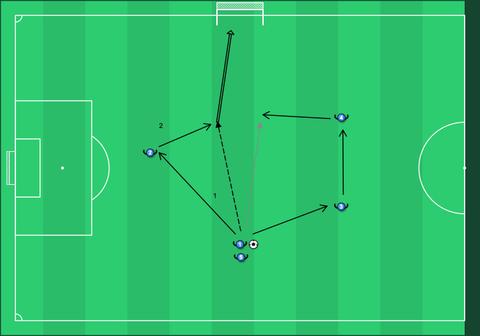
Combination play with one-twos
Players practise different one-two patterns on the move: a simple one-two or a triangle passing pattern. Each pattern ends with a shooting opportunity. First without defenders, then with passive defenders and finally with active defenders.
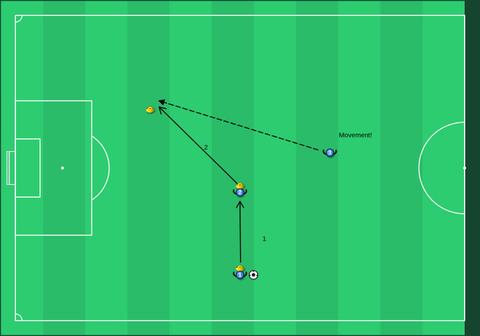
Third-player movement
Three-player combination: the first passes to the second, the second plays to the third, who has made a run into free space. The key is the third player's movement — they break away before the ball arrives at the second player. Practise in different patterns: in behind, wide and diagonally.
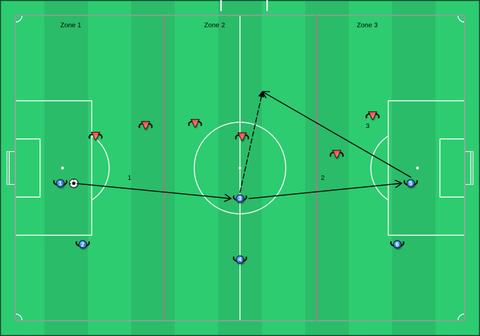
Width and depth
Team game (e.g. 6v6 or 7v7). The pitch is divided into three vertical zones. The attacking team only scores a point when the ball has been in all three zones before finishing. Forces the use of width and prevents narrow central play.
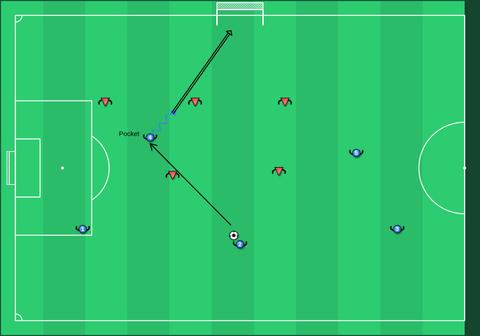
Playing between the lines
The attacking team aims to play the ball into the pocket — between the defensive line and the midfield. The player receiving in the pocket turns and plays forward or shoots. The defending team tries to keep the lines compact and prevent play into the pocket.
Counter-attack with numerical superiority
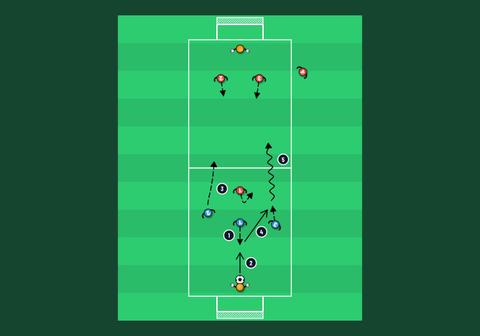
Play on a long, narrow pitch with a halfway line and a goal and goalkeeper at each end. In the diagram, the area is 16 x 40 m. Make it as long as the space allows. The blues attack with three. The reds are the counter-attackers: one is in the blues' half, two are in their own half in front of the goal, and a fourth waits outside the touchline. The other groups of three attackers wait for their turn outside the area with their own balls. The goalkeeper starts by giving the ball to an attacker who drops in to receive. In their own half, the blues beat one counter-attacker 3v1 and dribble over the halfway line. There they attack the goal against two. When the blues score, the next group of three starts. If they lose possession, the reds immediately break into a counter-attack towards the other end, and the fourth player who was waiting on the side joins in to create numerical superiority. The reds are not called defenders because they attack as well. Progression: add a time limit.
Four-goal game: play with width
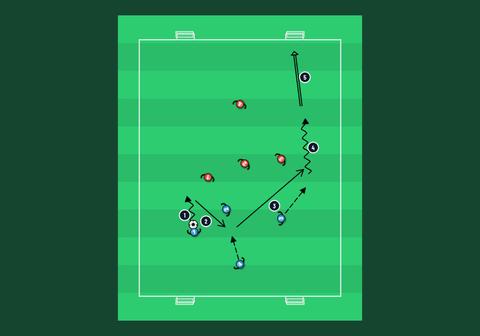
With young players, the whole team can easily end up chasing the ball into the same corner. When there are two goals at each end, staying wide pays off straight away: the play is switched to the other side, and the goal there is free. The animation first shows the usual mistake and then the correct way. Area approx. 22 × 28 m, with two small goals at each end close to the corners. 4v4 without goalkeepers. Each team attacks the opponent’s two goals and defends their own. After a goal, the team that conceded restarts by dribbling from their own end. Additional rule for older players: a goal scored after switching play is worth two.
Short corner routine
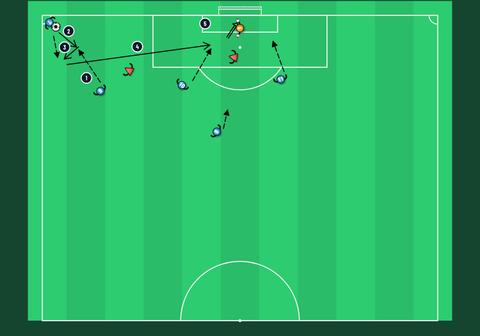
The corner is played short. The supporting player comes towards the corner flag and receives a pass, which makes the nearest defender come out of the penalty area to apply pressure. The ball is then played back to the taker, who has meanwhile moved from the corner to around eight metres away. The angle for the cross is better from there, and the ball can be delivered low between the near post and the goalkeeper. The player running to the near post finishes one-touch, and the run to the far post starts at the same time. There are two defenders: one applies pressure to the short corner, the other defends the area. Without the defender coming out, the pattern does not show why the short corner works.
Short corner routine with three players
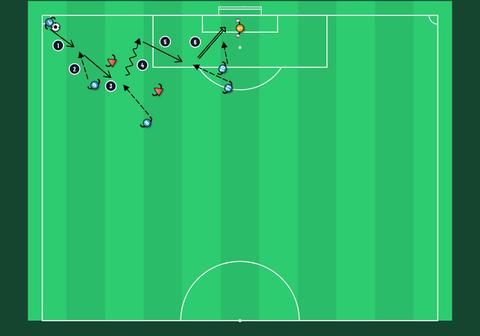
The corner is played short between three players. The player closest to the flag comes short and receives the pass, which brings the first defender out. Instead of the ball being returned to the taker, it goes first touch to the third player, who has come from the edge of the penalty area into the same corner. Now the second defender also has to come out, and the third player dribbles between them to the end line. From the end line, the ball is played back low towards the penalty spot. The finisher times the run so that they move towards the ball rather than waiting for it standing still. The player occupying the near post takes the goalkeeper with them. Two defenders out means there is briefly a 2v1 in the penalty area. That is the whole idea of the move: the short corner is not looking for a cross but for numerical superiority.
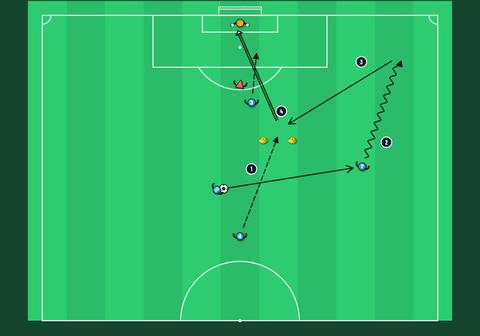
Lay-off for the second wave
A pass from the centre to the winger, who dribbles all the way to the byline. The attacker takes the defender with them to the near post. When the defending has dropped towards the goal, the midfield player arrives late at the edge of the penalty area into the gate. The winger lays the ball back and the arriving player shoots first time from the pass. A goalkeeper in goal. Start alternately from both flanks.
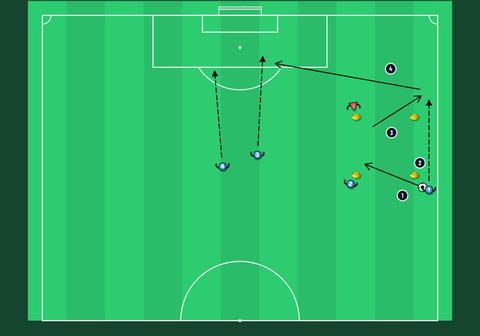
Wide 2v1 and cross
Two attackers break down one defender out wide and deliver a cross. The wide player passes to the inside player, who comes towards the ball and turns towards goal. At the same time, the defender sets off from the opposite corner to apply pressure. The passer immediately makes an overlapping run on the outside past their teammate, into the space between the penalty area and the touchline. From there, they receive the ball back and deliver a cross. The run into the penalty area is staggered: one to the near post, the other to the far post. The defender does not follow outside the square. Start alternately from both flanks. Alternatively, the wide player can solve the situation themselves in a 1v1, either by going inside or down the touchline.
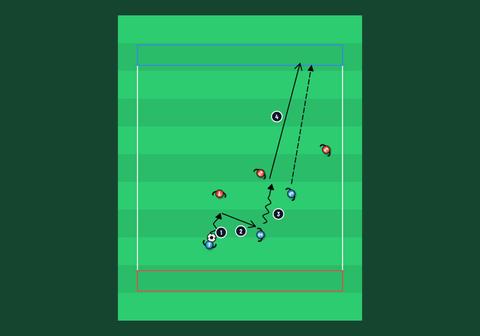
3v3 line game
3v3 game without goals. A goal is scored when a team gets the ball under control behind the opponent’s end line. If the whole team comes short to the ball, there is no one behind the line to pass to. One player stays high and runs in behind the defender. The animation first shows the usual mistake and then the correct way. Area approximately 20 × 20 m, and a two-metre zone behind each end line. The receiver must control the ball behind the line. A shot or dribbling over the line is not enough.
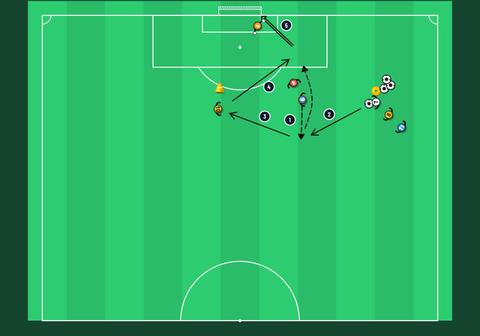
Finishing from a one-two
Flat cones show the starting positions of the passer and the attacker. The attacker makes the initial movement away from the defender, and the first player in the queue plays a pass into the movement. The attacker controls the ball and immediately passes to the wall player. The wall player plays the one-two into the space behind the defender. The attacker goes around the defender on the other side and aims to shoot first time past the goalkeeper. The defender tracks the run but does not intercept passes. Rotation: attacker becomes the wall player, wall player goes to the back of the queue, the player who made the first pass becomes the defender, and the defender becomes the attacker.
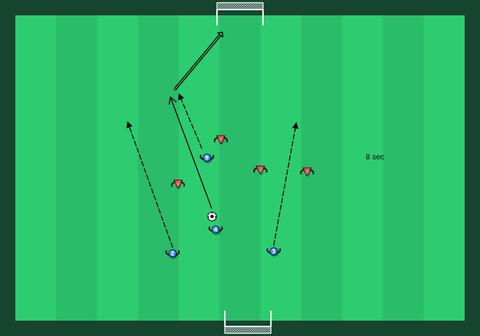
Counter-attack game
The defending team defends their own goal. When they win the ball, they have 8 seconds to attack the opposite goal. If a goal is scored within the time limit, the point counts double. The attacking team continues normal play. A quick transition from defending to attacking is decisive.
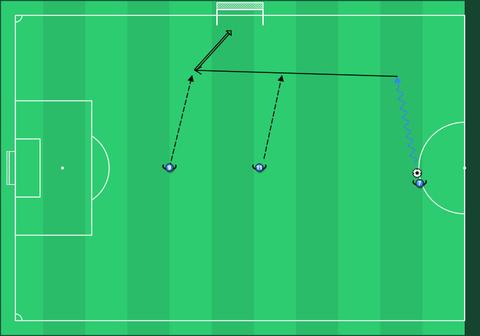
Cross and finishing on the move
The wide player receives the ball and goes to the byline or into the inside channel. In the penalty area, two attackers make crossing runs: one to the near post, the other to the far post. The player crossing chooses the type of cross.
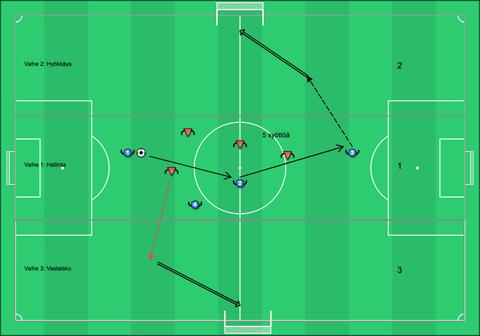
Gioco di transizioni in tre fasi
Campo diviso in tre zone. Il gioco inizia nella zona centrale come possesso palla. Quando una squadra completa 5 passaggi, attacca la porta dell’avversario (fase 2). Se la squadra in fase difensiva riconquista la palla, lancia un contropiede verso l’altra porta (fase 3). Ogni fase richiede una diversa comprensione tattica.
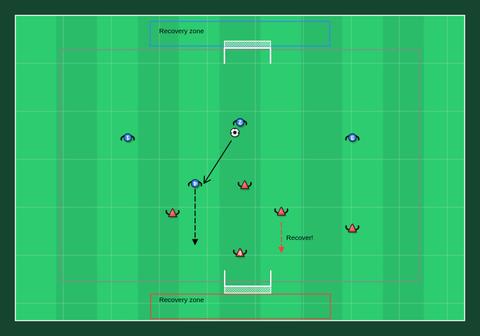
4v4 recovery zone game
4v4 game with two goals. Each team has its own "recovery zone" behind the goal. When a team loses possession, one player must go into the recovery zone before they can take part in defending. This creates temporary numerical superiority for the attacking team and forces a quick transition.