Esercitazioni di finalizzazione: segnare da situazioni di gioco
Finalizzare vuol dire segnare sotto pressione, che non è come tirare a porta vuota. In queste esercitazioni il tiro nasce da una situazione di gioco: un uno-due, un passaggio all'indietro dalla linea di fondo, un cross, una girata con il difensore alle spalle o un 1 contro 1 verso la porta. Inizia lo schema senza opposizione così i giocatori tirano tanto, poi aggiungi un difensore che insegue o un portiere. Chiedi pochi tocchi prima del tiro e uno sguardo alla porta prima di calciare. Tieni le file corte e scambia i ruoli dopo ogni ripetizione.
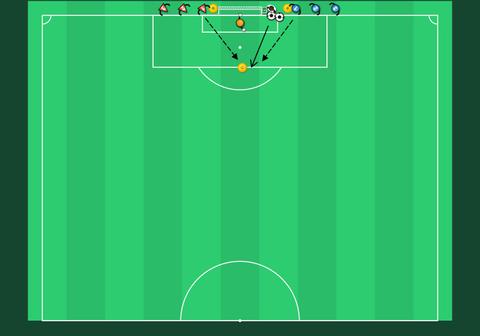
Corsa alla palla e tiro
I giocatori vengono divisi in due squadre, che si dispongono in fila dietro la linea di fondo ciascuna dal lato del proprio palo. La testa della fila è segnata con un cono. In porta c'è un portiere. L'allenatore si posiziona con i palloni dietro la linea di fondo accanto al palo destro. Al centro, a circa 20 metri dalla porta, viene posizionato un cono segnalatore. L'allenatore effettua un passaggio oltre il cono segnalatore in modo che la palla si fermi alla stessa distanza dalla testa di entrambe le file. I primi delle file partono al momento del passaggio. Chi arriva per primo sulla palla attacca, l'altro difende. Da lì si gioca un 1 contro 1 fino al tiro. Entrambi tornano in fondo alla propria fila e la coppia successiva inizia. Si contano i gol: quale squadra ne realizza di più? Con la direzione e la velocità del passaggio, l'allenatore mantiene equilibrata la sfida. I giocatori più grandi possono effettuare il passaggio da soli. In quel caso, il giocatore della fila di destra effettua il passaggio oltre il cono e parte in rincorsa; la palla può essere toccata solo dopo il cono, e il giocatore della fila di sinistra difende. Per aumentare la difficoltà della fase offensiva si può inserire un limite di tempo.
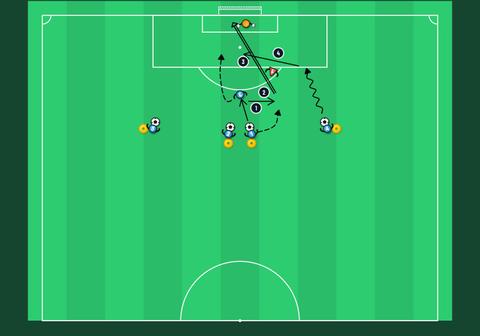
Two shots: lay-off from the wall and a square pass from the wing
A goal includes a goalkeeper. At the top of the penalty arc there is a wall player without the ball, and in the middle 7–8 metres behind them there are two lines with balls. On both wings there is a wide line with balls on the extension of the side of the penalty area, level with the central lines. On the edge of the penalty area there is one defender. The first player in the central line passes to the wall and makes a diagonal run wide. The wall lays the ball off into their run, and they shoot first time from about 18 metres before the defender can get tight. The wide player starts dribbling towards goal already during the first pass. After the lay-off, the wall drops back a step, runs into the penalty area and finishes first time from the wide player's square pass. The shooter then becomes the next wall player, the wall goes to the wide line on the side from which they finished, and the wide player goes to the central line. The next repetition is done from the opposite wing, so the side changes on every repetition.
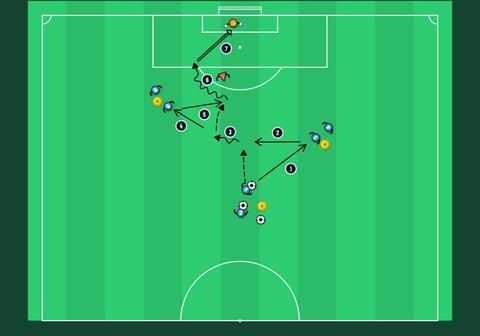
Two one-twos, a feint and a shot
There is a goalkeeper in goal. In the middle, outside the penalty area, there is a queue with balls. The wall players are on the sides: the right one slightly closer to the goal, the left one above the corner of the penalty area. Both have their own queue. There is a defender at the edge of the penalty arc. The first player in the middle queue plays a pass to the right wall player and runs forward. The wall player returns it one-touch into his run. He dribbles the ball to the left, plays a pass to the left wall player and runs forward again, and the wall player returns it into his run. At the defender, he shows inside, goes past on the outside and shoots into the far corner. The defender reacts to the feint but does not win the ball. Change the defender every few repetitions. The rotation goes anticlockwise. The shooter moves to the right wall queue, the right wall player to the left wall queue and the left wall player to the middle queue. When the pattern is mirrored, the first wall player is on the left and the shot is with the left foot.
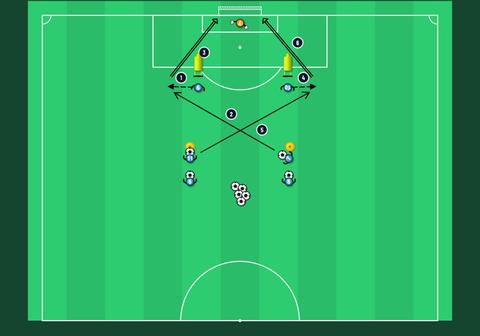
Breaking away and shooting from both sides
Finishing when the defender is behind you. The attacker stands in front of the mannequin with their back to goal. They move away from the mannequin outwards and call for a pass from the queue on the opposite side. First touch towards goal and a shot. Then the same on the other side. Rotation: the passer goes to shoot, and after the shot the finisher stays in the queue on their own side, so the queue changes on every repetition.
Two finishing actions
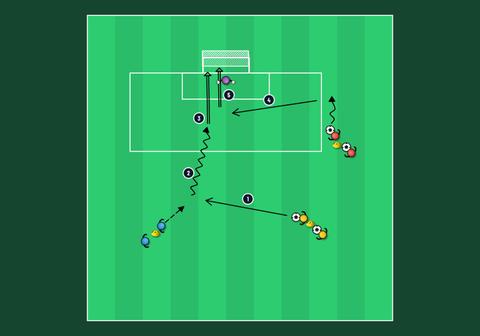
Split the players into three equal groups in front of the goal, with a goalkeeper in goal. The blue players are on the left, the yellow players on the right, and the red players near the right corner. The yellow players and the red players have balls. The first blue player starts a run, and the yellow player plays a pass into his path. The blue player dribbles briefly at full speed and shoots at goal. Immediately afterwards, he finishes from the red player's cross. After that, all three switch places: the finisher goes to the red queue, the crosser to the yellow queue, and the passer to the blue queue. Every shot should be on target.
Finishing from three positions
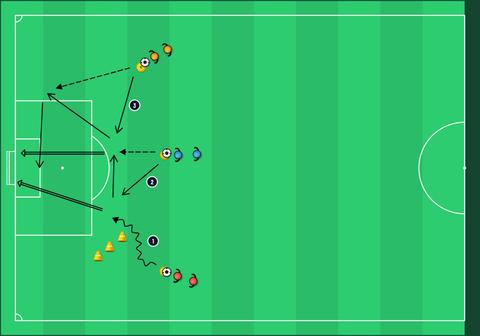
The red player sets off, beats the cone defender and shoots at goal. The blue player immediately gives a pass to the red player, and the red player lays off a one-two, from which the blue player shoots at goal. After this, the yellow player gives a pass to the blue player, who plays a one-two towards the end line. The yellow player crosses from the end line, and both the blue and the red player take part in finishing.
Lay-off for the second wave
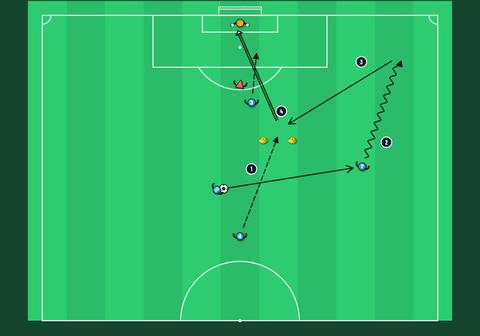
A pass from the centre to the winger, who dribbles all the way to the byline. The attacker takes the defender with them to the near post. When the defending has dropped towards the goal, the midfield player arrives late at the edge of the penalty area into the gate. The winger lays the ball back and the arriving player shoots first time from the pass. A goalkeeper in goal. Start alternately from both flanks.
Wide 2v1 and cross
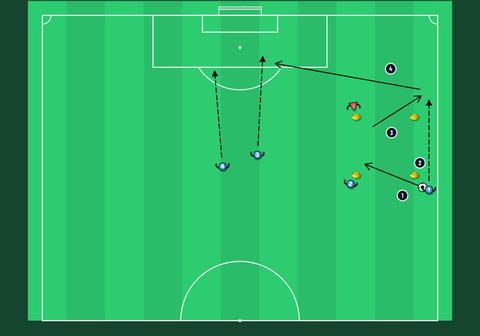
Two attackers break down one defender out wide and deliver a cross. The wide player passes to the inside player, who comes towards the ball and turns towards goal. At the same time, the defender sets off from the opposite corner to apply pressure. The passer immediately makes an overlapping run on the outside past their teammate, into the space between the penalty area and the touchline. From there, they receive the ball back and deliver a cross. The run into the penalty area is staggered: one to the near post, the other to the far post. The defender does not follow outside the square. Start alternately from both flanks. Alternatively, the wide player can solve the situation themselves in a 1v1, either by going inside or down the touchline.
Cutback finishing
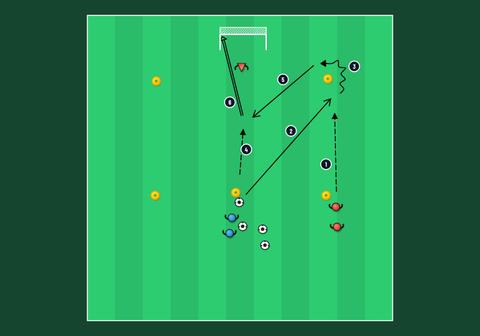
The drill starts with the red player making a movement, which the player in the middle looks to find with a pass. The red player controls the ball, goes around the cone near the end line and plays a cut-back pass to the central player, who looks to shoot and score. The queues change after every repetition.
Finishing - defender behind the back
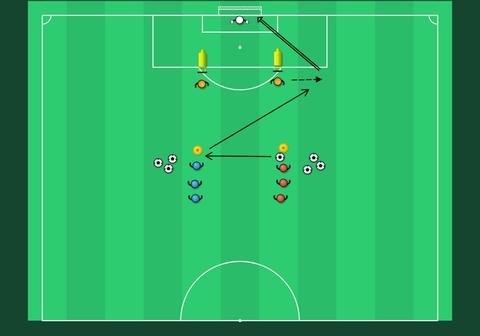
The situation starts with a sideways pass from one queue to the other. The diagonal attacker (orange) moves away to the side from the defender and looks to shoot immediately after the control. In the second variation, the attacker's movement is to the inside of the defender.
Cross and finishing on the move
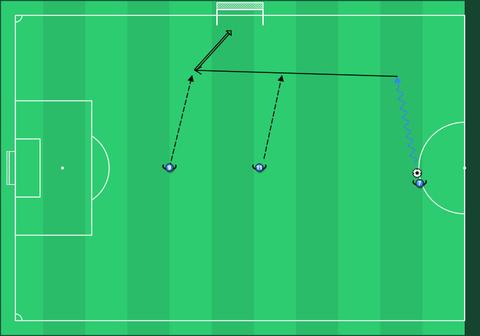
The wide player receives the ball and goes to the byline or into the inside channel. In the penalty area, two attackers make crossing runs: one to the near post, the other to the far post. The player crossing chooses the type of cross.
3v2 finishing
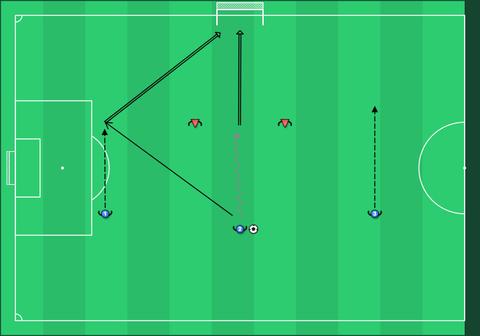
Three attackers start with the ball and move towards two defenders. The aim is to create numerical superiority and finish. After a goal, the attackers receive a new ball and attack the opposite goal.
One-two and finishing
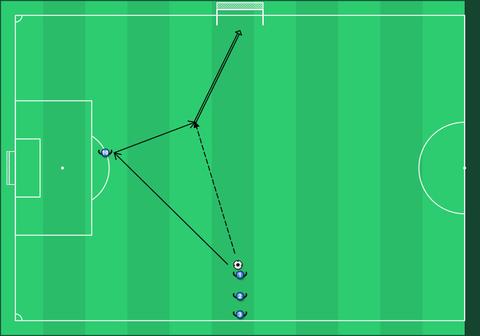
Players in a queue approximately 25 metres from goal. A passer is positioned on the side. The player plays a pass to the wide passer, makes a forward run and receives the ball back from a one-two. Finishes into the goal with one or two touches.
Back to goal turn and shoot
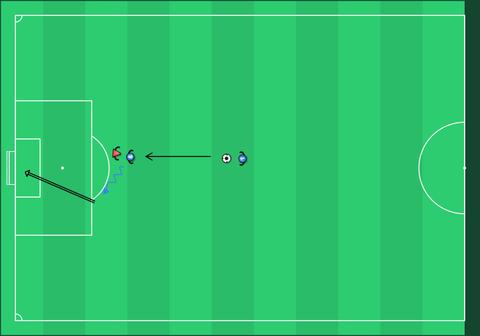
Attacker on the edge of the penalty area with back to goal, defender behind. The passer plays the ball to the attacker, who takes control, turns away from the defender and finishes. Check the defender’s position over the shoulder. Depending on the age group and skill level, you can make it easier at first by requiring the defender to keep their hands behind their back.
Continuous 2v1 towards one goal
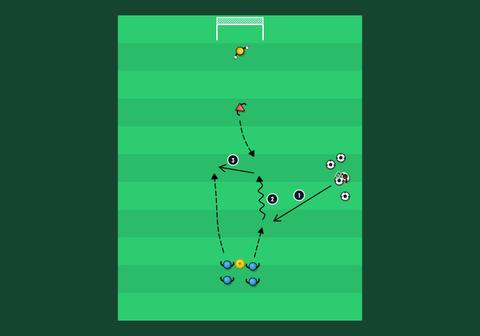
The attackers wait in two queues next to a flat cone, the defender is in front of the goal and the coach is on the wing with balls. The coach plays a pass to the first players in the queues, who attack the goal as a pair. They are up against a defender and a goalkeeper. The defender tries to win the ball, and the attackers’ decision depends on what he does. If he closes down the player on the ball, the player on the ball passes to the free player just before the confrontation. If he stays to block the passing lane, the player on the ball dribbles towards goal and shoots. If the player on the ball delays, the defender has time to win the ball. He passes the won ball back to the coach. When the situation ends, the attacker who shot or lost possession stays in as the next defender. The other attacker and the previous defender go to the back of the queues, and the coach starts the next round immediately. Bibs are not changed, so the defender can be of either colour.
Two-phase 1v1 to goal
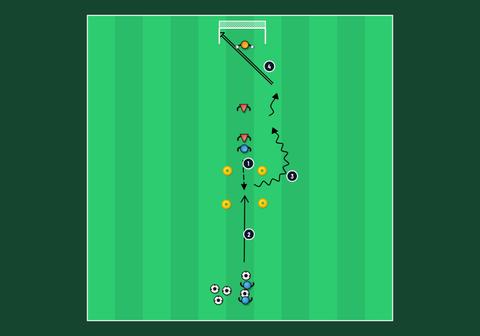
Two-phase 1v1. Starts with the attacker’s movement. The attacker asks for the pass into a square marked out with cones (the 1st defender follows), where they aim to move the ball with their first touch to either side. Once the ball is outside the square, it is the second defender’s turn to defend. Now a traditional 1v1, where the attacker aims for finishing. Rotation of roles: attacker goes to the back of the queue, 1st defender becomes the attacker and the second defender becomes the first defender. The passer becomes the second defender.
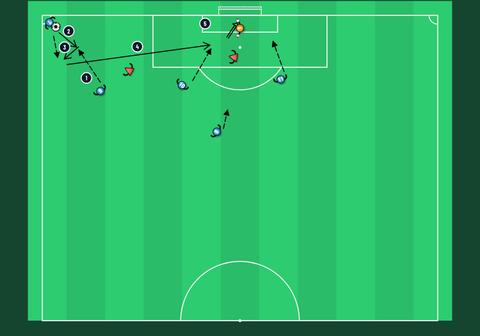
Short corner routine
The corner is played short. The supporting player comes towards the corner flag and receives a pass, which makes the nearest defender come out of the penalty area to apply pressure. The ball is then played back to the taker, who has meanwhile moved from the corner to around eight metres away. The angle for the cross is better from there, and the ball can be delivered low between the near post and the goalkeeper. The player running to the near post finishes one-touch, and the run to the far post starts at the same time. There are two defenders: one applies pressure to the short corner, the other defends the area. Without the defender coming out, the pattern does not show why the short corner works.
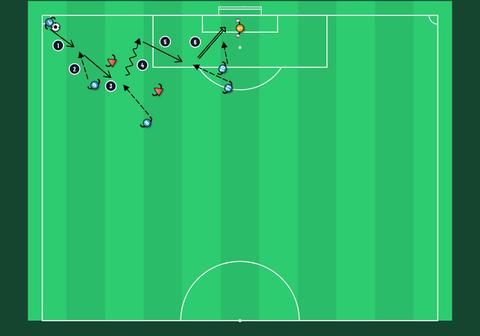
Short corner routine with three players
The corner is played short between three players. The player closest to the flag comes short and receives the pass, which brings the first defender out. Instead of the ball being returned to the taker, it goes first touch to the third player, who has come from the edge of the penalty area into the same corner. Now the second defender also has to come out, and the third player dribbles between them to the end line. From the end line, the ball is played back low towards the penalty spot. The finisher times the run so that they move towards the ball rather than waiting for it standing still. The player occupying the near post takes the goalkeeper with them. Two defenders out means there is briefly a 2v1 in the penalty area. That is the whole idea of the move: the short corner is not looking for a cross but for numerical superiority.
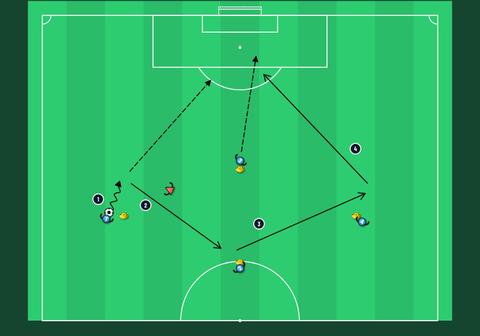
Switch of play and cross
Four players in a diamond: both flanks, one in the middle at the front and one in the middle at the back. The wide player starts dribbling towards goal. The deepest player calls, which stops the dribbling and the ball is played back. The deepest player switches play first time to the opposite flank, who advances and delivers a cross. The others arrive in front of goal in staggered runs to finish. Start alternately from each flank. Instead of a cross, a sharp low pass from the flank is also allowed.
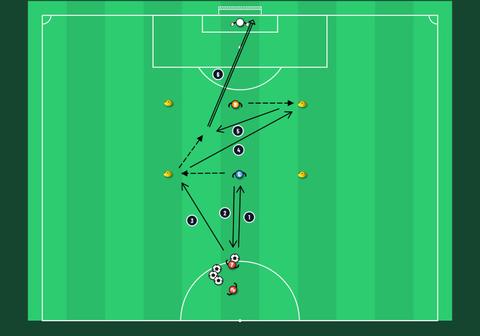
Barcelona shooting drill
A pass is played from the line to the blue player, who sets it back with a one-two to the first player in the line. After that, he chooses which cone to move to, and the yellow player moves to the opposite cone on his own line. The first player in the line passes to the blue player who has moved to the cone, and the blue player passes to the yellow player. The yellow player lays off a one-two to the blue player, who looks to shoot first time into the goal. There is a goalkeeper in goal. After the shot, the players rotate positions: the passer goes into the middle, the shooter goes up, and the top player goes to the back of the line. The next round starts from the line with a new ball.