Esercitazioni di tiro: la tecnica di calcio
Qui quasi tutto il lavoro va sul gesto del tiro, dalla rincorsa al piede d'appoggio accanto alla palla, fino al contatto e all'accompagnamento. I giocatori ripetono meglio la tecnica vicino alla porta e con la palla ferma. Dopo tirano su passaggio, dopo una conduzione e in girata. Fagli usare entrambi i piedi e mirare basso agli angoli. Con il portiere in porta ogni ripetizione conta. Se si riparte in fretta, nessuno resta fermo a lungo. Sulla lavagna avvicina o allarga i coni in base ai tuoi giocatori.
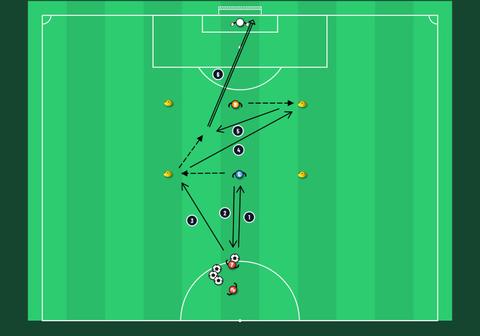
Barcelona shooting drill
A pass is played from the line to the blue player, who sets it back with a one-two to the first player in the line. After that, he chooses which cone to move to, and the yellow player moves to the opposite cone on his own line. The first player in the line passes to the blue player who has moved to the cone, and the blue player passes to the yellow player. The yellow player lays off a one-two to the blue player, who looks to shoot first time into the goal. There is a goalkeeper in goal. After the shot, the players rotate positions: the passer goes into the middle, the shooter goes up, and the top player goes to the back of the line. The next round starts from the line with a new ball.
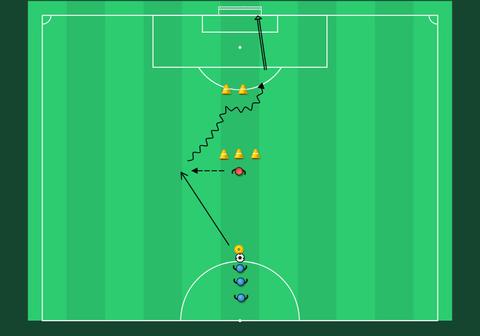
Dribbling and finishing
The red player chooses a side to move towards and calls for the pass. The first player in the queue plays the pass and the red player aims to take the first touch in the direction of travel. The red player dribbles towards the goal, beats the cone defender with a feint of their choice and shoots into the goal. Rotation: the passer becomes the finisher.
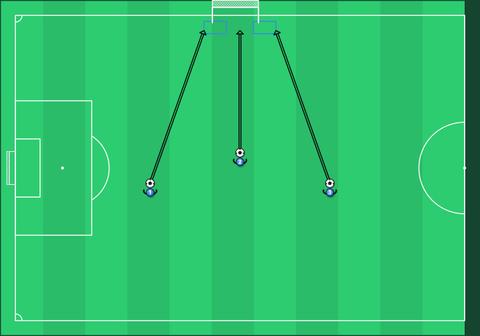
Shooting from a stationary ball
Players take turns shooting a stationary ball towards the goal from different distances (8–15 m). The balls are placed at different angles in front of the goal. Focus on correct striking technique: positioning the non-kicking foot next to the ball, locking the ankle, and striking with the instep.
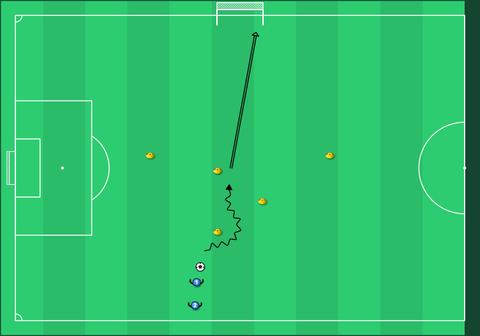
Dribbling and shooting
Players dribble the ball past or through the cones before shooting. The dribbling starts approximately 20–25 metres from the goal, the shooting area marked with cones approximately 10–14 metres away. Head up before shooting.
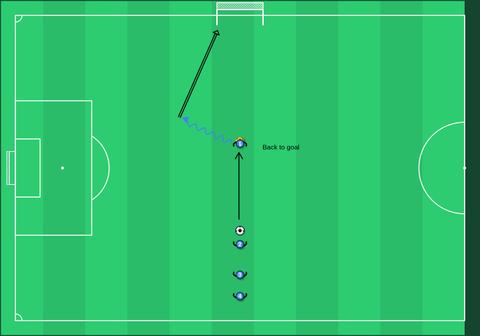
Turn and shoot
The player stands with their back to goal around 11–14 metres away, with the passer in front. The passer plays a low pass, the player controls the ball with the first touch to the side and shoots with the second touch.
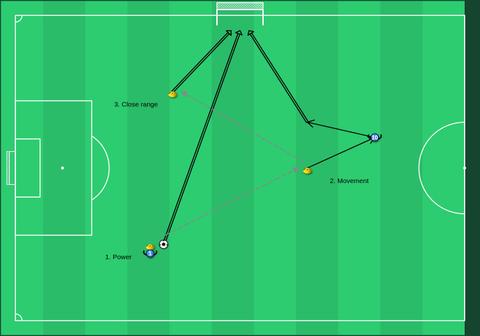
Shooting circuit
Three-point shooting circuit: (1) power shot from around 20 metres, (2) shot on the move from the passer’s lay-off from around 14 metres and (3) close-range shot or half-volley from short distance. After each shot, quickly move to the next station.
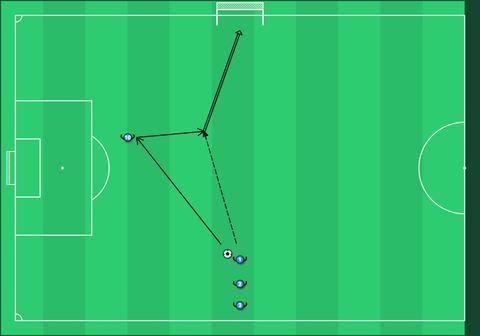
Passing and shooting
A line of players 18–20 metres from the goal, the passer at the edge of the penalty area. The shooter passes to the passer and continues the run, the passer returns the ball with one-touch into the shooter’s path. The shooter finishes directly or with one-touch.
Corsa alla palla e tiro
I giocatori vengono divisi in due squadre, che si dispongono in fila dietro la linea di fondo ciascuna dal lato del proprio palo. La testa della fila è segnata con un cono. In porta c'è un portiere. L'allenatore si posiziona con i palloni dietro la linea di fondo accanto al palo destro. Al centro, a circa 20 metri dalla porta, viene posizionato un cono segnalatore. L'allenatore effettua un passaggio oltre il cono segnalatore in modo che la palla si fermi alla stessa distanza dalla testa di entrambe le file. I primi delle file partono al momento del passaggio. Chi arriva per primo sulla palla attacca, l'altro difende. Da lì si gioca un 1 contro 1 fino al tiro. Entrambi tornano in fondo alla propria fila e la coppia successiva inizia. Si contano i gol: quale squadra ne realizza di più? Con la direzione e la velocità del passaggio, l'allenatore mantiene equilibrata la sfida. I giocatori più grandi possono effettuare il passaggio da soli. In quel caso, il giocatore della fila di destra effettua il passaggio oltre il cono e parte in rincorsa; la palla può essere toccata solo dopo il cono, e il giocatore della fila di sinistra difende. Per aumentare la difficoltà della fase offensiva si può inserire un limite di tempo.
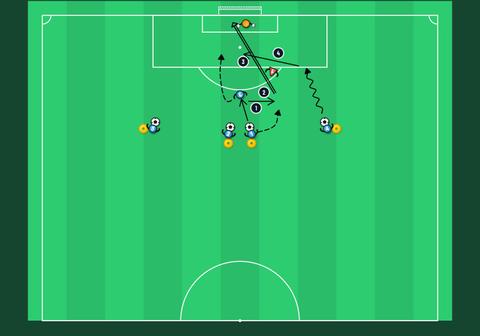
Two shots: lay-off from the wall and a square pass from the wing
A goal includes a goalkeeper. At the top of the penalty arc there is a wall player without the ball, and in the middle 7–8 metres behind them there are two lines with balls. On both wings there is a wide line with balls on the extension of the side of the penalty area, level with the central lines. On the edge of the penalty area there is one defender. The first player in the central line passes to the wall and makes a diagonal run wide. The wall lays the ball off into their run, and they shoot first time from about 18 metres before the defender can get tight. The wide player starts dribbling towards goal already during the first pass. After the lay-off, the wall drops back a step, runs into the penalty area and finishes first time from the wide player's square pass. The shooter then becomes the next wall player, the wall goes to the wide line on the side from which they finished, and the wide player goes to the central line. The next repetition is done from the opposite wing, so the side changes on every repetition.
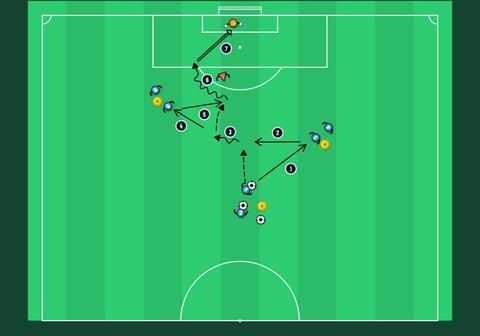
Two one-twos, a feint and a shot
There is a goalkeeper in goal. In the middle, outside the penalty area, there is a queue with balls. The wall players are on the sides: the right one slightly closer to the goal, the left one above the corner of the penalty area. Both have their own queue. There is a defender at the edge of the penalty arc. The first player in the middle queue plays a pass to the right wall player and runs forward. The wall player returns it one-touch into his run. He dribbles the ball to the left, plays a pass to the left wall player and runs forward again, and the wall player returns it into his run. At the defender, he shows inside, goes past on the outside and shoots into the far corner. The defender reacts to the feint but does not win the ball. Change the defender every few repetitions. The rotation goes anticlockwise. The shooter moves to the right wall queue, the right wall player to the left wall queue and the left wall player to the middle queue. When the pattern is mirrored, the first wall player is on the left and the shot is with the left foot.
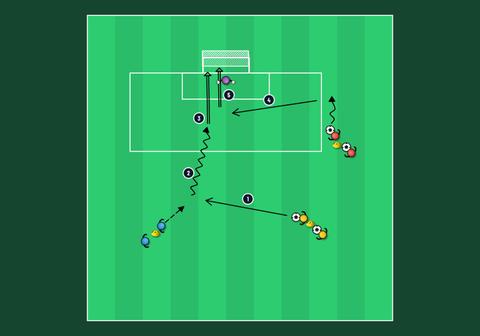
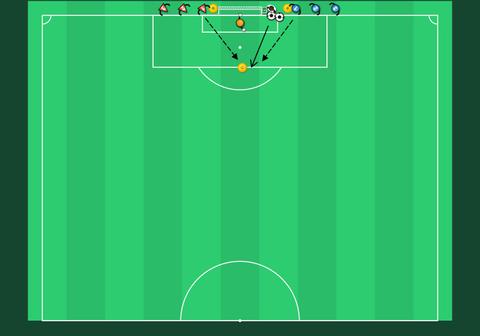
Two finishing actions
Split the players into three equal groups in front of the goal, with a goalkeeper in goal. The blue players are on the left, the yellow players on the right, and the red players near the right corner. The yellow players and the red players have balls. The first blue player starts a run, and the yellow player plays a pass into his path. The blue player dribbles briefly at full speed and shoots at goal. Immediately afterwards, he finishes from the red player's cross. After that, all three switch places: the finisher goes to the red queue, the crosser to the yellow queue, and the passer to the blue queue. Every shot should be on target.
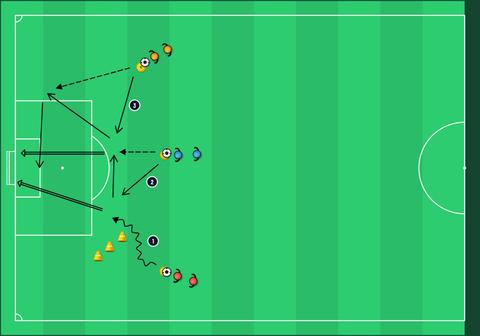
Finishing from three positions
The red player sets off, beats the cone defender and shoots at goal. The blue player immediately gives a pass to the red player, and the red player lays off a one-two, from which the blue player shoots at goal. After this, the yellow player gives a pass to the blue player, who plays a one-two towards the end line. The yellow player crosses from the end line, and both the blue and the red player take part in finishing.
Two-phase 1v1 to goal
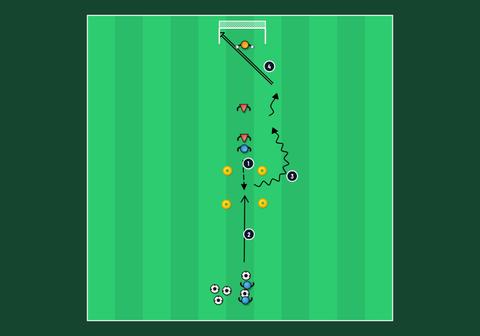
Two-phase 1v1. Starts with the attacker’s movement. The attacker asks for the pass into a square marked out with cones (the 1st defender follows), where they aim to move the ball with their first touch to either side. Once the ball is outside the square, it is the second defender’s turn to defend. Now a traditional 1v1, where the attacker aims for finishing. Rotation of roles: attacker goes to the back of the queue, 1st defender becomes the attacker and the second defender becomes the first defender. The passer becomes the second defender.
Free kick routine with a fake argument
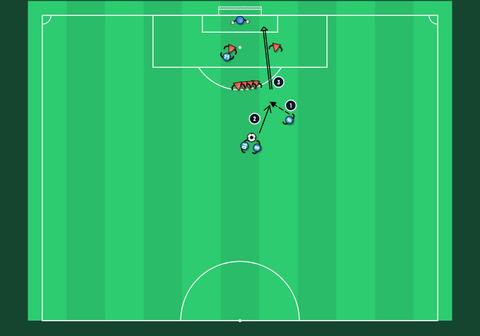
Two players stay over the ball and begin to act out a disagreement over who will shoot. Meanwhile, a third walks calmly towards his own position off to the side, without looking towards the ball even once. In the middle of the argument, the ball rolls into his path, and the shot is taken with the first touch from a new angle that the wall cannot turn to in time. The pattern lives or dies with the walker: as soon as he glances at the ball or breaks into a run too early, the defending reads the pattern. The pass is played only when the walker is one step away from the shooting position.
Free kick routine with a splitting wall
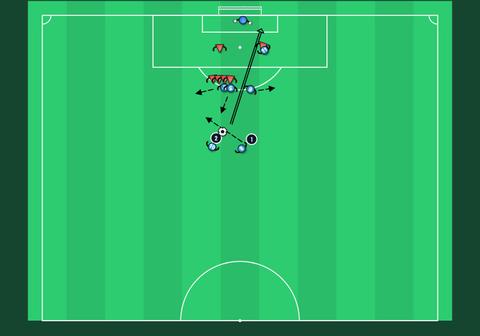
Direct free kick from around 20 metres, where your own line of three players stands in the goalkeeper’s line of sight, at least one metre away from the wall, as the law requires. A decoy runner goes over the ball, and at the same moment the line splits to the sides. The shooter strikes low through the newly opened channel into the far corner, where the goalkeeper only has time to look once the ball is already moving. The role of the line is not to cover the whole goal but to take away the goalkeeper’s moment of release: a goalkeeper who reacts late will not reach the low corner. Practise the line splitting so that it happens exactly on the shooter’s final step — if the line splits too early, it reveals everything.
Cutback finishing
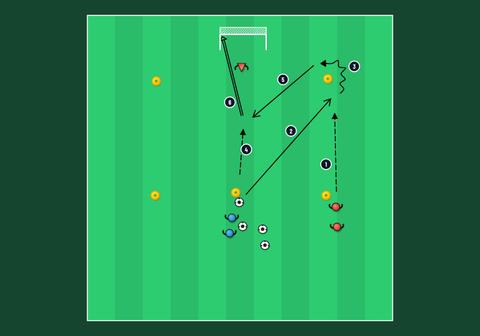
The drill starts with the red player making a movement, which the player in the middle looks to find with a pass. The red player controls the ball, goes around the cone near the end line and plays a cut-back pass to the central player, who looks to shoot and score. The queues change after every repetition.
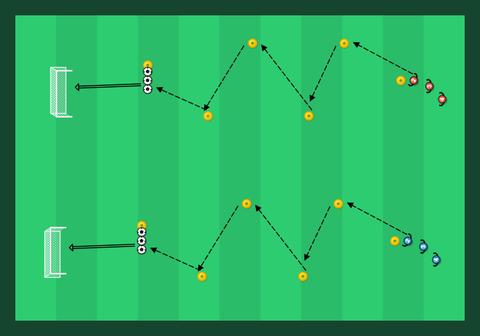
Cone relay race with a shot
Two identical courses side by side, with a team on each. At the end of the course there is a small goal and a cone in front of it with three balls. Between the goal and the starting cone there are four cones alternating on different sides of the course. The first player starts on the signal and goes round the cones at full speed, passing each on a different side. From the last cone, straight to the ball and a shot into the small goal. When the ball is in the goal, the next player starts. The team that gets all three balls into the goal first wins. Three players on each course, six in total. Adjust the spacing between the cones to suit the group. The closer together the cones are, the more the course demands braking and changes of direction.
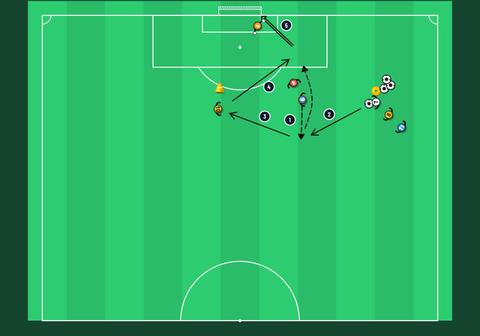
Finishing from a one-two
Flat cones show the starting positions of the passer and the attacker. The attacker makes the initial movement away from the defender, and the first player in the queue plays a pass into the movement. The attacker controls the ball and immediately passes to the wall player. The wall player plays the one-two into the space behind the defender. The attacker goes around the defender on the other side and aims to shoot first time past the goalkeeper. The defender tracks the run but does not intercept passes. Rotation: attacker becomes the wall player, wall player goes to the back of the queue, the player who made the first pass becomes the defender, and the defender becomes the attacker.
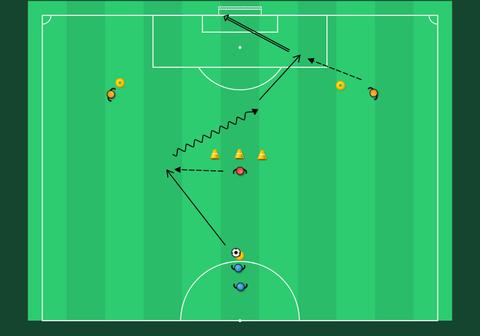
Passing, dribbling and shot from a through pass
The player in front of the cones makes a movement to either side of the line of cones and asks for the pass. The first player in the queue plays a pass and the receiver takes a short dribble towards the player positioned on the opposite diagonal and plays a through pass to them. The receiving player tries to "avoid offside" (the cones represent the deepest defenders) and finish first time from the pass.
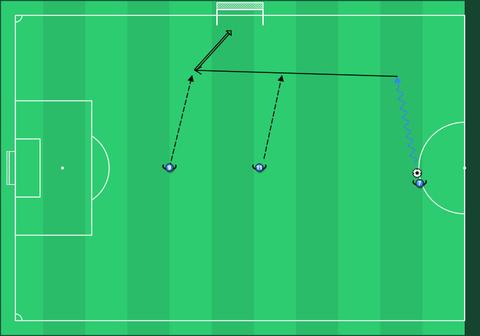
Cross and finishing on the move
The wide player receives the ball and goes to the byline or into the inside channel. In the penalty area, two attackers make crossing runs: one to the near post, the other to the far post. The player crossing chooses the type of cross.