Schemi su calcio d'angolo e punizione che creano un vantaggio
Calci d'angolo e punizioni sono palle inattive, momenti della partita che puoi provare in anticipo. Ogni schema su calcio d'angolo e punizione di questa pagina cerca un momento di vantaggio: un giocatore libero, un 2 contro 1 o un portiere che vede la palla in ritardo. Nessuno richiede una palla lunga in un'area affollata. Ogni schema è animato, così i giocatori vedono i movimenti prima di provarli, e ci sono sempre difensori o una barriera da superare, così si capisce perché lo schema funziona.
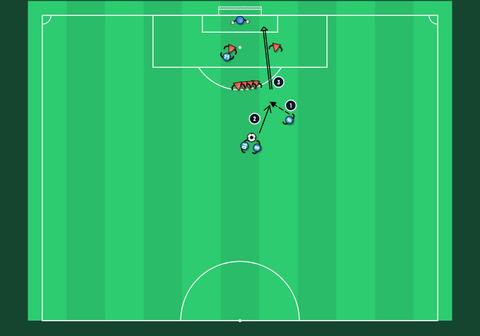
Free kick routine with a fake argument
Two players stay over the ball and begin to act out a disagreement over who will shoot. Meanwhile, a third walks calmly towards his own position off to the side, without looking towards the ball even once. In the middle of the argument, the ball rolls into his path, and the shot is taken with the first touch from a new angle that the wall cannot turn to in time. The pattern lives or dies with the walker: as soon as he glances at the ball or breaks into a run too early, the defending reads the pattern. The pass is played only when the walker is one step away from the shooting position.
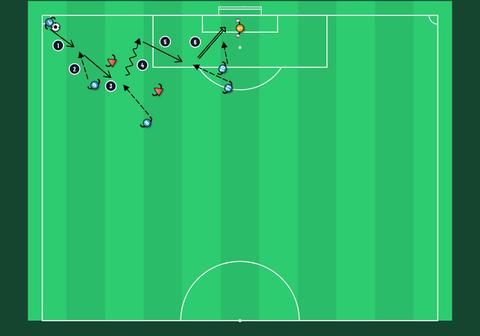
Short corner routine with three players
The corner is played short between three players. The player closest to the flag comes short and receives the pass, which brings the first defender out. Instead of the ball being returned to the taker, it goes first touch to the third player, who has come from the edge of the penalty area into the same corner. Now the second defender also has to come out, and the third player dribbles between them to the end line. From the end line, the ball is played back low towards the penalty spot. The finisher times the run so that they move towards the ball rather than waiting for it standing still. The player occupying the near post takes the goalkeeper with them. Two defenders out means there is briefly a 2v1 in the penalty area. That is the whole idea of the move: the short corner is not looking for a cross but for numerical superiority.
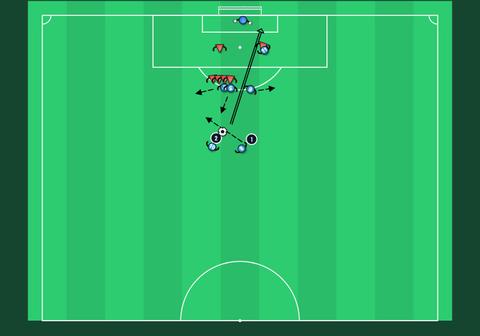
Free kick routine with a splitting wall
Direct free kick from around 20 metres, where your own line of three players stands in the goalkeeper’s line of sight, at least one metre away from the wall, as the law requires. A decoy runner goes over the ball, and at the same moment the line splits to the sides. The shooter strikes low through the newly opened channel into the far corner, where the goalkeeper only has time to look once the ball is already moving. The role of the line is not to cover the whole goal but to take away the goalkeeper’s moment of release: a goalkeeper who reacts late will not reach the low corner. Practise the line splitting so that it happens exactly on the shooter’s final step — if the line splits too early, it reveals everything.
Dagli angoli corti alle punizioni e alle rimesse
Prima i calci d'angolo. Nello schema su angolo corto il giocatore di appoggio va verso la bandierina e porta fuori dall'area il difensore più vicino. La palla torna a chi ha battuto, che si è spostato di circa otto metri dalla bandierina, e da lì il cross può entrare basso tra il primo palo e il portiere. Lo schema su angolo corto a tre giocatori sviluppa l'idea: il primo tocco va a un terzo giocatore che arriva dal limite dell'area, anche il secondo difensore deve uscire, e il passaggio all'indietro dalla linea di fondo trova per un attimo un 2 contro 1 in area. Poi le punizioni. Nello schema con la finta lite due giocatori fingono di discutere su chi deve tirare mentre un terzo si sposta verso un nuovo angolo. Il passaggio parte quando chi cammina è a un passo dalla posizione di tiro, e lui tira di prima. Nello schema con la barriera che si apre, una vostra fila di tre giocatori si mette sulla linea visiva del portiere, ad almeno un metro dalla barriera come chiede il regolamento. Un giocatore esca passa sopra la palla, la fila si apre all'ultimo passo del tiratore e il tiro passa basso nel varco. Restano due riprese di gioco: una rimessa laterale di futsal attraverso il pivot, battuta entro quattro secondi, e l'uscita dal basso su rinvio dal fondo nell'8 contro 8, dove il portiere e due difensori centrali giocano prima senza pressione, poi contro uno e infine contro due giocatori che pressano.
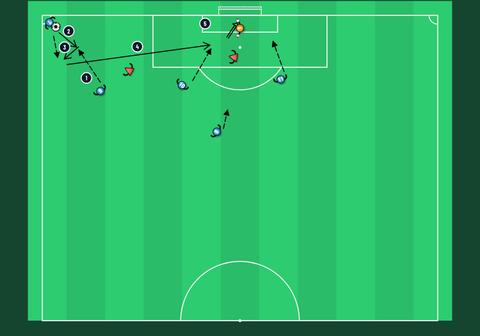
Short corner routine
The corner is played short. The supporting player comes towards the corner flag and receives a pass, which makes the nearest defender come out of the penalty area to apply pressure. The ball is then played back to the taker, who has meanwhile moved from the corner to around eight metres away. The angle for the cross is better from there, and the ball can be delivered low between the near post and the goalkeeper. The player running to the near post finishes one-touch, and the run to the far post starts at the same time. There are two defenders: one applies pressure to the short corner, the other defends the area. Without the defender coming out, the pattern does not show why the short corner works.
Futsal kick-in routine through the pivot
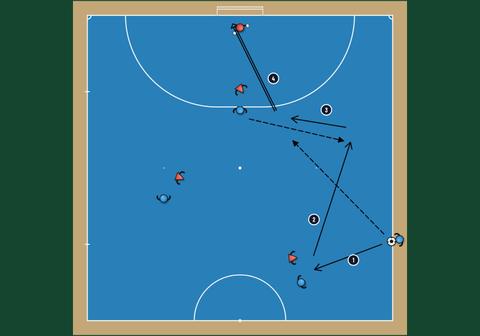
In futsal, the ball is put back into play from the touchline with a kick-in, and you have four seconds. That is why it is worth having a routine ready for the kick-in. Here the kick-in is taken in the attacking half from the right flank. There are four blue outfield players, three red defenders and a goalkeeper. The kicker plays a short pass to the deep player waiting further inside and immediately makes a diagonal run towards goal. At the same time, the pivot moves from in front of the goal out to the flank, and the marker follows. The deep player passes to the pivot on the flank, and the pivot plays the ball into the middle, where the kicker has run. The kicker shoots. If the passing lane to the pivot is blocked, the deep player switches the ball to the left-sided player. Once the routine is working, add a fourth defender to mark the kicker.
Playing out from a goal kick 3v2
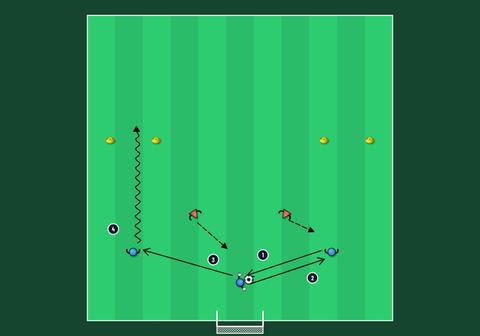
Practise the goal kick in an 8v8 game, where play is started with short passes. The goalkeeper and two centre-backs play against two players pressing. The centre-backs spread out wide level with the corners of the penalty area, and the goalkeeper kicks the ball from the ground to the one who is free. The blue team scores a point when they pass or dribble the ball through the wide gate about 24 metres from the goal line. The reds try to win the ball and score a goal. When the player pressing closes down the centre-back, the centre-back passes the ball back to the goalkeeper, and the goalkeeper switches play to the other side. Start without players pressing, then add one and finally two. In 8v8 for 10-11-year-olds, a goal kick may be taken from the ground anywhere in the penalty area, and the opponent does not have to retreat: it is enough to be 5.5 metres from the ball. The players pressing may therefore stand just as close in the drill as in a match.
I tempi decidono ogni schema
Tempi e mascheramento sono i punti chiave. Sull'angolo vai corto solo quando chi batte è pronto, perché se ti muovi troppo presto ti porti dietro il difensore prima che si apra lo spazio. Chi cammina rivela la punizione appena guarda la palla, e una fila che si apre troppo presto svela tutto. Sulla rimessa laterale il pivot va sulla fascia nel momento in cui la palla viene calciata e porta il marcatore lontano dalla porta. Se la linea di passaggio verso il pivot è chiusa, il centrale (il giocatore di movimento più arretrato) cambia gioco sul giocatore di sinistra. Le domande chiave insegnano a leggere la difesa: come capisci che il difensore ti segue, che il secondo difensore è uscito o che la linea di passaggio verso il pivot è chiusa? Sul rinvio dal fondo la squadra blu segna portando la palla alla porticina laterale, e anche il difensore centrale ha una scelta da fare: quando avanzare in conduzione e quando ridare la palla al portiere.
Per quali età
Gli schemi su calcio d'angolo e punizione sono indicati dagli U10. L'uscita dal basso su rinvio dal fondo è indicata dagli U9 e segue la regola dell'8 contro 8 per i bambini di 10 e 11 anni: il rinvio dal fondo si può battere da terra in qualsiasi punto dell'area di rigore, e l'avversario deve stare solo a 5,5 metri dalla palla, quindi nell'esercitazione chi pressa può stare vicino quanto in partita. Lo schema di rimessa laterale di futsal è indicato dagli U12. Gli angoli si giocano contro due difensori, le punizioni contro una barriera. Ogni schema richiede da cinque a sette giocatori, e sulla lavagna puoi adattarli tutti alla tua squadra.