Allenare l'1 contro 1 e la difesa di squadra
Ogni esercitazione di difesa torna al duello. Il difensore accorcia in fretta, rallenta in tempo, si mette di lato e resta in piedi. Quando un difensore sa farlo, se ne aggiunge un secondo in copertura, e più avanti un reparto impara a scivolare con la palla e a proteggere lo spazio alle sue spalle. L'attaccante deve avere un vero obiettivo da raggiungere. Così il difensore impara cosa proteggere invece di inseguire solo la palla. Le esercitazioni di difesa qui vanno dai duelli 1 contro 1 alla difesa in piccoli gruppi. Chiudi ogni turno prima che il difensore resti senza gambe.
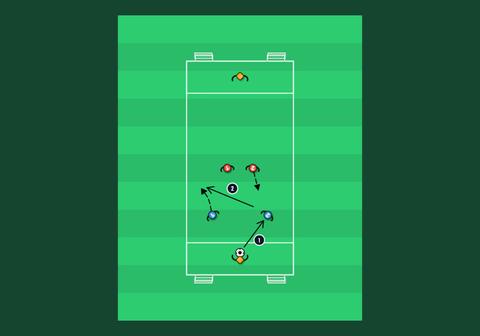
2v2+2 outnumbered: the pair closes the pass into the end zone
Mark out a 10 x 20 metre area and a three-metre zone at each end. There is a joker in each zone, who plays with the team in possession and does not leave their zone. Behind each end, place two small goals. In the middle, two teams of two players play. The joker starts by passing to a player from the team in possession. The pair tries to play the ball to the joker at the opposite end, receive it back from them, and score in either of the small goals at that end. As a target player, the joker may only play backwards. The defending pair tries to stop the split pass and win the ball. When they succeed, the roles change immediately. There are two phases in the animation. First, the blue team attacks up the pitch. When the joker passes to blue 2, red 2 starts pressing during the pass and red 1 stays inside to provide cover. Blue 2 plays into the run of blue 1. Red 1 shifts during the pass, but remains a step too far away, and the ball goes through to the joker. The joker plays it into the run of blue 2. The reds turn immediately and close the space behind them, and red 2 gets tight and wins the ball before the shot. In the second phase, the reds attack down the pitch immediately after winning the ball, when the blues have not yet had time for recovery defending. Red 2 plays into the run of red 1 to the left. Before blue 1 can get tight, red 1 passes directly along the touchline to the lower joker. The joker plays the ball into the run of red 2, and red 2 scores in the right small goal. The blues turn, but are a step late because the pair did not manage to close the passing lane into the end zone.
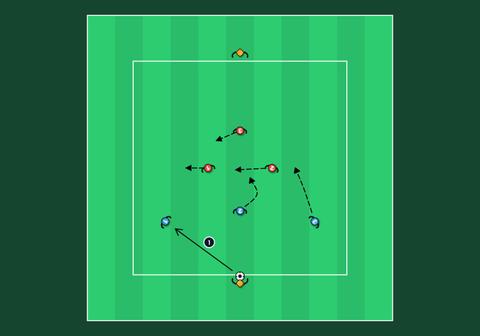
3v3+2 outnumbered: close the middle and force wide
Mark out a 20 × 20 metre area. Place a joker at each end, always playing with the team in possession. Two teams of three players play inside the area. The game starts with a joker. The team in possession tries to move the ball to the joker at the opposite end, so they have five players against three. The defending three try to win the ball. When they succeed, the roles change immediately, and the team that won the ball attacks. The nearest joker can be used as support. There are two rounds in the animation. First, the blues attack upwards. When the ball goes left, the reds shift across as a full three towards the ball side. Red 1 forces Blue 1 towards the touchline, and Red 2 closes the pass into the middle. Blue 1 still tries to play the ball inside, and Red 2 intercepts the ball. The reds keep the ball and play it through the nearest joker. The blues press for a moment and then drop back into their own three. In the second round, the blues stay compact, so the red player in the middle has to pass wide. The blues shift during the pass as one unit, Blue 1 closes down at the touchline and wins the ball, and the blues immediately launch a new attack.
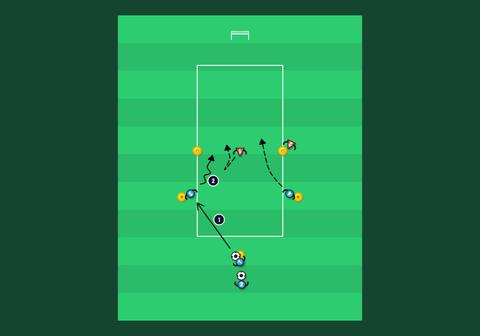
1v2 overload against: turn the situation into 1v1
Mark out a 10 × 20 metre area and a line across the halfway point with two flat cones. The small goal is placed three metres behind the top end of the area and a cone the same distance behind the bottom end. Two passers wait one behind the other by the cone, each with a ball. The wide players stand outside the area on each side, about five metres from the bottom end. The defender is on the halfway line, and the next defender waits at the end of the line outside the area. The passer plays the ball to either wide player. The defender sets off during the pass and decides whether to press the receiver or hold position. The wide players attack the small goal as a pair, and the defender tries to win the ball. The situation ends with a goal or when the ball goes out. There are two repetitions in the animation. In the first, blue 3 receives the ball on the left and dribbles inside. Red 1 approaches at an angle that blocks the pass to blue 4 and drops off diagonally. When blue starts dribbling towards goal, red closes down and plays the ball over the touchline. In the second repetition, the ball goes to the right. Red 2 stays farther away, drops back between the attackers and cuts out an overhit square pass. After winning the ball, he plays it back to the passers' cone. Rotation: the passer follows the pass to the wide position, the wide player who received the ball switches to the opposite flank, and the other wide player goes to the passers' queue. The defenders swap positions after every situation.
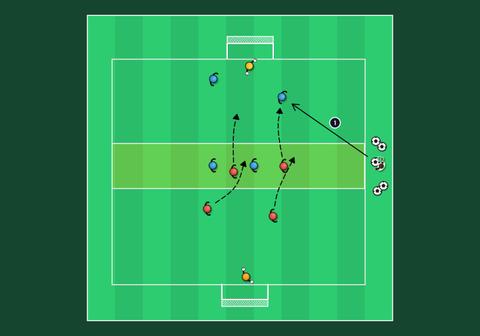
Three-zone pressing game
The coach gives the ball to the other team. The players in the middle can step up to press in their own attacking zone, at which point the players in their own defending zone can move in to fill the spaces in the middle. When the ball is won, free play continues until a goal or a stoppage in play.
2v2 recovery defending
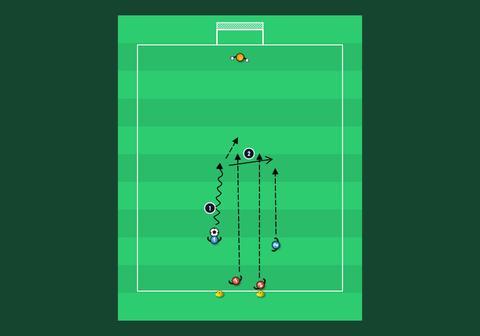
Two blue players attack the goal with a goalkeeper. Two red defenders start from the markers behind the attackers. The area is approximately 20 x 24 metres, with a cone gate at the opposite end. The blues start with the ball and drive towards the goal, and at the same moment the reds recover. The nearer defender runs along the inside line to get between the ball and the goal and delays the player on the ball. The second defender recovers to the inside, between the remaining attacker and the goal. Once it becomes 2v2, the defenders apply pressing and provide cover. In the example, red 1 gets across in front of blue 1 and delays. When blue passes out wide, red 2 moves to press during the pass and red 1 drops to cover. Red 2 wins the ball, and the reds immediately attack the gate. Now the blues recover. The blues score a point for a goal, the reds for dribbling the ball through the gate. The farther away the defenders start, the more difficult the recovery becomes, so adjust the distance of the starting markers according to the level. Change roles after a few repetitions.
2v2 pressing and penetration
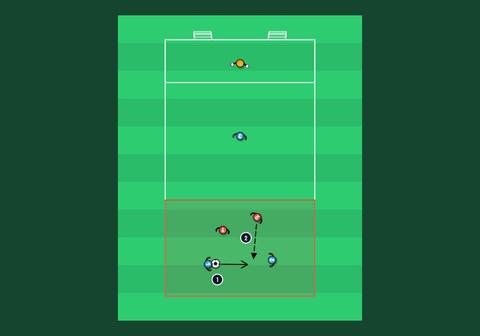
The area is approximately 14 × 24 metres and is divided into three sections. At the bottom is the 2v2 zone, in the middle the penetration zone and at the top the goalkeeper's area. On its end line there are two small goals. In the 2v2 zone, two blue players keep possession and two red players press as a pair. In the penetration zone, one blue defender waits. The reds' task is to win the ball. One presses the player on the ball, the other provides cover from the inside and reads the next pass. After winning the ball, the reds immediately break through: 2v1 against the blue defender and finishing into either small goal. Blue 1 and 2 are not allowed to follow from the 2v2 zone, blue 3 stays in the penetration zone and the goalkeeper stays in their own area. In the pattern, red 2 presses during the pass, and when the ball comes back, the roles change. When blue 1 tries to switch play again, red 2 intercepts the pass. Red 2 dribbles into the penetration zone, draws blue 3 towards them and passes to red 1, who shoots into the left small goal. Change roles every few repetitions so that everyone gets to press, defend the penetration and finish. The blues can be given a point, for example, for five consecutive passes in the 2v2 zone.
2v2 with a cover line
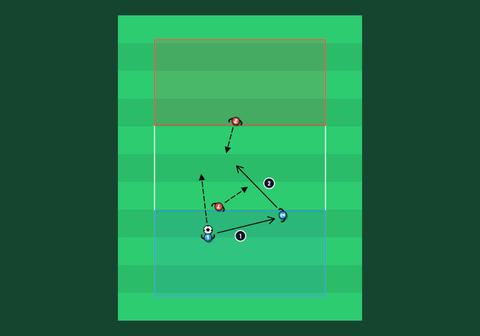
Two pairs play 2v2 in an area of approximately 16 × 24 metres. At each end there is an end line and a cover line eight metres in front of it. A pair scores a point when they dribble the ball over the opponent’s end line or pass to a teammate who controls it behind the line. The second player in the defending pair must be on or behind their own cover line. One presses the player on the ball, the other provides cover. They must not both go to the ball. The covering player may step off the line when they intercept a pass or win the ball from an attacker who has beaten the presser. In that case, the other defender immediately runs back behind the line. In the diagram, Red 1 presses the player on the ball from the inside and shows them wide. Red 2 is on the line diagonally behind on the inside. When Blue passes across to the other side, Red 1 shifts to press the new player on the ball while the ball is travelling, and Red 2 slides along the line to stay behind them. The pair move together. Blue 1 makes a run in behind the presser, but Red 2 reads the pass and intercepts it. After winning the ball, the Reds attack the Blues’ end line immediately. The nearest Blue presses, and the other runs behind their own cover line. Now the Blues defend in the same way. When Blue 1 wins the ball wide, only Red 2 gets back to the line in time. The Blues play a 2v1. Blue 1 draws Red 2 in and passes into the run of Blue 2, who dribbles the ball over the end line. Play 1–2 minute blocks. If there are more than four players, set up several pitches side by side or rotate pairs between blocks.
Pressing line and transitions
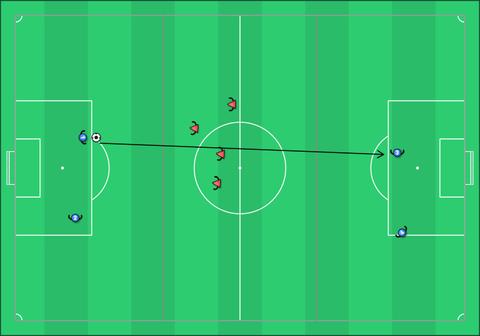
The pitch is divided into three vertical zones. The defending team sets up in the middle zone as a compact block. The attacking team plays the ball in the wide zones and tries to switch play. When the ball is moved, the defending block shifts together towards the ball.
2v2/3v3 with small goals
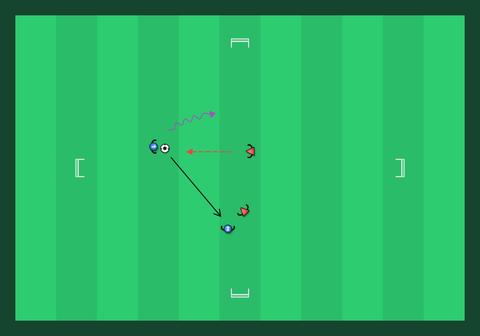
2v2 or 3v3 small-sided game with small goals and no goalkeeper. When the team loses possession, transition immediately into defending: the first defender presses the player on the ball, the second covers and the third provides balance.
4v2 pressing rondo
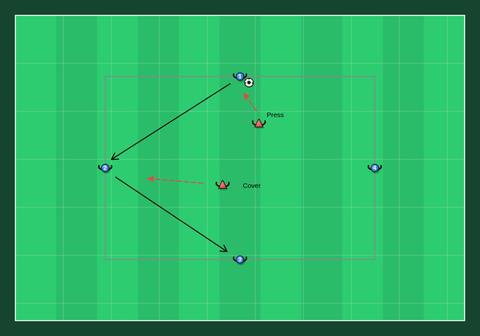
The outside players keep possession with one-touch or two touches, 2 defenders in the middle try to win the ball or intercept the pass. When a defender gets the ball or forces it outside the area, the player who made the last pass goes into the middle.
1v1 Defending Channel
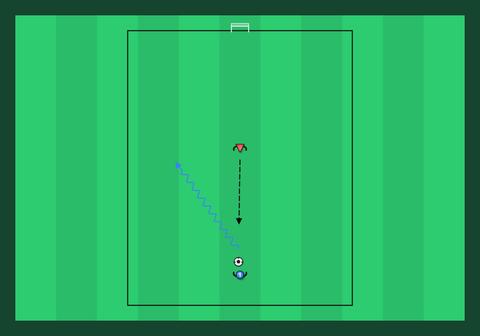
The defender passes the ball to the attacker from the end of the channel and immediately sets off to close down the space. The attacker’s objective is to dribble the ball to the other end of the channel. The defender delays, shows the attacker to the side and tries to win the ball.
Shadow defending
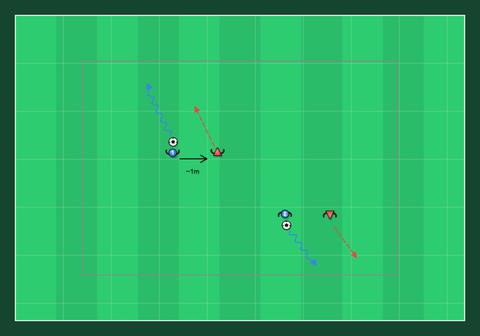
In pairs: the attacker dribbles the ball freely inside the grid, changing direction and speed. The defender follows the attacker’s movements like a mirror, keeping about an arm’s length distance, and does not try to win the ball.
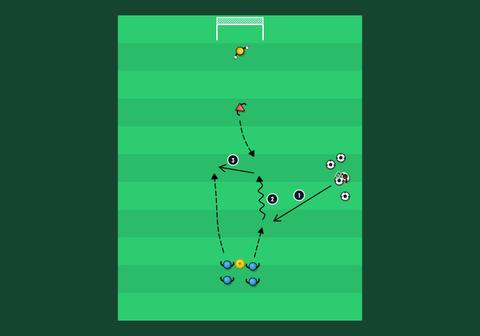
Continuous 2v1 towards one goal
The attackers wait in two queues next to a flat cone, the defender is in front of the goal and the coach is on the wing with balls. The coach plays a pass to the first players in the queues, who attack the goal as a pair. They are up against a defender and a goalkeeper. The defender tries to win the ball, and the attackers’ decision depends on what he does. If he closes down the player on the ball, the player on the ball passes to the free player just before the confrontation. If he stays to block the passing lane, the player on the ball dribbles towards goal and shoots. If the player on the ball delays, the defender has time to win the ball. He passes the won ball back to the coach. When the situation ends, the attacker who shot or lost possession stays in as the next defender. The other attacker and the previous defender go to the back of the queues, and the coach starts the next round immediately. Bibs are not changed, so the defender can be of either colour.
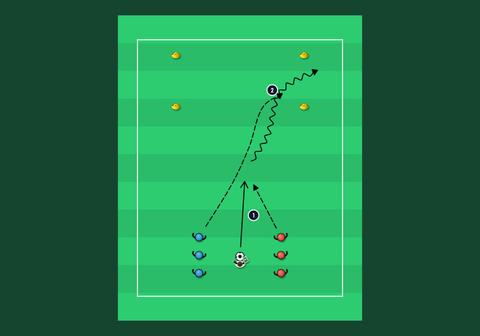
1v1 duel and shielding the ball to two gates
The coach stands with the balls at the lower end of the area, and the teams are in lines on either side of them. In the top corners of the area there are two four-metre gates, through which the ball is dribbled out to the side. The coach plays a pass forward into the middle, and the first player from each line goes for the ball. The player who gets the ball tries to dribble it through either gate, and the other tries to win the ball and stop them. If they win the ball, they can then try to go through either gate themselves. The duel ends with a goal or when the ball goes out of the area, and the players return to the back of their lines. Contact is allowed, but sliding tackles are forbidden. The area is approximately 16 × 20 metres.
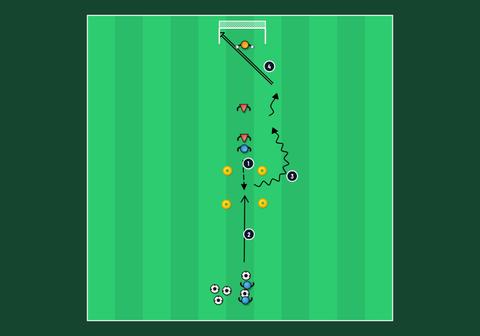
Two-phase 1v1 to goal
Two-phase 1v1. Starts with the attacker’s movement. The attacker asks for the pass into a square marked out with cones (the 1st defender follows), where they aim to move the ball with their first touch to either side. Once the ball is outside the square, it is the second defender’s turn to defend. Now a traditional 1v1, where the attacker aims for finishing. Rotation of roles: attacker goes to the back of the queue, 1st defender becomes the attacker and the second defender becomes the first defender. The passer becomes the second defender.
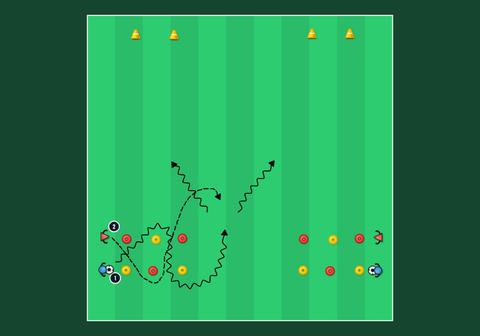
Dribbling and 1v1
A 1v1 drill in which players first weave through cones and then go into a traditional duel towards two small goals. The defender can start moving when the attacker has reached the first turn. After winning the ball, the defender can score by dribbling over the end line between the cones. Change ends and roles after every repetition.
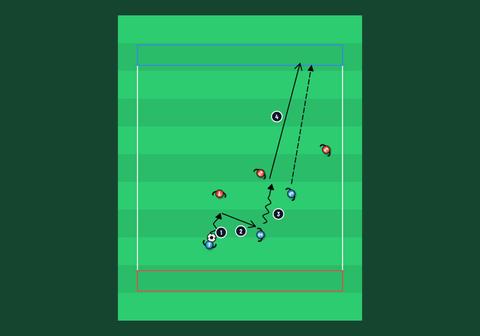
3v3 line game
3v3 game without goals. A goal is scored when a team gets the ball under control behind the opponent’s end line. If the whole team comes short to the ball, there is no one behind the line to pass to. One player stays high and runs in behind the defender. The animation first shows the usual mistake and then the correct way. Area approximately 20 × 20 m, and a two-metre zone behind each end line. The receiver must control the ball behind the line. A shot or dribbling over the line is not enough.
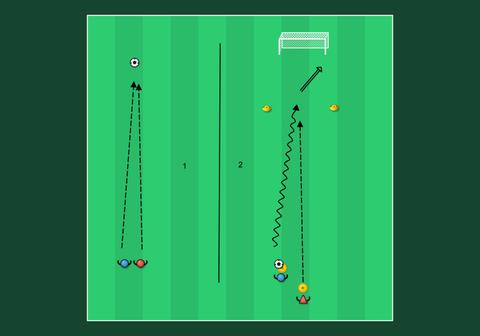
Running duel and winning the ball
Train progressively how to initiate contact and win the ball with recovery pressing. In phase 1, the players set off on the coach’s signal and try to reach the ball first. Contact already from the start; use of the arms and taking control of the running line are important. In phase 2, practise winning the ball from a slightly similar situation where one player has the ball. The attacking player may try for goal if they are able to advance close enough.
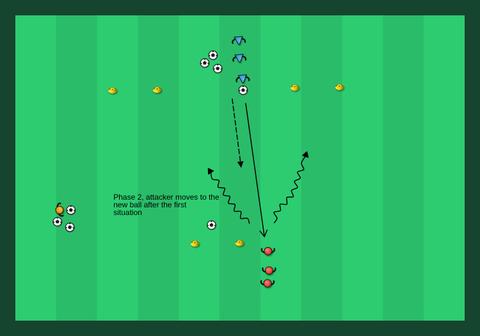
1v1 to gate goals
The drill starts with a defender’s pass and, after the control, the attacker tries to dribble into either gate goal. The defender tries to win the ball and dribble into the opposite gate goal. A second phase can be added to the drill, where after the first situation has ended, the coach adds a new ball and the attacker has to move with their back to the goals.
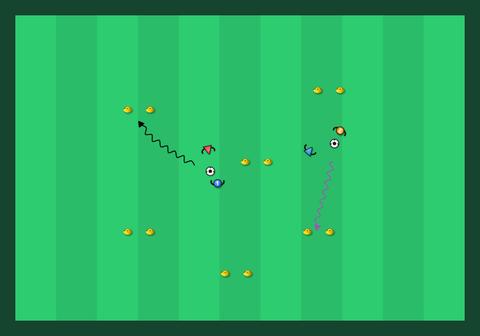
1v1 gate game
Players are split into pairs. There are several small gates on the pitch. The attacker on the ball tries to dribble the ball through a gate, the defender tries to stop them and win the ball. After a successful dribble through a gate, the attacker immediately continues to the next gate of their choice. The same gate cannot be used twice in a row.