Esercitazioni di calcio per bambini dai 7 ai 12 anni
I bambini imparano il calcio giocando, quindi quasi tutte le esercitazioni per loro sono piccoli giochi con un pallone a testa o uno ogni due. Un bambino in fila non impara niente, e tutti devono sapere chi sta vincendo. A 7 e 8 anni concentrati sulla conduzione e sul tenere la palla. Verso i 10 aggiungi il passaggio a coppie e in piccole squadre, e a 12 anni i giocatori gestiscono semplici regole tattiche. Un riscaldamento FIFA 11+ Kids prima della seduta aiuta a prevenire gli infortuni. Ogni esercitazione qui si può aprire e adattare al tuo gruppo.
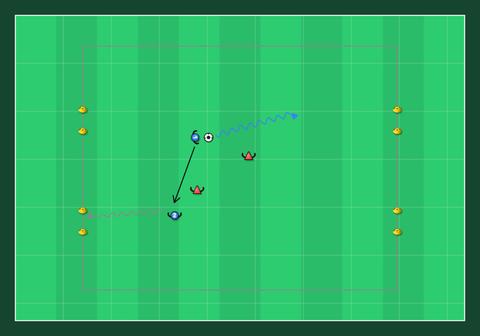
2v2 gate game
2v2 game in a small area, where both teams have 2 cone gates to defend on opposite sides. A goal is scored by dribbling the ball through a gate. A fast and intense small-sided game where every duel matters. Short games (90 seconds), pairs rotate.
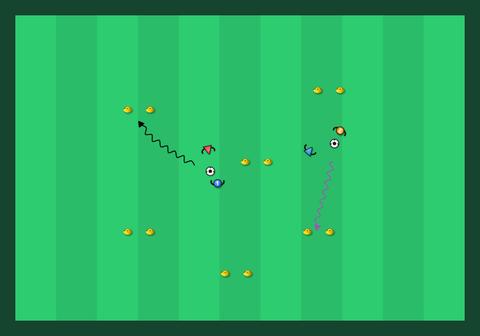
1v1 gate game
Players are split into pairs. There are several small gates on the pitch. The attacker on the ball tries to dribble the ball through a gate, the defender tries to stop them and win the ball. After a successful dribble through a gate, the attacker immediately continues to the next gate of their choice. The same gate cannot be used twice in a row.
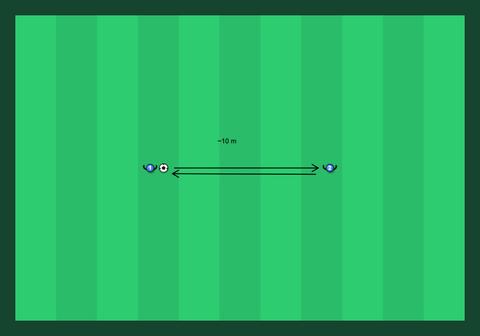
Passing and control in pairs
In pairs facing each other at a distance of about 10 metres. Player A plays a pass along the ground to player B, who controls the ball with the first touch and passes it back with the second touch. Variation: control with the right/left foot.
Riscaldamento e giochi di acchiapparella per bambini
Una seduta per bambini può iniziare con un gioco in cui tutti hanno un pallone e tutti si muovono. Nel semaforo l'allenatore chiama un colore: con il verde i giocatori conducono veloci, con il giallo piano e a piccoli tocchi, con il rosso fermano la palla sotto la suola. Nella versione più difficile l'allenatore mostra il colore con un cono o una casacca, senza dire una parola. Nella versione del vigile nessuno viene eliminato: chi si muove ancora fa cinque tocchi di suola e riparte. Nell'attacco dello squalo lo squalo calcia i palloni fuori dallo spazio, e chi perde il pallone diventa a sua volta squalo. Vince il turno l'ultimo giocatore con il pallone. Nella conduzione tra le porticine i giocatori attraversano più porticine possibile nel tempo dato. Nella palla prigioniera chi acchiappa può toccare solo il giocatore con la palla, quindi la palla deve arrivare in tempo a un compagno. La palla prigioniera diventa più facile giocata con le mani e più difficile con più cacciatori. Le staffette (tris a staffetta, riempi lo spazio a staffetta e la gara a staffetta tra i coni con tiro) aggiungono alla conduzione e alla corsa una sfida tra squadre.
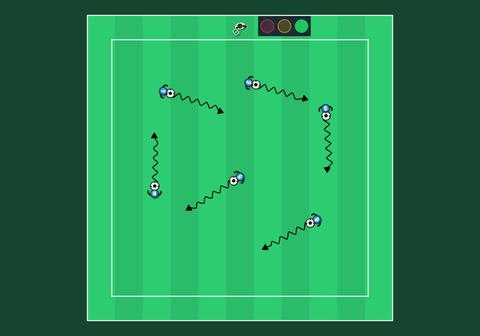
Red light, green light
Everyone has their own ball, and everyone keeps moving all the time. The coach calls out a colour. On green, the players dribble at a good speed; on yellow, slowly with small touches. On red, the ball stops under the sole. Mark out an area of about 15 × 15 metres with cones. The coach stands at the side of the area and changes position from time to time, so the players have to lift their eyes off the ball. The arrows in the picture show the green light. The animation shows the full cycle: green, yellow, red and green again. Harder: the coach shows the colour with a cone or bib and does not say anything. Then the colour can only be seen by looking at the coach. Traffic officer: on red, the coach checks whether anyone is still moving. Any player still moving does five alternating sole touches on top of the ball and continues. Nobody is out of the game. For a bigger group, use a bigger area.
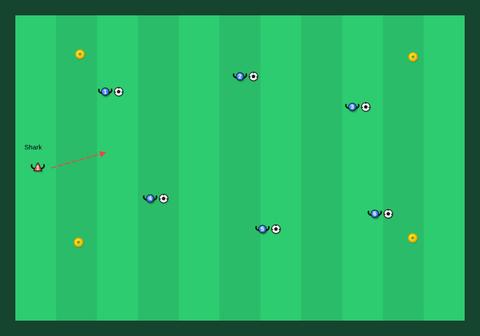
Shark Attack
All players have a ball inside the grid except for one "shark", who starts outside the area. On the coach's signal, the shark comes into the area and tries to kick the players' balls out. A player whose ball is kicked out also becomes a shark. The last player on the ball wins the round.
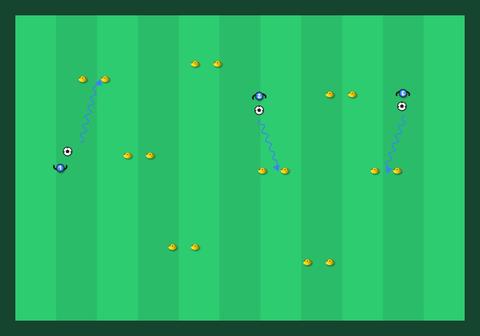
Gate dribbling
8–12 small gates are set up in the area. Each player has a ball. On the coach’s signal, the players dribble the ball and try to get through as many gates as possible in the given time. You cannot go through the same gate twice in a row.
Dalla conduzione alle piccole squadre
Nelle esercitazioni indicate per i più piccoli ogni giocatore ha un pallone o lo divide con un compagno. Per gli U7 ci sono il gioco delle porticine 1 contro 1, l'1 contro 1 verso quattro porticine d'angolo, passaggio e controllo a coppie e il gioco delle porticine 2 contro 2, che si gioca in partite da 90 secondi con le coppie che ruotano e in cui si segna attraversando una porticina in conduzione. Dagli U8 ci sono l'1 contro 1 verso la porta, la gara di passaggi tra le porticine a coppie, uno-due e finalizzazione, il 3 contro 3 con i portieri, dove partite brevi di 3–4 minuti e la formula a torneo tengono alta l'intensità, e la partita 5 contro 5 con ripresa in conduzione, che allena la ripresa del gioco in conduzione come chiedono le regole del 5 contro 5 della Federcalcio finlandese per i bambini di 8 e 9 anni. U9 e U10 hanno una pagina a parte, e questa pagina elenca anche esercitazioni indicate per U11 e U12, come il passaggio filtrante nello spazio e il cambio di gioco.
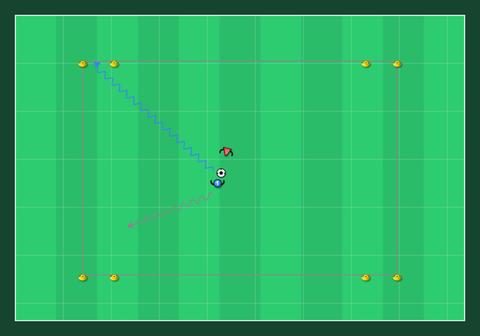
1v1 to four corner goals
Two players play against each other in a square-shaped area, with a cone goal in each corner. The player on the ball can attack any of the four goals and tries to dribble the ball through the goal.
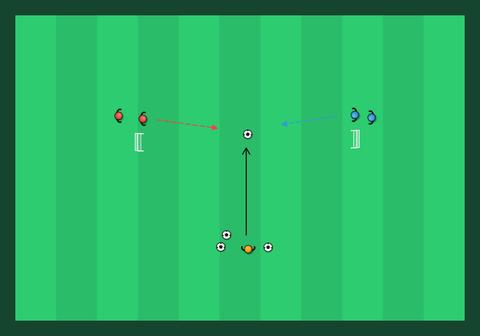
1v1 to goal — classic duel
The attacker and defender start from opposite ends of the area. The coach plays a pass into the middle of the area, and both set off to compete for the ball. The player who wins the ball attacks the opponent's goal.
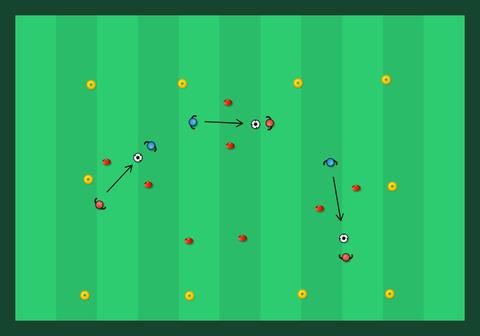
Passing gate competition in pairs
Several small gates are set up on the pitch (two cones 2 metres apart). Pairs pass the ball through the gates and count their successful passes. The gate must always be changed after a successful action. The pair that has gone through the most gates wins.
Domande da fare ai bambini
Quanto deve stare vicina al piede la palla perché tu possa fermarla subito? Dov'è adesso lo squalo, e lo sai senza guardare la palla? Proteggi la palla con il corpo? Sai qual è la prossima porticina prima di arrivare a questa? Le staffette in conduzione chiedono quale lunghezza del tocco va bene nello spazio libero e quando iniziare a rallentare perché la palla resti dentro lo spazio. Nel passaggio a coppie le domande chiedono se la palla resta giocabile dopo il primo controllo, e ai giocatori si chiede di provare anche con il piede debole. Molte domande riguardano dove sono gli occhi: a testa alta il giocatore vede l'allenatore, lo squalo e la porticina libera. Per questo nel semaforo l'allenatore ogni tanto si sposta, così i giocatori devono staccare gli occhi dalla palla.
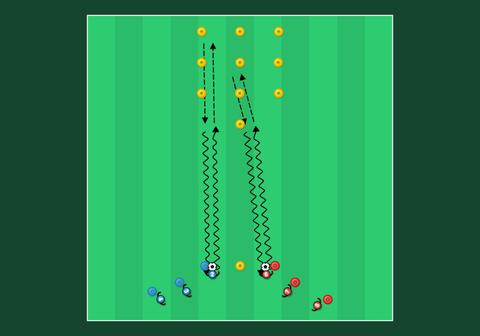
Tic-tac-toe relay
Two teams compete to see which can get three of their own markers in a straight line first. Build a 3 x 3 grid with cones, one cone in each square. Place a starting cone about 10–15 metres from the bottom edge of the grid, with two lines behind it. Each player has one marker in their team’s colour, and the first player in each line has a ball. Both teams start at the same time. The player whose turn it is dribbles the ball to the edge of the grid, leaves the ball there and runs into the grid. They place their marker in one free square, return to the ball and dribble it to the front of the line. The next player starts as soon as the ball is back, and the previous player goes to the back of the line. A team wins when it has three markers in the same row, column or diagonal. There are three markers per team, so every square is worth thinking about. If neither team gets three in a line, collect the markers and start again. With younger players, shorten the distance. Lengthen it if you want more running.
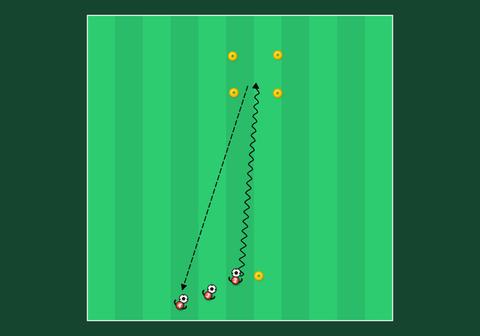
Fill the area relay
Mark out a square-shaped area with cones, about 3 x 3 metres, and a starting cone about 20 metres below it. The line stands at the starting cone, each with their own ball. The first player dribbles their ball into the area, leaves it inside the area and runs back without the ball to the back of the line. The next player sets off as soon as the previous one has left their ball. The rotation continues until all the balls are in the area. Two teams do this at the same time in their own areas. The winner is the one that gets their balls into the area first. The diagram shows the position of the other team. The other one is set up the same way on the other side of the pitch. The ball must stay inside the area. The drill can be continued so that in the second round the balls are collected out of the area.
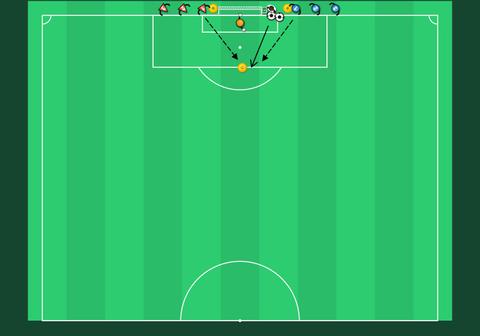
Corsa alla palla e tiro
I giocatori vengono divisi in due squadre, che si dispongono in fila dietro la linea di fondo ciascuna dal lato del proprio palo. La testa della fila è segnata con un cono. In porta c'è un portiere. L'allenatore si posiziona con i palloni dietro la linea di fondo accanto al palo destro. Al centro, a circa 20 metri dalla porta, viene posizionato un cono segnalatore. L'allenatore effettua un passaggio oltre il cono segnalatore in modo che la palla si fermi alla stessa distanza dalla testa di entrambe le file. I primi delle file partono al momento del passaggio. Chi arriva per primo sulla palla attacca, l'altro difende. Da lì si gioca un 1 contro 1 fino al tiro. Entrambi tornano in fondo alla propria fila e la coppia successiva inizia. Si contano i gol: quale squadra ne realizza di più? Con la direzione e la velocità del passaggio, l'allenatore mantiene equilibrata la sfida. I giocatori più grandi possono effettuare il passaggio da soli. In quel caso, il giocatore della fila di destra effettua il passaggio oltre il cono e parte in rincorsa; la palla può essere toccata solo dopo il cono, e il giocatore della fila di sinistra difende. Per aumentare la difficoltà della fase offensiva si può inserire un limite di tempo.
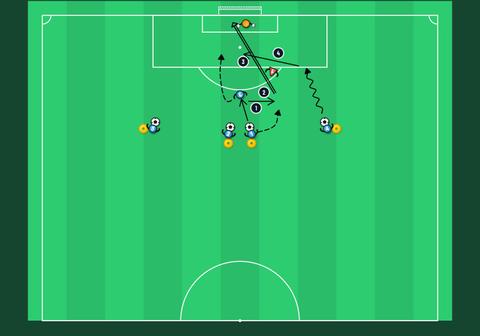
Two shots: lay-off from the wall and a square pass from the wing
A goal includes a goalkeeper. At the top of the penalty arc there is a wall player without the ball, and in the middle 7–8 metres behind them there are two lines with balls. On both wings there is a wide line with balls on the extension of the side of the penalty area, level with the central lines. On the edge of the penalty area there is one defender. The first player in the central line passes to the wall and makes a diagonal run wide. The wall lays the ball off into their run, and they shoot first time from about 18 metres before the defender can get tight. The wide player starts dribbling towards goal already during the first pass. After the lay-off, the wall drops back a step, runs into the penalty area and finishes first time from the wide player's square pass. The shooter then becomes the next wall player, the wall goes to the wide line on the side from which they finished, and the wide player goes to the central line. The next repetition is done from the opposite wing, so the side changes on every repetition.
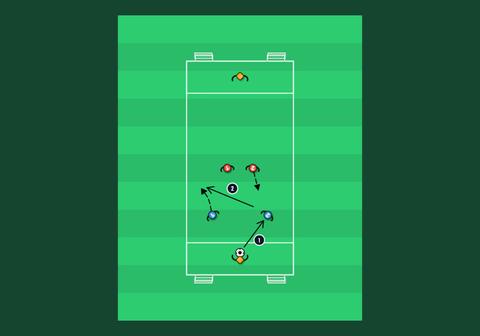
2v2+2 outnumbered: the pair closes the pass into the end zone
Mark out a 10 x 20 metre area and a three-metre zone at each end. There is a joker in each zone, who plays with the team in possession and does not leave their zone. Behind each end, place two small goals. In the middle, two teams of two players play. The joker starts by passing to a player from the team in possession. The pair tries to play the ball to the joker at the opposite end, receive it back from them, and score in either of the small goals at that end. As a target player, the joker may only play backwards. The defending pair tries to stop the split pass and win the ball. When they succeed, the roles change immediately. There are two phases in the animation. First, the blue team attacks up the pitch. When the joker passes to blue 2, red 2 starts pressing during the pass and red 1 stays inside to provide cover. Blue 2 plays into the run of blue 1. Red 1 shifts during the pass, but remains a step too far away, and the ball goes through to the joker. The joker plays it into the run of blue 2. The reds turn immediately and close the space behind them, and red 2 gets tight and wins the ball before the shot. In the second phase, the reds attack down the pitch immediately after winning the ball, when the blues have not yet had time for recovery defending. Red 2 plays into the run of red 1 to the left. Before blue 1 can get tight, red 1 passes directly along the touchline to the lower joker. The joker plays the ball into the run of red 2, and red 2 scores in the right small goal. The blues turn, but are a step late because the pair did not manage to close the passing lane into the end zone.
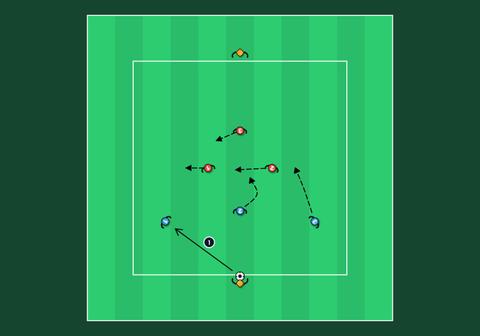
3v3+2 outnumbered: close the middle and force wide
Mark out a 20 × 20 metre area. Place a joker at each end, always playing with the team in possession. Two teams of three players play inside the area. The game starts with a joker. The team in possession tries to move the ball to the joker at the opposite end, so they have five players against three. The defending three try to win the ball. When they succeed, the roles change immediately, and the team that won the ball attacks. The nearest joker can be used as support. There are two rounds in the animation. First, the blues attack upwards. When the ball goes left, the reds shift across as a full three towards the ball side. Red 1 forces Blue 1 towards the touchline, and Red 2 closes the pass into the middle. Blue 1 still tries to play the ball inside, and Red 2 intercepts the ball. The reds keep the ball and play it through the nearest joker. The blues press for a moment and then drop back into their own three. In the second round, the blues stay compact, so the red player in the middle has to pass wide. The blues shift during the pass as one unit, Blue 1 closes down at the touchline and wins the ball, and the blues immediately launch a new attack.
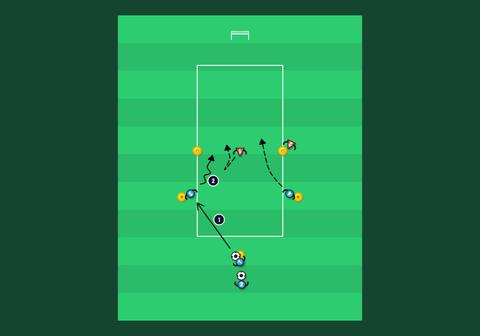
1v2 overload against: turn the situation into 1v1
Mark out a 10 × 20 metre area and a line across the halfway point with two flat cones. The small goal is placed three metres behind the top end of the area and a cone the same distance behind the bottom end. Two passers wait one behind the other by the cone, each with a ball. The wide players stand outside the area on each side, about five metres from the bottom end. The defender is on the halfway line, and the next defender waits at the end of the line outside the area. The passer plays the ball to either wide player. The defender sets off during the pass and decides whether to press the receiver or hold position. The wide players attack the small goal as a pair, and the defender tries to win the ball. The situation ends with a goal or when the ball goes out. There are two repetitions in the animation. In the first, blue 3 receives the ball on the left and dribbles inside. Red 1 approaches at an angle that blocks the pass to blue 4 and drops off diagonally. When blue starts dribbling towards goal, red closes down and plays the ball over the touchline. In the second repetition, the ball goes to the right. Red 2 stays farther away, drops back between the attackers and cuts out an overhit square pass. After winning the ball, he plays it back to the passers' cone. Rotation: the passer follows the pass to the wide position, the wide player who received the ball switches to the opposite flank, and the other wide player goes to the passers' queue. The defenders swap positions after every situation.
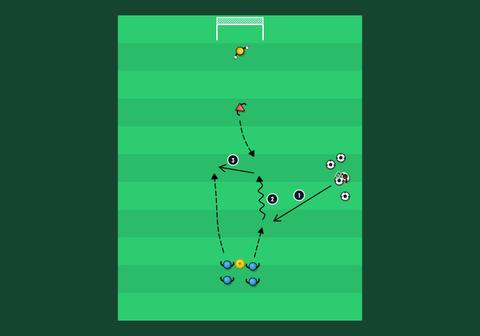
Continuous 2v1 towards one goal
The attackers wait in two queues next to a flat cone, the defender is in front of the goal and the coach is on the wing with balls. The coach plays a pass to the first players in the queues, who attack the goal as a pair. They are up against a defender and a goalkeeper. The defender tries to win the ball, and the attackers’ decision depends on what he does. If he closes down the player on the ball, the player on the ball passes to the free player just before the confrontation. If he stays to block the passing lane, the player on the ball dribbles towards goal and shoots. If the player on the ball delays, the defender has time to win the ball. He passes the won ball back to the coach. When the situation ends, the attacker who shot or lost possession stays in as the next defender. The other attacker and the previous defender go to the back of the queues, and the coach starts the next round immediately. Bibs are not changed, so the defender can be of either colour.
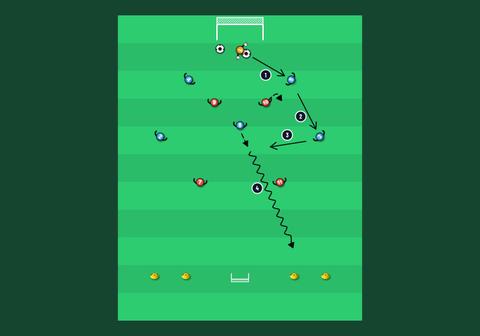
Safe build-up play with numerical superiority
The blues, five players and a goalkeeper, build up from the back against four reds. The blues attack the small goal in the middle or either cone goal on the flank. Dribbling through a cone goal is worth one point and a goal in the small goal is worth two. When the reds win the ball, they attack the large goal, and a goal gives them two points. Play always restarts with the blue goalkeeper, who has spare balls next to him. Every four minutes the teams swap tasks, and one player moves to the other team so that the attacking team has numerical superiority again. For a bigger group, the same game works with eight plus a goalkeeper against seven. The game can be made more difficult by limiting the blues to three touches.
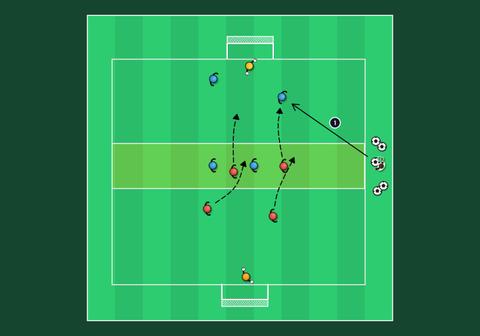
Three-zone pressing game
The coach gives the ball to the other team. The players in the middle can step up to press in their own attacking zone, at which point the players in their own defending zone can move in to fill the spaces in the middle. When the ball is won, free play continues until a goal or a stoppage in play.
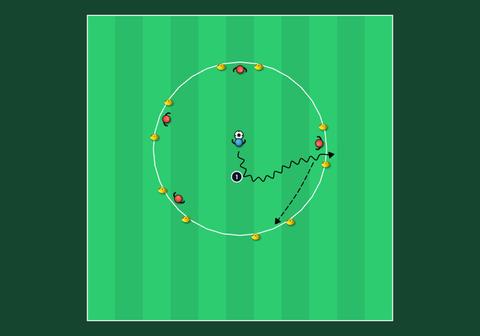
Dribbling through the free gate
The player on the ball in the middle must try to dribble the ball through a free gate. There is one more gate than there are defending players. The defending players guard the gate goals and must not step out to win the ball. The player on the ball tries to use feints to beat the defenders so that they can dribble through a free gate. The feint can also be made with their back to the opponent. In the central area, for example one minute at a time, and then rotate.
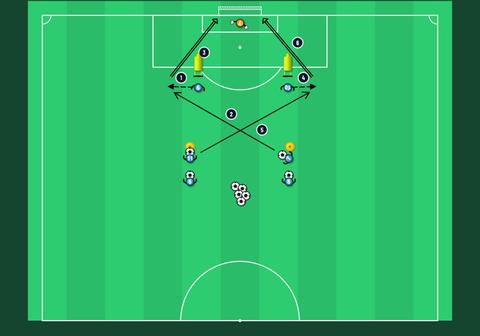
Breaking away and shooting from both sides
Finishing when the defender is behind you. The attacker stands in front of the mannequin with their back to goal. They move away from the mannequin outwards and call for a pass from the queue on the opposite side. First touch towards goal and a shot. Then the same on the other side. Rotation: the passer goes to shoot, and after the shot the finisher stays in the queue on their own side, so the queue changes on every repetition.
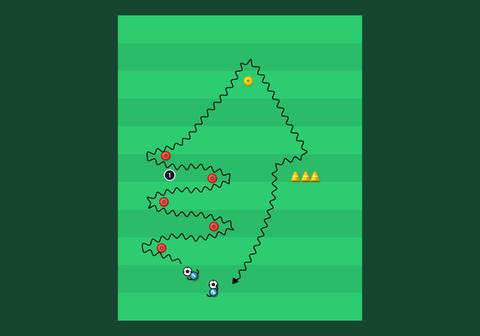
Slalom dribbling, feint and change of tempo
Around the red cones: 1. slalom dribbling (wide spacing, change of tempo important) 2. body feint at every cone. Around the yellow cone and feint past the yellow tall cones with a clear change of tempo. The players queue at the bottom with a ball each. The next player sets off when the previous one has gone through the red cones. In the animation, player 1 slaloms through the red cones and player 2 performs a body feint at each cone. After the yellow cone, the player dribbles straight towards the tall cones, feints in front of them and accelerates past them. Finally, he dribbles the ball back to the end of the queue. In the image, the area is 20 × 25 m.
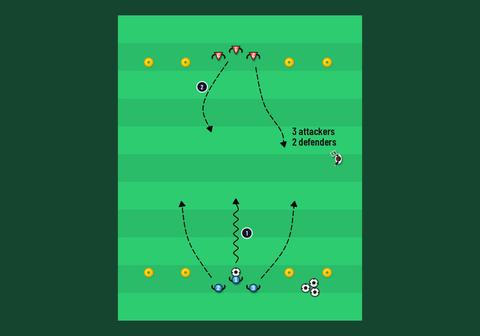
Numerical superiority and counter-attack on the coach’s call.
A small-sided game drill where the coach gives instructions on how many players from each side enter the pitch at a time. For example, "1 defender, 2 attackers". The defender(s) can start moving once the attackers have set off. The attackers queue with balls at one end and the defenders at the opposite end. There are two cone goals at each end. The attackers score by dribbling the ball through either of the opposite goals. If a defender wins the ball, they immediately attack the goals at the attackers’ end. The repetition ends when a goal is scored or the ball goes out. The players return to the back of their queues, and the coach calls the next numbers. Vary the numerical superiority, equal numbers and numerical inferiority, for example 2v1, 3v2, 2v2 and 1v2. Swap the attackers’ and defenders’ queues every few minutes.
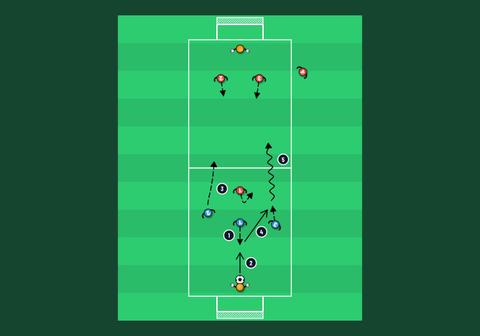
Counter-attack with numerical superiority
Play on a long, narrow pitch with a halfway line and a goal and goalkeeper at each end. In the diagram, the area is 16 x 40 m. Make it as long as the space allows. The blues attack with three. The reds are the counter-attackers: one is in the blues' half, two are in their own half in front of the goal, and a fourth waits outside the touchline. The other groups of three attackers wait for their turn outside the area with their own balls. The goalkeeper starts by giving the ball to an attacker who drops in to receive. In their own half, the blues beat one counter-attacker 3v1 and dribble over the halfway line. There they attack the goal against two. When the blues score, the next group of three starts. If they lose possession, the reds immediately break into a counter-attack towards the other end, and the fourth player who was waiting on the side joins in to create numerical superiority. The reds are not called defenders because they attack as well. Progression: add a time limit.
Alternating 3v2 numerical superiority
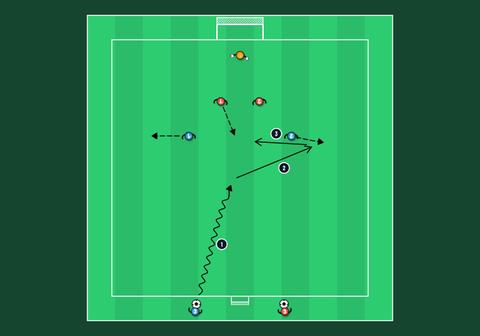
Indoor game on two pitches. On each pitch there is a goal with a goalkeeper and a small goal on the halfway line without a goalkeeper. Instead of the small goal, a bench turned onto its side can be used. The diagram shows one of the pitches, about 20 × 20 m, i.e. half a handball court. On the pitch, each team has two players in front of the goal and one with the ball behind the end line next to the small goal. Blue attacks first. The waiting blue player behind the end line dribbles at full speed towards the goal, creating a 3v2. The other two attackers position themselves as wide as possible. When the reds win the ball, they immediately pass it into the small goal. That is the goal for their counter-attack. The situation continues until there is a goal or the ball goes out. Then the attacking turn changes, and the waiting red player dribbles in. In the diagram, the blue overload player goes back behind the line so that the reds have a 3v2. Variation: blue attacks with numerical superiority towards the other goal and red does the same at the same time at the other end. The first goal is worth two points, including from the counter-attack.
2v2 attacking and counter-attack
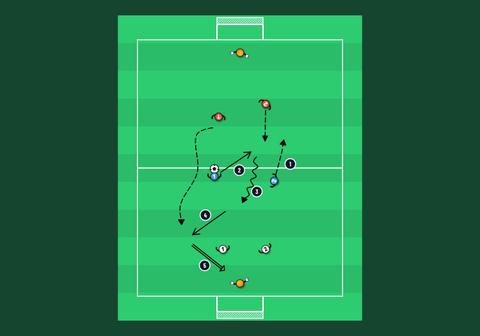
Eight players: three pairs and two goalkeepers. The area is split into two halves by a halfway line, and there is a goal at each end. In the diagram the area is 24 × 30 m. Adapt the size to the age group. One pair starts with the ball from the halfway line and attacks 2v2 towards the goal defended by the second pair. The third pair waits in the other half. If the defenders win the ball, they immediately attack the other end against the third pair. Play does not stop, and there is no need to collect the ball from the goalkeeper. When the attack ends with a goal or a save, or the ball goes out of play, the goalkeeper gives the ball to the pair that was defending, and they attack in the same way towards the other end. The pair that lost possession stays in their own half and defends when the next attack comes there. The defenders engage high so that the attacker cannot get a shot away. For a larger group, set up more than one area.
FIFA 11+ Kids warm-up: full programme
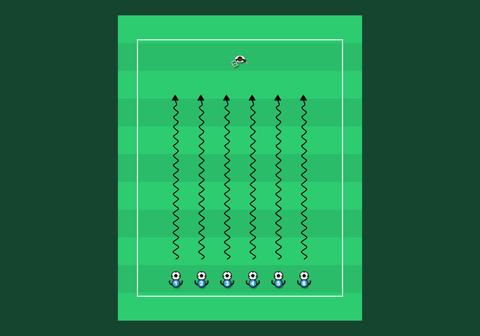
FIFA 11+ Kids is FIFA's warm-up programme for 7–13-year-olds, and it is there to reduce injuries. It replaces the usual warm-up: seven movements in the same order at the start of the session, at least twice a week. Once the players know the movements, the programme takes about 15 minutes. Every player needs a ball. Depending on the group, you need anything from a penalty area to a half pitch. The players start on the goal line about two metres apart. The coach stands in front, where they can see everyone and everyone can see them. The animation shows level 5 of movement 1. Every movement has five levels. Start at level 1. Players move up a level only when the movement goes well over several sessions in a row and there is little to correct. No level is skipped, and a player can easily be at level 1 in one movement and level 3 in another. 1. Stopping, 3 sets × 5 stops. The players run towards the coach. On the stop command they stand for 3 seconds on the leg the coach names, and after the set they jog back to the line. Levels: 1) spoken command, 2) the coach shows the command with a hand, 3) spoken command with the ball in the hands, 4) hand signal with the ball in the hands, 5) spoken command while dribbling: the ball is stopped with the sole, and the free foot doesn't touch the ball. 2. Jumps, 2 × 10 jumps (5 on each leg). Leap from one leg to the other diagonally forwards, so the path zigzags. Hold for 3 seconds after every landing. Levels: 1) learning to land, 2) ball in both hands, 3) ball in an outstretched hand, 4) after landing, the ball is lowered slowly to the ground, 5) as 4, with the free leg reaching back and the arms forwards so that ball, head, body and leg form a horizontal line. 3. Balance in pairs, 1 set on each leg. The partners stand facing each other on one leg. Levels: 1) throwing the ball 3–5 metres, 5 throws each, 2) after the throw, the ball is circled around the free leg, 3) ground passes with the instep over 2–5 metres, stopping the ball before the return pass, 4) a throw that the partner volleys back with the foot for the thrower to catch, 5) balance contest within arm's reach: each holds a ball, the balls are pressed together at chest height and each tries to knock the other off balance, 20 seconds on each leg. 4. Push and hold. Levels: 1) tunnel ball: the players are in a press-up position side by side, forming a tunnel, and the ball is rolled through it. The roller goes to the start of the tunnel in the press-up position, and the last player takes the ball and rolls it again. 2 rounds, at most 8 players in a group. 2) forearm support with the ball under the shins, the body slides slowly forwards and back, 3 × 15 s, 3) press-up position, the ball is circled in a figure of eight around the hands, 3 × 15 s, 4) the ball goes from a hand under the body to a foot, and from the foot to the other hand, 3 × 15 s, 5) hands on the ball, the feet walk back in small steps and return, 3 × 10 s. On wet grass, do level 4. 5. Hops, 2 × 10 hops (5 on each leg). The longest hop you can do on one leg, landing on the same leg, with a 3-second hold after landing. Levels: 1) forwards, 2) forwards and back, 3) sideways, 4) the coach shows the direction, 5) as 4, ball in both hands. Leave space between the players to the sides as well. 6. Core in the crab position: hands and feet on the ground, back facing the ground, bottom up. Levels: 1) the ball is rolled forwards and back with the foot, legs in turn, 3 × 15 s, 2) hands and feet move further out in turn and back, 3 × 15 s, 3) crab walk forwards 5–10 m, 3 sets, 4) crab walk dribbling the ball with the feet, 5) feet on the ball, the ball rolls under the feet for 3–7 m. 7. Roll, 5 in each direction. Learning to fall: chin to chest, and the roll goes over the outside of the arm and the shoulder, diagonally across the back. It isn't a straight forward roll: the head doesn't touch the ground. The coach names the direction every time and waits at least 5 seconds before the next one. Levels: 1) from a squat, 2) standing, slowly, 3) standing, quickly, 4) from walking, 5) from jogging. Move up a level only when the previous one is done safely in both directions. In a study (Rössler et al. 2018), teams that used the programme had 48% fewer injuries than the comparison teams. Sources: the FIFA 11+ for Kids manual and the Finnish FA's FIFA 11+ Kids poster.
Body feint to two gates
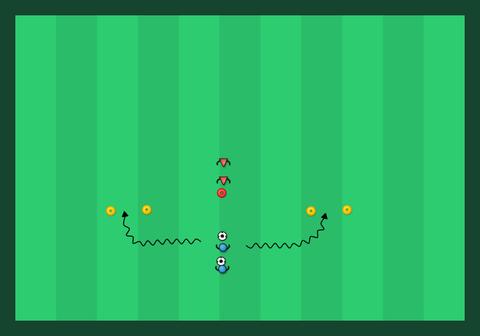
A 1v1 drill in which the attacker aims to dribble the ball through one of the two gates on the sides. Particularly suitable as a drill for practising the body feint. Players switch queues after each repetition. It can first be done without the ball, with the defender trying to touch the attacker immediately after coming through the gate.
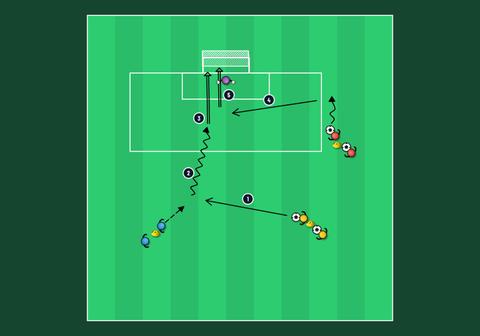
Two finishing actions
Split the players into three equal groups in front of the goal, with a goalkeeper in goal. The blue players are on the left, the yellow players on the right, and the red players near the right corner. The yellow players and the red players have balls. The first blue player starts a run, and the yellow player plays a pass into his path. The blue player dribbles briefly at full speed and shoots at goal. Immediately afterwards, he finishes from the red player's cross. After that, all three switch places: the finisher goes to the red queue, the crosser to the yellow queue, and the passer to the blue queue. Every shot should be on target.
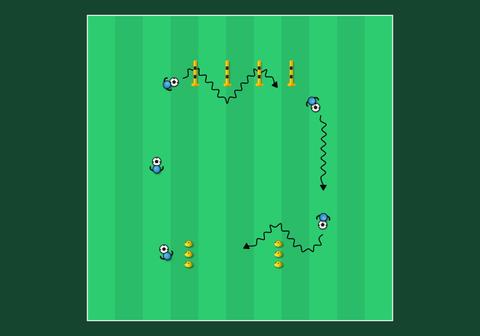
Dribbling circuit with slalom and rows of cones
Set up a circuit in a square shape of about 20 × 20 metres. On the top side, place four slalom poles 2.5 metres apart. On the bottom side, place two defenders about seven metres apart. Each consists of a line of three cones across the direction of travel. The right and left sides remain straight. Each player has their own ball, and the players start at different points on the circuit, so nobody queues. Everyone moves in the same direction. In the slalom, dribble with short touches and at direct speed. Dribble straight towards the middle of the defender, use a feint, and go around one end of the line. If you catch up to someone, beat them on the outside. One circuit suits 6–8 players, so for a large group build several circuits. Change direction every few laps, or dribble only with the right foot or only with the left foot. If there are no poles, the slalom can be done with cones.
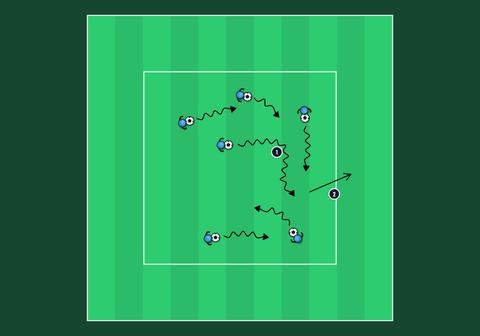
King game: protect your own ball and play the others' balls out
Mark out an area with cones according to the number of players, for example around 15 × 15 metres for six to eight. Each player has their own ball. Everyone dribbles in the area and at the same time tries to play the other players' balls out of the area. Nobody is out of the game. If a player's own ball goes out, the player retrieves it, does the movement task given by the coach and dribbles back into the game. When there are a lot of players, divide them into several areas. The areas can be ranked: the player who plays a ball out moves up to the higher area and the player who loses their ball drops down to the lower area. Also play at times with different-sized balls.
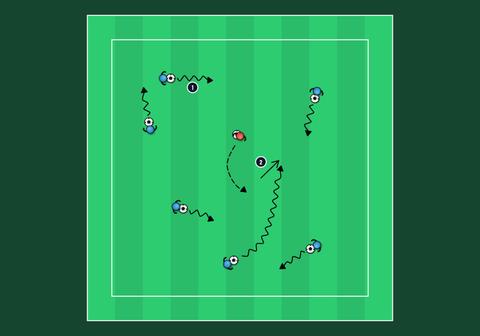
Bib tag: dribbling and shielding the ball with the whole group
Mark out an area of about 20 × 20 metres for around ten players. One of the players is the tagger, and they hold a bib or a small soft ball in their hand. All the others have their own ball. The players on the ball keep dribbling inside the area at all times. The tagger chases them and tries to throw the bib or ball at a dribbler’s ball. When the throw hits, the player whose ball was hit takes the bib or ball and becomes the new tagger. The previous tagger takes their ball and continues dribbling. The new tagger cannot immediately throw at the previous tagger’s ball. For a large group, set up several areas or add more taggers. In a smaller area, dribbling is more difficult.
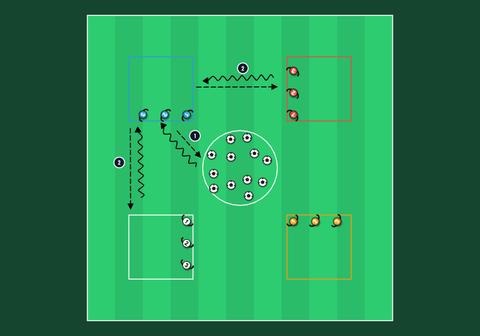
Ball Thieves
Four teams compete to see who can get the most balls into their own nest. The start is played as a relay, and once the centre is empty, everyone is moving. One coach can see the whole group from the middle. Mark out an area of about 24 × 24 metres and mark a 6 × 6 metre nest in each corner and a circle of about seven metres in the middle. Divide the players into four teams; with 12 players, make four teams of three. The teams wait in a line in their own nests. Spread the same number of balls inside the circle as there are players. Phase 1 is played as a relay. The first player from each team sets off, collects a ball from the middle and dribbles it all the way back to their own nest. The next player starts when the ball is in the nest. The middle is emptied once everyone has gone once. When the relay has finished, phase 2 begins: everyone starts moving at the same time, and a ball can be stolen from any nest. Each player dribbles one ball at a time all the way back to their own nest. You may not defend your own nest, and you may not touch a ball being dribbled by another player. A round lasts 60–90 seconds. On the whistle, count the balls. The team with the most balls in their nest wins. Return the balls to the middle and start a new round.
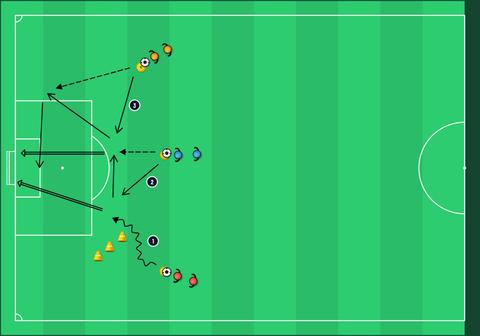
Finishing from three positions
The red player sets off, beats the cone defender and shoots at goal. The blue player immediately gives a pass to the red player, and the red player lays off a one-two, from which the blue player shoots at goal. After this, the yellow player gives a pass to the blue player, who plays a one-two towards the end line. The yellow player crosses from the end line, and both the blue and the red player take part in finishing.
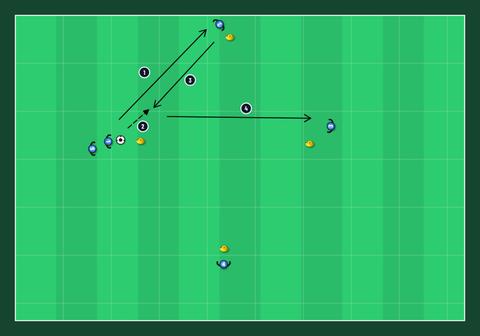
Diamante di passaggio
Si crea un diamante con i coni, con due giocatori al primo cono e un giocatore su ciascuno degli altri. Il giocatore 1 effettua il primo passaggio al giocatore 2, che lo restituisce con un uno-due. Il giocatore 1 cerca di effettuare un passaggio lungo al giocatore 3 con il controllo orientato. Dopo i passaggi, ruotare sempre nella direzione del passaggio.
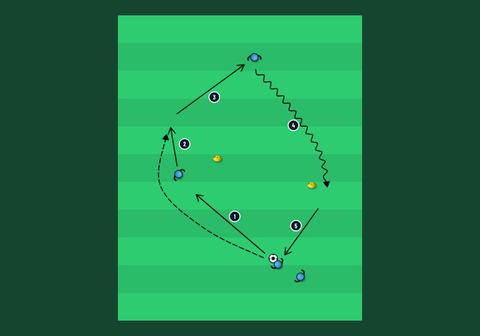
Overlap as a rotating passing drill
Mark out a slightly skewed diamond with cones, about 20 × 10 metres. There is a queue at the bottom corner, and the first player has a ball. There is a wall player at the left corner and a player at the top corner. The first player in the queue dribbles towards the wall player, passes to them and immediately makes an overlap past them on the outside. The wall player steps towards the ball, takes it infield towards the nearby cone and passes forward into the overlap runner’s path when they are almost level. The overlap runner plays the ball first time to the top corner and continues there. The player at the top corner dribbles around the cone on the right side, passes to the queue and goes to the back of the queue. No one runs back. Change the wall player every few rounds. When the pattern is flowing, place a semi-active defender at the wall player’s cone.
Who’s afraid of the defender? Dribbling game from island to island
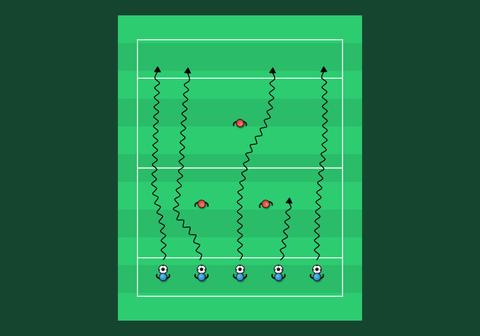
Mark out an area of approximately 16 x 20 metres. At each end, create an island about three metres deep, and divide the sea between them into two halves with a halfway line. There are three defenders in the sea: two in one half and one in the other. The defenders stay in their own half. Everyone else has their own ball and starts on the same island. The attackers dribble the ball from one island to the other, and each successful crossing is a point. Set off straight back from the island. If a defender wins the ball, the attacker and defender swap roles. Change the defenders every couple of minutes. Make it harder by adding defenders or removing the halfway line, allowing the defenders to move across the whole sea. For a large group, set up several areas.
Who’s Afraid of the Defender? Basic Version.
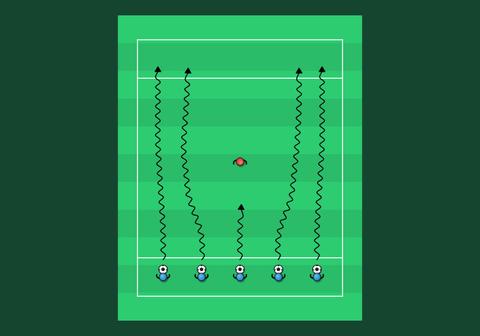
Mark out an area of approximately 16 × 20 metres. At each end, create an island about three metres deep, with the sea in between. In the sea, there is initially one defender, who can move anywhere in the whole sea. Everyone else has their own ball and starts on the same island. They all set off at the same time and try to dribble the ball to the opposite island. If the defender wins the ball, they kick it out of the area, and the caught player takes a bib and joins the defenders. Players leave the island straight away to go back again. There are more defenders and fewer dribblers on each crossing. The last player on the ball wins. For a large group, start with two defenders or create two areas.
Dribbling circuit with slalom and feint
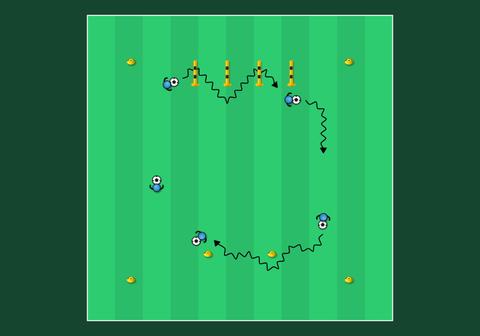
Set up a square circuit of approximately 20 × 20 metres and mark the corners with cones. On the top side, place four slalom poles at 2.5-metre intervals, and on the bottom side, place two cones about five metres apart. The right and left sides remain straight. Each player has their own ball, and the players start at different points on the circuit so that nobody is queuing. Everyone moves in the same direction. In the slalom, use dribbling with short touches and move through at speed. The cones on the bottom side act as defenders: dribble straight at them, use a feint, and beat an opponent by going past on the opposite side. Anyone who catches up can go around the outside. One circuit suits 6–8 players, so for a large group set up more than one circuit. Change direction every few laps, or have the players dribble with only the right foot or only the left foot. If there are no poles, the slalom can be done with cones.
Stop the ball on a cone
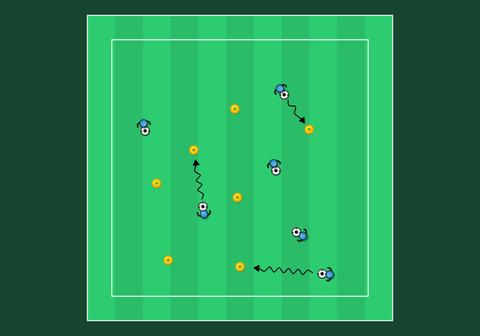
Mark out an area of approximately 16 × 16 metres and spread flat cones around it at different distances, so that there are both short and long gaps between them. Ten cones are enough for six players. Each player has their own ball, and everyone works at the same time. The players dribble from cone to cone and use different parts of the foot: the sole, the instep, the inside of the foot and the outside of the foot. When a player stops the ball on top of a cone, they score a point. The ball may be kept on the cone for a maximum of three seconds. If someone is already at a cone, continue to another cone. Who can score the most points in a minute? For a large group, make the area bigger and add more cones in the same proportion. When the game is going well, some of the players become blockers: they dribble their own ball to cones and block them by stopping the ball on top of them.
1v1 duel and shielding the ball to two gates
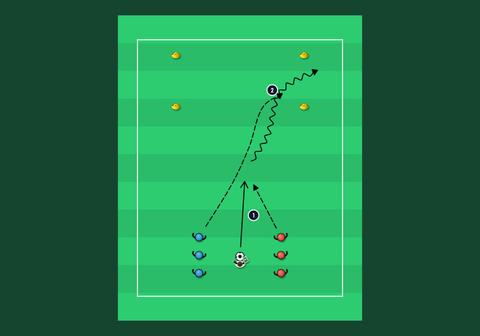
The coach stands with the balls at the lower end of the area, and the teams are in lines on either side of them. In the top corners of the area there are two four-metre gates, through which the ball is dribbled out to the side. The coach plays a pass forward into the middle, and the first player from each line goes for the ball. The player who gets the ball tries to dribble it through either gate, and the other tries to win the ball and stop them. If they win the ball, they can then try to go through either gate themselves. The duel ends with a goal or when the ball goes out of the area, and the players return to the back of their lines. Contact is allowed, but sliding tackles are forbidden. The area is approximately 16 × 20 metres.
Three-zone rondo (basic)
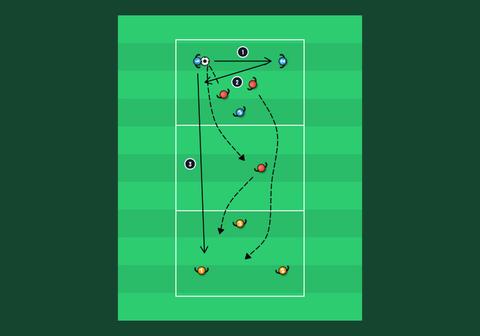
Mark out a 15 × 30 metre area and divide it into three 10-metre zones. Place a team of three players in each zone. The end teams keep possession and try to play the ball over the central zone to the other end. From the middle team, two players win the ball in the end zone where the ball is, and one stays in the middle to cut out long passes. When the ball switches ends, two players from the middle team run across after it. If the middle team wins the ball or the ball goes out, the team that lost possession moves into the middle and the winning team takes that end zone. Each successful pass from one end zone to the other is a point.
Rondo 5 contro 2
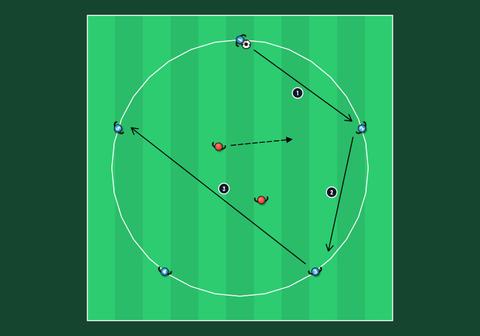
Delimita un cerchio di circa 12 metri. Cinque giocatori si dispongono sul perimetro a distanze uguali, e due difensori vanno al centro. I giocatori sul perimetro si scambiano il passaggio e si muovono lungo il cerchio, ma non devono entrare all'interno. Quando tra i difensori si apre uno spazio, la palla viene giocata attraverso quel varco. Il giocatore che perde il possesso palla va al centro, e al suo posto sul perimetro esce il difensore che è rimasto al centro più a lungo. Lo stesso cambio si effettua quando la palla esce dal cerchio. Si assegna un punto ogni dieci passaggi consecutivi. Limita i tocchi a uno o due in base al livello.
4v1 rondo
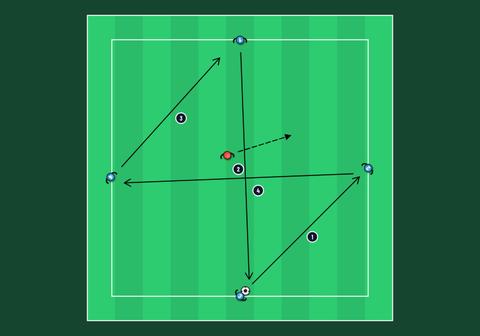
Mark out a square of approximately 10 x 10 metres. Four players are on the sides of the square, one on each side, with a defender in the middle. The players on the outside keep possession of the ball. They may move along their own side, but must not go inside the square. The defender tries to intercept the pass. When the defender wins the ball or the ball goes out of the square, the defender swaps places with the player who lost possession. Play restarts immediately. Ten consecutive passes equals one point. Make it easier with a bigger square or unlimited touches, and harder with a smaller square or a two-touch limit.
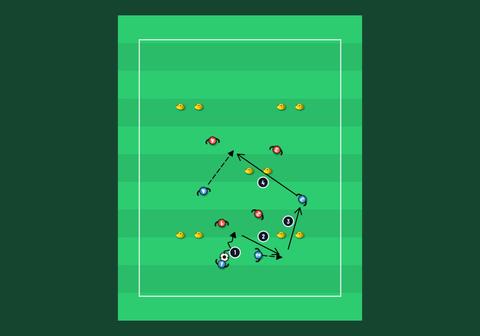
Gate passing game: move away from the ball
When teammates come next to the player on the ball, one defender can cover two of them. In this game, you only score from a pass through a gate to a teammate, so someone has to move away from the ball to the other side of the gate. The animation first shows the usual mistake and then the correct way. Area about 22 × 28 m. Spread five two-metre gates around the area. 4v4 with no goals. A point is scored when the ball is passed through any gate to a teammate who controls it on the other side of the gate. You cannot score two consecutive points through the same gate. Defenders can defend everywhere, and the team that loses possession defends immediately.
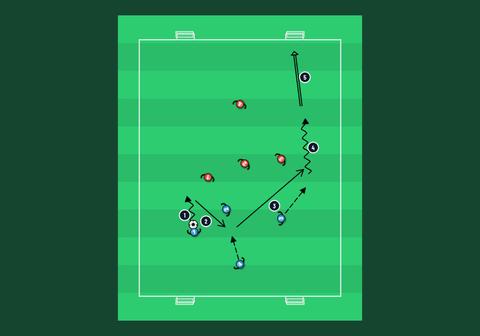
Four-goal game: play with width
With young players, the whole team can easily end up chasing the ball into the same corner. When there are two goals at each end, staying wide pays off straight away: the play is switched to the other side, and the goal there is free. The animation first shows the usual mistake and then the correct way. Area approx. 22 × 28 m, with two small goals at each end close to the corners. 4v4 without goalkeepers. Each team attacks the opponent’s two goals and defends their own. After a goal, the team that conceded restarts by dribbling from their own end. Additional rule for older players: a goal scored after switching play is worth two.
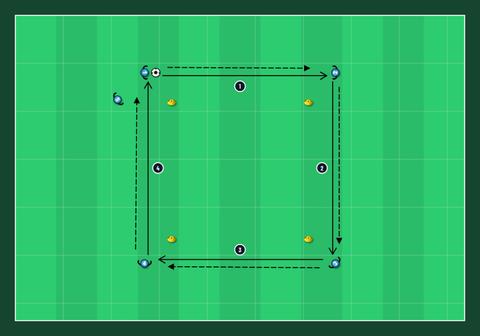
Square passing with directional first touch
Players are placed at four cones in a square. The ball is worked clockwise: the player plays a pass to the next cone and runs after the pass. The receiver takes the ball with a directional first touch.
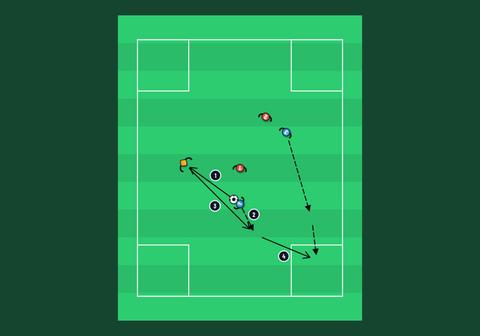
Four corners pass-and-move game
Many players make a pass and then just stand and watch the ball. In this game, you do not score points by standing still. The passer must move into a new space, and you can only arrive in the square by timing the run. The animation first shows the typical mistake and then the correct way. Area 20 × 25 m, with a 5 × 5 m square in each corner. Two teams and a joker, who always plays with the team in possession. The diagram shows 2v2 and a joker, so the attackers have 3v2 numerical superiority. With a bigger group, for example 4v4 and a joker. The attacking team scores a point by passing to a player who has run into a square. The joker does not score points. You cannot wait in the square. You only move there when the pass is coming, and after a point the ball is brought straight back out. When the defenders win the ball, the roles switch and the joker changes sides.
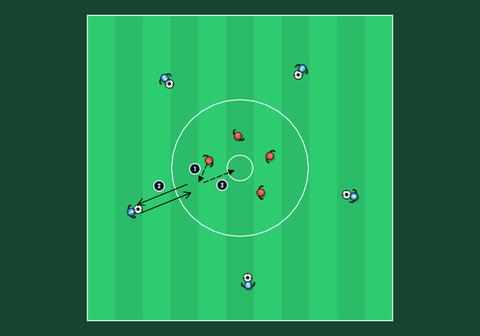
Passing circle
The animation first shows a common mistake and then the correct way. The players on the outside have balls. The players in the middle move and ask for the ball from the outside players and at first return it after a control (aiming to do so with the 2nd touch) and then one-touch as a one-two. The third variation is a throw from the wide player, which the middle player controls and returns. The middle players always go through the middle of the area after the return pass before asking for a new pass.
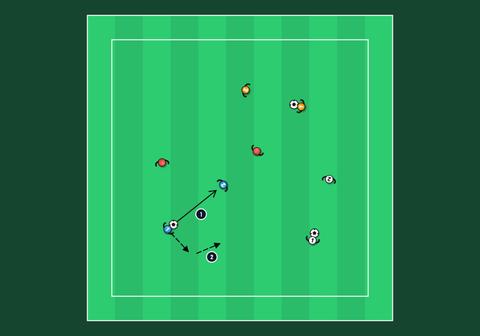
Ball tag
Many players make a pass and then just watch the ball. In tag, that is punished straight away: the ball must be moved on before the tagger gets there, and it can only be passed to a teammate who has moved into space. The animation first shows the usual mistake and then the correct way. Area approximately 23 × 23 m. Four teams, three of which have a ball. The fourth team are the taggers. A tagger may only touch the player with the ball. The teams help each other by passing and moving so that nobody gets caught. A caught player is freed by a high five from a teammate. In the picture, the teams are in pairs, and there are two taggers. Easier: play with hands by throwing and catching, and have fewer taggers. Harder: add more taggers.
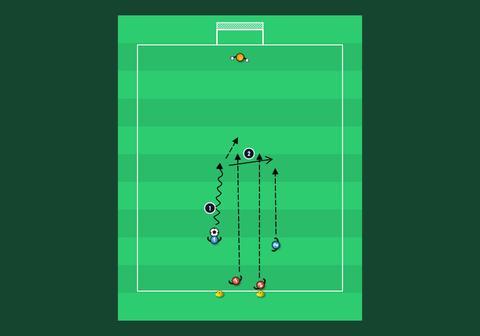
2v2 recovery defending
Two blue players attack the goal with a goalkeeper. Two red defenders start from the markers behind the attackers. The area is approximately 20 x 24 metres, with a cone gate at the opposite end. The blues start with the ball and drive towards the goal, and at the same moment the reds recover. The nearer defender runs along the inside line to get between the ball and the goal and delays the player on the ball. The second defender recovers to the inside, between the remaining attacker and the goal. Once it becomes 2v2, the defenders apply pressing and provide cover. In the example, red 1 gets across in front of blue 1 and delays. When blue passes out wide, red 2 moves to press during the pass and red 1 drops to cover. Red 2 wins the ball, and the reds immediately attack the gate. Now the blues recover. The blues score a point for a goal, the reds for dribbling the ball through the gate. The farther away the defenders start, the more difficult the recovery becomes, so adjust the distance of the starting markers according to the level. Change roles after a few repetitions.
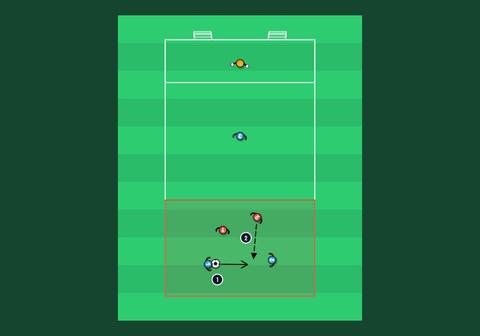
2v2 pressing and penetration
The area is approximately 14 × 24 metres and is divided into three sections. At the bottom is the 2v2 zone, in the middle the penetration zone and at the top the goalkeeper's area. On its end line there are two small goals. In the 2v2 zone, two blue players keep possession and two red players press as a pair. In the penetration zone, one blue defender waits. The reds' task is to win the ball. One presses the player on the ball, the other provides cover from the inside and reads the next pass. After winning the ball, the reds immediately break through: 2v1 against the blue defender and finishing into either small goal. Blue 1 and 2 are not allowed to follow from the 2v2 zone, blue 3 stays in the penetration zone and the goalkeeper stays in their own area. In the pattern, red 2 presses during the pass, and when the ball comes back, the roles change. When blue 1 tries to switch play again, red 2 intercepts the pass. Red 2 dribbles into the penetration zone, draws blue 3 towards them and passes to red 1, who shoots into the left small goal. Change roles every few repetitions so that everyone gets to press, defend the penetration and finish. The blues can be given a point, for example, for five consecutive passes in the 2v2 zone.
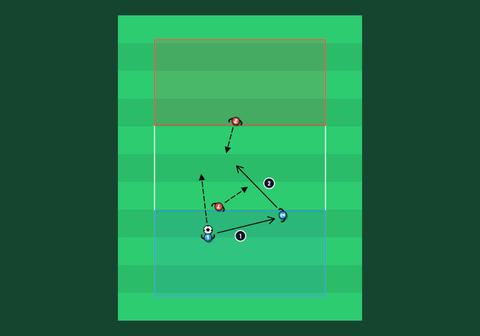
2v2 with a cover line
Two pairs play 2v2 in an area of approximately 16 × 24 metres. At each end there is an end line and a cover line eight metres in front of it. A pair scores a point when they dribble the ball over the opponent’s end line or pass to a teammate who controls it behind the line. The second player in the defending pair must be on or behind their own cover line. One presses the player on the ball, the other provides cover. They must not both go to the ball. The covering player may step off the line when they intercept a pass or win the ball from an attacker who has beaten the presser. In that case, the other defender immediately runs back behind the line. In the diagram, Red 1 presses the player on the ball from the inside and shows them wide. Red 2 is on the line diagonally behind on the inside. When Blue passes across to the other side, Red 1 shifts to press the new player on the ball while the ball is travelling, and Red 2 slides along the line to stay behind them. The pair move together. Blue 1 makes a run in behind the presser, but Red 2 reads the pass and intercepts it. After winning the ball, the Reds attack the Blues’ end line immediately. The nearest Blue presses, and the other runs behind their own cover line. Now the Blues defend in the same way. When Blue 1 wins the ball wide, only Red 2 gets back to the line in time. The Blues play a 2v1. Blue 1 draws Red 2 in and passes into the run of Blue 2, who dribbles the ball over the end line. Play 1–2 minute blocks. If there are more than four players, set up several pitches side by side or rotate pairs between blocks.
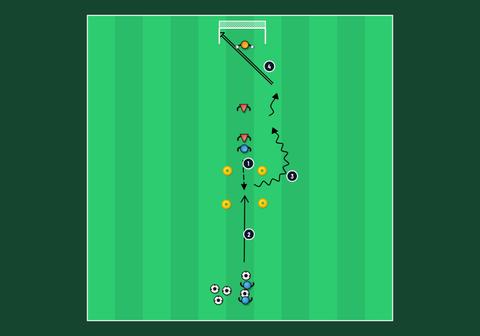
Two-phase 1v1 to goal
Two-phase 1v1. Starts with the attacker’s movement. The attacker asks for the pass into a square marked out with cones (the 1st defender follows), where they aim to move the ball with their first touch to either side. Once the ball is outside the square, it is the second defender’s turn to defend. Now a traditional 1v1, where the attacker aims for finishing. Rotation of roles: attacker goes to the back of the queue, 1st defender becomes the attacker and the second defender becomes the first defender. The passer becomes the second defender.
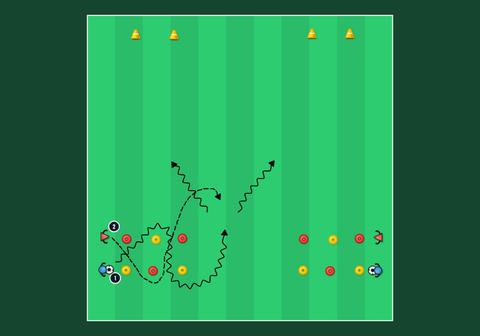
Dribbling and 1v1
A 1v1 drill in which players first weave through cones and then go into a traditional duel towards two small goals. The defender can start moving when the attacker has reached the first turn. After winning the ball, the defender can score by dribbling over the end line between the cones. Change ends and roles after every repetition.
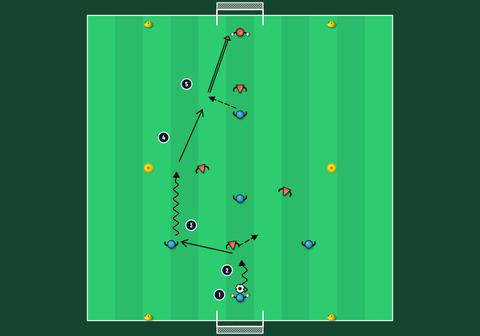
5v5 goal-dribbling game
5v5 game in which the team practises building play with a goal-dribble. When the ball goes over the end line, the defending team restarts by dribbling from any point in their own penalty area. The opponent may wait 5.5 metres from the ball. The player on the ball can carry the ball forwards or pass to a free player. In the example, the presser goes towards the goalkeeper, so the goalkeeper passes to the free player on the left. This player dribbles down the flank and passes to the attacker, who shoots. If an attack that starts from a goal-dribble ends in a goal, it is worth two points. All other goals are worth one. Play short blocks and rotate the teams often. According to the Football Association of Finland rules, 8- and 9-year-olds restart 5v5 by dribbling. In matches for seven-year-olds and younger, the opponent drops back to halfway for the goal-dribble and only defends once play has restarted.
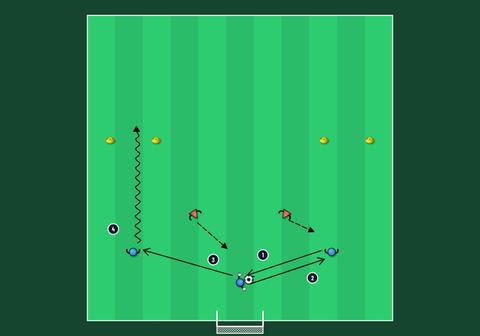
Playing out from a goal kick 3v2
Practise the goal kick in an 8v8 game, where play is started with short passes. The goalkeeper and two centre-backs play against two players pressing. The centre-backs spread out wide level with the corners of the penalty area, and the goalkeeper kicks the ball from the ground to the one who is free. The blue team scores a point when they pass or dribble the ball through the wide gate about 24 metres from the goal line. The reds try to win the ball and score a goal. When the player pressing closes down the centre-back, the centre-back passes the ball back to the goalkeeper, and the goalkeeper switches play to the other side. Start without players pressing, then add one and finally two. In 8v8 for 10-11-year-olds, a goal kick may be taken from the ground anywhere in the penalty area, and the opponent does not have to retreat: it is enough to be 5.5 metres from the ball. The players pressing may therefore stand just as close in the drill as in a match.
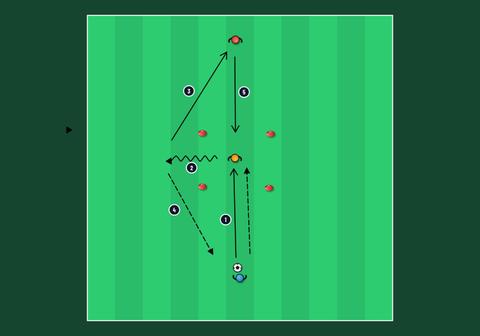
First touch and passing on the move
A three-player drill with one in the middle of a square marked by cones and two on either side at passing distance. The drill starts with a pass, which the player in the middle aims to guide with the first touch outside the square and immediately pass to the third player. After the pass, move into the centre and the middle player fills the empty space.
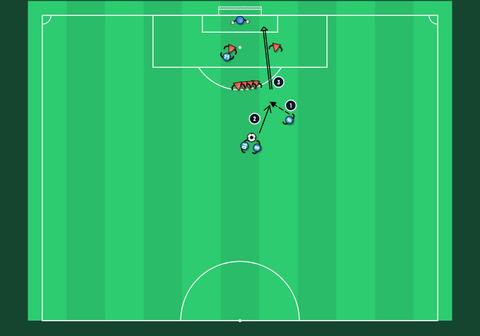
Free kick routine with a fake argument
Two players stay over the ball and begin to act out a disagreement over who will shoot. Meanwhile, a third walks calmly towards his own position off to the side, without looking towards the ball even once. In the middle of the argument, the ball rolls into his path, and the shot is taken with the first touch from a new angle that the wall cannot turn to in time. The pattern lives or dies with the walker: as soon as he glances at the ball or breaks into a run too early, the defending reads the pattern. The pass is played only when the walker is one step away from the shooting position.
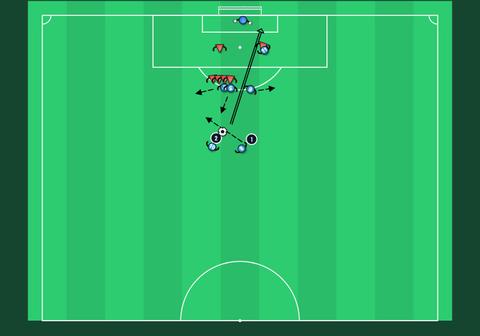
Free kick routine with a splitting wall
Direct free kick from around 20 metres, where your own line of three players stands in the goalkeeper’s line of sight, at least one metre away from the wall, as the law requires. A decoy runner goes over the ball, and at the same moment the line splits to the sides. The shooter strikes low through the newly opened channel into the far corner, where the goalkeeper only has time to look once the ball is already moving. The role of the line is not to cover the whole goal but to take away the goalkeeper’s moment of release: a goalkeeper who reacts late will not reach the low corner. Practise the line splitting so that it happens exactly on the shooter’s final step — if the line splits too early, it reveals everything.
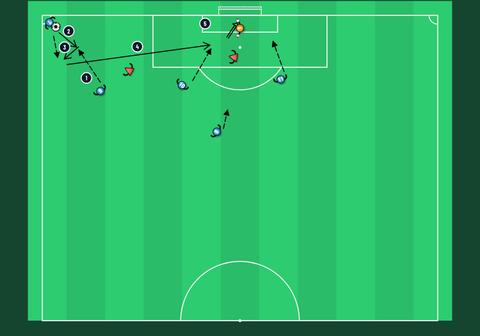
Short corner routine
The corner is played short. The supporting player comes towards the corner flag and receives a pass, which makes the nearest defender come out of the penalty area to apply pressure. The ball is then played back to the taker, who has meanwhile moved from the corner to around eight metres away. The angle for the cross is better from there, and the ball can be delivered low between the near post and the goalkeeper. The player running to the near post finishes one-touch, and the run to the far post starts at the same time. There are two defenders: one applies pressure to the short corner, the other defends the area. Without the defender coming out, the pattern does not show why the short corner works.
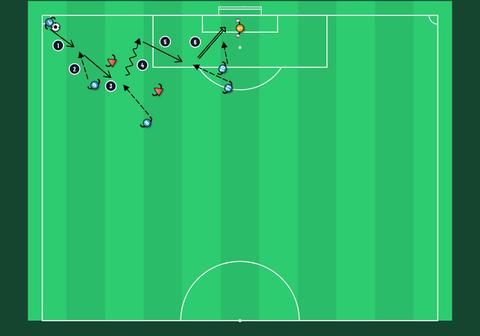
Short corner routine with three players
The corner is played short between three players. The player closest to the flag comes short and receives the pass, which brings the first defender out. Instead of the ball being returned to the taker, it goes first touch to the third player, who has come from the edge of the penalty area into the same corner. Now the second defender also has to come out, and the third player dribbles between them to the end line. From the end line, the ball is played back low towards the penalty spot. The finisher times the run so that they move towards the ball rather than waiting for it standing still. The player occupying the near post takes the goalkeeper with them. Two defenders out means there is briefly a 2v1 in the penalty area. That is the whole idea of the move: the short corner is not looking for a cross but for numerical superiority.
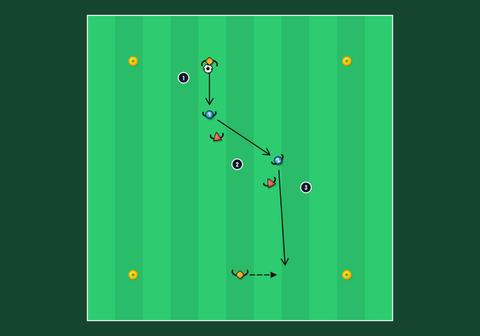
End zone game, target players in the end zones
Six players in three pairs in an empty area. No goals. One pair are the target players, one in each end zone, and they move only along their own end line. The other two pairs play 2v2 in the middle. A point is scored when the ball is dribbled from one end to the other, meaning from one target player to the other. After a successful pass, the same team continues with the ball in the opposite direction. The defending pair try to close the passing lane to the target player and win the ball. After winning the ball, the pair who won it can attack either end zone, but a point always requires the full distance: the ball must go from one target player to the other. In practice, the pair who won it start from the nearest end zone. Three minutes at a time, then the pairs rotate positions.
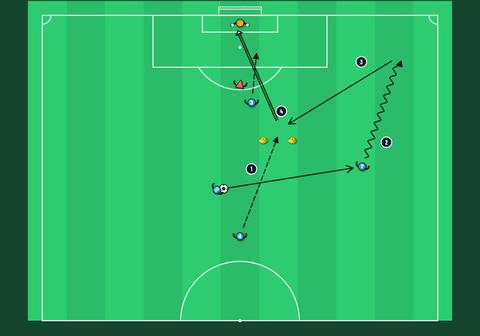
Lay-off for the second wave
A pass from the centre to the winger, who dribbles all the way to the byline. The attacker takes the defender with them to the near post. When the defending has dropped towards the goal, the midfield player arrives late at the edge of the penalty area into the gate. The winger lays the ball back and the arriving player shoots first time from the pass. A goalkeeper in goal. Start alternately from both flanks.
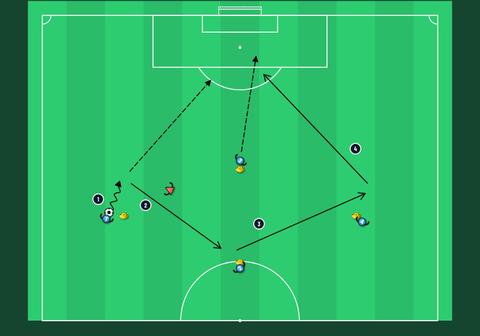
Switch of play and cross
Four players in a diamond: both flanks, one in the middle at the front and one in the middle at the back. The wide player starts dribbling towards goal. The deepest player calls, which stops the dribbling and the ball is played back. The deepest player switches play first time to the opposite flank, who advances and delivers a cross. The others arrive in front of goal in staggered runs to finish. Start alternately from each flank. Instead of a cross, a sharp low pass from the flank is also allowed.
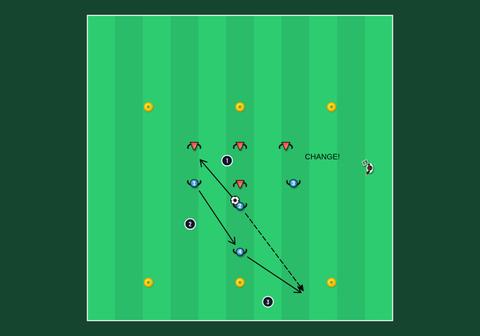
End zone game with changing direction
4v4 with an empty area, with end zones marked by cones at both ends. No goals. A point is scored when a player from your team receives a pass in the end zone. The coach calls for a change of direction during play, and the attacking direction switches from that moment. The defending team have just compacted towards the wrong end, so the space is behind them; this must be seen and used before they have time to turn. Playing time 3-4 minutes at a time, with several calls in each block.
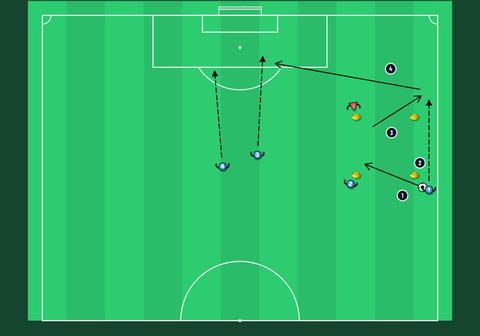
Wide 2v1 and cross
Two attackers break down one defender out wide and deliver a cross. The wide player passes to the inside player, who comes towards the ball and turns towards goal. At the same time, the defender sets off from the opposite corner to apply pressure. The passer immediately makes an overlapping run on the outside past their teammate, into the space between the penalty area and the touchline. From there, they receive the ball back and deliver a cross. The run into the penalty area is staggered: one to the near post, the other to the far post. The defender does not follow outside the square. Start alternately from both flanks. Alternatively, the wide player can solve the situation themselves in a 1v1, either by going inside or down the touchline.
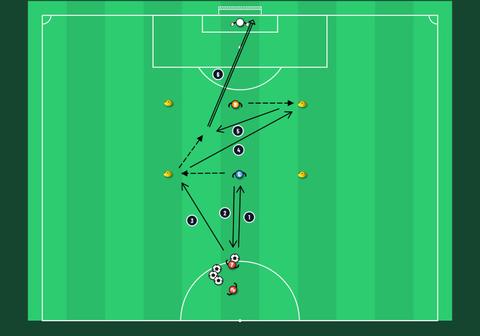
Barcelona shooting drill
A pass is played from the line to the blue player, who sets it back with a one-two to the first player in the line. After that, he chooses which cone to move to, and the yellow player moves to the opposite cone on his own line. The first player in the line passes to the blue player who has moved to the cone, and the blue player passes to the yellow player. The yellow player lays off a one-two to the blue player, who looks to shoot first time into the goal. There is a goalkeeper in goal. After the shot, the players rotate positions: the passer goes into the middle, the shooter goes up, and the top player goes to the back of the line. The next round starts from the line with a new ball.
Cutback finishing
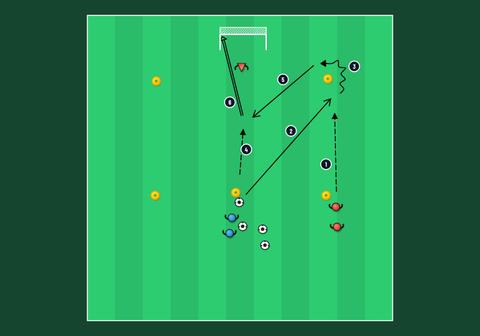
The drill starts with the red player making a movement, which the player in the middle looks to find with a pass. The red player controls the ball, goes around the cone near the end line and plays a cut-back pass to the central player, who looks to shoot and score. The queues change after every repetition.
Passing for an overlap
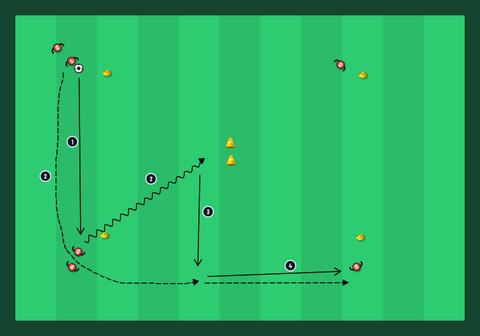
Player passes the ball and makes an overlapping run behind the other player. The receiver dribbles the ball near the cones and passes to the overlapping player, who then passes on to the third queue. The drill progresses in four phases: 1) initial pass, 2) dribbling towards the cones, 3) pass into the overlap and 4) pass to the third queue.
End zone game
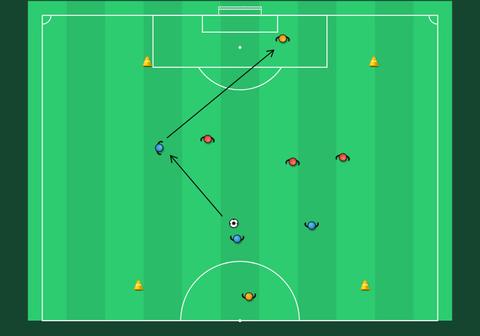
3v3 end zone game with two jokers. The jokers play in the end zones with the team in possession. The jokers can join the attack, creating temporary numerical superiority. A goal is scored when a player receives a pass in the end zone
Finishing - defender behind the back
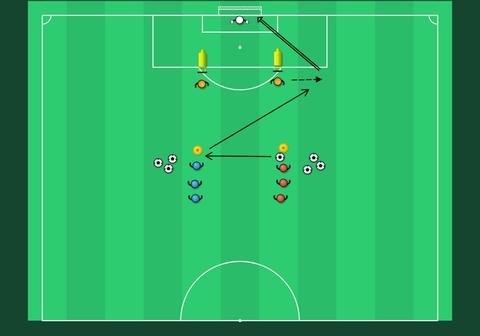
The situation starts with a sideways pass from one queue to the other. The diagonal attacker (orange) moves away to the side from the defender and looks to shoot immediately after the control. In the second variation, the attacker's movement is to the inside of the defender.
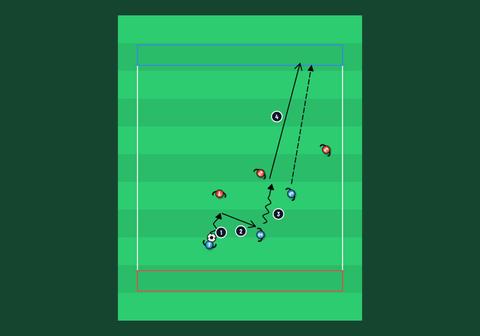
3v3 line game
3v3 game without goals. A goal is scored when a team gets the ball under control behind the opponent’s end line. If the whole team comes short to the ball, there is no one behind the line to pass to. One player stays high and runs in behind the defender. The animation first shows the usual mistake and then the correct way. Area approximately 20 × 20 m, and a two-metre zone behind each end line. The receiver must control the ball behind the line. A shot or dribbling over the line is not enough.
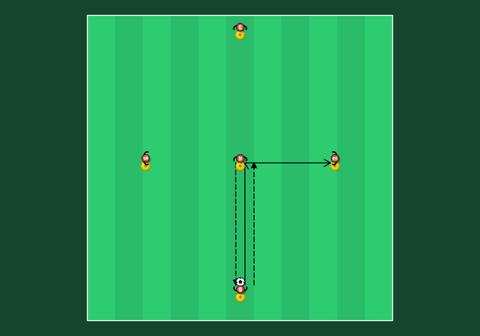
Cross passing with rotation
Five cones in a cross shape: one in the middle, four around it at a distance of 5–10 metres. One player at each cone. The ball starts from an outer cone and is played to the middle player. The middle player takes a directional first touch and with it plays a pass to a new outer cone, not back to where the ball came from. Then the passer and the middle player rotate positions: the passer runs into the middle, and the middle player takes the now free outer position. So there is a different player in the middle on each round. Adjust the distances according to the players’ age and skill level.
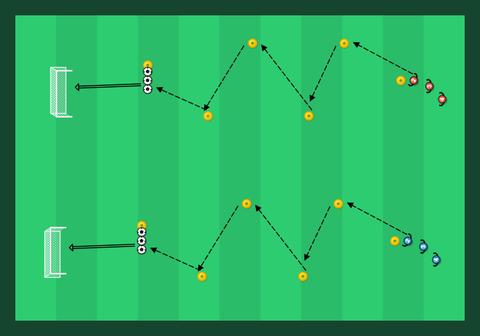
Cone relay race with a shot
Two identical courses side by side, with a team on each. At the end of the course there is a small goal and a cone in front of it with three balls. Between the goal and the starting cone there are four cones alternating on different sides of the course. The first player starts on the signal and goes round the cones at full speed, passing each on a different side. From the last cone, straight to the ball and a shot into the small goal. When the ball is in the goal, the next player starts. The team that gets all three balls into the goal first wins. Three players on each course, six in total. Adjust the spacing between the cones to suit the group. The closer together the cones are, the more the course demands braking and changes of direction.
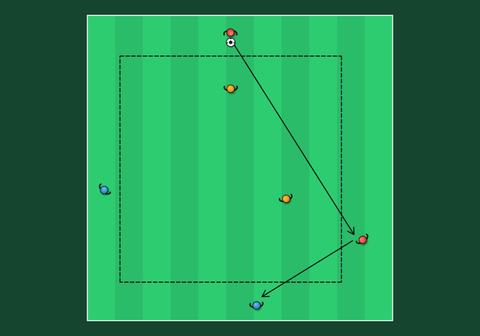
4v2 rondo
Mark out a square area and make three pairs of two players. Two pairs are on the outside on the edges, giving four passers in total, with one on each side. One pair is inside the area trying to win the ball. The players on the outside keep possession from side to side. The players winning the ball split the work: one presses the player on the ball, the other blocks the next passing lane. When they win the ball, the pairs swap places and play continues immediately without a restart. Adjust the size of the square to suit the level. A smaller square shortens the passes and forces quicker touches.
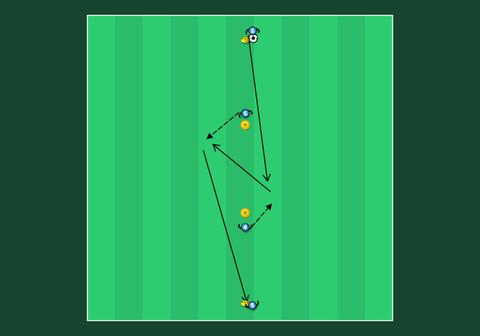
Line passing 2/3
Four players in one line, 5–10 metres apart, each position marked. The ball always bypasses the nearest player. The top player plays a long ball past the first middle player to the second middle player, who has moved out to the side. This player lays the ball off one-touch back to the bypassed player, who has meanwhile moved out to the other side of the line, and the bypassed player plays a long ball to the bottom player, again past the middle player. At the far end, the middle players return to their markers and the same pattern comes back the other way, moving out to the opposite sides. The bypassed player starts moving before the long pass is played.
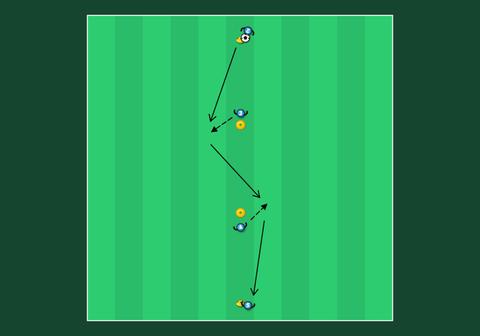
Line passing 1/3
Four players in a straight line 5–10 metres apart, each position marked. The top player starts with the ball. The two middle players move away from their marker to the side of the line, on opposite sides, and receive the ball in an open body position. The ball travels through the line: the top player passes to the first middle player, who passes to the second, who passes to the bottom player. Once it reaches the end, the middle players return to their markers and the same pattern comes back the other way, but now both move out to the opposite side. Start with two touches and move to one-touch when the pattern is flowing.
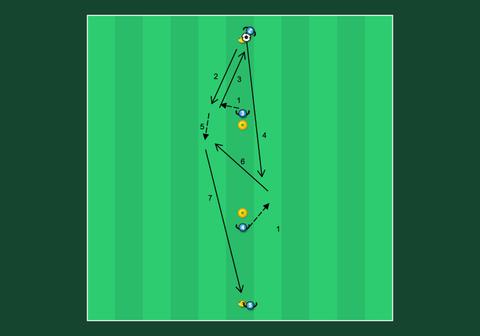
Line passing 3/3
Four players in a line 10–15 metres apart, with a marker at each position. Numbers from top to bottom: two, three, four, five. Two starts with the ball. Going down: two passes to three, who returns it straight back. Two plays a long pass beyond three to four, four directs the ball to three, and three plays a long pass beyond four to five. Going up, the same as a mirror image: five passes to four, gets the return pass and plays a long pass beyond four to three. Three directs it to four, four plays a long pass back to two, and the sequence starts again. Three and four move away from the line to opposite sides just before the pass is played. This allows the long pass to travel beyond the previous player. After their own pass, they return to the line. Short passes with two touches, long passes firmly along the ground. When the pattern is flowing, tighten the short passes to one-touch.
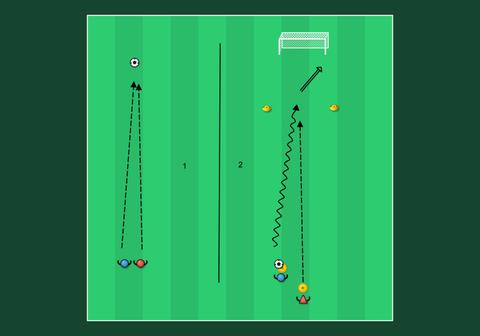
Running duel and winning the ball
Train progressively how to initiate contact and win the ball with recovery pressing. In phase 1, the players set off on the coach’s signal and try to reach the ball first. Contact already from the start; use of the arms and taking control of the running line are important. In phase 2, practise winning the ball from a slightly similar situation where one player has the ball. The attacking player may try for goal if they are able to advance close enough.
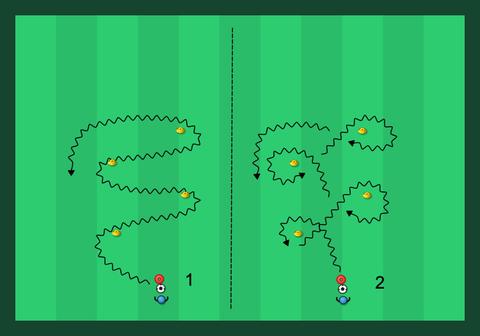
Cone slalom dribbling
Place the cones generously apart so that there are several touches between them. In phase 1, go around the cones normally, varying the dribbling methods (free, sole of the foot, turns with the outside/inside of the foot, etc.). In phase 2, go fully around the cones using either the inside or the outside of the foot.
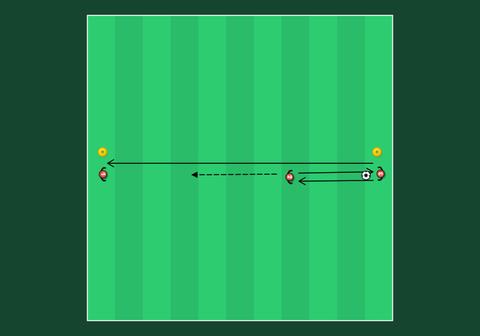
Three-player warm-up passing 3/3
Two players stand still 15–20 metres apart, with markers in front of their feet. The third works between them. One ball. The player on the right plays a short pass to the middle player, who has moved towards the ball, and the middle player returns the ball. Immediately after, the same player plays a long pass to the other end. The middle player does not stay in the passing lane but moves aside and at the same time runs to the other side. The same pattern is repeated there: short pass to the middle player, return pass, and then a long pass back. So the rotation has three passes: short pass in, return pass and long switch. The middle player's job is to get there to receive before the ball and out of the way before the long pass. Change the middle player about every minute.
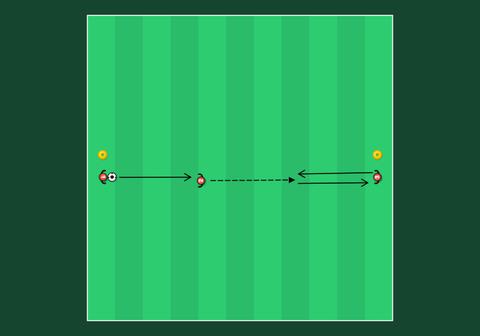
Three-player warm-up passing 2/3
Two players stand still 15–20 metres apart, with markers in front of their feet. The third works between them. One ball. The player on the left passes to the middle player, who has moved towards that side. The middle player takes the first touch towards the opposite side and passes there. The same continues alternately. Demand direction from the first touch: the ball must go where it is going next. Change the middle player about every minute.
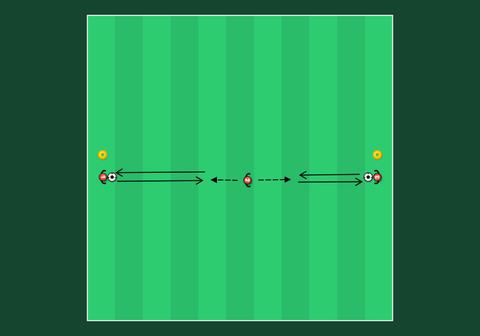
Three-player warm-up passing 1/3
Two players stand still 15–20 metres apart, each with a ball. The third works between them without a ball. The middle player moves towards the player on the right. That player makes a pass, and the middle player returns the ball straight back. He then turns, runs to the other side and does the same with the player on the left. Neither ball crosses the middle area but stays under the control of the wide player on that side. The middle player does not stay standing after the return pass but turns immediately. Change the middle player about every minute. First rounds with two touches. When the rhythm is there, return pass one-touch.
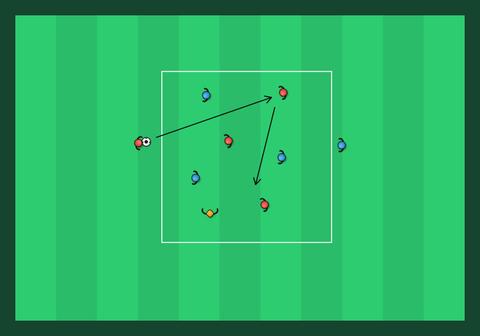
Possession game
The aim is to keep the ball in your own team's possession in a limited area. As variations, some players can be outside the area and/or there is a joker who is always on the side of the team in possession.
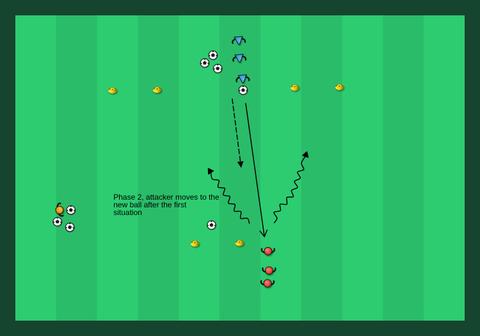
1v1 to gate goals
The drill starts with a defender’s pass and, after the control, the attacker tries to dribble into either gate goal. The defender tries to win the ball and dribble into the opposite gate goal. A second phase can be added to the drill, where after the first situation has ended, the coach adds a new ball and the attacker has to move with their back to the goals.
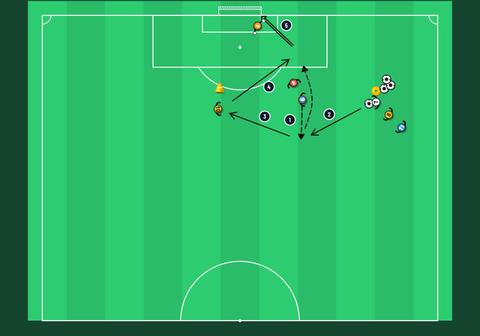
Finishing from a one-two
Flat cones show the starting positions of the passer and the attacker. The attacker makes the initial movement away from the defender, and the first player in the queue plays a pass into the movement. The attacker controls the ball and immediately passes to the wall player. The wall player plays the one-two into the space behind the defender. The attacker goes around the defender on the other side and aims to shoot first time past the goalkeeper. The defender tracks the run but does not intercept passes. Rotation: attacker becomes the wall player, wall player goes to the back of the queue, the player who made the first pass becomes the defender, and the defender becomes the attacker.
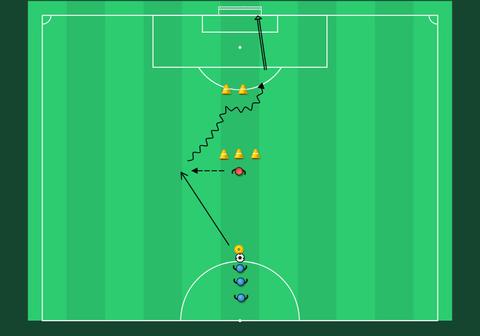
Dribbling and finishing
The red player chooses a side to move towards and calls for the pass. The first player in the queue plays the pass and the red player aims to take the first touch in the direction of travel. The red player dribbles towards the goal, beats the cone defender with a feint of their choice and shoots into the goal. Rotation: the passer becomes the finisher.
Passing, dribbling and shot from a through pass
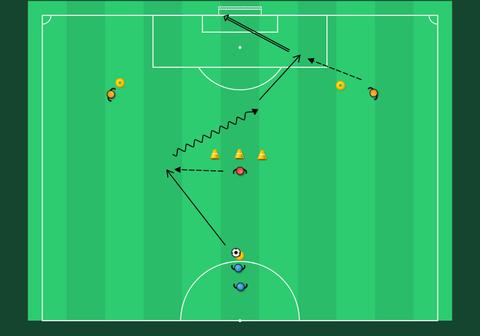
The player in front of the cones makes a movement to either side of the line of cones and asks for the pass. The first player in the queue plays a pass and the receiver takes a short dribble towards the player positioned on the opposite diagonal and plays a through pass to them. The receiving player tries to "avoid offside" (the cones represent the deepest defenders) and finish first time from the pass.
Passing in pairs
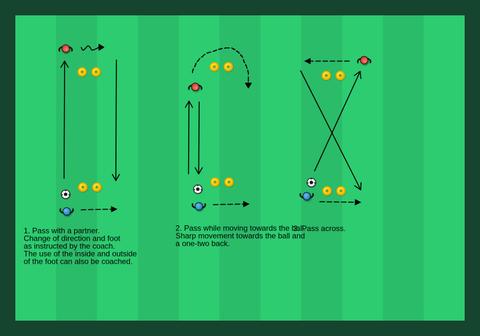
1) Straight pass back and forth with a partner - change of direction and foot as instructed by the coach, the use of the inside and outside of the foot can also be coached. 2) Pass while moving towards the ball - sharp movement towards the ball and a one-two back. 3) Pass across - pairs pass across.
Slalom dribbling relay
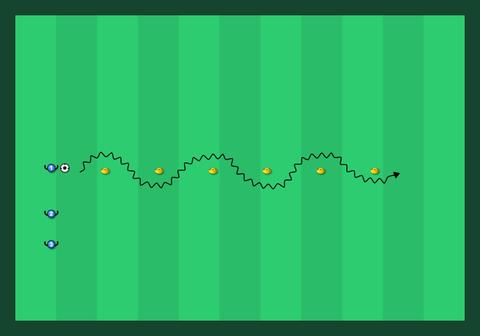
Cones are set out in a straight line 0.8–1.5 metres apart. Players dribble the ball between the cones using the inside and outside of the foot. Relay race: the player dribbles through the course, turns and returns, after which the next player sets off.
Possession square
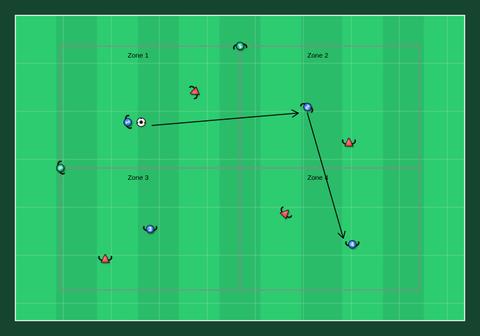
Square-shaped area divided into four zones. Two teams (e.g. 4v4+2 jokers). The team in possession keeps the ball and tries to play into as many zones as possible. A point for each new zone the ball is played into in succession. The jokers always play with the team in possession.
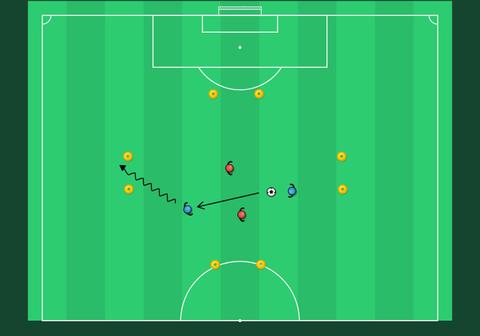
2v2 to four goals
2v2 in a small area, with four cone goals on the edges of the pitch. A goal is scored by dribbling the ball through any pair of cones. Because there are goals in every direction, the player on the ball must constantly turn and shield the ball to find an open goal.
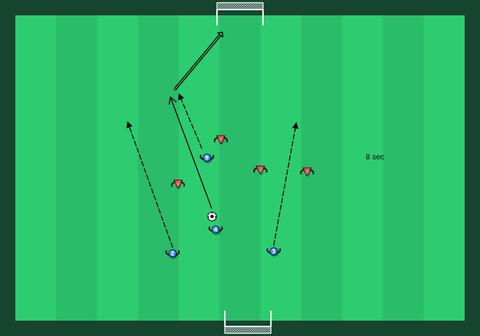
Counter-attack game
The defending team defends their own goal. When they win the ball, they have 8 seconds to attack the opposite goal. If a goal is scored within the time limit, the point counts double. The attacking team continues normal play. A quick transition from defending to attacking is decisive.
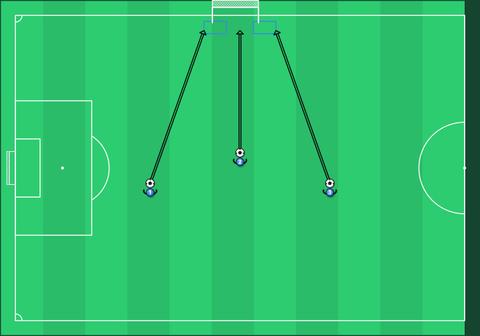
Shooting from a stationary ball
Players take turns shooting a stationary ball towards the goal from different distances (8–15 m). The balls are placed at different angles in front of the goal. Focus on correct striking technique: positioning the non-kicking foot next to the ball, locking the ankle, and striking with the instep.
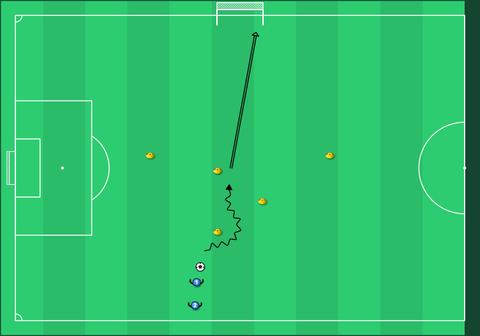
Dribbling and shooting
Players dribble the ball past or through the cones before shooting. The dribbling starts approximately 20–25 metres from the goal, the shooting area marked with cones approximately 10–14 metres away. Head up before shooting.
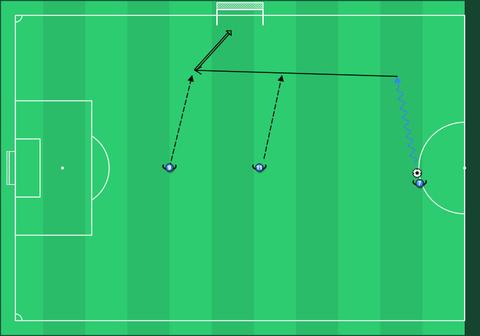
Cross and finishing on the move
The wide player receives the ball and goes to the byline or into the inside channel. In the penalty area, two attackers make crossing runs: one to the near post, the other to the far post. The player crossing chooses the type of cross.
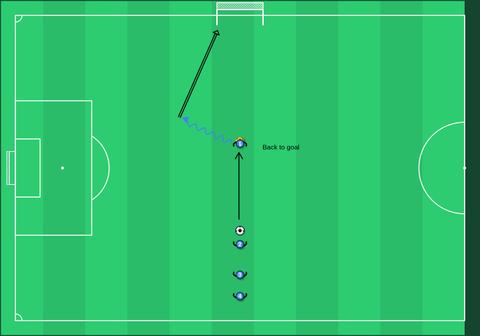
Turn and shoot
The player stands with their back to goal around 11–14 metres away, with the passer in front. The passer plays a low pass, the player controls the ball with the first touch to the side and shoots with the second touch.
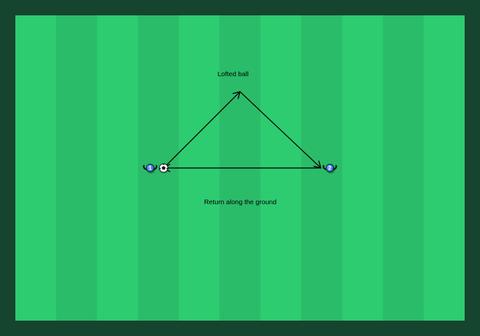
Aerial ball control
In pairs: the server throws a lofted ball to the receiver, who controls it with the thigh, chest or instep and plays the ball back along the ground in two touches. Three stations: thigh and down to the ground, chest and down to the ground, instep and down to the ground.
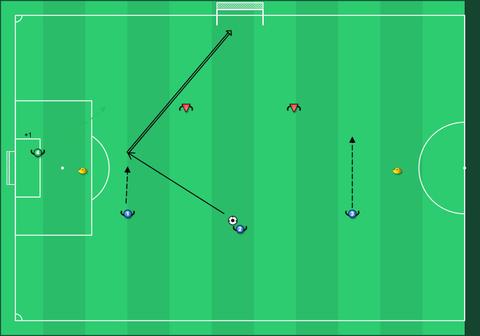
3v2+1 numerical superiority attack
Three attackers play against two defenders. One additional player waits on the flank and joins in when the ball crosses a certain line. The attackers aim for quick finishing before the defending can get organised. If the defenders win the ball, they play a counter-attack.
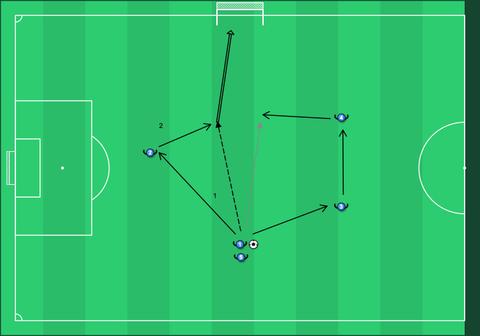
Combination play with one-twos
Players practise different one-two patterns on the move: a simple one-two or a triangle passing pattern. Each pattern ends with a shooting opportunity. First without defenders, then with passive defenders and finally with active defenders.
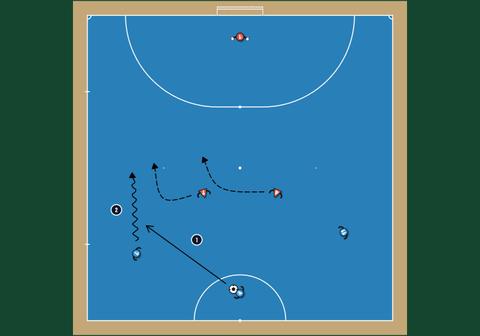
Futsal wide pressing and cover 3v2
Three blue players attack: the fixo on the halfway line and two wide players providing width. They are opposed by two defenders and a goalkeeper. The fixo passes wide. The nearest defender presses while the ball is travelling and moves to the receiver’s inside, so the attacker is left with only the direction along the touchline. The second defender provides cover centrally and stays closer to their own goal than the pressing defender. This way, they block both the turn inside and the square pass to the opposite flank. The touchline is the third defender: when the wide player dribbles along it, the pressing defender gets alongside and wins the ball. After winning the ball, the red players attack towards the halfway line, and dribbling the ball over the line is a point. The blue players score a point with a goal. Change roles every few repetitions.
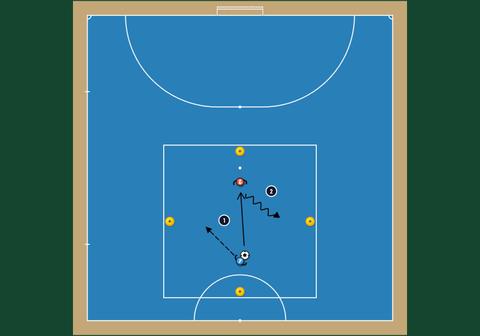
Futsal sole passes and 1v1 to four markers
In pairs, one ball per pair. Mark out an approximately 10 × 10 metre grid and place a marker in the middle of each side. The pairs pass to each other and receive the ball with the sole of the foot. After each pass, both move a quarter turn clockwise, and the player receiving the ball takes it along. When the pair has gone all the way around the circle and is facing each other again, the 1v1 begins. Either player can start the attack. Stopping the ball under control at a side marker is one point; beat an opponent and stop it at the marker behind them for three points. Make it more difficult by having the player on the ball keep the ball for as long as possible before scoring a point. If the opponent wins the ball cleanly, they attack immediately.
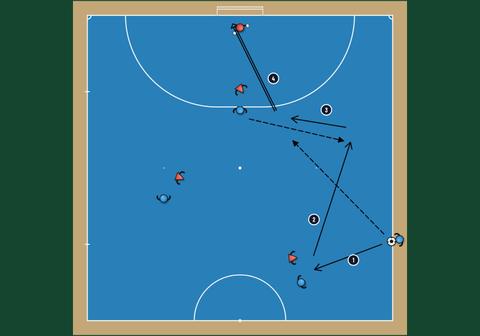
Futsal kick-in routine through the pivot
In futsal, the ball is put back into play from the touchline with a kick-in, and you have four seconds. That is why it is worth having a routine ready for the kick-in. Here the kick-in is taken in the attacking half from the right flank. There are four blue outfield players, three red defenders and a goalkeeper. The kicker plays a short pass to the deep player waiting further inside and immediately makes a diagonal run towards goal. At the same time, the pivot moves from in front of the goal out to the flank, and the marker follows. The deep player passes to the pivot on the flank, and the pivot plays the ball into the middle, where the kicker has run. The kicker shoots. If the passing lane to the pivot is blocked, the deep player switches the ball to the left-sided player. Once the routine is working, add a fourth defender to mark the kicker.
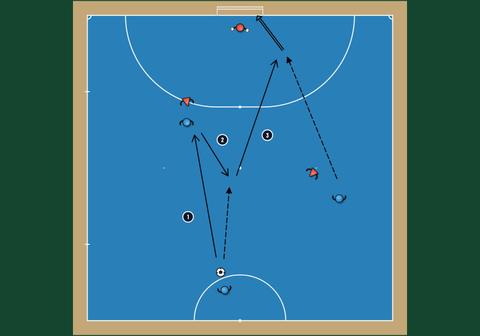
Futsal pivot lay-off and far-post run 3v2
Three blue players attack: a deep player, a pivot and a wide player. They are up against two defenders and a goalkeeper. The pivot plays close to goal with their back to goal, with a defender tight behind. The deep player passes to the pivot and follows their pass. The pivot lays the ball off one-touch to the oncoming deep player. At the same time, the wide player on the opposite side runs to the far post. The second defender has to choose whether to press the player on the ball or track the runner. If they stay with the runner, the deep player shoots. If they come to press, the deep player plays a low ball across the face of goal to the far post, and the wide player finishes. Start with the defenders at half intensity. After winning the ball, the red players attack towards the halfway line, and dribbling over the line is a point. Change roles and sides every few repetitions.
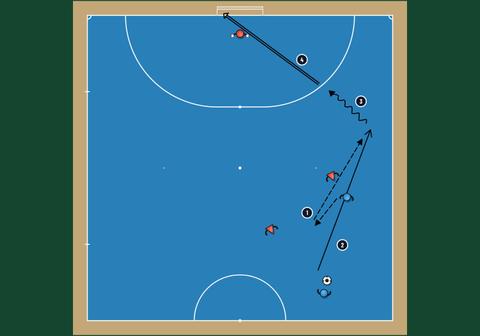
Futsal parallel run 2v2
The parallel run is a basic futsal movement: the wide player gets away behind their marker down the flank. The fixo and the wide player attack against two defenders and a goalkeeper. The wide player first moves diagonally towards the ball and takes the marker with them. Then they change direction and make an explosive run down the flank. At the same moment, the fixo plays a long ball along the flank into space behind the defender. The wide player dribbles inside and shoots towards the far post. The defenders play at half pace until the timing of the run and the pass works. If the reds win the ball, they get a point by dribbling it over the halfway line. Practise from both flanks.