Come allenare il passaggio nel calcio giovanile
In una buona esercitazione di passaggio il motivo per passare nasce dal gioco, e le ripetizioni si accumulano da sole. La versione più semplice è uno schema in cui la palla non si ferma mai e i giocatori imparano ad aprire il corpo prima che arrivi. Quando lo schema scorre, un difensore in mezzo costringe chi riceve a guardarsi intorno e a scegliere. Sotto i 10 anni servono distanze corte e tanti tocchi. Verso gli U12 puoi allargare lo spazio e chiedere il gioco di prima e i cambi di gioco. Allena il controllo orientato come parte del passaggio: chi riceve e controlla la palla nello spazio ha già reso più facile il passaggio successivo.
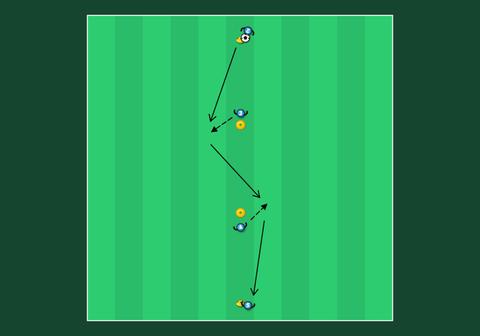
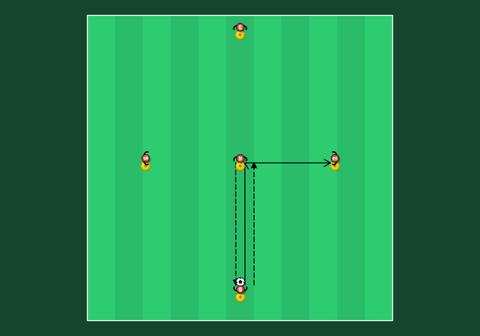
Line passing 1/3
Four players in a straight line 5–10 metres apart, each position marked. The top player starts with the ball. The two middle players move away from their marker to the side of the line, on opposite sides, and receive the ball in an open body position. The ball travels through the line: the top player passes to the first middle player, who passes to the second, who passes to the bottom player. Once it reaches the end, the middle players return to their markers and the same pattern comes back the other way, but now both move out to the opposite side. Start with two touches and move to one-touch when the pattern is flowing.
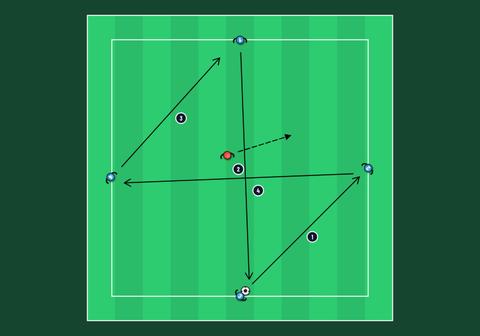
4v1 rondo
Mark out a square of approximately 10 x 10 metres. Four players are on the sides of the square, one on each side, with a defender in the middle. The players on the outside keep possession of the ball. They may move along their own side, but must not go inside the square. The defender tries to intercept the pass. When the defender wins the ball or the ball goes out of the square, the defender swaps places with the player who lost possession. Play restarts immediately. Ten consecutive passes equals one point. Make it easier with a bigger square or unlimited touches, and harder with a smaller square or a two-touch limit.
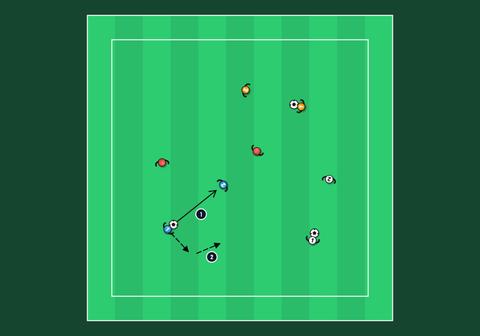
Ball tag
Many players make a pass and then just watch the ball. In tag, that is punished straight away: the ball must be moved on before the tagger gets there, and it can only be passed to a teammate who has moved into space. The animation first shows the usual mistake and then the correct way. Area approximately 23 × 23 m. Four teams, three of which have a ball. The fourth team are the taggers. A tagger may only touch the player with the ball. The teams help each other by passing and moving so that nobody gets caught. A caught player is freed by a high five from a teammate. In the picture, the teams are in pairs, and there are two taggers. Easier: play with hands by throwing and catching, and have fewer taggers. Harder: add more taggers.
Dagli schemi al gioco
Quasi tutte le esercitazioni di passaggio di questa pagina partono come schema senza difensori. Nel riscaldamento di passaggi a tre il giocatore centrale va incontro alla palla, la restituisce di prima, si gira e fa lo stesso dall'altra parte. Il passaggio in linea ha tre fasi: nella prima i due giocatori centrali si staccano dalla linea per ricevere con il corpo aperto, nella terza i passaggi lunghi scavalcano il giocatore centrale. Inizia a due tocchi e passa a un tocco quando lo schema scorre. I passaggi incrociati con rotazione aggiungono il controllo orientato: il giocatore centrale guarda oltre la spalla e passa a un nuovo cono, non da dove è arrivata la palla. I rondo 4 contro 1 e 5 contro 2 mettono in mezzo i difensori, mentre il gioco dei quattro angoli e la palla prigioniera trasformano il passa e muoviti in un gioco. Nel gioco dei quattro angoli si fa punto passando a un giocatore che si è smarcato in un quadrato d'angolo, e un jolly gioca sempre con la squadra in possesso. Il cambio di gioco, il passaggio filtrante nello spazio e il passaggio per la sovrapposizione lavorano sui passaggi lunghi e su quelli nello spazio o sulla corsa di un compagno. Nel cambio di gioco il campo è diviso in tre corridoi verticali, e un passaggio lungo sposta il gioco nel corridoio opposto.
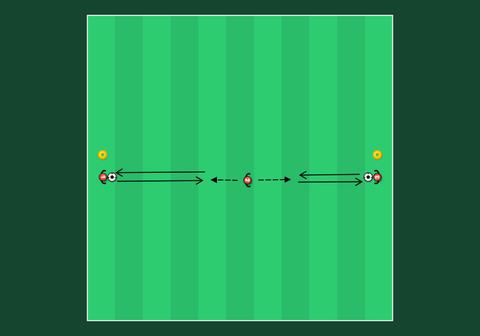
Three-player warm-up passing 1/3
Two players stand still 15–20 metres apart, each with a ball. The third works between them without a ball. The middle player moves towards the player on the right. That player makes a pass, and the middle player returns the ball straight back. He then turns, runs to the other side and does the same with the player on the left. Neither ball crosses the middle area but stays under the control of the wide player on that side. The middle player does not stay standing after the return pass but turns immediately. Change the middle player about every minute. First rounds with two touches. When the rhythm is there, return pass one-touch.
Cross passing with rotation
Five cones in a cross shape: one in the middle, four around it at a distance of 5–10 metres. One player at each cone. The ball starts from an outer cone and is played to the middle player. The middle player takes a directional first touch and with it plays a pass to a new outer cone, not back to where the ball came from. Then the passer and the middle player rotate positions: the passer runs into the middle, and the middle player takes the now free outer position. So there is a different player in the middle on each round. Adjust the distances according to the players’ age and skill level.
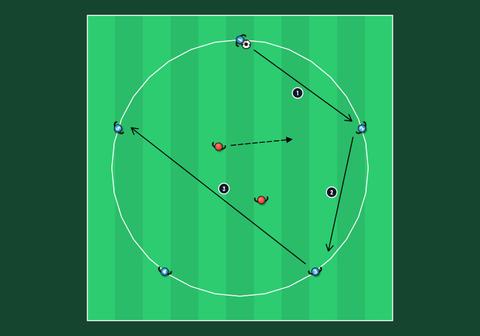
Rondo 5 contro 2
Delimita un cerchio di circa 12 metri. Cinque giocatori si dispongono sul perimetro a distanze uguali, e due difensori vanno al centro. I giocatori sul perimetro si scambiano il passaggio e si muovono lungo il cerchio, ma non devono entrare all'interno. Quando tra i difensori si apre uno spazio, la palla viene giocata attraverso quel varco. Il giocatore che perde il possesso palla va al centro, e al suo posto sul perimetro esce il difensore che è rimasto al centro più a lungo. Lo stesso cambio si effettua quando la palla esce dal cerchio. Si assegna un punto ogni dieci passaggi consecutivi. Limita i tocchi a uno o due in base al livello.
Domande per chi passa e per chi riceve
Il passaggio è abbastanza preciso perché il compagno lo giochi di prima? Vedi il prossimo bersaglio prima che arrivi la palla, e da che parte andrà il tuo controllo? Quando ti stacchi dal marcatore, prima o dopo il passaggio? Nei giochi la domanda diventa dove vai dopo aver passato. Nella palla prigioniera la palla può andare solo a un compagno che si è smarcato, e nel gioco dei quattro angoli chi resta fermo non segna. Con i passaggi lunghi c'è un'altra domanda: giochi sui piedi del compagno o nello spazio davanti a lui? Il passaggio in linea 3/3 chiede anche come cambia la forza del passaggio tra un corto di ritorno e un lungo oltre il giocatore centrale, e lo schema di passaggi a Y chiede se resti fermo dopo il passaggio. Le indicazioni tecniche sono le stesse in ogni esercitazione: il piede d'appoggio dietro la palla, il contatto con l'interno del piede al centro della palla e l'accompagnamento nella direzione del passaggio.
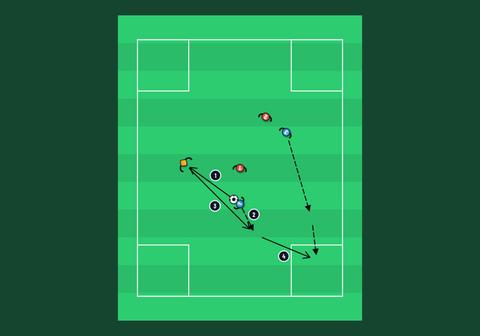
Four corners pass-and-move game
Many players make a pass and then just stand and watch the ball. In this game, you do not score points by standing still. The passer must move into a new space, and you can only arrive in the square by timing the run. The animation first shows the typical mistake and then the correct way. Area 20 × 25 m, with a 5 × 5 m square in each corner. Two teams and a joker, who always plays with the team in possession. The diagram shows 2v2 and a joker, so the attackers have 3v2 numerical superiority. With a bigger group, for example 4v4 and a joker. The attacking team scores a point by passing to a player who has run into a square. The joker does not score points. You cannot wait in the square. You only move there when the pass is coming, and after a point the ball is brought straight back out. When the defenders win the ball, the roles switch and the joker changes sides.
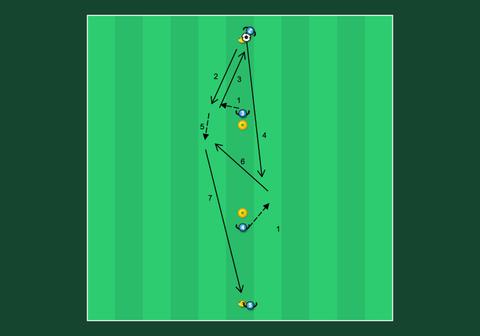
Line passing 3/3
Four players in a line 10–15 metres apart, with a marker at each position. Numbers from top to bottom: two, three, four, five. Two starts with the ball. Going down: two passes to three, who returns it straight back. Two plays a long pass beyond three to four, four directs the ball to three, and three plays a long pass beyond four to five. Going up, the same as a mirror image: five passes to four, gets the return pass and plays a long pass beyond four to three. Three directs it to four, four plays a long pass back to two, and the sequence starts again. Three and four move away from the line to opposite sides just before the pass is played. This allows the long pass to travel beyond the previous player. After their own pass, they return to the line. Short passes with two touches, long passes firmly along the ground. When the pattern is flowing, tighten the short passes to one-touch.
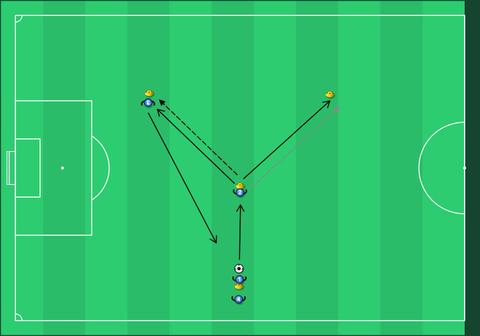
Y passing pattern
Players set up in a Y-shaped pattern at three points. The ball is played through the stem to the branch, the receiver plays a one-two or a through pass to the next point and follows the ball. The pattern is repeated into both branches alternately.
Esercitazioni di passaggio per età
Ogni esercitazione di questa pagina indica un'età. La palla prigioniera è indicata dagli U8. Dagli U9 ci sono il rondo 4 contro 1, il controllo e passaggio in movimento e il passaggio per la sovrapposizione. Dagli U10 ci sono tutte e tre le fasi del passaggio in linea, la serie di riscaldamento di passaggi a tre, lo schema di passaggi a Y, i passaggi incrociati con rotazione, il gioco dei quattro angoli e il rondo 5 contro 2. Dagli U11 ci sono il passaggio filtrante nello spazio e il cambio di gioco. Regola le distanze sul tuo gruppo, come consiglia l'esercitazione dei passaggi incrociati.
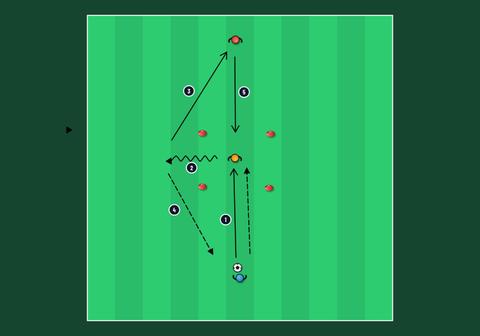
First touch and passing on the move
A three-player drill with one in the middle of a square marked by cones and two on either side at passing distance. The drill starts with a pass, which the player in the middle aims to guide with the first touch outside the square and immediately pass to the third player. After the pass, move into the centre and the middle player fills the empty space.
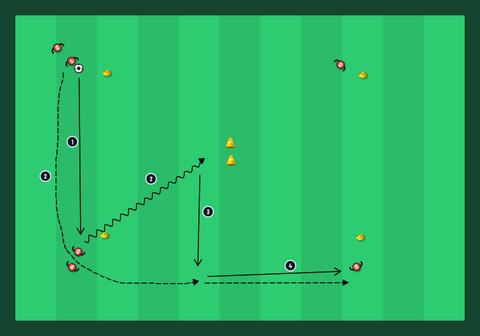
Passing for an overlap
Player passes the ball and makes an overlapping run behind the other player. The receiver dribbles the ball near the cones and passes to the overlapping player, who then passes on to the third queue. The drill progresses in four phases: 1) initial pass, 2) dribbling towards the cones, 3) pass into the overlap and 4) pass to the third queue.
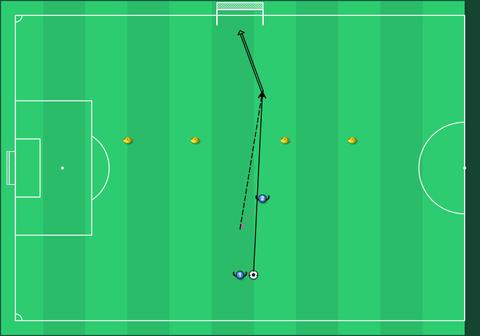
Through ball into space
The passer plays the ball in midfield, the receiver makes a run towards the ball and quickly breaks in behind. The passer plays a through pass into space behind the defensive line. The receiver runs onto the ball and finishes into the goal.
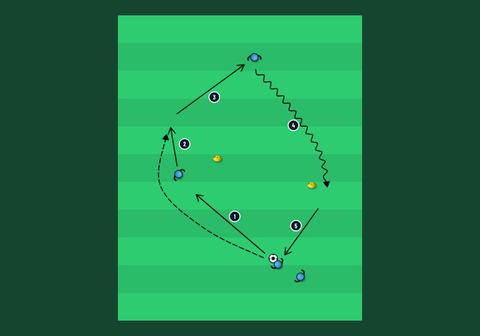
Overlap as a rotating passing drill
Mark out a slightly skewed diamond with cones, about 20 × 10 metres. There is a queue at the bottom corner, and the first player has a ball. There is a wall player at the left corner and a player at the top corner. The first player in the queue dribbles towards the wall player, passes to them and immediately makes an overlap past them on the outside. The wall player steps towards the ball, takes it infield towards the nearby cone and passes forward into the overlap runner’s path when they are almost level. The overlap runner plays the ball first time to the top corner and continues there. The player at the top corner dribbles around the cone on the right side, passes to the queue and goes to the back of the queue. No one runs back. Change the wall player every few rounds. When the pattern is flowing, place a semi-active defender at the wall player’s cone.
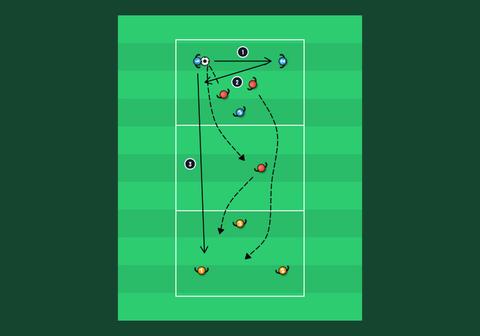
Three-zone rondo (basic)
Mark out a 15 × 30 metre area and divide it into three 10-metre zones. Place a team of three players in each zone. The end teams keep possession and try to play the ball over the central zone to the other end. From the middle team, two players win the ball in the end zone where the ball is, and one stays in the middle to cut out long passes. When the ball switches ends, two players from the middle team run across after it. If the middle team wins the ball or the ball goes out, the team that lost possession moves into the middle and the winning team takes that end zone. Each successful pass from one end zone to the other is a point.
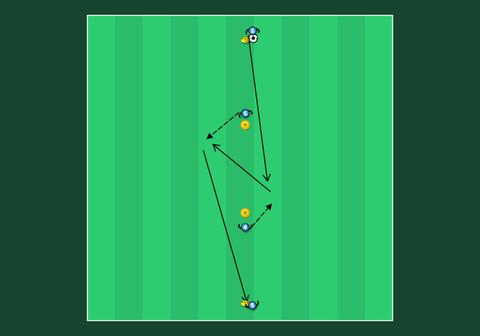
Line passing 2/3
Four players in one line, 5–10 metres apart, each position marked. The ball always bypasses the nearest player. The top player plays a long ball past the first middle player to the second middle player, who has moved out to the side. This player lays the ball off one-touch back to the bypassed player, who has meanwhile moved out to the other side of the line, and the bypassed player plays a long ball to the bottom player, again past the middle player. At the far end, the middle players return to their markers and the same pattern comes back the other way, moving out to the opposite sides. The bypassed player starts moving before the long pass is played.
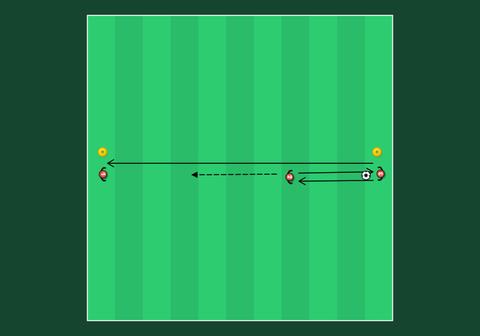
Three-player warm-up passing 3/3
Two players stand still 15–20 metres apart, with markers in front of their feet. The third works between them. One ball. The player on the right plays a short pass to the middle player, who has moved towards the ball, and the middle player returns the ball. Immediately after, the same player plays a long pass to the other end. The middle player does not stay in the passing lane but moves aside and at the same time runs to the other side. The same pattern is repeated there: short pass to the middle player, return pass, and then a long pass back. So the rotation has three passes: short pass in, return pass and long switch. The middle player's job is to get there to receive before the ball and out of the way before the long pass. Change the middle player about every minute.
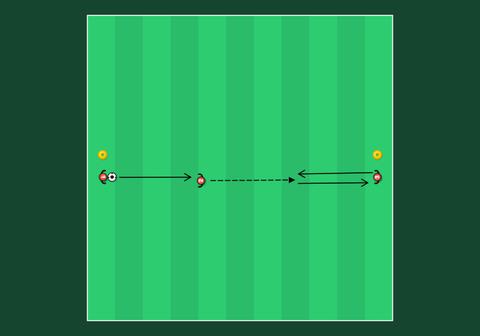
Three-player warm-up passing 2/3
Two players stand still 15–20 metres apart, with markers in front of their feet. The third works between them. One ball. The player on the left passes to the middle player, who has moved towards that side. The middle player takes the first touch towards the opposite side and passes there. The same continues alternately. Demand direction from the first touch: the ball must go where it is going next. Change the middle player about every minute.
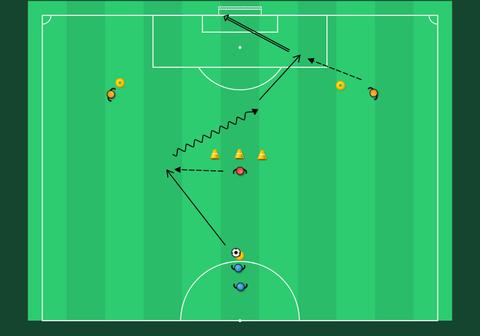
Passing, dribbling and shot from a through pass
The player in front of the cones makes a movement to either side of the line of cones and asks for the pass. The first player in the queue plays a pass and the receiver takes a short dribble towards the player positioned on the opposite diagonal and plays a through pass to them. The receiving player tries to "avoid offside" (the cones represent the deepest defenders) and finish first time from the pass.
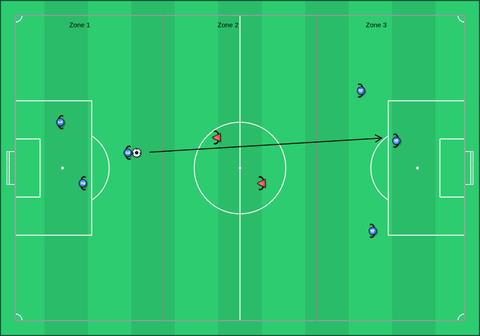
Switch of play
The pitch is divided into three vertical zones. The attacking team plays the ball in one zone and tries to switch play with a long pass into the opposite zone. The defending team tries to intercept the switch of play.
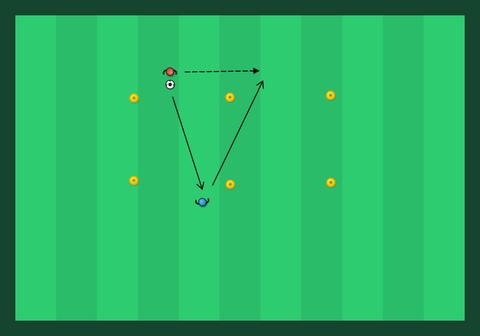
One-two passing in pairs
Player A plays a pass to player B and immediately moves either to the side or forwards. B returns the ball one-touch into the direction of A’s run. A controls and repeats. Change over every 2–3 minutes.
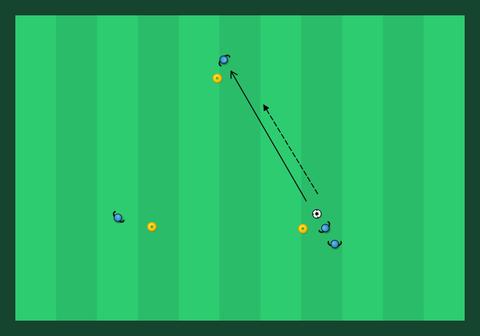
Triangle passing
Three players form a triangle. The ball moves clockwise or anti-clockwise. After the pass, the player follows the ball and runs to the next cone.
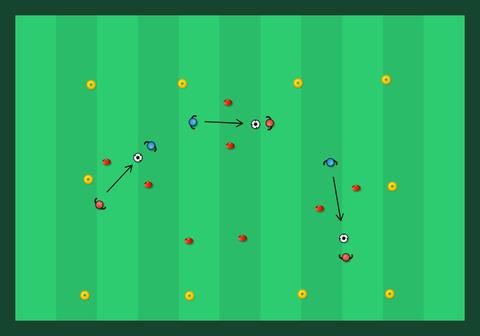
Passing gate competition in pairs
Several small gates are set up on the pitch (two cones 2 metres apart). Pairs pass the ball through the gates and count their successful passes. The gate must always be changed after a successful action. The pair that has gone through the most gates wins.
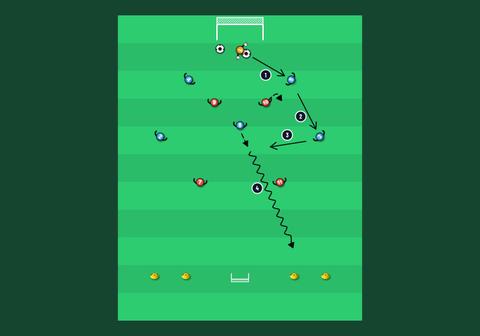
Safe build-up play with numerical superiority
The blues, five players and a goalkeeper, build up from the back against four reds. The blues attack the small goal in the middle or either cone goal on the flank. Dribbling through a cone goal is worth one point and a goal in the small goal is worth two. When the reds win the ball, they attack the large goal, and a goal gives them two points. Play always restarts with the blue goalkeeper, who has spare balls next to him. Every four minutes the teams swap tasks, and one player moves to the other team so that the attacking team has numerical superiority again. For a bigger group, the same game works with eight plus a goalkeeper against seven. The game can be made more difficult by limiting the blues to three touches.
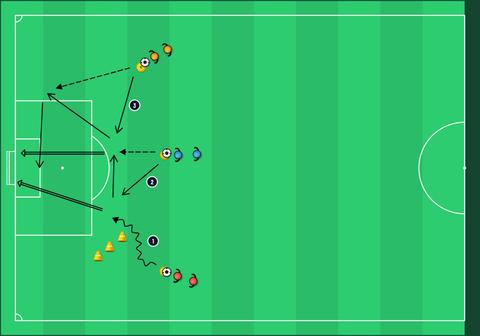
Finishing from three positions
The red player sets off, beats the cone defender and shoots at goal. The blue player immediately gives a pass to the red player, and the red player lays off a one-two, from which the blue player shoots at goal. After this, the yellow player gives a pass to the blue player, who plays a one-two towards the end line. The yellow player crosses from the end line, and both the blue and the red player take part in finishing.
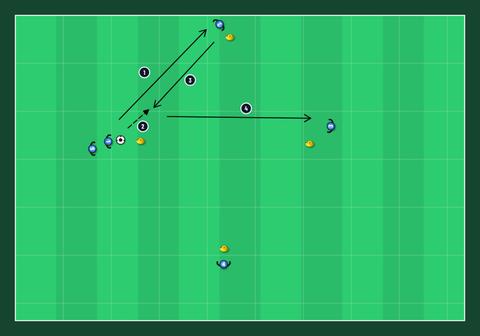
Diamante di passaggio
Si crea un diamante con i coni, con due giocatori al primo cono e un giocatore su ciascuno degli altri. Il giocatore 1 effettua il primo passaggio al giocatore 2, che lo restituisce con un uno-due. Il giocatore 1 cerca di effettuare un passaggio lungo al giocatore 3 con il controllo orientato. Dopo i passaggi, ruotare sempre nella direzione del passaggio.
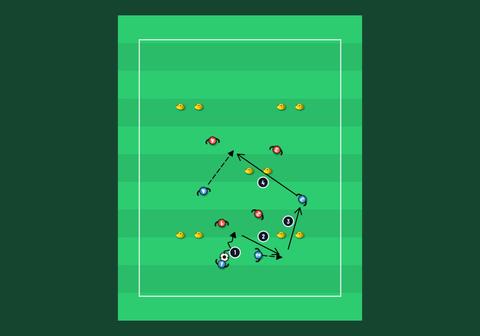
Gate passing game: move away from the ball
When teammates come next to the player on the ball, one defender can cover two of them. In this game, you only score from a pass through a gate to a teammate, so someone has to move away from the ball to the other side of the gate. The animation first shows the usual mistake and then the correct way. Area about 22 × 28 m. Spread five two-metre gates around the area. 4v4 with no goals. A point is scored when the ball is passed through any gate to a teammate who controls it on the other side of the gate. You cannot score two consecutive points through the same gate. Defenders can defend everywhere, and the team that loses possession defends immediately.
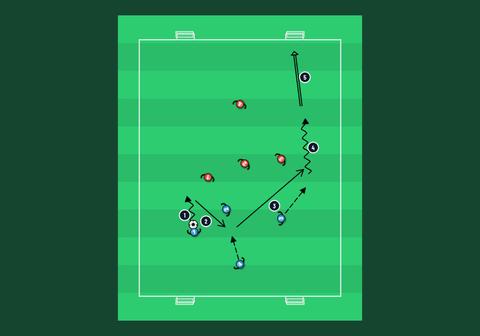
Four-goal game: play with width
With young players, the whole team can easily end up chasing the ball into the same corner. When there are two goals at each end, staying wide pays off straight away: the play is switched to the other side, and the goal there is free. The animation first shows the usual mistake and then the correct way. Area approx. 22 × 28 m, with two small goals at each end close to the corners. 4v4 without goalkeepers. Each team attacks the opponent’s two goals and defends their own. After a goal, the team that conceded restarts by dribbling from their own end. Additional rule for older players: a goal scored after switching play is worth two.
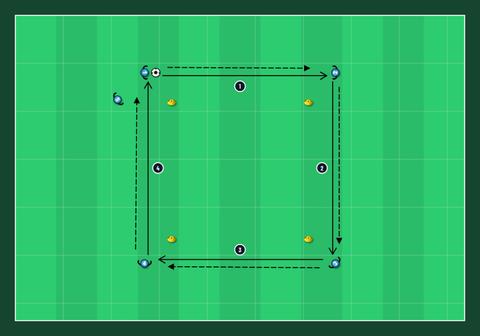
Square passing with directional first touch
Players are placed at four cones in a square. The ball is worked clockwise: the player plays a pass to the next cone and runs after the pass. The receiver takes the ball with a directional first touch.
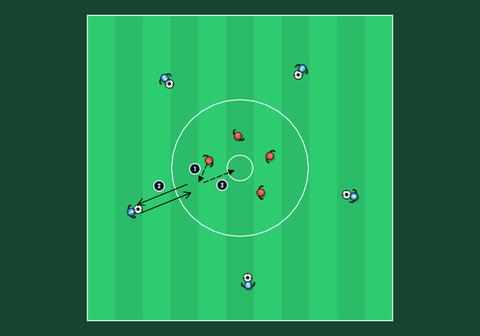
Passing circle
The animation first shows a common mistake and then the correct way. The players on the outside have balls. The players in the middle move and ask for the ball from the outside players and at first return it after a control (aiming to do so with the 2nd touch) and then one-touch as a one-two. The third variation is a throw from the wide player, which the middle player controls and returns. The middle players always go through the middle of the area after the return pass before asking for a new pass.
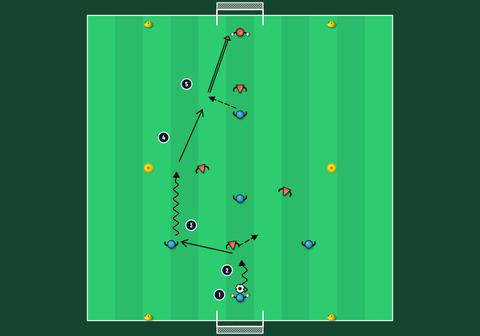
5v5 goal-dribbling game
5v5 game in which the team practises building play with a goal-dribble. When the ball goes over the end line, the defending team restarts by dribbling from any point in their own penalty area. The opponent may wait 5.5 metres from the ball. The player on the ball can carry the ball forwards or pass to a free player. In the example, the presser goes towards the goalkeeper, so the goalkeeper passes to the free player on the left. This player dribbles down the flank and passes to the attacker, who shoots. If an attack that starts from a goal-dribble ends in a goal, it is worth two points. All other goals are worth one. Play short blocks and rotate the teams often. According to the Football Association of Finland rules, 8- and 9-year-olds restart 5v5 by dribbling. In matches for seven-year-olds and younger, the opponent drops back to halfway for the goal-dribble and only defends once play has restarted.
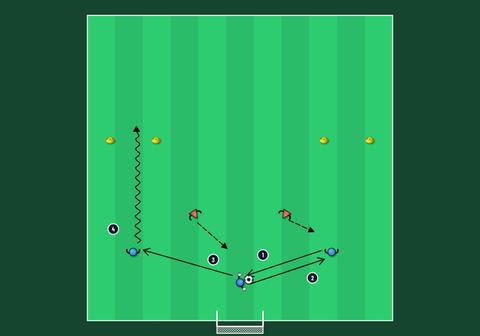
Playing out from a goal kick 3v2
Practise the goal kick in an 8v8 game, where play is started with short passes. The goalkeeper and two centre-backs play against two players pressing. The centre-backs spread out wide level with the corners of the penalty area, and the goalkeeper kicks the ball from the ground to the one who is free. The blue team scores a point when they pass or dribble the ball through the wide gate about 24 metres from the goal line. The reds try to win the ball and score a goal. When the player pressing closes down the centre-back, the centre-back passes the ball back to the goalkeeper, and the goalkeeper switches play to the other side. Start without players pressing, then add one and finally two. In 8v8 for 10-11-year-olds, a goal kick may be taken from the ground anywhere in the penalty area, and the opponent does not have to retreat: it is enough to be 5.5 metres from the ball. The players pressing may therefore stand just as close in the drill as in a match.
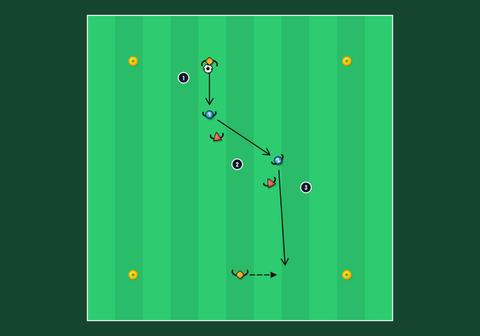
End zone game, target players in the end zones
Six players in three pairs in an empty area. No goals. One pair are the target players, one in each end zone, and they move only along their own end line. The other two pairs play 2v2 in the middle. A point is scored when the ball is dribbled from one end to the other, meaning from one target player to the other. After a successful pass, the same team continues with the ball in the opposite direction. The defending pair try to close the passing lane to the target player and win the ball. After winning the ball, the pair who won it can attack either end zone, but a point always requires the full distance: the ball must go from one target player to the other. In practice, the pair who won it start from the nearest end zone. Three minutes at a time, then the pairs rotate positions.