Shooting drills for youth players: from queues to shots
You've probably run this one. Twelve players line up 20 metres from goal, the coach rolls a ball in, one player shoots and eleven watch. Someone fetches the ball from behind the net, and the next player steps up. It looks organised. Count the shots, though, and each player gets surprisingly few.
This post covers four changes that turn a queue into a shooting drill where players actually shoot. Each one rests on a study or on The FA's coaching guidance, and each comes with a drill you can open on the board and adapt.
The queue is the most common shooting drill, and it gives the fewest shots
The FA puts the problem in three sentences [1]:
"lining up for a shot with everyone watching can be daunting. It's also not realistic to the game. And it reduces the amount of repetition players get at finishing."
Our own drill library isn't innocent here. Plenty of its shooting drills are queues: shooting from a stationary ball, passing and shooting and dribbling and shooting. They work fine for teaching striking technique. They just don't produce many shots, because one player shoots at a time, and you can fix that without throwing the drill away.
1. More goals, smaller groups
The FA suggests splitting the team into smaller groups [2]. The maths is simple. With 12 players queuing for one goal, each shoots once every twelve turns. With three goals and groups of four, the same ten minutes gives everyone three times as many shots. If you don't have enough full-size goals, two cones or a mini-goal will do.
Where the goals sit matters in small-sided games too. Pulling, Twitchen and Pettefer (2016) filmed 12-year-olds playing 4v4 in four formats [3]. With two standard goals, the players took 18 shots in 20 minutes. With four goals moved inside the pitch, each one open from the front and the back, they took 45. Only eight players took part, so treat the numbers as an illustration. Still, the direction is hard to miss: more goals, closer to the action, means more shots.
2. Vary the angle, the foot and the distance
García-Herrero and colleagues (2016) compared two ways of practising shooting with young players [4]. One group repeated the same shot. For the other, the shot changed from one repetition to the next. After ten sessions, the variable group was more accurate straight away and still more accurate a week later. The repetition group only improved on the retest after the week off. Shot speed went up in both groups.
In practice, that means the ball position, the shooting foot or the distance changes every rep. The shooting circuit has three stations: a power shot from around 20 metres, a shot on the move off a lay-off from around 14 metres, then a close-range finish or half-volley. Players don't get the chance to groove a single strike. In finishing from three positions, the first shot comes after a feint, the second off a one-two and the third from a cross. In the Barcelona shooting drill, the shooter picks which cone to move to, so the angle changes every round.
A single rule adds variety to a queue drill as well. When shooting from a stationary ball, the balls already sit at different angles 8–15 metres out. Make every second shot a weaker-foot shot and the same setup gives two different reps.
3. Get closer and give them time
Masmoudi et al. (2021) put 32 boys aged around 11 through a kicking accuracy test [5]. Shot quality was better from 6 metres than from 10, and better with one shot every 6 seconds than one every 3. Young players shoot more accurately when they're close enough and have time to set themselves.
The FA says the same in coaching terms [2]: young players are less likely to finish first time and might need to be closer to goal to score. The same article notes that 82% of the goals at Euro 2020 came from inside the 18-yard box, which is a good reason to stage shooting practice there.
That can look like a contradiction. Didn't we just say players need more reps? They do, but the reps come from more goals and smaller groups. The individual player can still take their shot without being rushed.
4. Move finishing into the game
Silvino, Sarmento and Teoldo (2024) followed 180 players in the U8, U10 and U12 age groups [6]. The same teams played both 11v11 on a full-size pitch and the small-sided format for their age. U8 and U10 players took significantly more shots in the small-sided games than on the big pitch. The FA recommends 2v2 and 3v3 games for the same reason [1], and points out that 3v3 or futsal makes a first-time finish more likely [2]. And if it looks chaotic, that's fine: "It's OK for your session to look messy." [2]
Between the queue and the game sit drills that bring in an opponent step by step and still give plenty of reps. In turn and shoot, the player receives with their back to goal, takes the first touch to the side and shoots with the second. Once that's working, add a defender to turn away from. In the two-phase 1v1 to goal, the attacker escapes the first defender with their first touch and has to beat a second one before shooting.
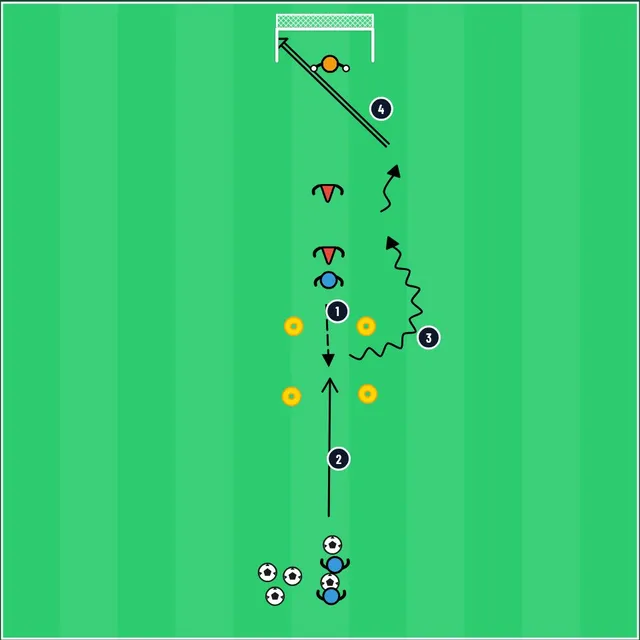
In 3v2 finishing, three attackers take on two defenders, and the player on the ball has to decide whether to shoot or pass to the free teammate. After a goal, the attackers get a new ball and attack the other way, so there's no break.
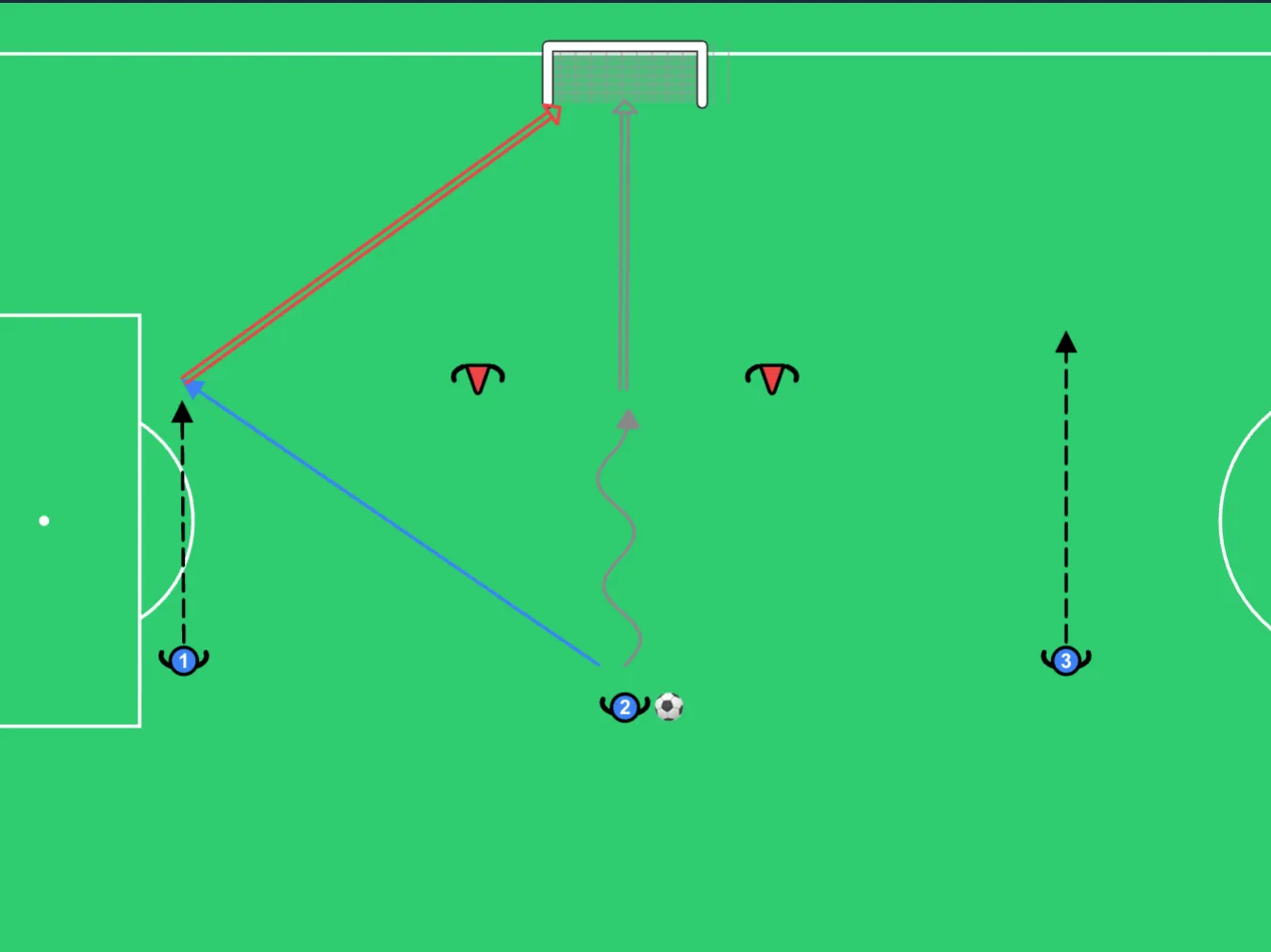
Finishing that starts from one-twos, cut-backs and crosses has its own page: finishing drills.
For the youngest players
For the youngest, a shooting drill can be a race. In the speed race on a cone course, two teams of three weave round the cones and shoot into a mini-goal, and the first team to get all three balls in wins. The queue is three long, and the wait goes on cheering your own team.
The FA warns that with younger players the game can look chaotic, with everyone swarming the ball and relying on toe pokes or laces for every shot. Its advice is two words: "Embrace it." [1] Confidence in the basic techniques comes first, and you may need to hold off adding defenders until players are ready [1]. For beginners, The FA suggests one player against one keeper, so nobody has to get past an opponent before trying to score [2].
Turn your own queue drill around
Take a drill you use now and run it past these questions:
- How many shots does one player get in ten minutes? If it's fewer than ten, add goals and split the group so no queue is longer than three.
- Does the angle, the foot or the distance change from one rep to the next?
- Is the shooting spot close enough? For under-12s, inside the box is plenty.
- Does the player have time to set up the shot, or does the drill rush them?
- Does the session end in a game where the same shot comes with an opponent in front?
You can make the changes on the drill diagram in the tactics board before the session: move the goals, add cones and save your own version.
Sources
- The FA (2022): "How to coach shooting in football"
- The FA (2022): "How to design a football shooting session"
- Pulling, Twitchen & Pettefer (2016): "Goal Format in Small-Sided Soccer Games: Technical Actions and Offensive Scenarios of Prepubescent Players" — Sports
- García-Herrero, Sánchez-Sánchez, Luis-Pereira & Menayo (2016): "The effects of induced variability in the performance on shot in soccer" — International Journal of Sports Science & Coaching
- Masmoudi et al. (2021): "The Effects of Exercise Difficulty and Time-of-Day on the Perception of the Task and Soccer Performance in Child Soccer Players" — Children
- Silvino, Sarmento & Teoldo (2024): "Comparing the Tactical Behavior of Young Soccer Players in Full- and Small-Sided Games" — Research Quarterly for Exercise and Sport
Related reading
- 1v1 dribbling — how to train beating a defender
- Game-based training — why drills aren't enough
- All shooting drills and finishing drills you can copy and edit